


Your Worksheet is Ready
CBSE - Class 11 Physics Oscillations Worksheet
Exercises
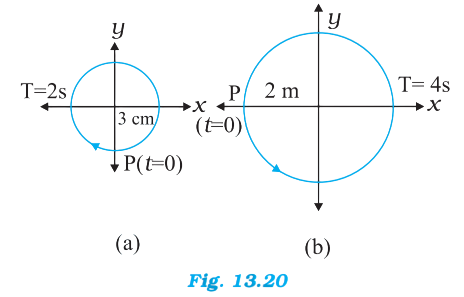
Figures 13.20 correspond to two circular motions. The radius of the circle, the period of revolution, the initial position, and the sense of revolution (i.e. clockwise or anti-clockwise) are indicated on each figure. Obtain the corresponding simple harmonic motions of the (x)-projection of the radius vector of the revolving particle P, in each case.
Let us take the position of mass when the spring is unstreched as $x = 0$, and the direction from left to right as the positive direction of x-axis. Give $x$ as a function of time $t$ for the oscillating mass if at the moment we start the stopwatch ($t = 0$), the mass is (a) at the mean position,
Let us take the position of mass when the spring is unstreched as $x = 0$, and the direction from left to right as the positive direction of x-axis. Give $x$ as a function of time $t$ for the oscillating mass if at the moment we start the stopwatch ($t = 0$), the mass is (b) at the maximum stretched position, and
Worksheet Answers
Solution:
The standard equation for Simple Harmonic Motion (SHM) is given by:
$x(t) = A \sin(\omega t + \phi)$
Given the equation: $x = -2 \sin(3t + \pi/3)$ cm
To align with the reference circle convention where $x = A \sin(\omega t + \theta)$, we use the trigonometric identity $-\sin(\theta) = \sin(\theta + \pi)$ [Per the Unit Circle Symmetry Principle]:
$x = 2 \sin(3t + \pi/3 + \pi)$
$x = 2 \sin(3t + 4\pi/3)$
In the reference circle method, the projection of a particle rotating with constant angular velocity $\omega$ on the $x$-axis represents the SHM. The radius of the circle is the amplitude $A$.
At $t = 0$, the reference particle is at an angle $\theta = 4\pi/3$ radians relative to the positive $x$-axis. Using coordinate geometry: $x_0 = A \cos(4\pi/3) = 2 \cos(240^\circ) = 2(-0.5) = -1 \text{ cm}$ $y_0 = A \sin(4\pi/3) = 2 \sin(240^\circ) = 2(-\sqrt{3}/2) = -\sqrt{3} \approx -1.732 \text{ cm}$
This confirms the position of the particle at the start of the observation period in the 3rd quadrant.
Final Solution: The reference circle has a radius of $2 \text{ cm}$, an angular speed of $3 \text{ rad/s}$, and the particle starts at an angular position of $4\pi/3$ radians ($240^\circ$) measured counter-clockwise from the positive $x$-axis.
Solution:
In a linear Simple Harmonic Motion (SHM) system occurring between two points $A$ and $B$, the total distance $AB = 10 \text{ cm}$. Let the equilibrium position (mean position) be $O$.
At the extreme positions of SHM, the particle momentarily comes to rest before changing direction. Since point $A$ is an extreme position, the instantaneous velocity of the particle is zero.
$v = 0$ [Per the definition of extreme points in SHM where $v = \omega\sqrt{A^2 - x^2}$ and $x = \pm A$].
The acceleration of a particle in SHM is given by $a = -\omega^2 x$.
[Justification: According to the restoring force principle, acceleration is always directed towards the equilibrium position $O$. Since $A$ is to the left of $O$, the force/acceleration must act towards the right].
According to Newton's Second Law of Motion ($F = ma$):
[Justification: $F = -k x$. With $x = -5$, $F = -k(-5) = +5k$, which is positive].
| Physical Quantity | Sign | Reasoning |
|---|---|---|
| Velocity ($v$) | 0 | Instantaneous rest at extreme point |
| Acceleration ($a$) | Positive (+) | Directed towards equilibrium (towards B) |
| Force ($F$) | Positive (+) | Aligned with acceleration vector |
Final Solution: At point A, the velocity is 0, the acceleration is positive, and the force is positive.
Solution:
Periodic motion is defined as a motion that repeats itself at regular intervals of time, known as the period ($T$). Mathematically, a physical quantity $f(t)$ representing the motion must satisfy the condition: $f(t) = f(t + T)$, where $T > 0$ is the smallest constant interval.
A hydrogen molecule ($H_2$) consists of two hydrogen atoms linked by a covalent bond, essentially behaving as a rigid rotor when rotating about its center of mass. In a stable, isolated environment, the molecule possesses a fixed angular momentum and rotates with a constant angular velocity ($\omega$).
The position of any point on the molecule can be described using angular coordinates in polar or spherical systems. The angular displacement $\theta$ as a function of time $t$ is given by: $\theta(t) = \omega t + \theta_0$
We check if the orientation of the molecule repeats at regular intervals. Let the orientation be defined by the angle $\theta$. The motion is periodic if $\theta(t + T) = \theta(t) + 2\pi n$ for some integer $n$.
Since $\omega$ is constant for a free rotating molecule, $T$ is a constant, finite value.
The rotation of a hydrogen molecule about its center of mass is a classic example of uniform circular motion. Because the angular velocity remains constant in the absence of external torques, the molecule returns to the same spatial orientation after every time interval $T = \frac{2\pi}{\omega}$. Therefore, the motion is strictly periodic.
Final Solution: Yes, the rotation of a hydrogen molecule about its center of mass represents a periodic motion, as it repeats its spatial orientation at a constant time interval $T = \frac{2\pi}{\omega}$.
Solution:
The given function is defined as:
$f(t) = \cos(\omega t) + \cos(3\omega t) + \cos(5\omega t)$
A function $f(t)$ is periodic if there exists a smallest positive constant $T$ such that $f(t + T) = f(t)$.
The individual terms have periods:
[By the Principle of Superposition of Periodic Functions]: The sum of periodic functions is periodic if the ratio of their periods is a rational number. Here, the ratios are $T_1:T_2:T_3 = 1 : \frac{1}{3} : \frac{1}{5} = 15 : 5 : 3$. Since these are rational, the function is periodic.
The fundamental period $T$ is the Least Common Multiple (LCM) of the individual periods $T_1, T_2,$ and $T_3$.
$T = \text{LCM}\left( \frac{2\pi}{\omega}, \frac{2\pi}{3\omega}, \frac{2\pi}{5\omega} \right)$
$T = \frac{2\pi}{\omega} \times \text{LCM}\left( 1, \frac{1}{3}, \frac{1}{5} \right)$
To find the LCM of fractions, we use the formula: $\text{LCM}\left(\frac{a}{b}, \frac{c}{d}\right) = \frac{\text{LCM}(a, c)}{\text{GCD}(b, d)}$.
$T = \frac{2\pi}{\omega} \times \frac{\text{LCM}(1, 1, 1)}{\text{GCD}(1, 3, 5)} = \frac{2\pi}{\omega} \times \frac{1}{1} = \frac{2\pi}{\omega}$
Simple Harmonic Motion (SHM) must be representable as a single sinusoidal function of the form $A \cos(\omega t + \phi)$. Since $f(t)$ is a superposition of three distinct frequencies ($\omega, 3\omega, 5\omega$), it does not satisfy the definition of SHM.
| Criterion | Result |
|---|---|
| Periodic | Yes |
| Simple Harmonic | No |
Final Solution: The function represents a periodic but not simple harmonic motion. Its fundamental period is $T = \frac{2\pi}{\omega}$.
Solution:
To determine the maximum speed of the piston undergoing Simple Harmonic Motion (SHM), we extract the following parameters from the problem statement:
The stroke is defined as the total distance covered by the piston in one full cycle, which is equivalent to twice the amplitude ($L = 2A$). [Per the definition of SHM kinematics]
$A = \frac{L}{2} = \frac{1.0\text{ m}}{2} = 0.5\text{ m}$
To maintain consistency with SI units, the angular frequency must be converted from radians per minute to radians per second. [Per the International System of Units (SI) standards]
$\omega = 200\text{ rad/min} = \frac{200}{60}\text{ rad/s}$
$\omega = \frac{10}{3}\text{ rad/s} \approx 3.33\text{ rad/s}$
In SHM, the displacement is given by $x(t) = A \sin(\omega t + \phi)$. The velocity is the first derivative of displacement with respect to time: $v(t) = \frac{dx}{dt} = A\omega \cos(\omega t + \phi)$. The maximum speed occurs when the cosine term is unity. [By the Fundamental Theorem of Calculus]
$v_{max} = A \cdot \omega$
Substituting the values derived in Step 1 and Step 2:
$v_{max} = 0.5\text{ m} \times \frac{10}{3}\text{ rad/s}$
$v_{max} = \frac{5}{3}\text{ m/s}$
$v_{max} \approx 1.67\text{ m/s}$
Final Solution: The maximum speed of the piston is approximately $1.67\text{ m/s}$.
Solution:
To determine the time period of the pendulum, we must transition to the non-inertial frame of reference of the moving car. In this frame, the pendulum bob experiences two primary accelerations:
As the car moves, the bob experiences a pseudo-force directed radially outward, equal to $M \frac{v^2}{R}$.
The equilibrium position of the pendulum is shifted such that the tension in the string balances the resultant of the gravitational force and the pseudo-force. The effective acceleration $g_{eff}$ is the vector sum of the acceleration due to gravity and the centripetal acceleration:
$\vec{g}_{eff} = \vec{g} + \vec{a}_c$
Since $\vec{g}$ (vertical) and $\vec{a}_c$ (horizontal) are mutually perpendicular, the magnitude of the effective acceleration is calculated using the Pythagorean theorem [Per the Law of Vector Addition]:
$g_{eff} = \sqrt{g^2 + a_c^2}$
$g_{eff} = \sqrt{g^2 + \left( \frac{v^2}{R} \right)^2}$
For a simple pendulum undergoing small oscillations, the time period $T$ is given by the standard formula [By Simple Harmonic Motion theory for a pendulum]:
$T = 2\pi \sqrt{\frac{l}{g_{eff}}}$
Substituting the expression for $g_{eff}$ derived in Step 2:
$T = 2\pi \sqrt{\frac{l}{\sqrt{g^2 + \left( \frac{v^2}{R} \right)^2}}}$
The time period depends on the effective gravity experienced by the bob in the rotating frame of reference. By substituting the components:
$T = 2\pi \left( \frac{l^2}{g^2 + \frac{v^4}{R^2}} \right)^{1/4}$
Final Solution: $T = 2\pi \sqrt{\frac{l}{(g^2 + v^4/R^2)^{1/2}}}$ seconds
Solution:
The given function of time is $f(t) = 1 + \omega t + \omega^2 t^2$. This is a second-degree polynomial in $t$ [Reference: Algebraic Theory of Polynomials].
A function $f(t)$ is defined as periodic if there exists a smallest positive constant $T$ (the period) such that $f(t + T) = f(t)$ for all $t$ [Definition of Periodicity].
Let us test the condition $f(t + T) = f(t)$:
$1 + \omega(t + T) + \omega^2(t + T)^2 = 1 + \omega t + \omega^2 t^2$
Expanding the left side:
$1 + \omega t + \omega T + \omega^2(t^2 + 2tT + T^2) = 1 + \omega t + \omega^2 t^2$
$1 + \omega t + \omega T + \omega^2 t^2 + 2\omega^2 tT + \omega^2 T^2 = 1 + \omega t + \omega^2 t^2$
Subtracting $1 + \omega t + \omega^2 t^2$ from both sides:
$\omega T + 2\omega^2 tT + \omega^2 T^2 = 0$
For the equality to hold, the expression $\omega T + 2\omega^2 tT + \omega^2 T^2$ must equal zero for all values of $t$. However, this expression is a function of $t$ (specifically, it is linear in $t$ because of the term $2\omega^2 tT$).
Since $\omega$ is a non-zero positive constant, the coefficient of $t$, which is $2\omega^2 T$, must be zero for the entire expression to be independent of $t$. This implies $T = 0$.
However, by definition, the period $T$ of a periodic motion must be a positive constant ($T > 0$). Since no such non-zero $T$ exists, the function does not satisfy the requirements of periodic motion [Theorem of Periodic Functions].
As the function $f(t) = 1 + \omega t + \omega^2 t^2$ grows indefinitely as $t \to \infty$ and does not repeat its values at any regular interval, it is classified as non-periodic.
Final Solution: The function $1 + \omega t + \omega^2 t^2$ represents (c) non-periodic motion.
Solution:
A particle undergoing uniform circular motion at radius $A$ and angular frequency $\omega$ has a position vector $\vec{r}(t)$. The projection of this motion on the $x$-axis follows the equation of Simple Harmonic Motion (SHM):
$x(t) = A \cos(\omega t + \phi)$
Where:
Given Parameters:
Substituting into the standard SHM equation:
$x(t) = 3 \cos\left(\pi t + \frac{\pi}{4}\right)$
[Per the circular projection theorem, where phase $\phi$ is the initial angle with the reference axis]Given Parameters:
For clockwise motion, the angular displacement is $-\omega t$. Thus, the phase becomes $(\phi - \omega t)$:
$x(t) = 2 \cos\left(\frac{\pi}{2}t - \frac{\pi}{2}\right)$
Using the trigonometric identity $\cos(\theta - \frac{\pi}{2}) = \sin(\theta)$:
$x(t) = 2 \sin\left(\frac{\pi}{2}t\right)$
[By the trigonometric identity $\cos(A-B) = \cos A \cos B + \sin A \sin B$]| Case | Amplitude ($A$) | Angular Freq ($\omega$) | SHM Equation |
|---|---|---|---|
| (a) | $3\text{ cm}$ | $\pi \text{ rad/s}$ | $x(t) = 3 \cos(\pi t + \pi/4)$ |
| (b) | $2\text{ m}$ | $\pi/2 \text{ rad/s}$ | $x(t) = 2 \sin(\pi t/2)$ |
Final Solution: The equations of motion for the $x$-projections are (a) $x(t) = 3 \cos(\pi t + \pi/4)$ and (b) $x(t) = 2 \sin(\pi t/2)$ in their respective units.
Solution:
The displacement of a particle executing Simple Harmonic Motion at any time $t$ is given by the general displacement equation:
$x(t) = A \sin(\omega t + \phi)$
Where:
According to the problem statement, at $t = 0$, the mass is at the mean position. By the coordinate system defined, the mean position corresponds to:
$x(0) = 0$
Substitute the initial condition into the general equation:
$0 = A \sin(\omega(0) + \phi)$
$0 = A \sin(\phi)$
Assuming the amplitude $A \neq 0$ for an oscillating system, we have:
$\sin(\phi) = 0 \implies \phi = 0$ or $\phi = \pi$
Taking the standard phase convention where the particle starts from the mean position moving in the positive direction, we set $\phi = 0$.
Substituting $\phi = 0$ into the general displacement equation:
$x(t) = A \sin(\omega t + 0)$
$x(t) = A \sin(\omega t)$
The displacement of the mass as a function of time, starting from the mean position ($x=0$ at $t=0$), is governed by the sine function. The motion is purely periodic and passes through the origin at $t=0, \frac{\pi}{\omega}, \frac{2\pi}{\omega}, \dots$
Final Solution: $x(t) = A \sin(\omega t)$
Solution:
The given function of time is:
$f(t) = 3 \cos(\frac{\pi}{4} - 2\omega t)$
By applying the trigonometric identity $\cos(-\theta) = \cos(\theta)$, we can simplify the argument of the function:
$f(t) = 3 \cos(2\omega t - \frac{\pi}{4})$
[Per the properties of circular functions and trigonometric symmetry].
A function represents Simple Harmonic Motion (SHM) if it can be expressed in the form $f(t) = A \cos(\omega' t + \phi)$ or $f(t) = A \sin(\omega' t + \phi)$, where $A$ is the amplitude, $\omega'$ is the angular frequency, and $\phi$ is the phase constant.
Comparing our given function $f(t) = 3 \cos(2\omega t - \frac{\pi}{4})$ with the standard form:
Since the function is a single-frequency sinusoidal function, it satisfies the requirements for Simple Harmonic Motion [Per the definition of linear SHM, which is the projection of uniform circular motion on a diameter].
For a function of the form $\cos(\omega' t + \phi)$, the time period $T$ is given by the relation:
$T = \frac{2\pi}{\omega'}$
Substituting $\omega' = 2\omega$ into the formula:
$T = \frac{2\pi}{2\omega}$
$T = \frac{\pi}{\omega}$
[By the relation between angular frequency and temporal period in periodic motion].
Final Solution: The function represents Simple Harmonic Motion (SHM) with a time period $T = \frac{\pi}{\omega}$.
Solution:
Consider a U-tube containing mercury of density $\rho$. Let $A$ be the uniform cross-sectional area of the tube. When the pressure difference is maintained, the mercury levels in the two arms are at different heights. Let the equilibrium position be $y = 0$, where the height of the mercury column in each arm is equal. When the suction pump is removed, the mercury column is displaced by a small vertical distance $y$ from the equilibrium position.
When the mercury column is displaced by a distance $y$ in one arm, the level drops by $y$ in the other arm. Consequently, the total difference in the height of the mercury columns in the two arms becomes $h = y - (-y) = 2y$.
The weight of the excess mercury column, which acts as the restoring force $F$, is given by: $F = -(\text{Volume}) \times (\text{Density}) \times (g)$ Since the total length of the displaced column is $2y$, the volume is $V = A \times (2y)$. Thus, $F = -(A \cdot 2y) \rho g$ [Per the definition of weight of a liquid column].
Let $L$ be the total length of the mercury column in the U-tube. The total mass $m$ of the mercury in the tube is: $m = \rho \cdot A \cdot L$ [Given mass is density times volume].
Applying Newton's Second Law of Motion ($F = ma$): $(\rho \cdot A \cdot L) \frac{d^2y}{dt^2} = -2Ay\rho g$
By simplifying the terms $A$ and $\rho$ from both sides, we obtain the differential equation: $\frac{d^2y}{dt^2} = -\left( \frac{2g}{L} \right)y$
The standard differential equation for simple harmonic motion is: $\frac{d^2y}{dt^2} = -\omega^2 y$ [Where $\omega$ is the angular frequency].
Comparing the derived equation with the standard form, we identify the angular frequency: $\omega^2 = \frac{2g}{L} \implies \omega = \sqrt{\frac{2g}{L}}$
Since $\frac{d^2y}{dt^2} \propto -y$, the restoring force is directly proportional to the displacement and directed towards the equilibrium position. This satisfies the necessary and sufficient condition for Simple Harmonic Motion.
The time period $T$ of the oscillations of the mercury column is determined by: $T = \frac{2\pi}{\omega} = 2\pi \sqrt{\frac{L}{2g}}$
Final Solution: The mercury column executes Simple Harmonic Motion because the restoring force $F = -(2A\rho g)y$ is proportional to the displacement $y$ and opposes the motion, conforming to the characteristic differential equation $\frac{d^2y}{dt^2} + \omega^2 y = 0$.
Solution:
The displacement of a particle executing Simple Harmonic Motion is mathematically represented as:
$x(t) = A \cos(\omega t + \phi)$
[Where $A$ is the amplitude, $\omega$ is the angular frequency, and $\phi$ is the phase constant].
The problem states that at $t = 0$, the mass is at the maximum stretched position. Based on our coordinate system definition where the right direction is positive:
[By the definition of circular projection, the cosine function reaches its maximum value at an argument of zero].
By substituting the phase constant $\phi = 0$ back into the general equation, we obtain the specific function for the given condition:
$x(t) = A \cos(\omega t + 0)$
$x(t) = A \cos(\omega t)$
| Variable | Value/Expression |
|---|---|
| Amplitude | $A$ |
| Angular Frequency | $\omega$ |
| Phase Constant ($\phi$) | $0$ |
| Function $x(t)$ | $A \cos(\omega t)$ |
Final Solution: The displacement of the mass as a function of time is $x(t) = A \cos(\omega t)$.
Solution:
According to the dynamical definition of Simple Harmonic Motion, a particle undergoes SHM if its acceleration $a$ is directly proportional to its displacement $x$ from a fixed equilibrium position and is always directed towards that equilibrium position. Mathematically, this is expressed as:
$a(x) = -\omega^2 x$
where $\omega$ is the angular frequency of the motion, and the negative sign indicates that the acceleration is always in the opposite direction of the displacement [Per Newton's Second Law and Hooke's Law].
The provided relationship is:
$a = 0.7x$
In this expression, the constant of proportionality is positive ($+0.7$).
We compare the given equation $a = 0.7x$ with the standard form $a = -\omega^2 x$.
Since the acceleration $a$ does not oppose the displacement $x$ (i.e., there is no negative sign), the particle will move away from the origin with increasing acceleration if displaced, rather than oscillating about it. Therefore, the condition for SHM is not satisfied.
Final Solution: The relationship $a = 0.7x$ does not involve simple harmonic motion because the acceleration is not directed towards the equilibrium position (it lacks the necessary restoring force characteristic).
Solution:
In linear Simple Harmonic Motion (SHM), the equilibrium position $O$ is defined as the midpoint between the two extreme points $A$ and $B$. Let the total distance $AB = 10 \text{ cm}$. Therefore, the amplitude $A$ of the motion is:
$A = \frac{AB}{2} = 5 \text{ cm}$
Given the direction from $A \to B$ is positive ($+$), we define the positions as follows:
The particle is currently at the midpoint ($x = 0$) and is moving towards $A$. Since the direction $A \to B$ is defined as the positive direction, motion from $B \to A$ or towards $A$ is defined as the negative direction.
| Parameter | Analysis | Sign |
|---|---|---|
| Velocity ($v$) | The particle is moving towards $A$. Since $A$ lies in the negative direction relative to the origin, the velocity vector points in the negative direction. [Per Kinematics convention, $v = \frac{dx}{dt}$] | Negative ($-$) |
| Acceleration ($a$) | In SHM, acceleration is defined as $a = -\omega^2 x$. At the midpoint $O$, the displacement $x = 0$. Therefore, $a = -\omega^2(0) = 0$. | Zero |
| Force ($F$) | Per Newton's Second Law, $F = ma$. Since $a = 0$ at the equilibrium position, the net restoring force acting on the particle at the midpoint is zero. | Zero |
The restoring force in SHM is given by $F = -kx$. At the equilibrium position ($x=0$), the displacement is zero, resulting in zero restoring force. By the definition of acceleration in SHM ($a = F/m$), the acceleration must also be zero. The velocity is non-zero (maximum) because the particle is passing through the equilibrium point, but its sign is dictated strictly by the displacement vector relative to the chosen positive axis. [Ref: Hooke's Law and the differential equation of SHM: $\frac{d^2x}{dt^2} + \omega^2 x = 0$].
Final Solution: At the mid-point of AB going towards A, the velocity is negative, the acceleration is zero, and the force is zero.
Solution:
To determine the time period of a simple pendulum in a non-inertial frame (the accelerating car), we must first identify the net effective acceleration acting on the bob. The car is moving in a circular path of radius $R$ at a uniform speed $v$. This implies a centripetal acceleration ($a_c$) directed toward the center of the circular track:
$a_c = \frac{v^2}{R}$ [Per Newton's Second Law of Motion in a rotating frame]
In the frame of the car, the bob experiences a pseudo-force directed radially outward, equal in magnitude to $M \frac{v^2}{R}$. Simultaneously, the bob is subject to the gravitational force $Mg$ acting vertically downward.
The total effective acceleration ($g_{eff}$) is the vector sum of the gravitational acceleration ($\vec{g}$) and the pseudo-acceleration ($\vec{a}_p = -\vec{a}_c$):
$\vec{g}_{eff} = \vec{g} + \vec{a}_p$
Since the gravitational acceleration $\vec{g}$ (downward) and the pseudo-acceleration $\vec{a}_p$ (radially outward) are mutually perpendicular, the magnitude of $g_{eff}$ is derived using the Pythagorean theorem [By the Law of Vector Addition]:
$g_{eff} = \sqrt{g^2 + \left(\frac{v^2}{R}\right)^2}$
The time period $T$ of a simple pendulum is governed by the formula $T = 2\pi \sqrt{\frac{l}{g_{eff}}}$. Substituting our expression for $g_{eff}$ into the standard pendulum equation [Per Simple Harmonic Motion dynamics]:
$T = 2\pi \sqrt{\frac{l}{\sqrt{g^2 + \left(\frac{v^2}{R}\right)^2}}}$
By simplifying the algebraic expression under the radical, we obtain the finalized period of oscillation for the pendulum in the moving car frame:
$T = 2\pi \left( l^2 \right)^{1/4} \cdot \left( g^2 + \frac{v^4}{R^2} \right)^{-1/4}$
Or, expressed in the standard radical form:
$T = 2\pi \sqrt{\frac{l}{(g^2 + v^4/R^2)^{1/2}}}$
Final Solution: $T = 2\pi \left[ \frac{l^2}{g^2 + (v^2/R)^2} \right]^{1/4}$
Solution:
To determine if the motion of a swimmer completing one trip from one bank of a river to the other and back represents periodic motion, we must define the criteria for such motion. A motion is classified as periodic if and only if it repeats itself exactly after a fixed interval of time, known as the time period ($T$).
The problem states: "A swimmer completing one (return) trip from one bank of a river to the other and back."
Let us analyze the scope of this description:
| Criteria | Swimmer's Motion |
|---|---|
| Repetitive nature | Single occurrence (non-repetitive) |
| Fixed Time Period ($T$) | Not applicable (event is singular) |
| Classification | Non-periodic |
[Justification: The motion concludes after the return trip. Without a commitment to repeat the action indefinitely, the criteria for a periodic function $f(t) = f(t+T)$ cannot be satisfied.]
Final Solution: The motion described is not periodic, as it is a single, non-repetitive event that does not continue indefinitely to satisfy the definition of periodic motion.
Solution:
Consider a simple pendulum consisting of a bob of mass $m$ suspended by a massless, inextensible string of length $l$. When the pendulum is displaced by an angle $\theta$ from the vertical, the restoring force $F$ is provided by the tangential component of the gravitational force.
The gravitational force acting on the bob is $mg$. Resolving this into components:
For small angular displacements ($\theta \ll 1$ radian), we use the small-angle approximation $\sin\theta \approx \theta$. Since the arc length $s = l\theta$, we have $\theta = s/l$. Substituting these into the force equation:
$F = -mg \left(\frac{s}{l}\right) = -\left(\frac{mg}{l}\right)s$
Comparing this to the standard SHM force equation $F = -ks$, we identify the effective force constant $k$ for the pendulum as:
$k = \frac{mg}{l}$
The general formula for the period of an oscillator is $T = 2\pi \sqrt{\frac{m}{k}}$. Substituting our derived value for $k$:
$T = 2\pi \sqrt{\frac{m}{(mg/l)}}$
Algebraic simplification yields:
$T = 2\pi \sqrt{\frac{m \cdot l}{m \cdot g}}$
$T = 2\pi \sqrt{\frac{l}{g}}$
Observe that in the expression $T = 2\pi \sqrt{\frac{l}{g}}$, the variable $m$ (mass of the bob) cancels out completely. This occurs because:
Since both the force driving the motion and the resistance to that motion increase linearly with mass, they cancel each other out in terms of acceleration, rendering the acceleration (and thus the period) independent of mass.
Final Solution: The mass $m$ appears in the numerator as the inertial term and in the denominator as part of the restoring force constant $k = mg/l$. Consequently, the mass terms cancel out during the derivation, proving that the time period of a simple pendulum is independent of the mass of the bob, depending only on the pendulum length and local gravitational acceleration.
Solution:
Simple Harmonic Motion (SHM) is defined by the governing differential equation $\frac{d^2x}{dt^2} + \omega^2 x = 0$, where the restoring force $F$ is directly proportional to the displacement $x$ and acts in the opposite direction ($F = -kx$). [Per Newton's Second Law of Motion].
Consider a U-tube containing a mercury column of total length $L$. When the liquid is displaced by a small distance $y$ from its equilibrium position in one arm, the level in the other arm rises by the same distance $y$. Thus, the total difference in levels is $2y$.
Step 1: Calculating the Restoring Force
The difference in height $2y$ creates a pressure difference $\Delta P = \rho g (2y)$, where $\rho$ is the density of mercury and $g$ is the acceleration due to gravity. [Per Hydrostatic Law].
Step 2: Force Equation
The restoring force acting on the column of area $A$ is:
$F = -(\Delta P)A = -(\rho g 2y)A = -(2\rho g A)y$
Step 3: Equation of Motion
The mass of the mercury column is $m = \rho A L$. Using Newton's Second Law ($F = ma$):
$(\rho A L) \frac{d^2y}{dt^2} = - (2\rho g A)y$
$\frac{d^2y}{dt^2} = - \left( \frac{2g}{L} \right) y$
The equation $\frac{d^2y}{dt^2} + \omega^2 y = 0$ is satisfied, where $\omega^2 = \frac{2g}{L}$. Since the restoring force is linearly proportional to the displacement ($F \propto -y$), the motion fulfills the criteria for Simple Harmonic Motion.
Constraints for Validity: The derivation assumes the amplitude of oscillation is small such that the geometry of the tube does not introduce non-linearities and air resistance is negligible. Under these conditions, the motion is effectively simple harmonic.
Final Solution: The motion of an oscillating mercury column in a U-tube represents Simple Harmonic Motion (SHM).
Solution:
In linear Simple Harmonic Motion (SHM), we define the equilibrium position (mean position) as the origin, $x = 0$. Given that the particle oscillates between points $A$ and $B$, which are $10\text{ cm}$ apart, the amplitude $A$ of the motion is:
$Amplitude (a) = \frac{Distance(AB)}{2} = \frac{10\text{ cm}}{2} = 5\text{ cm}$
If $A$ is at $x = -5\text{ cm}$ and $B$ is at $x = +5\text{ cm}$, the mean position is at $x = 0$.
The problem states the particle is $3\text{ cm}$ away from $A$ moving towards $B$. Since $A$ is at $x = -5\text{ cm}$, the position $x$ is calculated as:
$x = -5\text{ cm} + 3\text{ cm} = -2\text{ cm}$
$a = -\omega^2(-2) = +2\omega^2$
Since $\omega^2$ is always positive, $a$ is positive ($a > 0$).| Parameter | Sign |
|---|---|
| Velocity ($v$) | Positive (+) |
| Acceleration ($a$) | Positive (+) |
| Force ($F$) | Positive (+) |
Final Solution: The velocity, acceleration, and force are all positive.
Solution:
In a linear Simple Harmonic Motion (SHM) occurring between points $A$ and $B$, the total distance between the two extreme positions is the length of the path. Given:
Let the equilibrium position (mean position) be at the origin $x = 0$. Since the total path length is $10\text{ cm}$, the particle oscillates between $x = -5\text{ cm}$ (Point $A$) and $x = +5\text{ cm}$ (Point $B$).
1. Velocity ($v$):
At either extreme position (Point $A$ or Point $B$), the particle momentarily comes to rest before reversing its direction [Per the Kinematics of SHM].
$v = 0$.
Sign: Zero (Neither positive nor negative).
2. Acceleration ($a$):
The acceleration in SHM is given by $a(x) = -\omega^2 x$, where $\omega$ is the angular frequency [Per Newton’s Second Law and Hooke's Law].
At Point $A$, the displacement $x = -5\text{ cm}$ (which is $-a$).
Substituting: $a(-a) = -\omega^2(-a) = +\omega^2 a$.
Since the result is positive, the acceleration vector points toward the mean position, i.e., in the positive direction ($A \rightarrow B$).
Sign: Positive.
3. Force ($F$):
According to Newton's Second Law of Motion, $F = ma$.
Since the mass $m$ is always positive and the acceleration $a$ at point $A$ is positive, the force $F$ must also be positive.
Sign: Positive.
| Quantity | Sign | Reasoning |
|---|---|---|
| Velocity ($v$) | Zero | Instantaneous rest at extreme |
| Acceleration ($a$) | Positive | Directed toward mean position (rightwards) |
| Force ($F$) | Positive | $F = ma$; same direction as acceleration |
Final Solution: At point A, the velocity is zero; the acceleration is positive, and the force is positive.