


Your Worksheet is Ready
CBSE - Class 11 Physics Oscillations Worksheet
Additional Exercises
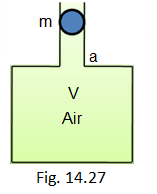
An air chamber of volume $V$ has a neck area of cross section $a$ into which a ball of mass $m$ just fits and can move up and down without any friction (Fig.14.27). Show that when the ball is pressed down a little and released , it executes SHM. Obtain an expression for the time period of oscillations assuming pressure-volume variations of air to be isothermal [see Fig. 14.27].
Worksheet Answers
Solution:
For a particle undergoing Simple Harmonic Motion (SHM) along a straight line, the displacement $x(t)$ as a function of time is given by:
$x(t) = A \sin(\omega t + \phi)$
[Per the definition of SHM, where $A$ is amplitude, $\omega$ is angular frequency, and $\phi$ is the phase constant].
The instantaneous velocity $v(t)$ is the first derivative of displacement with respect to time:
$v(t) = \frac{dx}{dt} = A\omega \cos(\omega t + \phi)$
The instantaneous Kinetic Energy ($K$) is defined as:
$K = \frac{1}{2}mv^2 = \frac{1}{2}m A^2 \omega^2 \cos^2(\omega t + \phi)$
[Using the relation $k = m\omega^2$, where $k$ is the force constant, we can write $K = \frac{1}{2} k A^2 \cos^2(\omega t + \phi)$].
The instantaneous Potential Energy ($U$) is defined as:
$U = \frac{1}{2}kx^2 = \frac{1}{2} k A^2 \sin^2(\omega t + \phi)$
The average value of a function $f(t)$ over a period $T$ is given by $\langle f \rangle = \frac{1}{T} \int_{0}^{T} f(t) dt$.
For Kinetic Energy:
$\langle K \rangle = \frac{1}{T} \int_{0}^{T} \frac{1}{2} k A^2 \cos^2(\omega t + \phi) dt$
Using the identity $\cos^2\theta = \frac{1 + \cos(2\theta)}{2}$:
$\langle K \rangle = \frac{kA^2}{2T} \int_{0}^{T} \frac{1 + \cos(2(\omega t + \phi))}{2} dt$
Since the integral of $\cos(2\omega t + 2\phi)$ over a full period $T = \frac{2\pi}{\omega}$ is zero:
$\langle K \rangle = \frac{kA^2}{4T} [t]_{0}^{T} = \frac{kA^2}{4T} \cdot T = \frac{1}{4}kA^2$
Similarly, for Potential Energy:
$\langle U \rangle = \frac{1}{T} \int_{0}^{T} \frac{1}{2} k A^2 \sin^2(\omega t + \phi) dt$
Using the identity $\sin^2\theta = \frac{1 - \cos(2\theta)}{2}$:
$\langle U \rangle = \frac{kA^2}{2T} \int_{0}^{T} \frac{1 - \cos(2(\omega t + \phi))}{2} dt$
$\langle U \rangle = \frac{kA^2}{4T} [t]_{0}^{T} = \frac{1}{4}kA^2$
Comparing the derived averages:
| Energy Type | Average Value |
|---|---|
| Kinetic Energy ($\langle K \rangle$) | $\frac{1}{4}kA^2$ |
| Potential Energy ($\langle U \rangle$) | $\frac{1}{4}kA^2$ |
Final Solution: Since $\langle K \rangle = \frac{1}{4}kA^2$ and $\langle U \rangle = \frac{1}{4}kA^2$, it is proven that $\langle K \rangle = \langle U \rangle$ for a particle in linear SHM.
Solution:
To determine the torsional spring constant $\alpha$, we utilize the dynamics of a torsional pendulum. The system consists of a circular disc suspended by a wire, undergoing angular simple harmonic motion.
[By the Principle of Angular Harmonic Motion, the period $T$ is given by $T = 2\pi \sqrt{\frac{I}{\alpha}}$, where $I$ is the Moment of Inertia of the disc about the axis of rotation.]
For a circular disc rotating about an axis passing through its centre and perpendicular to its plane, the moment of inertia is defined as:
$I = \frac{1}{2} M R^2$
Substituting the given values:
$I = \frac{1}{2} \times 10\text{ kg} \times (0.15\text{ m})^2$
$I = 5 \times 0.0225 = 0.1125\text{ kg}\cdot\text{m}^2$
Rearranging the period formula $T = 2\pi \sqrt{\frac{I}{\alpha}}$ to solve for $\alpha$:
$\frac{T}{2\pi} = \sqrt{\frac{I}{\alpha}}$
$\frac{T^2}{4\pi^2} = \frac{I}{\alpha}$
$\alpha = \frac{4\pi^2 I}{T^2}$
Using $\pi^2 \approx 9.8696$:
$\alpha = \frac{4 \times 9.8696 \times 0.1125}{(1.5)^2}$
$\alpha = \frac{4.44132}{2.25}$
$\alpha \approx 1.9739\text{ N}\cdot\text{m/rad}$
Final Solution: The torsional spring constant of the wire is approximately $1.97\text{ N}\cdot\text{m/rad}$.
Solution:
Let $P$ be the atmospheric pressure and $V$ be the volume of the air chamber. When the ball of mass $m$ is at equilibrium, the downward force due to its weight ($mg$) is balanced by the upward force due to the pressure difference. However, if the pressure inside the chamber is equal to the atmospheric pressure $P$, the ball rests at the opening. Let the pressure inside the chamber be $P$.
Suppose the ball is pushed down by a small distance $x$ into the neck of area $a$. The decrease in volume is $\Delta V = ax$. [By the definition of isothermal processes, the product of pressure and volume remains constant].
The initial state is $(P, V)$. The final state after compression is $(P + \Delta P, V - \Delta V)$.
According to Boyle's Law: $PV = (P + \Delta P)(V - \Delta V)$
$PV = PV - P\Delta V + V\Delta P - \Delta P \Delta V$
Neglecting the small product term $\Delta P \Delta V$:
$P\Delta V = V\Delta P \implies \Delta P = \frac{P \Delta V}{V} = \frac{Pax}{V}$
The excess pressure $\Delta P$ acts on the bottom of the ball, exerting an upward force $F$.
$F = -(\Delta P) \cdot a$ [The negative sign indicates the force is restorative, directed opposite to the displacement $x$].
Substituting the expression for $\Delta P$:
$F = -\left( \frac{Pax}{V} \right) a = -\left( \frac{Pa^2}{V} \right) x$
According to Newton's Second Law, $F = ma = m \frac{d^2x}{dt^2}$.
$m \frac{d^2x}{dt^2} = -\left( \frac{Pa^2}{V} \right) x$
$\frac{d^2x}{dt^2} = -\left( \frac{Pa^2}{mV} \right) x$
This equation is of the form $\frac{d^2x}{dt^2} = -\omega^2 x$, which is the defining differential equation of SHM [Per the definition of linear restorative forces].
Comparing the derived equation with the standard SHM equation, we identify the angular frequency $\omega$:
$\omega^2 = \frac{Pa^2}{mV} \implies \omega = \sqrt{\frac{Pa^2}{mV}}$
The time period $T$ is given by $T = \frac{2\pi}{\omega}$ [Relationship between angular frequency and periodic time]:
$T = 2\pi \sqrt{\frac{mV}{Pa^2}}$
Final Solution: The system executes SHM because the restoring force is directly proportional to displacement $x$ ($F \propto -x$). The time period of oscillation is $T = 2\pi \sqrt{\frac{mV}{Pa^2}}$.
Solution:
Based on the provided motion parameters, we identify the following variables:
The angular frequency is related to the period of oscillation by the relation $\omega = \frac{2\pi}{T}$ [Per the definition of SHM periodicity].
$\omega = \frac{2\pi}{0.2} = 10\pi \text{ rad/s}$
The velocity of a particle in Simple Harmonic Motion is given by the expression $v = \omega \sqrt{A^2 - x^2}$ [By the conservation of energy in SHM].
Substituting the given values:
$v = 10\pi \sqrt{(0.05)^2 - (0.05)^2}$
$v = 10\pi \sqrt{0.0025 - 0.0025} = 0 \text{ m/s}$
Justification: At the extreme position ($x = A$), the body momentarily comes to rest before reversing its direction.
The acceleration of a particle in SHM is defined by $a = -\omega^2 x$ [Per the restoring force law $F = -kx$ and Newton's Second Law $F=ma$].
Substituting the values:
$a = -(10\pi)^2 \times (0.05)$
$a = -(100\pi^2) \times (0.05)$
$a = -5\pi^2 \text{ m/s}^2$
Using $\pi^2 \approx 9.87$:
$a \approx -5 \times 9.87 = -49.35 \text{ m/s}^2$
Final Solution: At a displacement of 5 cm, the velocity is 0 m/s and the acceleration is $-5\pi^2 \text{ m/s}^2 \approx -49.35 \text{ m/s}^2$.
Solution:
To determine the spring constant $k$, we utilize the equilibrium condition of the automobile's mass on the suspension system.
At static equilibrium, the restoring force of the spring system must balance the gravitational force acting on the automobile [Per Hooke's Law and Newton's Second Law].
$F_{restoring} = F_{gravity}$
$kx = Mg$
Rearranging the equation to solve for the spring constant $k$:
$k = \frac{Mg}{x}$
Substitute the given numerical values:
$k = \frac{3000 \, \text{kg} \times 9.8 \, \text{m/s}^2}{0.15 \, \text{m}}$
$k = \frac{29400 \, \text{N}}{0.15 \, \text{m}}$
$k = 1.96 \times 10^5 \, \text{N/m}$
The spring constant represents the stiffness of the suspension system. Since the four wheels share the load, this calculated $k$ represents the effective spring constant of the entire suspension system [Per the principle of equivalent spring constants in parallel].
Final Solution: The estimated value of the spring constant $k$ is $1.96 \times 10^5 \, \text{N/m}$.
Solution:
The system describes Simple Harmonic Motion (SHM) defined by the following parameters:
First, calculate the angular frequency ($\omega$) using the relationship between period and frequency [Per the definition of SHM]:
$\omega = \frac{2\pi}{T} = \frac{2\pi}{0.2} = 10\pi\text{ rad/s} \approx 31.42\text{ rad/s}$
The velocity of a particle in SHM as a function of displacement $x$ is given by [Derived from the conservation of energy in SHM]:
$v = \pm \omega \sqrt{A^2 - x^2}$
Substituting the given values:
$v = \pm (10\pi) \sqrt{(5)^2 - (3)^2}\text{ cm/s}$
$v = \pm 10\pi \sqrt{25 - 9} = \pm 10\pi \sqrt{16} = \pm 10\pi(4)$
$v = \pm 40\pi\text{ cm/s} \approx \pm 125.66\text{ cm/s}$
$v = \pm 1.26\text{ m/s}$
The acceleration of a particle in SHM is given by the differential equation of motion [Per Newton's Second Law and Hooke's Law]:
$a = -\omega^2 x$
Substituting the known values:
$a = -(10\pi)^2 \times (3\text{ cm})$
$a = -100\pi^2 \times 3$
$a = -300\pi^2\text{ cm/s}^2$
Using $\pi^2 \approx 9.87$:
$a \approx -300 \times 9.87 = -2961\text{ cm/s}^2 = -29.61\text{ m/s}^2$
| Parameter | Magnitude (cm units) | Magnitude (SI units) |
|---|---|---|
| Velocity ($v$) | $\pm 125.66\text{ cm/s}$ | $\pm 1.26\text{ m/s}$ |
| Acceleration ($a$) | $-2961\text{ cm/s}^2$ | $-29.61\text{ m/s}^2$ |
Final Solution: The velocity of the body is approximately $\pm 1.26\text{ m/s}$ and the acceleration is $-29.61\text{ m/s}^2$.
Solution:
To analyze the Simple Harmonic Motion (SHM) of the body, we extract the primary parameters provided:
We calculate the angular frequency ($\omega$) using the relationship between period and frequency [Per the definition of SHM]:
$\omega = \frac{2\pi}{T} = \frac{2\pi}{0.2} = 10\pi\text{ rad/s}$
The velocity ($v$) of a body in SHM is defined by the function [Derived from the differentiation of $x(t) = A \sin(\omega t + \phi)$]:
$v = \omega \sqrt{A^2 - x^2}$
Substituting $x = 0$ into the equation:
$v = (10\pi) \sqrt{(0.05)^2 - 0^2}$
$v = (10\pi) \times 0.05$
$v = 0.5\pi\text{ m/s} \approx 1.57\text{ m/s}$
The acceleration ($a$) of a body in SHM is defined by the restoring force relationship [Per Newton’s Second Law and Hooke’s Law]:
$a = -\omega^2 x$
Substituting $x = 0$ into the equation:
$a = -(10\pi)^2 \times 0$
$a = 0\text{ m/s}^2$
At the equilibrium position ($x=0$), the body possesses maximum potential energy transformation into kinetic energy, resulting in maximum velocity. Conversely, since the restoring force $F = -kx$ is directly proportional to displacement, the acceleration vanishes at the equilibrium point.
Final Solution: The velocity is $1.57\text{ m/s}$ and the acceleration is $0\text{ m/s}^2$.
Solution:
For a single wheel system, we define the following parameters based on the problem statement:
The spring constant $k$ is derived from the equilibrium condition where the downward force of gravity equals the restoring spring force [Per Hooke's Law: $F = kx$]:
$mg = k x_0$
$k = \frac{mg}{x_0} = \frac{750 \times 9.8}{0.15}$
$k = \frac{7350}{0.15} = 49000\text{ N/m}$
For a damped oscillator, the displacement is given by $x(t) = A_0 e^{-(b/2m)t} \cos(\omega' t + \phi)$. The amplitude decays as $A(t) = A_0 e^{-(b/2m)t}$. [Per the theory of Damped Oscillations].
Given that after one period ($t = T$), the amplitude is $50\%$ of the initial amplitude:
$0.5 A_0 = A_0 e^{-(b/2m)T}$
$\ln(0.5) = -\frac{bT}{2m} \implies \frac{bT}{2m} = \ln(2) \approx 0.693$
Assuming the damping is light ($\omega' \approx \omega_0 = \sqrt{k/m}$):
$\omega_0 = \sqrt{\frac{49000}{750}} \approx \sqrt{65.33} \approx 8.08\text{ rad/s}$
$T = \frac{2\pi}{\omega_0} = \frac{2 \times 3.1416}{8.08} \approx 0.777\text{ s}$
Now, solve for $b$ using the relationship derived in Step 3:
$b = \frac{2m \ln(2)}{T}$
$b = \frac{2 \times 750 \times 0.693}{0.777}$
$b = \frac{1039.5}{0.777} \approx 1337.8\text{ kg/s}$
Final Solution: The estimated value of the damping constant $b$ is approximately $1338\text{ kg/s}$.
Solution:
The displacement of a simple harmonic oscillator is given by the general solution: $x(t) = A \cos(\omega t + \phi)$ where $A$ is the amplitude and $\phi$ is the initial phase constant. [Per the differential equation $\frac{d^2x}{dt^2} + \omega^2 x = 0$]
At time $t = 0$, the initial position is $x(0) = x_0$ and the initial velocity is $v(0) = -v_0$ (negative as it is directed towards the center).
Using the displacement equation at $t=0$:
$x_0 = A \cos(\phi)$ --- (Equation 1)
Differentiating $x(t)$ with respect to time to obtain the velocity equation: $v(t) = \frac{dx}{dt} = -A \omega \sin(\omega t + \phi)$
Applying the initial velocity condition at $t=0$: $-v_0 = -A \omega \sin(\phi)$ $v_0 = A \omega \sin(\phi)$ $\frac{v_0}{\omega} = A \sin(\phi)$ --- (Equation 2)
To isolate $A$, square Equation 1 and Equation 2 and invoke the trigonometric identity $\sin^2\phi + \cos^2\phi = 1$: $x_0^2 = A^2 \cos^2\phi$ $(\frac{v_0}{\omega})^2 = A^2 \sin^2\phi$
Summing the equations: $x_0^2 + \frac{v_0^2}{\omega^2} = A^2 (\cos^2\phi + \sin^2\phi)$ $x_0^2 + \frac{v_0^2}{\omega^2} = A^2$
Solving for $A$: $A = \sqrt{x_0^2 + \frac{v_0^2}{\omega^2}}$
| Variable | Physical Significance |
|---|---|
| $x_0$ | Initial displacement |
| $v_0$ | Initial velocity magnitude |
| $\omega$ | Angular frequency |
| $A$ | Resultant amplitude |
Final Solution: $A = \sqrt{x_0^2 + \frac{v_0^2}{\omega^2}}$