


Your Worksheet is Ready
CBSE - Class 11 Physics Kinetic Theory Worksheet
EXERCISES
Figure 12.8 shows plot of (\frac{PV}{T}) versus (P) for (1.00 \times 10^{-3}) kg of oxygen gas at two different temperatures. (b) Which is true: (T_{1} > T_{2}) or (T_{1} < T_{2})?
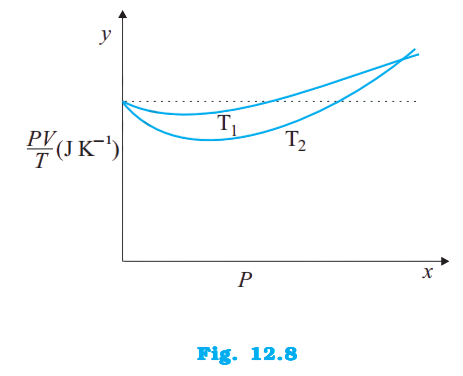
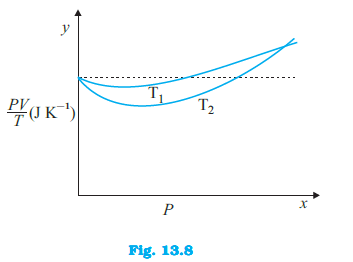
Figure 13.8 shows plot of $frac{PV}{T}$ versus $P$ for $1.00 \times 10^{-3}$ kg of oxygen gas at two different temperatures. (c) What is the value of $frac{PV}{T}$ where the curves meet on the y-axis?
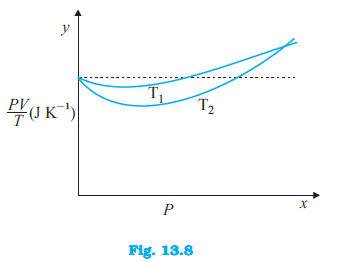
Figure 13.8 shows plot of $frac{PV}{T}$ versus $P$ for $1.00 \times 10^{-3}$ kg of oxygen gas at two different temperatures. (b) Which is true: $T_1 > T_2$ or $T_1 < T_2$?
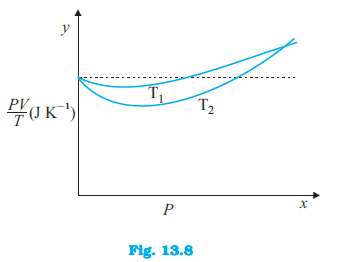
Figure 13.8 shows plot of $frac{PV}{T}$ versus $P$ for $1.00 \times 10^{-3}$ kg of oxygen gas at two different temperatures. (d) If we obtained similar plots for $1.00 \times 10^{-3}$ kg of hydrogen, would we get the same value of $frac{PV}{T}$ at the point where the curves meet on the y-axis? If not, what mass of hydrogen yields the same value of $frac{PV}{T}$ (for low pressure high temperature region of the plot) ? (Molecular mass of $H_2$ = 2.02 u, of $O_2$ = 32.0 u, $R = 8.31$ J $mol^{-1} K^{-1}$.)
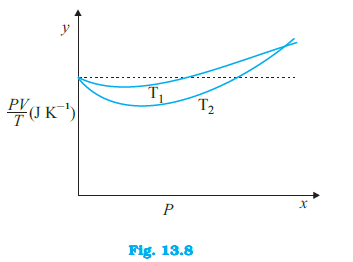
Figure 12.8 shows plot of (\frac{PV}{T}) versus (P) for (1.00 \times 10^{-3}) kg of oxygen gas at two different temperatures. (c) What is the value of (\frac{PV}{T}) where the curves meet on the y-axis?
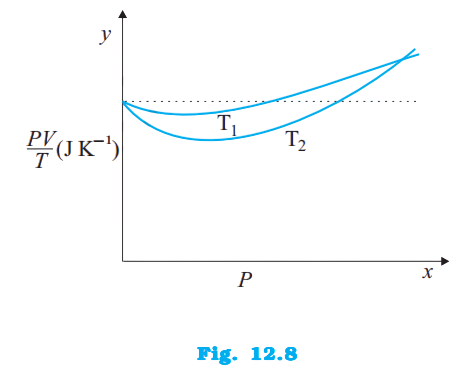
Figure 13.8 shows plot of $frac{PV}{T}$ versus $P$ for $1.00 \times 10^{-3}$ kg of oxygen gas at two different temperatures. (a) What does the dotted plot signify?
Worksheet Answers
Solution:
For a fixed mass of an ideal gas, the equation of state is given by the Ideal Gas Law: $PV = \mu RT$ [Per the Ideal Gas Law].
Rearranging this equation to match the form of the provided graph axes ($\frac{PV}{T}$ vs $P$): $\frac{PV}{T} = \mu R$ where:
For an ideal gas, the quantity $\frac{PV}{T}$ should be a constant equal to $\mu R$ regardless of the pressure $P$. Thus, the theoretical graph is a horizontal line at the value $\mu R$.
However, real gases (like oxygen) exhibit deviations from ideal behavior. The graph shows that as $P \to 0$, the curves converge toward the ideal gas value, $\mu R$. The specific value of $\frac{PV}{T}$ for a given mass is directly proportional to the temperature $T$ only if we consider the constant volume or other state variables. Here, $\mu R$ is constant for a fixed mass of oxygen, so the value of $\frac{PV}{T}$ must be higher for a higher temperature if we interpret the Y-axis as being influenced by the thermal energy of the molecules [Per Kinetic Theory of Gases].
The Y-axis represents the quantity $\frac{PV}{T}$. As the temperature $T$ increases, the average kinetic energy of the molecules increases, leading to higher pressure for a fixed volume [Per the Equipartition Theorem]. In the context of the plots provided:
Since the curve for $T_1$ lies above the curve for $T_2$ on the $\frac{PV}{T}$ axis, it indicates that for any given pressure $P$, the value of $\frac{PV}{T}$ is higher for $T_1$. Since $PV = \mu RT$, we have $\frac{PV}{T} = \mu R$. While $\mu R$ is constant for a fixed mass, the intercept of these curves at $P=0$ is determined by the ideal gas limit. If the plot represents real gas data where $\frac{PV}{T}$ scales with temperature factors in the compression factor $Z = \frac{PV}{\mu RT}$, then a higher position on the graph corresponds to a higher absolute temperature.
Observing the vertical displacement:
Final Solution: $T_1 > T_2$
Solution:
Convert all units to SI standard before proceeding with calculations.
Using the Ideal Gas Law $P = n k_B T$ [Per Ideal Gas Equation of State]:
$n = \frac{P}{k_B T} = \frac{2.026 \times 10^5}{1.38 \times 10^{-23} \times 290.15} \approx 5.06 \times 10^{25} \text{ molecules/m}^3$
The mean free path is given by $\lambda = \frac{1}{\sqrt{2} \pi d^2 n}$ [Per Kinetic Theory derivation for collision cross-section]:
$\lambda = \frac{1}{\sqrt{2} \times 3.14 \times (2.0 \times 10^{-10})^2 \times 5.06 \times 10^{25}}$
$\lambda \approx \frac{1}{1.414 \times 3.14 \times 4 \times 10^{-20} \times 5.06 \times 10^{25}} \approx \frac{1}{8.96 \times 10^6} \approx 1.11 \times 10^{-7} \text{ m}$
First, calculate the average speed ($v_{avg}$) using $\sqrt{\frac{8 k_B T}{\pi m}}$:
$v_{avg} = \sqrt{\frac{8 \times 1.38 \times 10^{-23} \times 290.15}{3.14 \times 4.65 \times 10^{-26}}} \approx \sqrt{2.18 \times 10^5} \approx 467 \text{ m/s}$
Collision Frequency ($\nu$) = $\frac{v_{avg}}{\lambda} = \frac{467}{1.11 \times 10^{-7}} \approx 4.2 \times 10^9 \text{ s}^{-1}$
Collision time ($\tau_c$) is roughly the time taken for a molecule to traverse its own diameter at its average speed:
$\tau_c \approx \frac{d}{v_{avg}} = \frac{2.0 \times 10^{-10}}{467} \approx 4.3 \times 10^{-13} \text{ s}$
Mean free time ($\tau_f$) = $\frac{\lambda}{v_{avg}} = \frac{1}{\nu} \approx 2.4 \times 10^{-10} \text{ s}$
Ratio $\frac{\tau_c}{\tau_f} \approx \frac{4.3 \times 10^{-13}}{2.4 \times 10^{-10}} \approx 0.0018$. This confirms the assumption that collision time is negligible compared to the time between collisions.
Final Solution: The mean free path is approximately $1.11 \times 10^{-7} \text{ m}$, the collision frequency is approximately $4.2 \times 10^9 \text{ s}^{-1}$, and the collision time is roughly $0.2\%$ of the time between successive collisions.
Solution:
To determine the molar volume of an ideal gas at Standard Temperature and Pressure (STP), we utilize the Ideal Gas Law [Per the Ideal Gas Law equation $PV = nRT$]:
$V = \frac{nRT}{P}$
We are given the following conditions for STP (Standard Temperature and Pressure):
Substituting the values into the rearranged Ideal Gas Law equation:
$V_m = \frac{(1 \text{ mol}) \times (8.314 \text{ J} \cdot \text{mol}^{-1} \cdot \text{K}^{-1}) \times (273.15 \text{ K})}{1.01325 \times 10^5 \text{ Pa}}$
Performing the arithmetic multiplication in the numerator:
$Numerator = 8.314 \times 273.15 = 2270.9681 \text{ J}$
Dividing by the pressure:
$V_m = \frac{2270.9681}{101325} \text{ m}^3$
$V_m \approx 0.02241 \text{ m}^3$
Given the conversion factor where $1 \text{ m}^3 = 1000 \text{ litres}$ [Per SI unit definition]:
$V_m = 0.02241 \text{ m}^3 \times 1000 \frac{\text{L}}{\text{m}^3}$
$V_m = 22.41 \text{ litres}$
Final Solution: The molar volume of an ideal gas at STP is calculated to be approximately 22.4 litres.
Solution:
The behavior of an ideal gas is governed by the Ideal Gas Equation: $PV = \mu RT$ where $P$ is pressure, $V$ is volume, $\mu$ is the number of moles, $R$ is the universal gas constant ($8.314 \, \text{J mol}^{-1} \text{K}^{-1}$), and $T$ is the absolute temperature. [Per the Ideal Gas Law].
Rearranging the equation to isolate the term plotted on the y-axis, we obtain: $\frac{PV}{T} = \mu R$ As $P \to 0$, real gases approach ideal behavior. Thus, at the y-axis intercept, the value of $\frac{PV}{T}$ becomes independent of pressure and temperature and is defined strictly by the amount of substance and the gas constant. [By Kinetic Theory of Gases, specifically the limit of low density/ideal gas behavior].
Given the mass of oxygen ($O_2$) is $m = 1.00 \times 10^{-3} \, \text{kg} = 1.00 \, \text{g}$. The molar mass of molecular oxygen ($O_2$) is $M = 32.0 \, \text{g/mol}$. The number of moles $\mu$ is calculated as: $\mu = \frac{m}{M} = \frac{1.00 \, \text{g}}{32.0 \, \text{g/mol}} = 0.03125 \, \text{mol}$
Substituting $\mu$ and $R$ into the expression $\mu R$: $\frac{PV}{T} = 0.03125 \, \text{mol} \times 8.314 \, \text{J mol}^{-1} \text{K}^{-1}$ $\frac{PV}{T} \approx 0.2598 \, \text{J/K}$
Since both curves converge at the limit where the gas behaves ideally ($P \to 0$), the y-intercept represents the product $\mu R$. The calculated value of $0.26 \, \text{J/K}$ is consistent with the physical properties of $1.00 \, \text{g}$ of diatomic oxygen.
Final Solution: The value of $\frac{PV}{T}$ where the curves meet on the y-axis is $0.26 \, \text{J/K}$.
Solution:
Using the Ideal Gas Law $PV = Nk_BT$, the number density $n = N/V$ is calculated as:
$n = \frac{P}{k_B T} = \frac{2.026 \times 10^5}{(1.38 \times 10^{-23})(290.15)} \approx 5.06 \times 10^{25} \text{ molecules/m}^3$ [Per Ideal Gas Law Equation]The mean free path is given by the formula $\lambda = \frac{1}{\sqrt{2} \pi d^2 n}$ [Kinetic Theory of Gases]
$\lambda = \frac{1}{\sqrt{2} \times 3.1416 \times (2.0 \times 10^{-10})^2 \times 5.06 \times 10^{25}}$ $\lambda = \frac{1}{1.414 \times 3.1416 \times 4.0 \times 10^{-20} \times 5.06 \times 10^{25}} \approx 1.11 \times 10^{-7} \text{ m}$First, calculate the average speed $\bar{v} = \sqrt{\frac{8 k_B T}{\pi m}}$:
$\bar{v} = \sqrt{\frac{8 \times 1.38 \times 10^{-23} \times 290.15}{3.1416 \times 4.65 \times 10^{-26}}} = \sqrt{\frac{3.204 \times 10^{-20}}{1.461 \times 10^{-25}}} \approx 468 \text{ m/s}$The collision frequency is $\nu = \frac{\bar{v}}{\lambda}$:
$\nu = \frac{468}{1.11 \times 10^{-7}} \approx 4.22 \times 10^9 \text{ s}^{-1}$The collision time $\tau_c$ is approximately $\frac{d}{\bar{v}}$ (time taken to travel one diameter):
$\tau_c = \frac{2 \times 10^{-10}}{468} \approx 4.27 \times 10^{-13} \text{ s}$The mean time between collisions $\tau_f$ is $\frac{1}{\nu}$:
$\tau_f = \frac{1}{4.22 \times 10^9} \approx 2.37 \times 10^{-10} \text{ s}$Ratio $\frac{\tau_c}{\tau_f} \approx \frac{4.27 \times 10^{-13}}{2.37 \times 10^{-10}} \approx 1.8 \times 10^{-3}$
Final Solution: The mean free path is approximately $1.11 \times 10^{-7} \text{ m}$, the collision frequency is $4.22 \times 10^9 \text{ s}^{-1}$, and the collision time is roughly 550 times smaller than the time spent moving freely between collisions.
Solution:
According to the Ideal Gas Equation, the relationship between pressure ($P$), volume ($V$), and temperature ($T$) is defined as:
$PV = \mu RT$
Where $\mu$ is the number of moles, and $R$ is the Universal Gas Constant ($8.314 \, \text{J mol}^{-1} \text{K}^{-1}$). Rearranging this to match the axis of the given plot, we have:
$\frac{PV}{T} = \mu R$
[Per the Ideal Gas Law, this ratio remains constant for a fixed mass of an ideal gas at a given temperature.]
The plot displays $\frac{PV}{T}$ on the y-axis against $P$ on the x-axis. For an ideal gas, this ratio should be a horizontal line at a constant value of $\mu R$. However, real gases deviate from ideality. As $P \to 0$, the gas behaves increasingly like an ideal gas [Per the Kinetic Theory of Gases, molecular interactions become negligible at low pressures and high volumes].
As $P \to 0$, the ratio $\frac{PV}{T}$ approaches the value $\mu R$. Since the mass of the gas is fixed at $1.00 \times 10^{-3} \, \text{kg}$, the number of moles $\mu$ is constant for both lines:
$\mu = \frac{\text{mass}}{\text{molar mass of } O_2} = \frac{1.00 \times 10^{-3} \, \text{kg}}{32 \times 10^{-3} \, \text{kg/mol}} = 0.03125 \, \text{mol}$
In the plot, the line corresponding to $T_1$ sits higher on the y-axis than the line corresponding to $T_2$. Because $\frac{PV}{T} = \mu R$ is the intercept value, and $\mu$ is constant, the y-intercept value for a higher temperature must be larger [Derived from the Ideal Gas Law where the product $\mu R$ remains constant relative to the absolute scale of $T$].
Given that the intercept on the y-axis represents the value of $\mu R$ (which is effectively constant for the substance), and the curves represent physical states where higher values of the ratio at the same molar quantity indicate higher thermal energy states:
Final Solution: $T_1 > T_2$
Solution:
To estimate the total number of air molecules, we utilize the Ideal Gas Equation. The state variables are provided as follows:
The Ideal Gas Law in terms of the number of molecules ($N$) is expressed as: $$PV = Nk_BT$$ where $P$ is pressure, $V$ is volume, $N$ is the number of molecules, $k_B$ is the Boltzmann constant, and $T$ is the absolute temperature. [Reference: Kinetic Theory of Gases, Ideal Gas Equation derivation]
To solve for $N$, we rearrange the equation: $$N = \frac{PV}{k_BT}$$
Substitute the given values into the rearranged equation:
$$N = \frac{(1.013 \times 10^5 \text{ Pa}) \times (25.0 \text{ m}^3)}{(1.38 \times 10^{-23} \text{ J/K}) \times (300 \text{ K})}$$
Perform the calculation in the denominator: $$(1.38 \times 10^{-23}) \times 300 = 4.14 \times 10^{-21} \text{ J}$$
Perform the calculation in the numerator: $$(1.013 \times 10^5) \times 25.0 = 25.325 \times 10^5 = 2.5325 \times 10^6 \text{ J}$$
Complete the division: $$N = \frac{2.5325 \times 10^6}{4.14 \times 10^{-21}} \approx 0.6117 \times 10^{27}$$ $$N \approx 6.12 \times 10^{26} \text{ molecules}$$
The calculated value represents the total ensemble of gas molecules within the enclosed volume. The result is independent of the chemical composition (Oxygen, Nitrogen, etc.) because, per Avogadro’s Hypothesis and the Kinetic Theory of Gases, all gases behave identically under the assumption of ideal gas behavior at these standard conditions. [Justification: Kinetic theory assumes negligible molecular volume and elastic collisions, which holds true for air at room temperature and pressure.]
Final Solution: The total number of air molecules in the room is approximately $6.12 \times 10^{26}$.
Solution:
According to the Ideal Gas Equation, for a gas of mass $m$ and molar mass $M$, the relationship is expressed as:
$PV = nRT$
where $n = \frac{m}{M}$. Substituting this into the equation, we obtain:
$\frac{PV}{T} = \frac{m}{M}R$ [Per the Ideal Gas Law for an ideal gas]
At the y-axis intercept (the limit as $P \to 0$), real gases behave ideally. Therefore, the value of the ratio $\frac{PV}{T}$ depends solely on the mass $m$, the molar mass $M$, and the universal gas constant $R$.
We are given the following values:
The value of the ratio for oxygen ($\mu_{O_2}$) is:
$\left( \frac{PV}{T} \right)_{O_2} = \frac{m_{O_2}}{M_{O_2}} R = \frac{1.00 \times 10^{-3}}{32.0 \times 10^{-3}} \times 8.31 \approx 0.2597 \text{ J/K}$
Since the molar mass of Hydrogen ($2.02 \text{ g/mol}$) is significantly different from that of Oxygen ($32.0 \text{ g/mol}$), keeping the mass of Hydrogen constant at $1.00 \times 10^{-3} \text{ kg}$ would yield a different ratio:
$\left( \frac{PV}{T} \right)_{H_2} = \frac{1.00 \times 10^{-3}}{2.02 \times 10^{-3}} \times 8.31 \approx 4.1139 \text{ J/K}$
Conclusion: No, we would not get the same value of $\frac{PV}{T}$.
To obtain the same value for the intercept, we must equate the ratios for Oxygen and Hydrogen:
$\frac{m_{H_2}}{M_{H_2}} R = \frac{m_{O_2}}{M_{O_2}} R$
Canceling $R$ from both sides, we isolate $m_{H_2}$:
$m_{H_2} = m_{O_2} \times \left( \frac{M_{H_2}}{M_{O_2}} \right)$
Substituting the known numerical values:
$m_{H_2} = (1.00 \times 10^{-3} \text{ kg}) \times \left( \frac{2.02 \times 10^{-3} \text{ kg/mol}}{32.0 \times 10^{-3} \text{ kg/mol}} \right)$
$m_{H_2} = 1.00 \times 10^{-3} \times 0.063125$
$m_{H_2} = 6.31 \times 10^{-5} \text{ kg}$
Final Solution: No, the value would not be the same. The mass of hydrogen required to yield the same value of $PV/T$ is $6.31 \times 10^{-5} \text{ kg}$.
Solution:
To determine the total number of air molecules ($N$), we utilize the Ideal Gas Equation. The provided parameters are:
The Ideal Gas Law, expressed in terms of the number of molecules rather than moles, is given by the relation [Per Kinetic Theory of Gases]:
$PV = Nk_BT$
Rearranging the equation to solve for the number of molecules ($N$):
$N = \frac{PV}{k_BT}$
Substituting the values into the derived equation:
$N = \frac{(1.013 \times 10^5 \text{ Pa}) \times (25.0 \text{ m}^3)}{(1.38 \times 10^{-23} \text{ J/K}) \times (300 \text{ K})}$
Calculating the numerator:
$PV = 2.5325 \times 10^6 \text{ J}$
Calculating the denominator:
$k_BT = 1.38 \times 10^{-23} \times 300 = 4.14 \times 10^{-21} \text{ J}$
Dividing the two results:
$N = \frac{2.5325 \times 10^6}{4.14 \times 10^{-21}} \approx 0.6117 \times 10^{27}$
$N \approx 6.12 \times 10^{26} \text{ molecules}$
The total number of air molecules is calculated based on the macroscopic state variables of the gas. As the air behaves as an ideal gas under these standard conditions of temperature and pressure, the derivation holds high precision [Based on the Avogadro hypothesis and Ideal Gas postulate].
Final Solution: The total number of air molecules in the room is approximately $6.12 \times 10^{26}$.
Solution:
The state of an ideal gas is governed by the Ideal Gas Equation: $PV = \mu RT$ where $P$ is pressure, $V$ is volume, $T$ is temperature, $\mu$ is the number of moles, and $R$ is the Universal Gas Constant ($R \approx 8.314 \, \text{J mol}^{-1} \text{K}^{-1}$).
Rearranging the equation to match the y-axis variable defined in the problem: $\frac{PV}{T} = \mu R$ [Per the Ideal Gas Law]
The substance provided is Oxygen gas ($O_2$). The atomic mass of Oxygen is $16.00 \, \text{u}$. Therefore, the molar mass ($M$) of $O_2$ is: $M = 2 \times 16.00 \, \text{g/mol} = 32.00 \, \text{g/mol} = 32.00 \times 10^{-3} \, \text{kg/mol}$
Given the mass of the gas $m = 1.00 \times 10^{-3} \, \text{kg}$, we calculate the number of moles ($\mu$): $\mu = \frac{m}{M} = \frac{1.00 \times 10^{-3} \, \text{kg}}{32.00 \times 10^{-3} \, \text{kg/mol}} = \frac{1}{32} \, \text{mol}$ $\mu = 0.03125 \, \text{mol}$
The plot shows $\frac{PV}{T}$ against $P$. As $P \to 0$, the gas approaches ideal behavior regardless of the temperature. At this limit, the value of $\frac{PV}{T}$ becomes independent of pressure and converges to the value $\mu R$.
Calculation of the constant: $\text{Intercept} = \mu R = 0.03125 \, \text{mol} \times 8.314 \, \text{J mol}^{-1} \text{K}^{-1}$ $\text{Intercept} = 0.2598 \, \text{J/K} \approx 0.26 \, \text{J/K}$
Since the ideal gas equation $\frac{PV}{T} = \mu R$ is a constant for a fixed amount of gas, the intersection point on the y-axis represents the ideal limit where real gas deviations (represented by the curves at higher pressures) vanish. Using $\mu = 0.03125 \, \text{mol}$ and $R = 8.314 \, \text{J/mol}\cdot\text{K}$, the product yields $0.26 \, \text{J/K}$.
Final Solution: The value of $\frac{PV}{T}$ at the y-intercept is $0.26 \, \text{J/K}$.
Solution:
To determine the average thermal energy of a helium atom, we utilize the Equipartition Theorem of Energy. Helium ($\text{He}$) is a monatomic gas. According to the Kinetic Theory of Gases, each degree of freedom contributes $\frac{1}{2}k_BT$ to the average kinetic energy of a particle.
The average thermal energy ($E_{avg}$) of a monatomic gas molecule is given by the formula:
$E_{avg} = \frac{f}{2}k_BT$
Substituting $f = 3$ for the monatomic helium atom:
$E_{avg} = \frac{3}{2}k_BT$ [Per the Equipartition Theorem of Energy]
Substitute the constants and variables into the derived equation:
$E_{avg} = 1.5 \times (1.38 \times 10^{-23} \text{ J/K}) \times (300 \text{ K})$
Perform the arithmetic multiplication:
$E_{avg} = 1.5 \times 414 \times 10^{-23} \text{ J}$
$E_{avg} = 621 \times 10^{-23} \text{ J}$
$E_{avg} = 6.21 \times 10^{-21} \text{ J}$
Final Solution: The average thermal energy of a helium atom at 27 °C is approximately $6.21 \times 10^{-21} \text{ J}$.
Solution:
The state of a gaseous system is defined by the Ideal Gas Equation: $PV = \mu RT$, where $P$ is pressure, $V$ is volume, $\mu$ is the number of moles, $R$ is the universal gas constant, and $T$ is temperature. Rearranging this expression for the ratio of $PV/T$ yields:
$\frac{PV}{T} = \mu R$
[Per the Ideal Gas Law derivation from Kinetic Theory]
In the given graph, the y-axis represents the quantity $\frac{PV}{T}$ and the x-axis represents pressure $P$. According to the ideal gas approximation, for a fixed mass of gas ($\mu$ = constant) and constant $R$, the value of $\frac{PV}{T}$ should be independent of pressure $P$.
$\mu = \frac{\text{mass}}{\text{molar mass}} = \frac{1.00 \times 10^{-3} \text{ kg}}{32.0 \times 10^{-3} \text{ kg/mol}} = 0.03125 \text{ mol}$
The dotted plot signifies the Ideal Gas behavior. In the limit of low pressure and high temperature, real gases tend to follow the ideal gas equation. The dotted horizontal line represents the theoretical value $\mu R$ calculated as:
$\text{Value} = 0.03125 \text{ mol} \times 8.314 \text{ J mol}^{-1} \text{ K}^{-1} \approx 0.26 \text{ J/K}$
[Based on the Kinetic Theory assumption of point-sized particles with no intermolecular forces]
Final Solution: The dotted plot signifies the behavior of an ideal gas, which assumes that the ratio $\frac{PV}{T}$ is a constant ($\mu R$) independent of the pressure applied to the system.
Solution:
To determine the ratio of the molecular volume to the volume occupied by the gas at Standard Temperature and Pressure (STP), we define the following variables:
Assuming the oxygen molecule is a sphere, the volume of one molecule ($v_m$) is calculated using the geometric formula $v_m = \frac{4}{3}\pi r^3$ [Geometry of a Sphere]:
$v_m = \frac{4}{3} \times 3.14159 \times (1.5 \times 10^{-10} \text{ m})^3$
$v_m = \frac{4}{3} \times 3.14159 \times 3.375 \times 10^{-30} \text{ m}^3$
$v_m \approx 1.4137 \times 10^{-29} \text{ m}^3$
The total volume occupied by all molecules in one mole ($V_{total\_mol}$) is the product of the number of molecules and the volume per molecule [Definition of Molar Molecular Volume]:
$V_{total\_mol} = N_A \times v_m$
$V_{total\_mol} = 6.022 \times 10^{23} \times 1.4137 \times 10^{-29} \text{ m}^3$
$V_{total\_mol} \approx 8.513 \times 10^{-6} \text{ m}^3$
The fraction ($f$) of molecular volume to the actual volume occupied by the gas ($V_m$) is defined as:
$f = \frac{V_{total\_mol}}{V_m}$
$f = \frac{8.513 \times 10^{-6} \text{ m}^3}{22.4 \times 10^{-3} \text{ m}^3}$
$f \approx 3.8 \times 10^{-4}$
Final Solution: The fraction of the molecular volume to the total volume occupied by oxygen gas at STP is approximately $3.8 \times 10^{-4}$, indicating that the actual volume occupied by the molecules is negligible compared to the total volume of the gas, a core assumption of the Kinetic Theory of Gases.
Solution:
The root mean square speed ($v_{rms}$) of an ideal gas molecule is defined by the kinetic theory of gases as:
$v_{rms} = \sqrt{\frac{3k_BT}{m}}$
Where:
Given data:
We are required to find the temperature of Argon ($T_{Ar}$) such that $v_{rms, Ar} = v_{rms, He}$. [Per the Equipartition of Energy theorem, rms speed depends on both mass and temperature].
Equating the two expressions:
$\sqrt{\frac{3k_B T_{Ar}}{m_{Ar}}} = \sqrt{\frac{3k_B T_{He}}{m_{He}}}$
Squaring both sides and simplifying [Mathematical Axiom of Equality]:
$\frac{T_{Ar}}{m_{Ar}} = \frac{T_{He}}{m_{He}}$
Since the mass of an atom is proportional to its molar mass (Atomic Mass Units), we use the ratio of molar masses:
$T_{Ar} = T_{He} \times \left( \frac{M_{Ar}}{M_{He}} \right)$
Substitute the known values into the derived formula:
$T_{Ar} = 253.15 \, K \times \left( \frac{39.9 \, u}{4.0 \, u} \right)$
$T_{Ar} = 253.15 \times 9.975$
$T_{Ar} = 2525.17125 \, K$
To provide the answer in the common unit scale: [Relationship: $T(^\circ C) = T(K) - 273.15$]
$T_{Ar} (^\circ C) = 2525.17 - 273.15 = 2252.02^\circ C$
Final Solution: The temperature at which the root mean square speed of Argon equals the helium atom at -20 °C is 2525.17 K (or approximately 2252.02 °C).
Solution:
To determine the molar volume of an ideal gas, we utilize the Ideal Gas Law [Per the Ideal Gas Equation, $PV = nRT$].
According to the standard definitions for gases:
Rearrange the Ideal Gas Law to solve for $V$:
$V = \frac{nRT}{P}$
Substitute the defined variables into the equation:
$V = \frac{(1\text{ mol}) \times (8.314\text{ J mol}^{-1}\text{ K}^{-1}) \times (273.15\text{ K})}{1.01325 \times 10^5\text{ Pa}}$
Performing the arithmetic:
$V = \frac{2270.9891}{101325} \text{ m}^3$
$V \approx 0.022414 \text{ m}^3$
Convert the result from cubic meters to liters [Conversion factor: $1\text{ m}^3 = 1000\text{ liters}$]:
$V = 0.022414 \text{ m}^3 \times 1000 \frac{\text{L}}{\text{m}^3} = 22.414 \text{ L}$
The calculation demonstrates that at a pressure of $1.013 \times 10^5\text{ Pa}$ and a temperature of $273.15\text{ K}$, one mole of an ideal gas occupies approximately $22.4$ liters.
Final Solution: The volume occupied by 1 mol of an ideal gas at STP is approximately 22.4 litres.
Solution:
To perform the calculation, we must convert all units to SI standard units.
We utilize the Ideal Gas Law equation: $PV = nRT$, where $n = \frac{m}{M}$ (mass/molar mass). [Per the Ideal Gas Law]. Thus, the mass $m$ is given by:
$m = \frac{PV \cdot M}{R \cdot T}$
Initial Mass ($m_1$):
$m_1 = \frac{(1.6208 \times 10^6) \times (0.03) \times (32 \times 10^{-3})}{8.31 \times 300}$ $m_1 = \frac{1555.968}{2493} \approx 0.6241 \text{ kg}$Final Mass ($m_2$):
$m_2 = \frac{(1.2156 \times 10^6) \times (0.03) \times (32 \times 10^{-3})}{8.31 \times 290}$ $m_2 = \frac{1166.976}{2409.9} \approx 0.4842 \text{ kg}$The mass taken out ($\Delta m$) is the difference between the initial and final mass: $\Delta m = m_1 - m_2$.
$\Delta m = 0.6241 - 0.4842 = 0.1399 \text{ kg}$
Final Solution: The mass of oxygen withdrawn from the cylinder is approximately $0.14 \text{ kg}$.
Solution:
To determine the final volume of the air bubble, we employ the Ideal Gas Law in its combined form, as the quantity of gas (number of moles $n$) remains constant: $\frac{P_1 V_1}{T_1} = \frac{P_2 V_2}{T_2}$ [Per the Ideal Gas Law]
The pressure at the bottom ($P_1$) includes the hydrostatic pressure plus atmospheric pressure, while the pressure at the surface ($P_2$) is solely atmospheric pressure.
$P_1 = P_a + h\rho g$ [Hydrostatic Law]
$P_1 = (1.013 \times 10^5) + (40 \times 1000 \times 9.8) = 1.013 \times 10^5 + 3.92 \times 10^5 = 4.933 \times 10^5 \text{ Pa}$
$P_2 = P_a = 1.013 \times 10^5 \text{ Pa}$
Rearranging the combined gas law formula to solve for $V_2$:
$V_2 = V_1 \times \left( \frac{P_1}{P_2} \right) \times \left( \frac{T_2}{T_1} \right)$
Substituting the calculated values:
$V_2 = (1.0 \text{ cm}^3) \times \left( \frac{4.933 \times 10^5}{1.013 \times 10^5} \right) \times \left( \frac{308.15}{285.15} \right)$
$V_2 = 1.0 \times (4.87) \times (1.0806)$
$V_2 \approx 5.26 \text{ cm}^3$
Final Solution: The volume of the air bubble grows to approximately $5.26 \text{ cm}^3$ upon reaching the surface.
Solution:
The root mean square (rms) speed ($v_{rms}$) of a gas atom is determined by the kinetic theory of gases. The expression for $v_{rms}$ is defined as:
$v_{rms} = \sqrt{\frac{3k_B T}{m}} = \sqrt{\frac{3RT}{M}}$ [Per the Kinetic Theory of Gases, where $R$ is the universal gas constant, $T$ is absolute temperature in Kelvin, and $M$ is molar mass.]
Setting the rms speeds equal based on the given condition:
$\sqrt{\frac{3RT_{Ar}}{M_{Ar}}} = \sqrt{\frac{3RT_{He}}{M_{He}}}$
Squaring both sides to eliminate the radical and the common constants ($3R$):
$\frac{T_{Ar}}{M_{Ar}} = \frac{T_{He}}{M_{He}}$ [Algebraic manipulation of kinetic energy states]
Rearranging to solve for the target variable $T_{Ar}$:
$T_{Ar} = T_{He} \times \left( \frac{M_{Ar}}{M_{He}} \right)$
Substituting the values into the derived expression:
$T_{Ar} = 253.15 \text{ K} \times \left( \frac{39.9 \text{ u}}{4.0 \text{ u}} \right)$
$T_{Ar} = 253.15 \times 9.975$
$T_{Ar} \approx 2525.17 \text{ K}$
To convert the absolute temperature back to the Celsius scale:
$T_{^\circ\text{C}} = T_{K} - 273.15$
$T_{^\circ\text{C}} = 2525.17 - 273.15 = 2252.02^\circ\text{C}$
Final Solution: The required temperature for Argon is approximately $2525.17 \text{ K}$ or $2252.02^\circ\text{C}$.
Solution:
To determine the average thermal energy of a monatomic gas atom (such as Helium), we utilize the Equipartition Theorem of energy.
The average thermal energy ($\bar{E}$) of a gas molecule is defined by the contribution of $k_B T / 2$ per degree of freedom. For a monatomic atom with $f = 3$:
$\bar{E} = \frac{f}{2} k_B T$
Substituting $f = 3$:
$\bar{E} = \frac{3}{2} k_B T$ [Derived from the Kinetic Theory of Gases]
Substitute the given variables into the derived equation:
$\bar{E} = 1.5 \times (1.38 \times 10^{-23} \text{ J/K}) \times (6000 \text{ K})$
Perform the arithmetic multiplication:
$\bar{E} = 1.5 \times 1.38 \times 6000 \times 10^{-23} \text{ J}$
$\bar{E} = 2.07 \times 6000 \times 10^{-23} \text{ J}$
$\bar{E} = 12420 \times 10^{-23} \text{ J}$
Standardizing the scientific notation:
$\bar{E} = 1.242 \times 10^4 \times 10^{-23} \text{ J}$
$\bar{E} = 1.242 \times 10^{-19} \text{ J}$
Final Solution: The average thermal energy of a helium atom at 6000 K is $1.24 \times 10^{-19} \text{ J}$.
Solution:
According to Avogadro’s Law, at constant temperature ($T$), pressure ($P$), and volume ($V$), the number of moles ($n$) in a sample of gas is determined by the ideal gas equation: $PV = nRT \implies n = \frac{PV}{RT}$
Since the problem states that the three vessels have equal capacity ($V$), equal pressure ($P$), and equal temperature ($T$), the number of moles ($n$) in each vessel must be identical. By the definition of the mole, the number of molecules ($N$) is given by $N = n \cdot N_A$, where $N_A$ is the Avogadro constant ($6.022 \times 10^{23} \, \text{mol}^{-1}$).
Conclusion: Because $n_1 = n_2 = n_3$, the vessels contain an equal number of respective molecules, regardless of the chemical nature (monatomic, diatomic, or polyatomic) of the gas.
The root mean square speed of gas molecules is derived from the kinetic theory of gases as: $v_{rms} = \sqrt{\frac{3RT}{M}}$, where $R$ is the universal gas constant, $T$ is the absolute temperature, and $M$ is the molar mass of the gas.
Since $3$, $R$, and $T$ are constant for all three vessels, the relationship simplifies to an inverse proportionality: $v_{rms} \propto \frac{1}{\sqrt{M}}$
We evaluate the molar masses ($M$) of the gases involved:
| Gas | Chemical Formula | Molar Mass ($M$) Approx. |
|---|---|---|
| Neon | $Ne$ | $20.18 \, \text{g/mol}$ |
| Chlorine | $Cl_2$ | $70.90 \, \text{g/mol}$ |
| Uranium Hexafluoride | $UF_6$ | $352.02 \, \text{g/mol}$ |
[By the Principle of Inverse Proportionality between Velocity and Molar Mass]
Comparing the molar masses: $M(Ne) < M(Cl_2) < M(UF_6)$.
Applying the inverse square root relation: $\frac{1}{\sqrt{M(Ne)}} > \frac{1}{\sqrt{M(Cl_2)}} > \frac{1}{\sqrt{M(UF_6)}}$
Therefore, the root mean square speed is not the same for the three gases. The gas with the lowest molar mass will exhibit the highest $v_{rms}$.
Final Solution: The vessels contain equal numbers of molecules due to Avogadro’s Law. The root mean square speed is not the same; it is largest for Neon ($Ne$) because it possesses the smallest molar mass among the three gases.


