


Your Worksheet is Ready
CBSE - Class 11 Physics Thermal Properties of Matter Worksheet
EXERCISES
Two ideal gas thermometers A and B use oxygen and hydrogen respectively. The following observations are made :
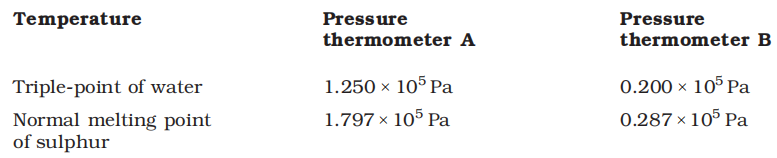
(b) What do you think is the reason behind the slight difference in answers of thermometers A and B ? (The thermometers are not faulty). What further procedure is needed in the experiment to reduce the discrepancy between the two readings ?
Worksheet Answers
Solution:
The rate of heat transfer ($Q/t$) required to vaporize water at a steady rate is given by the product of the mass flow rate and the latent heat of vaporization [Per the principle of calorimetry]:
$\frac{Q}{t} = \left( \frac{dm}{dt} \right) \times L$
$\frac{Q}{t} = 0.1 \, \text{kg/s} \times 2256 \times 10^3 \, \text{J/kg} = 225,600 \, \text{J/s (or Watts)}$
The heat transfer rate through a slab of material is governed by the conduction equation [Fourier's Law of Heat Conduction]:
$\frac{Q}{t} = \frac{K \cdot A \cdot (T_1 - T_2)}{d}$
Where $T_1$ is the temperature of the flame side and $T_2$ is the temperature of the water side.
Rearranging the equation to solve for $T_1$:
$T_1 - T_2 = \frac{(\frac{Q}{t}) \cdot d}{K \cdot A}$
$T_1 = T_2 + \frac{(\frac{Q}{t}) \cdot d}{K \cdot A}$
Substituting the known values:
$T_1 = 373 + \frac{225,600 \times 1.0 \times 10^{-2}}{109 \times 0.15}$
$T_1 = 373 + \frac{2256}{16.35}$
$T_1 \approx 373 + 137.98$
$T_1 \approx 510.98 \, \text{K}$
Converting back to Celsius [Scale conversion $T(^\circ\text{C}) = T(\text{K}) - 273.15$]:
$T_1 (^\circ\text{C}) \approx 510.98 - 273 = 237.98^\circ\text{C}$
Rounding to significant figures, we obtain $238^\circ\text{C}$.
Final Solution: The estimated temperature of the flame in contact with the boiler is approximately 511 K or 238°C.
Solution:
The triple point of water is defined as the unique state where water coexists in three phases—solid (ice), liquid (water), and gas (water vapor)—in thermodynamic equilibrium. Its value is internationally fixed at $273.16 \, K$.
Justification for Selection:
The original Celsius scale utilized the melting point of ice ($0^\circ C$) and the boiling point of water ($100^\circ C$) as standard fixed points. This methodology possesses inherent physical drawbacks:
| Variable | Impact on Melting/Boiling Point |
|---|---|
| Pressure Dependence | The boiling point of water is extremely sensitive to atmospheric pressure fluctuations. A change of $1 \, kPa$ alters the boiling point by approximately $0.3 \, K$. [Per the Clausius-Clapeyron Relation: $\frac{dP}{dT} = \frac{L}{T(V_v - V_l)}$]. |
| Purity Constraints | The melting point of ice is affected by dissolved impurities and atmospheric gases. Small concentrations of solutes cause "freezing point depression," leading to non-reproducibility. |
The adoption of the triple point of water as a single fixed point—in conjunction with the value of the Boltzmann constant—obviates the need for a second reference point. It eliminates the experimental uncertainties introduced by pressure variations and chemical impurities that rendered the two-point system (freezing and boiling) unreliable for modern high-precision metrology.
Final Solution: The triple point of water is chosen because it represents a unique, invariant state of matter defined by fixed pressure and temperature, independent of experimental fluctuations. Conversely, the melting and boiling points are unsuitable as primary standards because they are highly dependent on external pressure and the purity of the substance, leading to lack of international reproducibility.
Solution:
To determine the fractional change in density of glycerine, we define the following parameters provided in the problem statement:
The volume $V$ of a substance at a temperature $T + \Delta T$ is given by the equation of thermal expansion [Per the definition of the coefficient of volume expansion]:
$V = V_0(1 + \gamma \Delta T)$
Since density $\rho$ is inversely proportional to volume for a fixed mass $m$ ($ \rho = \frac{m}{V} $), the density at the final temperature is:
$\rho = \frac{m}{V} = \frac{m}{V_0(1 + \gamma \Delta T)} = \rho_0(1 + \gamma \Delta T)^{-1}$
Given that the product $\gamma \Delta T$ is very small compared to $1$, we apply the Binomial Theorem $(1 + x)^n \approx 1 + nx$ for $|x| \ll 1$:
$\rho \approx \rho_0(1 - \gamma \Delta T)$
Rearranging this to find the change in density ($\Delta \rho = \rho - \rho_0$):
$\rho - \rho_0 = -\rho_0 \gamma \Delta T$
$\frac{\Delta \rho}{\rho_0} = -\gamma \Delta T$
Substitute the known values into the derived expression for fractional change ($\frac{\Delta \rho}{\rho_0}$):
$\text{Fractional change} = -(49 \times 10^{-5} \, K^{-1}) \times (30 \, K)$
$\text{Fractional change} = -(1470 \times 10^{-5})$
$\text{Fractional change} = -1.47 \times 10^{-2}$
The negative sign indicates a decrease in density as temperature increases, which is physically consistent with the expansion of the fluid occupying a larger volume for the same mass [Per the Law of Conservation of Mass].
Final Solution: The fractional change in density is $-1.47 \times 10^{-2}$ (or a decrease of approximately $1.47\%$).
Solution:
The resistance of the thermometer is defined by the linear relation:
$R = R_0 [1 + \alpha (T - T_0)]$
Where:
Using the values at the melting point of lead, we isolate $\alpha$ [Per the linear resistance-temperature model]:
$165.5 = 101.6 [1 + \alpha (600.5 - 273.16)]$
$\frac{165.5}{101.6} = 1 + \alpha (327.34)$
$1.628937 = 1 + \alpha (327.34)$
$0.628937 = \alpha (327.34)$
$\alpha = \frac{0.628937}{327.34} \approx 1.92135 \times 10^{-3}\text{ K}^{-1}$
Using the target resistance $R = 123.4\text{ }\Omega$, we rearrange the initial equation to solve for $T$:
$R = R_0 + R_0 \alpha (T - T_0)$
$T - T_0 = \frac{R - R_0}{R_0 \alpha}$
$T = T_0 + \frac{R - R_0}{R_0 \alpha}$
Substitute the known values:
$T = 273.16 + \frac{123.4 - 101.6}{101.6 \times 1.92135 \times 10^{-3}}$
$T = 273.16 + \frac{21.8}{0.195209}$
$T = 273.16 + 111.675$
$T \approx 384.835\text{ K}$
Final Solution: The temperature corresponding to a resistance of 123.4 $\Omega$ is 384.84 K.
Solution:
The total energy ($E_{total}$) produced by the machine is given by the product of power and time [By Definition of Work and Energy, $E = P \times \Delta t$]:
$E_{total} = P \times \Delta t = 10,000\text{ J/s} \times 150\text{ s} = 1,500,000\text{ J}$
Since only $50\%$ of the power is effective in heating the aluminium block ($Q_{absorbed}$):
$Q_{absorbed} = \eta \times E_{total}$
$Q_{absorbed} = 0.5 \times 1,500,000\text{ J} = 750,000\text{ J}$
The heat energy absorbed by a substance is related to the temperature rise ($\Delta T$) by the formula [Per the Principle of Calorimetry]:
$Q = m \cdot c \cdot \Delta T$
Rearranging the equation to solve for the change in temperature ($\Delta T$):
$\Delta T = \frac{Q_{absorbed}}{m \cdot c}$
Substitute the known values into the equation:
$\Delta T = \frac{750,000\text{ J}}{8,000\text{ g} \times 0.91\text{ J g}^{-1}\text{ K}^{-1}}$
$\Delta T = \frac{750,000}{7,280}\text{ K}$
$\Delta T \approx 103.02\text{ K}$
Final Solution: The rise in temperature of the aluminium block is approximately 103.02 K (or 103.02 °C).
Solution:
The steel tape expands at $45.0\ ^\circ\text{C}$. The length of the tape $L'$ corresponding to the $1\ \text{cm}$ marking at $T_0$ is given by the linear expansion formula: $L' = L_0(1 + \alpha \Delta T)$.
Therefore, a marking of $1\ \text{cm}$ on the tape at $45.0\ ^\circ\text{C}$ represents an actual length of:
$L_{actual\_unit} = 1 \times (1 + (1.20 \times 10^{-5} \times 18.0))$
$L_{actual\_unit} = 1 + 2.16 \times 10^{-4} = 1.000216\ \text{cm}$
The actual length of the rod ($L_{actual}$) is the measured length multiplied by this factor:
$L_{actual} = 63.0 \times 1.000216 \approx 63.0136\ \text{cm}$
The rod, like the tape, also has a coefficient of linear expansion $\alpha$. Let $L_{27}$ be the length of the rod at $27.0\ ^\circ\text{C}$. The length of the rod at $45.0\ ^\circ\text{C}$ ($L_{45}$) relates to its length at $27.0\ ^\circ\text{C}$ by the expansion formula: $L_{45} = L_{27}(1 + \alpha \Delta T)$.
$63.0136 = L_{27}(1 + (1.20 \times 10^{-5} \times 18.0))$
$63.0136 = L_{27}(1.000216)$
$L_{27} = \frac{63.0136}{1.000216} \approx 63.0000\ \text{cm}$
| Condition | Calculated Length |
|---|---|
| Actual length of rod at 45.0 °C | 63.0136 cm |
| Actual length of rod at 27.0 °C | 63.0000 cm |
Final Solution: The actual length of the rod at 45.0 °C is 63.0136 cm, and the length of the same rod at 27.0 °C is 63.0000 cm.
Solution:
To determine the mass of ice remaining, we must calculate the total heat energy ($Q$) that flows into the icebox through its walls via thermal conduction over the specified duration.
A cube has 6 faces. The surface area ($A$) of each face is $L^2$. Therefore, the total surface area for heat transfer is:
$A = 6 \times L^2 = 6 \times (0.30 \, m)^2 = 6 \times 0.09 \, m^2 = 0.54 \, m^2$
Per the Fourier Law of Thermal Conduction: $Q = \frac{K \cdot A \cdot \Delta T \cdot t}{\Delta x}$
Substituting the values:
$Q = \frac{0.01 \cdot 0.54 \cdot 45 \cdot 21600}{0.05}$
$Q = \frac{0.243 \times 21600}{0.05} = \frac{5248.8}{0.05} = 104976 \, J$
The heat required to melt a mass $m$ of ice is $Q = m \cdot L_f$. Thus, $m = \frac{Q}{L_f}$
$m = \frac{104976}{335 \times 10^3} \, kg$
$m \approx 0.313 \, kg$
$M_{remaining} = M_{initial} - m$
$M_{remaining} = 4.0 - 0.313 = 3.687 \, kg$
Final Solution: The amount of ice remaining after 6 hours is approximately 3.69 kg.
Solution:
The Earth's surface temperature is determined by a radiative balance between incoming solar radiation (primarily short-wave visible light) and outgoing terrestrial radiation (long-wave infrared radiation). The atmosphere acts as a selective filter, governed by the following physical principles:
| Radiation Type | Source | Wavelength | Atmospheric Interaction |
|---|---|---|---|
| Short-wave | Sun (~5800 K) | Visible/UV | Largely transparent; reaches Earth's surface. |
| Long-wave | Earth (~288 K) | Infrared (IR) | Absorbed/re-emitted by greenhouse gases ($CO_2, H_2O, CH_4$). |
Step 1: The Without-Atmosphere Scenario
If the atmosphere were removed, the Earth would function as a bare black body in the vacuum of space. It would absorb solar radiation and emit thermal radiation directly into space without any re-absorption. The effective temperature ($T_e$) would be approximately $255 \, K$ ($-18^\circ C$).
Step 2: The Mechanism of Atmospheric Retention
Greenhouse gases in the atmosphere possess vibrational/rotational energy states that correspond to the frequencies of outgoing infrared (IR) radiation. By absorbing these photons, the atmosphere becomes heated [Per the Principle of Selective Absorption].
Step 3: Back-Radiation
The warmed atmosphere re-radiates a significant portion of this thermal energy back toward the Earth's surface. This "Back-Radiation" adds to the energy flux received from the Sun, raising the equilibrium temperature of the surface to the current global average of approximately $288 \, K$ ($15^\circ C$).
Without the atmosphere, the lack of this "radiative insulation" would result in a massive net loss of energy to space. The Earth would not be able to maintain the thermal energy required to sustain liquid water or biological processes, leading to an average surface temperature drop of roughly $33^\circ C$, rendering the planet inhospitable.
Final Solution: The atmosphere traps outgoing infrared radiation through the greenhouse effect, maintaining a surface temperature higher than the radiative equilibrium of a vacuum-exposed Earth; without this insulation, the Earth would radiate heat rapidly into space, resulting in sub-zero temperatures across most of the planet.
Solution:
The tape expands as the temperature increases from $27.0 \, ^\circ\text{C}$ to $45.0 \, ^\circ\text{C}$. The change in temperature is $\Delta T = 45.0 - 27.0 = 18.0 \, \text{K}$.
The actual length ($L$) of a scale marking representing $1 \, \text{cm}$ on the tape at the hot day is given by the linear expansion formula [Per the Thermal Expansion Law]:
$L = L_0(1 + \alpha \Delta T)$
$L = 1 \, \text{cm} \times [1 + (1.20 \times 10^{-5} \, \text{K}^{-1})(18.0 \, \text{K})]$
$L = 1 + 2.16 \times 10^{-4} = 1.000216 \, \text{cm}$
The rod length measured by the tape is $63.0$ markings. Since each marking corresponds to $1.000216 \, \text{cm}$ at $45.0 \, ^\circ\text{C}$, the actual length ($L_{actual, 45}$) is:
$L_{actual, 45} = 63.0 \times 1.000216 \, \text{cm}$
$L_{actual, 45} = 63.013608 \, \text{cm} \approx 63.014 \, \text{cm}$
To find the length of the rod at the calibration temperature ($27.0 \, ^\circ\text{C}$), we reverse the thermal expansion of the rod itself using the same coefficient [Per the Law of Thermal Contraction]:
$L_{27} = \frac{L_{actual, 45}}{1 + \alpha \Delta T}$
$L_{27} = \frac{63.013608}{1 + (1.20 \times 10^{-5})(18.0)}$
$L_{27} = \frac{63.013608}{1.000216} = 63.0 \, \text{cm}$
| Condition | Actual Length |
|---|---|
| At $45.0 \, ^\circ\text{C}$ | $63.014 \, \text{cm}$ |
| At $27.0 \, ^\circ\text{C}$ | $63.000 \, \text{cm}$ |
Final Solution: The actual length of the rod at 45.0 °C is 63.014 cm, and at 27.0 °C, it is 63.0 cm.
Solution:
The following parameters are provided for the substance glycerine:
[Per the definition of thermal expansion, the volume of a substance increases as temperature increases, and since mass remains constant, density must decrease.]
The density ($\rho$) of a substance is defined as mass ($m$) divided by volume ($V$):
$\rho = \frac{m}{V}$
For a small change in temperature $\Delta T$, the new volume $V'$ is given by the formula:
$V' = V(1 + \gamma \Delta T)$
The new density $\rho'$ is therefore:
$\rho' = \frac{m}{V'} = \frac{m}{V(1 + \gamma \Delta T)} = \rho(1 + \gamma \Delta T)^{-1}$
[Using the Binomial Theorem $(1 + x)^n \approx 1 + nx$ for small $x$, where $\gamma \Delta T \ll 1$]:
$\rho' \approx \rho(1 - \gamma \Delta T)$
The fractional change in density is defined as the ratio of the change in density ($\Delta \rho$) to the original density ($\rho$):
$\Delta \rho = \rho' - \rho = \rho(1 - \gamma \Delta T) - \rho = -\rho \gamma \Delta T$
The fractional change is:
$\frac{\Delta \rho}{\rho} = -\gamma \Delta T$
[The negative sign indicates a decrease in density as temperature rises].
Substitute the given values into the derived equation:
$\frac{\Delta \rho}{\rho} = -(49 \times 10^{-5} \, \text{K}^{-1}) \times (30 \, \text{K})$
$\frac{\Delta \rho}{\rho} = -(49 \times 30) \times 10^{-5}$
$\frac{\Delta \rho}{\rho} = -1470 \times 10^{-5}$
$\frac{\Delta \rho}{\rho} = -1.47 \times 10^{-2}$
$\frac{\Delta \rho}{\rho} = -0.0147$
Final Solution: The fractional decrease in the density of glycerine for a 30 °C rise in temperature is $1.47 \times 10^{-2}$ (or approximately $1.47\%$).
Solution:
The relationship between electrical resistance $R$ and temperature $T$ is governed by the linear model:
$R = R_0 [1 + \alpha (T - T_0)]$
From the problem statement, we identify the following data points:
Using the linear equation for the known state at the melting point of lead, we isolate the coefficient $\alpha$:
$R_1 = R_0 [1 + \alpha(T_1 - T_0)]$
Substituting the known values:
$165.5 = 101.6 [1 + \alpha(600.5 - 273.16)]$
$165.5 = 101.6 [1 + \alpha(327.34)]$
Divide by $101.6$:
$1.628937 = 1 + \alpha(327.34)$
$0.628937 = \alpha(327.34)$
$\alpha = \frac{0.628937}{327.34} \approx 1.92135 \times 10^{-3}\text{ K}^{-1}$
We rearrange the original formula to solve for $T$ at $R_t = 123.4\text{ }\Omega$:
$R_t = R_0 [1 + \alpha(T - T_0)]$
$\frac{R_t}{R_0} = 1 + \alpha(T - T_0)$
$\frac{R_t}{R_0} - 1 = \alpha(T - T_0)$
$T = T_0 + \frac{R_t - R_0}{\alpha \cdot R_0}$
Substituting the values:
$T = 273.16 + \frac{123.4 - 101.6}{(1.92135 \times 10^{-3}) \times 101.6}$
$T = 273.16 + \frac{21.8}{0.195209}$
$T = 273.16 + 111.675$
$T \approx 384.835\text{ K}$
Final Solution: The temperature when the resistance is 123.4 Ω is approximately 384.84 K.
Solution:
According to Newton’s Law of Cooling, the rate of loss of heat is directly proportional to the difference in temperature between the body and its surroundings, provided the difference is small. The formula is expressed as:
$$\frac{dT}{dt} = -K(T - T_s)$$
Where:
For finite temperature differences, we use the integrated form (average temperature approximation):
$$\frac{T_1 - T_2}{t} = K\left(\frac{T_1 + T_2}{2} - T_s\right)$$
Interval: $80^\circ\text{C}$ to $50^\circ\text{C}$ in $t_1 = 5$ minutes.
Substituting the values into the cooling formula:
$$\frac{80 - 50}{5} = K\left(\frac{80 + 50}{2} - 20\right)$$
$$\frac{30}{5} = K(65 - 20)$$
$$6 = K(45) \implies K = \frac{6}{45} = \frac{2}{15} \text{ min}^{-1}$$
[Justification: Per Newton's Law of Cooling applied to the interval mean temperature.]
Interval: $60^\circ\text{C}$ to $30^\circ\text{C}$ in time $t_2$.
Using the constant $K$ derived in Step 1:
$$\frac{60 - 30}{t_2} = K\left(\frac{60 + 30}{2} - 20\right)$$
$$\frac{30}{t_2} = \left(\frac{2}{15}\right)(45 - 20)$$
$$\frac{30}{t_2} = \left(\frac{2}{15}\right)(25)$$
$$\frac{30}{t_2} = \frac{50}{15} = \frac{10}{3}$$
Solving for $t_2$:
$$t_2 = \frac{30 \times 3}{10}$$
$$t_2 = 9 \text{ minutes}$$
Final Solution: The time taken to cool from 60 °C to 30 °C is 9 minutes.
Solution:
A cube has 6 faces. The total surface area ($A$) is:
$A = 6 \times l^2 = 6 \times (0.3\text{ m})^2 = 6 \times 0.09\text{ m}^2 = 0.54\text{ m}^2$ [Per the definition of geometric surface area for a cube]Using the steady-state heat conduction formula [Fourier’s Law of Heat Conduction]:
$Q = \frac{K \cdot A \cdot \Delta T \cdot t}{\Delta x}$ $Q = \frac{0.01 \cdot 0.54 \cdot 45 \cdot 21600}{0.05}$ $Q = \frac{5248.8}{0.05} = 104,976\text{ J}$The heat absorbed causes the ice to change state at constant temperature ($0^\circ\text{C}$). [Per the Principle of Latent Heat]
$Q = m_{melted} \cdot L_f$ $m_{melted} = \frac{Q}{L_f}$ $m_{melted} = \frac{104,976}{335 \times 10^3} \approx 0.313\text{ kg}$Final Solution: The estimated amount of ice remaining after 6 hours is approximately 3.69 kg.
Solution:
To fit the wheel onto the shaft, the shaft must be cooled until its diameter $D_s'$ is equal to the diameter of the hole $D_h$. Since the coefficient of linear expansion is assumed constant, we utilize the linear thermal expansion formula: $D' = D(1 + \alpha \Delta T)$ [Per the definition of thermal expansion].
The shaft diameter must reduce from $8.70\,\text{cm}$ to $8.69\,\text{cm}$. Let $T_2$ be the final temperature of the shaft. The change in length is governed by:
$D_h = D_s[1 + \alpha(T_2 - T_1)]$
Rearranging the equation to isolate the change in temperature $\Delta T = (T_2 - T_1)$:
$\frac{D_h}{D_s} = 1 + \alpha \Delta T$
$\alpha \Delta T = \frac{D_h}{D_s} - 1$
$\Delta T = \frac{D_h - D_s}{D_s \cdot \alpha}$
Substitute the given values into the derived expression:
$\Delta T = \frac{8.69 - 8.70}{8.70 \times 1.20 \times 10^{-5}}$
$\Delta T = \frac{-0.01}{8.70 \times 1.20 \times 10^{-5}}$
$\Delta T = \frac{-0.01}{1.044 \times 10^{-4}}$
$\Delta T \approx -95.78\,\text{K}$
Since $\Delta T = T_2 - T_1$:
$T_2 = T_1 + \Delta T$
$T_2 = 27\,^\circ\text{C} - 95.78\,^\circ\text{C}$
$T_2 \approx -68.78\,^\circ\text{C}$
Final Solution: The shaft must be cooled to approximately -68.8 °C to fit the wheel.
Solution:
To determine the temperature of the flame, we equate the heat conducted through the brass boiler to the heat absorbed by the water for phase change.
The rate of heat transfer ($Q/t$) via conduction is given by Fourier's Law of Heat Conduction [Per Fourier’s Law]:
$\frac{Q}{t} = \frac{K \cdot A \cdot (T_1 - T_2)}{\Delta x}$
The rate of heat required for boiling water is given by:
$\frac{Q}{t} = L_v \cdot \frac{dm}{dt}$
Equating the two expressions:
$L_v \cdot \frac{dm}{dt} = \frac{K \cdot A \cdot (T_1 - T_2)}{\Delta x}$
Rearranging to solve for $T_1$ (the temperature of the flame):
$T_1 = T_2 + \frac{L_v \cdot (dm/dt) \cdot \Delta x}{K \cdot A}$
Substitute the values into the derived equation:
$T_1 = 373 + \frac{(2256 \times 10^3) \cdot (0.1) \cdot (0.01)}{109 \cdot 0.15}$
$T_1 = 373 + \frac{2256}{16.35}$
$T_1 = 373 + 137.98$
$T_1 \approx 510.98 \, \text{K}$
Convert temperature from Kelvin back to Celsius if required by context, though Kelvin is the standard SI unit for thermal calculations:
$T_{^\circ\text{C}} = 510.98 - 273.15 = 237.83^\circ\text{C}$
Final Solution: The temperature of the flame in contact with the boiler is approximately 511 K or 237.8 °C.
Solution:
Mass of the metal block ($m_m$) = $0.20\text{ kg}$
Initial temperature of the metal ($T_m$) = $150\text{ °C}$
Water equivalent of the calorimeter ($W$) = $0.025\text{ kg}$
Volume of water ($V_w$) = $150\text{ cm}^3 \Rightarrow$ Mass of water ($m_w$) = $0.150\text{ kg}$ [Since density $\rho = 1\text{ g/cm}^3$]
Initial temperature of water and calorimeter ($T_i$) = $27\text{ °C}$
Final equilibrium temperature ($T_f$) = $40\text{ °C}$
Specific heat capacity of water ($c_w$) = $4186\text{ J kg}^{-1}\text{ K}^{-1}$
Per the Principle of Calorimetry: Heat lost by the hot body = Heat gained by the cold body system.
$\Delta Q_{\text{lost}} = \Delta Q_{\text{gained}}$
$m_m \cdot c_m \cdot (T_m - T_f) = (m_w \cdot c_w + W \cdot c_w) \cdot (T_f - T_i)$
[Note: $W$ represents the mass of water that would have the same heat capacity as the calorimeter; hence, it adds to the thermal mass of the water.]
Substitute the known values into the equation:
$0.20 \cdot c_m \cdot (150 - 40) = (0.150 + 0.025) \cdot 4186 \cdot (40 - 27)$
$0.20 \cdot c_m \cdot 110 = 0.175 \cdot 4186 \cdot 13$
$22 \cdot c_m = 9523.15$
$c_m = \frac{9523.15}{22} \approx 432.87\text{ J kg}^{-1}\text{ K}^{-1}$
If heat losses to the surroundings were not negligible, the measured $T_f$ (40 °C) would be lower than the theoretical equilibrium temperature achieved in an adiabatic system.
Looking at the heat balance equation: $c_m = \frac{(m_w + W) \cdot c_w \cdot (T_f - T_i)}{m_m \cdot (T_m - T_f)}$.
If $T_f$ is smaller than the true value, the numerator $(T_f - T_i)$ decreases and the denominator $(T_m - T_f)$ increases. Consequently, the calculated specific heat value would be smaller than the actual value.
Final Solution: The specific heat of the metal is approximately $432.87\text{ J kg}^{-1}\text{ K}^{-1}$. If heat losses were considered, the calculated value would be smaller than the actual value.
Solution:
The Kelvin scale, also known as the absolute thermodynamic temperature scale, is defined based on the behavior of ideal gases and the triple point of water. Historically, the scale was tied to two fixed points: absolute zero (where the pressure of an ideal gas extrapolated to zero) and the triple point of water (the unique temperature and pressure at which ice, liquid water, and water vapor coexist in equilibrium). [Per the International System of Units (SI) standards].
By international agreement, the triple point of water is assigned an exact numerical value of $273.16 \, \text{K}$. This selection serves as the fundamental fixed point for defining the magnitude of the Kelvin unit. The relationship is defined as:
$T_{tp} = 273.16 \, \text{K}$
The Celsius scale is defined such that the freezing point of water (at standard atmospheric pressure, $1 \, \text{atm}$) is $0 \, ^\circ\text{C}$, and the boiling point of water is $100 \, ^\circ\text{C}$. Experimental measurements indicate that the freezing point of water (ice point) at $1 \, \text{atm}$ is approximately $0.01 \, ^\circ\text{C}$ lower than the triple point of water.
Mathematically:
$t_{ice} \approx T_{tp} - 273.15$
$0 \, ^\circ\text{C} = 273.16 \, \text{K} - 273.15 \, \text{K}$
| Parameter | Value (K) | Significance |
|---|---|---|
| Triple Point of Water | $273.16$ | Fundamental reference point defined by SI. |
| Ice Point (at $1 \, \text{atm}$) | $273.15$ | Practical reference point relative to $0 \, ^\circ\text{C}$. |
If we used $273.16$ in the conversion formula $t_c = T - 273.16$, the freezing point of water would occur at $0 \, \text{K}$ (which is absolute zero), which is physically impossible as the ice point is at $273.15 \, \text{K}$. Therefore, $273.15$ is the necessary offset to align the Celsius scale's zero point with the physical freezing point of water at $1 \, \text{atm}$ while maintaining the Kelvin scale's definition centered on the $273.16 \, \text{K}$ triple point.
Final Solution: The constant 273.16 is the defined absolute temperature of the triple point of water. The constant 273.15 is used in the conversion formula $t_c = T - 273.15$ because the freezing point of water at 1 atm is 0.01 K lower than the triple point of water, ensuring that 0 °C correctly corresponds to 273.15 K.
Solution:
To analyze the efficiency of heating systems, we must compare the energy transfer mechanisms of water at $100^\circ\text{C}$ and steam at $100^\circ\text{C}$.
Consider $1 \, \text{kg}$ of substance at $100^\circ\text{C}$ transferring heat to a room at $20^\circ\text{C}$.
| Mechanism | Calculation | Total Energy Released |
|---|---|---|
| Hot Water | $1 \cdot 4186 \cdot (100 - 20)$ | $334,880 \, \text{J}$ |
| Steam | $(1 \cdot 22.6 \times 10^5) + (1 \cdot 4186 \cdot 80)$ | $2,594,880 \, \text{J}$ |
[Per the Principle of Calorimetry, $Q_{total} = \sum mc\Delta T + \sum mL$].
The steam system is significantly more efficient because the latent heat of vaporization ($L_v$) is an order of magnitude larger than the sensible heat released by water cooling over a standard temperature range.
When steam comes into contact with the cooler radiator surfaces, it undergoes a phase change (condensation), releasing a massive amount of energy ($2.26 \times 10^6 \, \text{J/kg}$) isothermally at $100^\circ\text{C}$.
Because steam provides a much higher energy density per unit mass compared to hot water, a steam-based system requires a lower mass-flow rate of fluid to achieve the same heating effect. This leads to smaller pipe sizes, reduced pumping requirements, and higher overall thermodynamic efficiency in large-scale building heating applications.
Final Solution: Steam is more efficient because it releases latent heat of vaporization ($22.6 \times 10^5 \, \text{J/kg}$) in addition to the sensible heat released by the condensed water, providing substantially more thermal energy per kilogram than hot water.
Solution:
To determine the rise in temperature, we identify the following constants and variables provided by the problem statement:
The total work done by the machine is given by $W = P \times t$. Since only $50\%$ of the power is used to heat the aluminium block, the heat energy ($Q$) absorbed by the block is:
$Q = \eta \times P \times t$
$Q = 0.5 \times 10,000\text{ J/s} \times 150\text{ s}$
$Q = 5,000 \times 150 = 750,000\text{ J}$
[Per the definition of energy transfer where $Q = \text{Power} \times \text{Time} \times \text{Efficiency}$]
Using the principle of calorimetry, the heat absorbed is related to the change in temperature ($\Delta T$) by the formula:
$Q = mc\Delta T$
Rearranging the formula to solve for $\Delta T$:
$\Delta T = \frac{Q}{mc}$
Substituting the known values:
$\Delta T = \frac{750,000\text{ J}}{(8.0\text{ kg}) \times (910\text{ J kg}^{-1}\text{ K}^{-1})}$
$\Delta T = \frac{750,000}{7,280}$
$\Delta T \approx 103.02\text{ K}$
| Parameter | Value |
|---|---|
| Total Energy Supplied | $1.5 \times 10^6\text{ J}$ |
| Heat Absorbed ($Q$) | $7.5 \times 10^5\text{ J}$ |
| Temperature Rise ($\Delta T$) | $103.02\text{ K}$ |
Final Solution: The rise in temperature of the aluminium block is approximately 103.02 K.
Solution:
The temperature $T$ recorded by a constant-volume gas thermometer is defined by the relation:
$T = 273.16 \left( \frac{p}{p_{tr}} \right)$
where $p$ is the pressure of the gas at temperature $T$, and $p_{tr}$ is the pressure at the triple point of water ($273.16 \, K$). This definition assumes that the gas behaves as an ideal gas [Per the Ideal Gas Law $PV = nRT$].
The "slight difference" arises because real gases, such as Oxygen ($O_2$) and Hydrogen ($H_2$), deviate from ideal gas behavior under experimental conditions. Specifically:
To align the readings, one must approach the limit where real gases behave as ideal gases. This is achieved by systematically reducing the gas density.
The Procedure:
This approach relies on the van der Waals Equation of State:
$\left( P + \frac{an^2}{V^2} \right) (V - nb) = nRT$
As $p \rightarrow 0$, the volume $V \rightarrow \infty$, making the correction terms $\frac{an^2}{V^2}$ and $nb$ negligible. Consequently, the equation simplifies to $PV \approx nRT$, rendering the gas perfectly ideal and eliminating the instrument-dependent discrepancy [Per Kinetic Theory of Gases].
Final Solution: The discrepancy is caused by the deviation of real gases ($O_2$ and $H_2$) from ideal behavior. The discrepancy can be reduced by taking measurements at successively lower pressures and extrapolating the result to zero pressure ($p_{tr} \rightarrow 0$).


