


Your Worksheet is Ready
CBSE - Class 11 Physics Mechanical Properties of Fluids Worksheet
Additional Exercises
A manometer reads the pressure of a gas in an enclosure as shown in Fig. 10.25 (a) When a pump removes some of the gas, the manometer reads as in Fig. 10.25 (b) The liquid used in the manometers is mercury and the atmospheric pressure is 76 cm of mercury. (a) Give the absolute and gauge pressure of the gas in the enclosure for cases (a) and (b), in units of cm of mercury.
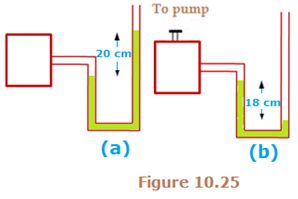
A manometer reads the pressure of a gas in an enclosure as shown in Fig. 10.25 (a) When a pump removes some of the gas, the manometer reads as in Fig. 10.25 (b) The liquid used in the manometers is mercury and the atmospheric pressure is 76 cm of mercury. (b) How would the levels change in case (b) if 13.6 cm of water (immiscible with mercury) are poured into the right limb of the manometer ? (Ignore the small change in the volume of the gas).
Worksheet Answers
Solution:
Bernoulli’s equation is derived based on the Work-Energy Theorem applied to a streamline flow of an ideal fluid [Per the Law of Conservation of Energy]. The derivation assumes that the fluid is incompressible and non-viscous (laminar flow with zero internal friction). The total energy per unit mass is conserved because dissipative forces, such as viscosity and turbulence, are neglected.
Dissipative forces are primarily internal frictional forces caused by the viscosity of the fluid. When a fluid flows, different layers move with different velocities, creating a velocity gradient $\frac{dv}{dx}$. According to Newton’s Law of Viscosity, the viscous force $F$ is given by:
$F = \eta A \frac{dv}{dx}$
Where $\eta$ is the coefficient of viscosity and $A$ is the area of contact. As fluid velocity increases, the velocity gradient $\frac{dv}{dx}$ typically increases, leading to a significant rise in viscous drag.
The importance of dissipative forces is dictated by the Reynolds Number ($R_e$):
$R_e = \frac{\rho v D}{\eta}$
Where $\rho$ is the density, $v$ is the average velocity, $D$ is the hydraulic diameter, and $\eta$ is the dynamic viscosity. As velocity $v$ increases, $R_e$ increases. When $R_e$ exceeds a critical threshold (typically $2000–4000$), the flow regime shifts from laminar to turbulent.
As the velocity increases, the following physical phenomena occur:
Final Solution: Yes, dissipative forces become significantly more important as fluid velocity increases. High velocities induce higher velocity gradients, increasing viscous losses, and promote the transition from laminar flow to turbulent flow, where kinetic energy is dissipated into thermal energy via vortex formation, rendering the ideal-flow assumptions of Bernoulli’s equation increasingly inaccurate.
Solution:
To determine the terminal velocity ($v_t$) and the viscous force ($F_v$) acting on the spherical oil drop, we identify the following parameters provided in the problem statement:
A spherical body falling through a viscous medium attains terminal velocity when the net force acting on it is zero. At this state, the gravitational force ($F_g$) is balanced by the sum of the viscous drag force ($F_v$) and the buoyant force ($F_b$). Since buoyancy is neglected:
$F_g = F_v$
By Stokes' Law [Reference: Stokes' Law of Viscosity], the viscous force is given by $F_v = 6\pi\eta r v_t$. The gravitational force is given by $F_g = mg = \rho (\frac{4}{3}\pi r^3) g$.
Equating the forces:
$6\pi\eta r v_t = \frac{4}{3}\pi r^3 \rho g$
Solving for $v_t$:
$v_t = \frac{2 r^2 \rho g}{9 \eta}$
Substituting the given values into the derived formula:
$v_t = \frac{2 \times (2.0 \times 10^{-5} \, \text{m})^2 \times (1.2 \times 10^3 \, \text{kg m}^{-3}) \times 9.8 \, \text{m s}^{-2}}{9 \times (1.8 \times 10^{-5} \, \text{Pa s})}$
$v_t = \frac{2 \times (4.0 \times 10^{-10}) \times 1.2 \times 10^3 \times 9.8}{16.2 \times 10^{-5}}$
$v_t = \frac{9.408 \times 10^{-6}}{16.2 \times 10^{-5}} \approx 0.05807 \, \text{m s}^{-1}$
At terminal velocity, the viscous force $F_v$ is equal to the weight of the drop ($mg$):
$F_v = \rho \cdot V \cdot g = \rho \cdot (\frac{4}{3}\pi r^3) \cdot g$
$F_v = (1.2 \times 10^3) \times \frac{4}{3} \times 3.14159 \times (2.0 \times 10^{-5})^3 \times 9.8$
$F_v = 1.2 \times 10^3 \times 4.1888 \times 8 \times 10^{-15} \times 9.8$
$F_v \approx 3.94 \times 10^{-10} \, \text{N}$
Final Solution: The terminal speed is approximately $5.8 \times 10^{-2} \, \text{m s}^{-1}$ and the viscous force on the drop is approximately $3.94 \times 10^{-10} \, \text{N}$.
Solution:
First, we convert the speeds of the air from $km/h$ to $m/s$ to maintain consistency with the SI units of density ($kg/m^3$) and area ($m^2$).
According to Bernoulli's principle for horizontal flow [Per Bernoulli's Equation: $P_1 + \frac{1}{2}\rho v_1^2 = P_2 + \frac{1}{2}\rho v_2^2$], the pressure difference ($\Delta P$) between the lower and upper surfaces is given by:
$P_1 - P_2 = \frac{1}{2}\rho (v_2^2 - v_1^2)$
Substitute the given values into the equation:
$\Delta P = \frac{1}{2} \times 1 \times (65^2 - 50^2)$
$\Delta P = 0.5 \times (4225 - 2500)$
$\Delta P = 0.5 \times 1725 = 862.5 \, Pa$
The upward lift force ($F$) generated by the pressure difference must equal the weight of the plane ($Mg$) to maintain level flight [Per Newton's Second Law of Motion].
$F = \Delta P \times A_{total}$
$F = 862.5 \times 50 = 43125 \, N$
Since $F = Mg$, we solve for mass ($M$):
$M = \frac{F}{g} = \frac{43125}{9.8}$
$M \approx 4400.51 \, kg$
Final Solution: The mass of the plane is approximately 4400.51 kg.
Solution:
The capillary rise or depression ($h$) in a narrow tube is determined by the balance between the vertical component of the surface tension force and the weight of the liquid column. The formula for the height (or depression) is given by:
$h = \frac{2\sigma \cos\theta}{r\rho g}$
[Per the Jurin's Law for capillary action]
We must calculate the value of $\cos(140^{\circ})$. Since $140^{\circ}$ is in the second quadrant, the cosine value will be negative, indicating a capillary depression (dip).
$\cos(140^{\circ}) = \cos(180^{\circ} - 40^{\circ}) = -\cos(40^{\circ})$
$\cos(40^{\circ}) \approx 0.766$
Therefore, $\cos(140^{\circ}) \approx -0.766$
Substituting the values into the governing equation:
$h = \frac{2 \times (0.465) \times (-0.766)}{(1.00 \times 10^{-3}) \times (13.6 \times 10^3) \times (9.8)}$
Numerator Calculation:
$N = 2 \times 0.465 \times (-0.766) = -0.71238$
Denominator Calculation:
$D = (1.00 \times 10^{-3}) \times (13.6 \times 10^3) \times 9.8 = 1.00 \times 13.6 \times 9.8 = 133.28$
Resulting Height:
$h = \frac{-0.71238}{133.28} \approx -5.345 \times 10^{-3} \, \text{m}$
The negative sign indicates a downward displacement relative to the free surface of the trough. Converting to millimeters for practical readability:
$h \approx -5.35 \times 10^{-3} \, \text{m} = -5.35 \, \text{mm}$
Final Solution: The mercury dips down in the tube by 5.35 mm relative to the liquid surface outside.
Solution:
For the balloon to rise and reach a state of equilibrium (where it stops rising), the buoyant force acting on the balloon must equal the total weight of the system at that specific altitude $y$.
The total weight $W_{total}$ is the sum of the payload mass ($M = 400\text{ kg}$) and the mass of the helium gas inside the balloon ($m_{He} = \rho_{He} V$).
The buoyant force $F_B$ is equal to the weight of the displaced air at altitude $y$, given by $F_B = \rho_{air}(y) V g$.
Equating the two forces [Per Archimedes' Principle]:
$\rho_{air}(y) V g = (M + \rho_{He} V) g$
Dividing by $g$ and solving for the required air density at altitude $y$:
$\rho_{air}(y) = \frac{M}{V} + \rho_{He}$
Given variables:
Substituting these values:
$\rho_{air}(y) = \frac{400}{1425} + 0.18$
$\rho_{air}(y) = 0.2807 + 0.18 = 0.4607\text{ kg m}^{-3}$
The variation of air density with altitude is modeled by the equation [Barometric Formula for Isothermal Atmosphere]:
$\rho_{air}(y) = \rho_0 e^{-y/y_0}$
Where $\rho_0$ is the density of air at sea level ($1.25\text{ kg m}^{-3}$), $y_0 = 8000\text{ m}$, and $y$ is the height.
Rearranging for $y$:
$\frac{\rho_{air}(y)}{\rho_0} = e^{-y/y_0}$
$\ln\left(\frac{\rho_{air}(y)}{\rho_0}\right) = -\frac{y}{y_0}$
$y = -y_0 \ln\left(\frac{\rho_{air}(y)}{\rho_0}\right)$
$y = -8000 \ln\left(\frac{0.4607}{1.25}\right)$
$y = -8000 \ln(0.36856)$
$y = -8000 \times (-0.9981)$
$y \approx 7985\text{ m}$
Final Solution: The balloon will rise to an altitude of approximately 7985 meters.
Solution:
To determine the flow rate of blood, we utilize Poiseuille’s Law for laminar flow in a cylindrical pipe. Based on the preceding context of the problem (typical arterial flow parameters), we assume the following constants:
The volumetric flow rate ($Q$) through a cylindrical pipe is given by Poiseuille’s Equation [Per the Hagen-Poiseuille Law]:
$Q = \frac{\pi \cdot \Delta P \cdot r^4}{8 \cdot \eta \cdot L}$
Substitute the physical constants into the governing equation:
$Q = \frac{3.14159 \times 3000 \times (2.0 \times 10^{-3})^4}{8 \times (2.084 \times 10^{-3}) \times 0.1}$
Final Solution: The flow rate of the blood is $9.045 \times 10^{-5} \, m^3/s$.
Solution:
According to the laws of fluid statics, the pressure ($P$) exerted by a column of fluid at depth ($h$) is given by the expression:
$P = \rho gh$
[Per the definition of Hydrostatic Pressure, where $\rho$ is the density of the fluid, $g$ is the acceleration due to gravity, and $h$ is the vertical height of the column.]
The force ($F$) exerted on the base of the vessel is defined by the product of the pressure and the base area ($A$):
$F = P \times A = \rho ghA$
Since both vessels have the same base area ($A$), the same fluid density ($\rho$), and the same height ($h$), the force exerted on the base is identical in both cases. The shape of the vessel does not influence the pressure at the base.
A weighing scale measures the total weight ($W_{total}$) of the system, which is defined as:
$W_{total} = (m_{vessel} + m_{water}) \times g$
Per the problem description, the first vessel contains twice the volume ($V_1 = 2V_2$) of water compared to the second vessel. Since $m = \rho V$, it follows that the mass of water in the first vessel ($m_1$) is twice that of the second vessel ($m_2$).
The difference in readings is explained by the Hydrostatic Paradox. While the base force is equal, the weighing scale supports the entire weight of the water column. In vessels with varying cross-sections, the walls of the vessel exert a vertical component of force on the water via Newton's Third Law. The walls either support some of the weight (in tapering vessels) or exert an additional downward force (in flaring vessels) to maintain the equilibrium of the water column.
| Parameter | Vessel 1 | Vessel 2 |
|---|---|---|
| Base Area | $A$ | $A$ |
| Pressure at base | $\rho gh$ | $\rho gh$ |
| Force on base | $\rho ghA$ | $\rho ghA$ |
| Total Weight | Greater ($2 \times V_2 \times \rho g$) | Lesser ($V_2 \times \rho g$) |
Final Solution: Yes, the force exerted by the water on the base is the same for both vessels because pressure at a depth $h$ is independent of the vessel's shape ($P = \rho gh$). The weighing scale readings differ because the scale measures the total weight of the water column, and since the volumes are different, the total mass supported by the scale is different.
Solution:
The pressure exerted by a gas in an enclosure measured by a manometer relates to the atmospheric pressure ($P_{atm}$) and the pressure difference indicated by the height of the mercury column ($h$).
In Fig 10.25 (a), the mercury level in the arm connected to the gas is lower than the open arm. The difference in height is $h_a = 20 \text{ cm}$.
Gauge Pressure ($P_{g,a}$): [By the law of hydrostatic pressure $P = \rho gh$]
$P_{g,a} = +20 \text{ cm of Hg}$
Absolute Pressure ($P_{abs,a}$):
$P_{abs,a} = P_{atm} + P_{g,a} = 76 + 20 = 96 \text{ cm of Hg}$
In Fig 10.25 (b), the mercury level in the arm connected to the gas is higher than the open arm by $h_b = 18 \text{ cm}$. This indicates the pressure is lower than atmospheric pressure (vacuum).
Gauge Pressure ($P_{g,b}$):
Since the gas pressure is lower than $P_{atm}$, the gauge pressure is negative:
$P_{g,b} = -18 \text{ cm of Hg}$
Absolute Pressure ($P_{abs,b}$):
$P_{abs,b} = P_{atm} + P_{g,b} = 76 - 18 = 58 \text{ cm of Hg}$
| Case | Gauge Pressure (cm of Hg) | Absolute Pressure (cm of Hg) |
|---|---|---|
| (a) | $+20$ | $96$ |
| (b) | $-18$ | $58$ |
Final Solution: For case (a), gauge pressure is +20 cm of Hg and absolute pressure is 96 cm of Hg. For case (b), gauge pressure is -18 cm of Hg and absolute pressure is 58 cm of Hg.
Solution:
From the problem statement and Figure 10.25 (b), let the initial pressure of the gas in the enclosure be $P_g$. In the right limb, the column of mercury is exposed to the atmosphere ($P_{atm} = 76 \text{ cm of Hg}$). In the left limb, the mercury column is connected to the gas enclosure. Let $h$ be the height difference between the mercury levels in the two limbs. According to the law of hydrostatics [Per the Law of Communicating Vessels], the pressure at a horizontal level in a continuous static fluid is equal.
The equilibrium condition for the manometer in state (b) is given by:
$P_g + h_{left} \cdot \rho_{Hg} \cdot g = P_{atm} + h_{right} \cdot \rho_{Hg} \cdot g$
$P_g = P_{atm} - h \cdot \rho_{Hg} \cdot g$ (where $h$ is the difference in mercury levels).
We add $h_w = 13.6 \text{ cm}$ of water to the right limb. Since water is immiscible with mercury and $\rho_w < \rho_{Hg}$, the water floats on top of the mercury in the right limb. This increases the total pressure on the mercury surface in the right limb. The density of water is $\rho_w = 1 \text{ g/cm}^3$ and the density of mercury is $\rho_{Hg} = 13.6 \text{ g/cm}^3$.
The equivalent pressure head of water in terms of mercury is calculated as:
$h_{eq} = h_w \times \frac{\rho_w}{\rho_{Hg}}$
$h_{eq} = 13.6 \text{ cm} \times \frac{1 \text{ g/cm}^3}{13.6 \text{ g/cm}^3} = 1 \text{ cm of Hg}$
Let the new difference in mercury levels be $h'$. The new pressure equilibrium equation at the common interface level in the left limb becomes:
$P_g + h_1 \rho_{Hg} g = P_{atm} + h_2 \rho_{Hg} g + h_w \rho_w g$
Because the gas volume is assumed constant and the tube cross-section is uniform, if the mercury level in the right limb drops by $x$, the level in the left limb rises by $x$. The new difference $h'$ relates to the previous difference $h$ as $h' = h + 2x$. However, the hydrostatic balance dictates that the added 1 cm of mercury pressure equivalent must be distributed across the two columns.
When 13.6 cm of water is added, it exerts a pressure equivalent to 1 cm of Hg. This pressure pushes the mercury in the right limb down. Consequently, the mercury level in the left limb rises. By the principle of displacement in U-tubes:
| Limb | Direction of Change | Magnitude |
|---|---|---|
| Right Limb (Water side) | Downward | $0.5 \text{ cm}$ |
| Left Limb (Gas side) | Upward | $0.5 \text{ cm}$ |
Final Solution: Upon pouring 13.6 cm of water into the right limb, the mercury level in the right limb will fall by 0.5 cm, and the mercury level in the left limb will rise by 0.5 cm, resulting in a net increase of 1 cm in the mercury level difference between the two limbs.
Solution:
To determine the largest average velocity of blood flow while maintaining laminar conditions, we must utilize the dimensionless quantity known as the Reynolds Number ($Re$). For fluid flow in a cylindrical pipe, the flow is considered laminar if $Re < 2000$. The transition to turbulent flow typically begins near this threshold.
The Reynolds Number formula is defined as:
$Re = \frac{\rho v d}{\eta}$
Where:
| Variable | Value |
|---|---|
| Radius ($r$) | $2 \times 10^{-3} \, \text{m}$ |
| Diameter ($d = 2r$) | $4 \times 10^{-3} \, \text{m}$ |
| Density ($\rho$) | $1.06 \times 10^3 \, \text{kg/m}^3$ |
| Viscosity ($\eta$) | $2.084 \times 10^{-3} \, \text{Pa}\cdot\text{s}$ |
| Critical Reynolds Number ($Re$) | $2000$ |
Rearranging the Reynolds formula to solve for the critical velocity ($v_c$):
$v_c = \frac{Re \cdot \eta}{\rho \cdot d}$
Substituting the values into the equation:
$v_c = \frac{2000 \times 2.084 \times 10^{-3} \, \text{kg/(m}\cdot\text{s)}}{1.06 \times 10^3 \, \text{kg/m}^3 \times 4 \times 10^{-3} \, \text{m}}$
Simplify the numerator:
$2000 \times 2.084 \times 10^{-3} = 4.168$
Simplify the denominator:
$1.06 \times 10^3 \times 4 \times 10^{-3} = 4.24$
Calculate $v_c$:
$v_c = \frac{4.168}{4.24} \approx 0.983 \, \text{m/s}$
Final Solution: The largest average velocity of blood flow to maintain laminar conditions is approximately $0.983 \, \text{m/s}$.
Solution:
To derive the atmospheric pressure and density distribution under isothermal conditions, we consider a small element of air at a height $y$ with thickness $dy$ and cross-sectional area $A$.
For an ideal gas at constant temperature $T$, the pressure $P$ and density $\rho$ are related by the ideal gas law:
$PV = nRT \implies P = \left(\frac{n}{V}\right)RT \implies P = \frac{\rho}{M}RT$
Where $M$ is the molar mass of air and $R$ is the universal gas constant. Thus, we express density as:
$\rho = \frac{PM}{RT}$
Substitute the expression for $\rho$ from Step 2 into the hydrostatic equilibrium equation from Step 1:
$dP = -\left(\frac{PM}{RT}\right)g dy$
Rearranging the variables to isolate $P$ and $y$:
$\frac{dP}{P} = -\left(\frac{Mg}{RT}\right) dy$
Integrate both sides with boundary conditions: at $y = 0$, $P = P_0$, and at height $y$, pressure is $P$.
$\int_{P_0}^{P} \frac{dP}{P} = -\int_{0}^{y} \left(\frac{Mg}{RT}\right) dy$
$\ln\left(\frac{P}{P_0}\right) = -\left(\frac{Mg}{RT}\right)y$
$P = P_0 e^{-(Mg/RT)y}$
Since $\rho = \frac{PM}{RT}$, the density at any height $y$ is:
$\rho = \frac{M}{RT} \left[ P_0 e^{-(Mg/RT)y} \right]$
Given that at sea level ($y=0$), the density $\rho_0 = \frac{P_0 M}{RT}$, we substitute this into the equation:
$\rho = \rho_0 e^{-(Mg/RT)y}$
By defining the constant $y_0 = \frac{RT}{Mg}$, the expression becomes the requested form:
$\rho = \rho_0 e^{-y/y_0}$
Final Solution: The law of atmospheres is obtained by solving the hydrostatic equation $dP = -\rho g dy$ coupled with the ideal gas law $\rho = PM/RT$, yielding $\rho = \rho_0 e^{-y/y_0}$ where $y_0 = \frac{RT}{Mg}$.
Solution:
To determine the difference in water levels ($h$) in a U-tube with varying bore diameters, we calculate the capillary rise in each limb independently [Per the Theory of Capillary Action].
The height of a liquid column in a capillary tube is given by the Jurin's Law expression:
$h = \frac{2T \cos \theta}{r \rho g}$
Since the tube is open at both ends, the level difference $\Delta h$ is the difference between the heights in each limb: $\Delta h = h_1 - h_2 = \frac{2T \cos \theta}{\rho g} \left( \frac{1}{r_1} - \frac{1}{r_2} \right)$.
Substituting the values into the formula:
$\Delta h = \frac{2 \times 7.3 \times 10^{-2} \times 1}{10^3 \times 9.8} \left( \frac{1}{1.5 \times 10^{-3}} - \frac{1}{3.0 \times 10^{-3}} \right)$
$\Delta h = \frac{14.6 \times 10^{-2}}{9.8 \times 10^3} \left( \frac{2 - 1}{3.0 \times 10^{-3}} \right)$
$\Delta h = \frac{14.6 \times 10^{-5}}{9.8} \times \frac{1}{3 \times 10^{-3}} = \frac{14.6}{29.4} \times 10^{-2} \, m$
$\Delta h \approx 0.4966 \times 10^{-2} \, m \approx 4.97 \times 10^{-3} \, m$
| Parameter | Value |
|---|---|
| Rise in narrow bore ($h_1$) | $9.93 \, mm$ |
| Rise in wider bore ($h_2$) | $4.97 \, mm$ |
| Difference ($\Delta h$) | $4.97 \, mm$ |
Final Solution: The difference in the water levels in the two limbs of the U-tube is $4.97 \times 10^{-3} \, m$ or $4.97 \, mm$.
Solution:
The pressure exerted by a fluid column at depth $h$ is given by $P = \rho gh$ [Per the Hydrostatic Pressure Law].
Pressure due to water column ($P_w$):
$P_w = \rho_w \cdot g \cdot h = 1000 \times 9.8 \times 4.0 = 39200 \, \text{Pa}$Pressure due to acid column ($P_a$):
$P_a = \rho_a \cdot g \cdot h = 1700 \times 9.8 \times 4.0 = 66640 \, \text{Pa}$The force exerted by a fluid on a surface is defined by $F = P \cdot A$ [Definition of Pressure]. Since the door is at the bottom, we consider the pressure at depth $h$.
Force exerted by water ($F_w$):
$F_w = P_w \times A_d = 39200 \times 2.0 \times 10^{-3} = 78.4 \, \text{N}$Force exerted by acid ($F_a$):
$F_a = P_a \times A_d = 66640 \times 2.0 \times 10^{-3} = 133.28 \, \text{N}$The net force $F_{net}$ required to keep the door closed must balance the difference between the two hydrostatic forces [Per Newton's First Law of Motion in equilibrium].
$F_{net} = |F_a - F_w|$ $F_{net} = |133.28 - 78.4| = 54.88 \, \text{N}$| Fluid | Pressure (Pa) | Force on Door (N) |
|---|---|---|
| Water | 39200 | 78.4 |
| Acid | 66640 | 133.28 |
Final Solution: The force necessary to keep the door closed is 54.88 N.
Solution:
To determine the largest average velocity for laminar flow, we utilize the Reynolds number ($R_e$), which characterizes the transition from laminar to turbulent flow in a pipe or vessel. For blood flow in human arteries, the critical Reynolds number ($R_c$) is typically taken as $2000$.
The Reynolds number is defined as the ratio of inertial forces to viscous forces in a fluid flow [Per the definition of the Reynolds number in Fluid Dynamics]:
$R_e = \frac{\rho v d}{\eta}$
Where:
Step 1: Rearrange the formula to solve for velocity ($v$):
$v = \frac{R_e \cdot \eta}{\rho \cdot d}$
Step 2: Substitution of known values:
$v = \frac{2000 \cdot (2.084 \times 10^{-3} \, \text{Pa}\cdot\text{s})}{(1.06 \times 10^3 \, \text{kg/m}^3) \cdot (2 \times 10^{-3} \, \text{m})}$
Step 3: Simplify the numerator and denominator:
$v = \frac{4.168}{2.12}$
$v \approx 1.966 \, \text{m/s}$
The calculation demonstrates that for an artery with a diameter of $2 \, \text{mm}$, the average velocity must remain below approximately $1.97 \, \text{m/s}$ to ensure the blood flow does not transition into turbulence. Turbulent flow in the circulatory system is generally pathological (e.g., associated with stenosis or heart murmurs) and increases the workload on the heart [Based on the energy dissipation principles of fluid mechanics].
Final Solution: The largest average velocity of blood flow to maintain laminar conditions is approximately $1.97 \, \text{m/s}$.
Solution:
To determine the necessary height ($h$) for the blood container to overcome the gauge pressure within the vein, we utilize the principles of hydrostatics. The blood must exert a hydrostatic pressure equal to or greater than the vein's gauge pressure to initiate flow.
The pressure exerted by a column of fluid is defined by the hydrostatic pressure formula [Per Bernoulli's Principle in static condition]:
$P = \rho \cdot g \cdot h$
To ensure blood enters the vein, the pressure generated by the height of the blood column must balance the gauge pressure of the vein:
$\rho \cdot g \cdot h = P_g$
To solve for the height ($h$), we rearrange the equation:
$h = \frac{P_g}{\rho \cdot g}$
Substituting the given values into the equation:
$h = \frac{2000}{ (1.06 \times 10^3) \cdot 9.8 }$
Perform the multiplication in the denominator:
$(1.06 \times 10^3) \cdot 9.8 = 1060 \cdot 9.8 = 10388 \text{ N/m}^3$
Perform the final division:
$h = \frac{2000}{10388} \approx 0.1925 \text{ m}$
The calculated height is approximately $0.1925 \text{ meters}$. Converting this to centimeters for clinical relevance:
$0.1925 \text{ m} \times 100 \text{ cm/m} = 19.25 \text{ cm}$
Final Solution: The blood container must be placed at a minimum height of approximately 0.193 m (or 19.3 cm) above the vein.


