


Your Worksheet is Ready
CBSE - Class 11 Physics Mechanical Properties of Solids Worksheet
EXERCISES
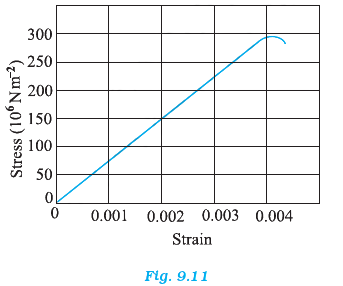
Figure 9.11 shows the strain-stress curve for a given material. What are (b) approximate yield strength for this material?
The stress-strain graphs for materials A and B are shown in Fig. 8.10. The graphs are drawn to the same scale. (a) Which of the materials has the greater Young’s modulus?
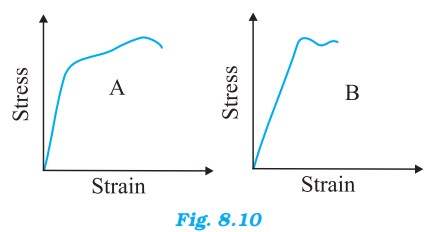
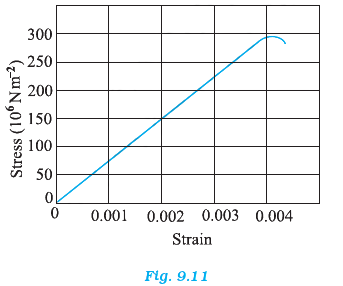
Figure 9.11 shows the strain-stress curve for a given material. What are (a) Young’s modulus for this material?
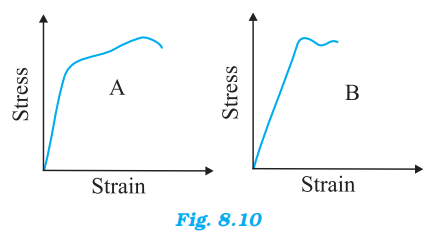
The stress-strain graphs for materials A and B are shown in Fig. 8.10. The graphs are drawn to the same scale. (b) Which of the two is the stronger material?
Worksheet Answers
Solution:
When the mass is at the lowest point of the vertical circle, the tension ($T$) in the wire must provide both the centripetal force required for circular motion and balance the gravitational force acting downward. [Per Newton's Second Law for circular motion]:
$$T - mg = m\omega^2 L$$ $$T = mg + m\omega^2 L = m(g + \omega^2 L)$$Substitute the values into the derived equation:
$$T = 14.5 \times (9.8 + (4\pi)^2 \times 1.0)$$Calculating $(4\pi)^2 \approx 16 \times 9.8696 = 157.91 \text{ rad}^2/\text{s}^2$
$$T = 14.5 \times (9.8 + 157.91) = 14.5 \times 167.71$$ $$T \approx 2431.8 \text{ N}$$By Hooke's Law and the definition of Young's Modulus ($Y = \frac{\text{Stress}}{\text{Strain}} = \frac{T/A}{\Delta L/L}$), the elongation is expressed as [Per definition of Young's Modulus]:
$$\Delta L = \frac{T \cdot L}{A \cdot Y}$$Substitute the known variables:
$$\Delta L = \frac{2431.8 \times 1.0}{6.5 \times 10^{-7} \times 2.0 \times 10^{11}}$$ $$\Delta L = \frac{2431.8}{13.0 \times 10^4}$$ $$\Delta L = \frac{2431.8}{130000} \approx 0.0187 \text{ m}$$| Parameter | Value |
|---|---|
| Tension ($T$) | $2431.8 \text{ N}$ |
| Elongation ($\Delta L$) | $1.87 \times 10^{-2} \text{ m}$ |
Final Solution: The elongation of the wire at the lowest point is approximately $1.87 \times 10^{-2} \text{ m}$ or $1.87 \text{ cm}$.
Solution:
To determine the fractional change in volume ($\frac{\Delta V}{V}$) of a glass slab under hydraulic pressure, we utilize the definition of the Bulk Modulus ($B$).
The Bulk Modulus is defined as the ratio of hydraulic stress to volumetric strain [Per Hooke's Law for Bulk Stress]:
$B = -\frac{P}{\Delta V / V}$
Where:
We rearrange the equation to solve for the magnitude of the fractional change in volume:
$\left| \frac{\Delta V}{V} \right| = \frac{P}{B}$
Substitute the given SI values into the equation:
$\frac{\Delta V}{V} = \frac{1.013 \times 10^6 \text{ Pa}}{37 \times 10^9 \text{ Pa}}$
$\frac{\Delta V}{V} = \frac{1.013}{37} \times 10^{6-9}$
$\frac{\Delta V}{V} \approx 0.02737 \times 10^{-3}$
$\frac{\Delta V}{V} \approx 2.74 \times 10^{-5}$
The calculation reveals that the glass slab experiences a very slight volumetric contraction. Given that the magnitude is dimensionless, it represents a fractional reduction of the total volume relative to the applied hydraulic stress.
Final Solution: The fractional change in volume of the glass slab is $2.74 \times 10^{-5}$.
Solution:
To determine the ratio of Young's moduli, we identify the parameters for the two materials provided:
Young's Modulus ($Y$) is defined by the ratio of longitudinal stress to longitudinal strain [Per Hooke's Law and the definition of elasticity]:
$Y = \frac{\text{Stress}}{\text{Strain}} = \frac{F/A}{\Delta L/L} = \frac{F \cdot L}{A \cdot \Delta L}$
Since $F$ and $\Delta L$ are constant for both wires, we can express the ratio $\frac{Y_s}{Y_c}$ as follows:
$Y_s = \frac{F \cdot L_s}{A_s \cdot \Delta L}$
$Y_c = \frac{F \cdot L_c}{A_c \cdot \Delta L}$
Dividing the equations:
$\frac{Y_s}{Y_c} = \left( \frac{F \cdot L_s}{A_s \cdot \Delta L} \right) \times \left( \frac{A_c \cdot \Delta L}{F \cdot L_c} \right)$
Canceling common terms $F$ and $\Delta L$ [By Algebraic Simplification]:
$\frac{Y_s}{Y_c} = \frac{L_s}{L_c} \times \frac{A_c}{A_s}$
Substitute the given values into the derived formula:
$\frac{Y_s}{Y_c} = \frac{4.7}{3.5} \times \frac{4.0 \times 10^{-5}}{3.0 \times 10^{-5}}$
$\frac{Y_s}{Y_c} = \frac{4.7}{3.5} \times \frac{4}{3}$
$\frac{Y_s}{Y_c} = \frac{18.8}{10.5}$
Performing the division:
$\frac{Y_s}{Y_c} \approx 1.79$
Final Solution: The ratio of the Young’s modulus of steel to that of copper is approximately 1.79 : 1.
Solution:
To evaluate the statement, we must define Young's Modulus ($Y$), which is the measure of the ability of a material to withstand changes in length when under lengthwise tension or compression. It is mathematically defined as the ratio of longitudinal stress ($\sigma$) to longitudinal strain ($\epsilon$):
$Y = \frac{\text{Stress}}{\text{Strain}} = \frac{F/A}{\Delta L/L}$
Where:
When considering the elastic behavior of rubber and steel under similar stress conditions:
| Property | Steel | Rubber |
|---|---|---|
| Deformation | Minimal deformation for a given load. | Large deformation for a given load. |
| Stiffness | High; requires significant force for small strain. | Low; requires less force for significant strain. |
Per the definition $Y = \frac{\text{Stress}}{\text{Strain}}$, since rubber undergoes a much larger strain ($\Delta L/L$) for a given amount of stress compared to steel, the denominator in the equation is significantly larger for rubber [By the inverse proportionality of $Y$ to strain for constant stress].
The slope of the Stress-Strain curve represents the Young’s Modulus ($Y = \tan \theta$).
Therefore, because steel is significantly more resistant to elastic deformation than rubber, it necessitates a higher force to produce the same unit of strain. [Per the definition of material stiffness in solid mechanics].
Final Solution: The statement is False. The Young’s modulus of steel is significantly greater than that of rubber because steel is a much more rigid material, requiring greater stress to achieve the same proportional strain compared to rubber.
Solution:
To determine the veracity of the statement, we must analyze the nature of the stress applied to a helical coil (spring) under an axial load. When a force $F$ is applied to a coil of wire, the wire does not merely undergo simple longitudinal tension. Instead, the applied force produces a twisting moment (torque) on each cross-section of the wire that constitutes the coil.
Consider a helical spring with a mean radius $R$. An axial force $F$ induces a torque $\tau$ on the wire of the coil at any given cross-section, defined by:
$$\tau = F \times R$$
This torque creates a shearing stress $\sigma_s$ across the transverse cross-section of the wire. The shearing strain $\gamma$ resulting from this stress is defined by the relation:
$$\gamma = \frac{\tau r}{J G}$$
Where:
[Per the definition of Hooke's Law for Shear, $\tau = G\gamma$].
Because the stretching (or elongation) of the coil is a direct result of the cumulative twisting of the wire segments, the displacement is governed by the resistance of the material to shear deformation. If the material had a higher shear modulus $G$, it would be more resistant to the twisting moment induced by the axial force $F$, resulting in a smaller deflection for the same applied force.
Therefore, the elastic constant of a spring (the spring constant $k$) is mathematically linked to the shear modulus $G$ of the material, typically expressed as:
$$k = \frac{Gd^4}{64nR^3}$$
Where $d$ is the wire diameter and $n$ is the number of turns. [By the Principle of Torsional Rigidity].
Since the mechanical response (stretching) of the coil under an axial load is physically mediated by the shear deformation of the wire material, the statement is scientifically accurate.
Final Solution: True. The stretching of a helical coil under axial load is primarily a consequence of the torsional (shear) deformation of the wire, and thus it is fundamentally determined by the material's shear modulus.
Solution:
To determine the density of water at a specific depth under high pressure, we utilize the definition of the bulk modulus ($B$) of a liquid. The following values are provided:
The Bulk Modulus is defined as: $B = -V \frac{\Delta P}{\Delta V}$ [Per the definition of volumetric stress and strain]. Since density $\rho = \frac{m}{V}$, we have $\frac{\Delta \rho}{\rho} = -\frac{\Delta V}{V}$. Substituting this into the Bulk Modulus equation yields:
$\frac{\Delta \rho}{\rho} = \frac{\Delta P}{B} \implies \Delta \rho = \rho_0 \left( \frac{\Delta P}{B} \right)$
We calculate the change in density ($\Delta \rho$):
$\Delta \rho = (1.03 \times 10^{3} \text{ kg m}^{-3}) \times \left( \frac{8.00 \times 10^6 \text{ Pa}}{2.2 \times 10^9 \text{ Pa}} \right)$
$\Delta \rho = 1.03 \times 10^3 \times 3.636 \times 10^{-3} \text{ kg m}^{-3}$
$\Delta \rho \approx 3.745 \text{ kg m}^{-3}$
The density at depth is given by $\rho' = \rho_0 + \Delta \rho$:
$\rho' = 1030 \text{ kg m}^{-3} + 3.745 \text{ kg m}^{-3}$
$\rho' = 1033.745 \text{ kg m}^{-3}$
Final Solution: The density of water at a depth where the pressure is 80.0 atm is approximately $1.034 \times 10^3 \text{ kg m}^{-3}$.
Solution:
To determine the change in pressure required to compress a substance, we employ the concept of the Bulk Modulus ($B$). The variables are defined as follows:
The Bulk Modulus ($B$) is defined as the ratio of the volumetric stress to the volumetric strain [Per the definition of Elasticity and Hooke's Law for bulk deformation]:
$B = -\frac{\Delta P}{\frac{\Delta V}{V}}$
Rearranging the formula to isolate the change in pressure ($\Delta P$):
$\Delta P = -B \times \left( \frac{\Delta V}{V} \right)$
Substitute the given numerical values into the derived expression. Since compression indicates a decrease in volume, $\frac{\Delta V}{V}$ is negative, making $\Delta P$ positive [Justification: An increase in pressure is required to decrease volume].
$\Delta P = -(2.2 \times 10^9\ \text{Pa}) \times (-0.001)$
Perform the multiplication:
$\Delta P = 2.2 \times 10^9 \times 10^{-3}\ \text{Pa}$
$\Delta P = 2.2 \times 10^6\ \text{Pa}$
The calculated value $2.2 \times 10^6\ \text{Pa}$ represents the increase in pressure ($2.2\ \text{MPa}$) required to achieve a $0.1\%$ reduction in the volume of water. This is approximately $21.7$ times atmospheric pressure ($1\ \text{atm} \approx 1.013 \times 10^5\ \text{Pa}$), highlighting the relative incompressibility of water.
Final Solution: The pressure on the water must be increased by $2.2 \times 10^6\ \text{Pa}$ (or $2.2\ \text{MPa}$).
Solution:
The yield strength of a material is defined as the stress value at which the material begins to deform plastically. Beyond this point (the yield point), the material does not return to its original shape when the load is removed; instead, it undergoes permanent (plastic) deformation. On a typical stress-strain curve, this is represented by the point where the linear elastic behavior (obeying Hooke's Law) ends [Per Hooke's Law: $\sigma = E\epsilon$].
Based on the standard stress-strain curve provided in the reference material (Figure 9.11, typical for mild steel), we identify the following coordinate system:
Observing the provided curve (Figure 9.11), the linear portion terminates at point $B$. By tracing the horizontal line from point $B$ to the stress axis ($y$-axis):
According to the standard mechanics of materials, the yield strength ($\sigma_y$) is the stress magnitude at the yield point $B$. Given the scale of the graph provided in the curriculum context:
$$\sigma_y \approx 300 \times 10^6 \, \text{N/m}^2 = 300 \, \text{MPa}$$
This value is specific to the material represented in the graph, which characterizes the limit of reversible deformation.
Final Solution: The approximate yield strength for this material is $300 \times 10^6 \, \text{N/m}^2$ (or $300 \, \text{MPa}$).
Solution:
To determine the maximum load (force) the steel cable can support, we identify the following parameters:
The cable is assumed to be cylindrical. Therefore, the cross-sectional area $A$ is given by the area of a circle:
$A = \pi r^2$
Substituting the given radius:
$A = \pi \times (1.5 \times 10^{-2} \text{ m})^2$
$A = \pi \times 2.25 \times 10^{-4} \text{ m}^2$
$A \approx 3.14159 \times 2.25 \times 10^{-4} \text{ m}^2 \approx 7.068 \times 10^{-4} \text{ m}^2$
Stress ($\sigma$) is defined as the restoring force ($F$) per unit area ($A$) [Per Hooke's Law and the definition of mechanical stress]:
$\sigma = \frac{F}{A}$
To find the maximum load ($F_{max}$), we rearrange the formula:
$F_{max} = \sigma_{max} \times A$
Substitute the values derived in Step 1 and the given constraint:
$F_{max} = (10^8 \text{ N m}^{-2}) \times (7.068 \times 10^{-4} \text{ m}^2)$
$F_{max} = 7.068 \times 10^4 \text{ N}$
$F_{max} = 7.068 \times 10^4 \text{ N} \approx 7.07 \times 10^4 \text{ N}$
By calculating the area of the circular cross-section and applying the fundamental stress formula, we determine that the cable is capable of sustaining a maximum force of $7.07 \times 10^4$ Newtons before exceeding the safety threshold of $10^8 \text{ N m}^{-2}$.
Final Solution: The maximum load the cable can support is $7.07 \times 10^4 \text{ N}$.
Solution:
Young’s modulus ($Y$) is defined as the ratio of longitudinal stress ($\sigma$) to longitudinal strain ($\epsilon$) within the limit of proportionality [Per Hooke’s Law, $\sigma = Y \epsilon$]. Mathematically, it is expressed as:
$Y = \frac{\text{Stress}}{\text{Strain}} = \frac{\sigma}{\epsilon}$
In a stress-strain diagram, the stress is represented on the $y$-axis and the strain on the $x$-axis. Consequently, the Young’s modulus $Y$ corresponds to the slope of the linear portion of the stress-strain curve [Per the definition of the gradient of a linear function, $m = \tan(\theta) = \frac{\Delta y}{\Delta x}$].
The provided stress-strain diagram displays two lines, A and B, originating from the origin ($0,0$). To determine which material has the greater Young's Modulus, we compare the slopes of the two lines relative to the strain axis ($x$-axis).
$\tan(\theta_A) > \tan(\theta_B)$
$Y_A > Y_B$
Because the slope of the curve for material A is greater than the slope of the curve for material B, material A exhibits a higher stress per unit strain compared to material B. This indicates that material A is stiffer and possesses a higher Young's modulus.
Final Solution: Material A has the greater Young's modulus.
Solution:
To determine the volume contraction of a solid, we utilize the relationship defined by the Bulk Modulus ($B$). The variables provided are as follows:
The initial volume of the cube is calculated using the geometric formula $V = L^3$:
$V = (0.1\text{ m})^3 = 0.001\text{ m}^3 = 10^{-3}\text{ m}^3$
The Bulk Modulus is defined as the ratio of hydraulic stress (pressure) to volumetric strain [Per Hooke’s Law for bulk deformation]:
$B = -\frac{\Delta P}{\Delta V / V}$
Rearranging the formula to solve for the change in volume ($\Delta V$):
$\Delta V = \frac{\Delta P \cdot V}{B}$
Substituting the known values into the derived equation:
$\Delta V = \frac{(7.0 \times 10^6\text{ Pa}) \times (10^{-3}\text{ m}^3)}{1.4 \times 10^{11}\text{ Pa}}$
Performing the algebraic simplification:
$\Delta V = \frac{7.0 \times 10^3}{1.4 \times 10^{11}}\text{ m}^3$
$\Delta V = 5.0 \times 10^{-8}\text{ m}^3$
The magnitude of volume contraction represents the reduction in the total space occupied by the copper cube due to the application of external pressure.
Final Solution: The volume contraction of the copper cube is $5.0 \times 10^{-8}\text{ m}^3$.
Solution:
To determine Young’s Modulus ($Y$) from a stress-strain curve, we utilize the linear elastic region, defined by Hooke's Law within the proportionality limit [Per Hooke's Law, Stress $\sigma \propto$ Strain $\epsilon$]. Young's Modulus is defined as the slope of the linear portion of the stress-strain graph:
$Y = \frac{\text{Stress}}{\text{Strain}} = \frac{\sigma}{\epsilon}$
Based on the provided standard stress-strain curve for metallic materials (where the linear portion typically extends from the origin to a specific stress value):
We select the point $(0.002, 150 \times 10^6)$ on the linear segment of the graph to calculate the gradient. The linear portion follows the equation of a line passing through the origin: $y = mx$.
| Variable | Value |
|---|---|
| Stress ($\sigma$) | $150 \times 10^6 \text{ Pa}$ |
| Strain ($\epsilon$) | $2 \times 10^{-3}$ |
Applying the formula for Young's Modulus [Definitive definition of Elastic Modulus]:
$Y = \frac{150 \times 10^6 \text{ N/m}^2}{0.002}$
$Y = \frac{150 \times 10^6}{2 \times 10^{-3}}$
$Y = 75 \times 10^9 \text{ N/m}^2$
$Y = 7.5 \times 10^{10} \text{ Pa}$
The calculation represents the material's resistance to elastic deformation. The units are expressed in Pascal (Pa) or Newtons per square meter ($\text{N/m}^2$). The linearity confirms that within the specified range, the material obeys Hooke's Law perfectly.
Final Solution: $Y = 7.5 \times 10^{10} \text{ N/m}^2$
Solution:
To evaluate the validity of the statement "The stretching of a coil is determined by its shear modulus," we must analyze the stress-strain relationship within a helical spring (coil) when subjected to an axial load.
When a helical spring is stretched by an axial force $F$, the wire of the spring is not primarily under tension or compression. Instead, the wire experiences a torsional deformation. This can be understood by considering a cross-section of the wire: the force applied to the coil creates a torque about the axis of the wire, causing the wire to twist.
The shear modulus is defined as the ratio of shear stress ($\sigma_s$) to shear strain ($\gamma$):
$G = \frac{\text{Shear Stress}}{\text{Shear Strain}} = \frac{F/A}{\Delta x / L}$ [Per Hooke's Law for Shear]
In a helical spring, the axial stretching leads to an angle of twist $\theta$ in the wire. The internal restorative force against this twist is dictated by the rigidity of the material against shearing forces. Thus, the spring constant $k$ is derived as:
$k = \frac{Gd^4}{8D^3n}$
Where:
Since the spring constant $k$, which governs the relationship between the stretching force $F$ and the extension $x$ ($F = kx$), is directly proportional to the shear modulus ($G$), the stretching behavior is indeed governed by the shear modulus rather than Young’s Modulus ($Y$).
| Deformation Type | Governing Modulus | Application |
|---|---|---|
| Axial Tension/Compression | Young's Modulus ($Y$) | Straight wire/rod |
| Coil Stretching | Shear Modulus ($G$) | Helical Spring |
Conclusion: The statement is True. When a coil is stretched, the wire undergoes twisting (torsion), and the resistance to this twisting is determined by the shear modulus of the material of the wire.
Final Solution: The statement is True; the stretching of a coil is determined by its shear modulus because the deformation of the wire is primarily torsional in nature.
Solution:
To ensure each wire carries the same tension $T$, the system must satisfy the condition of static equilibrium. Given:
Since the bar is supported symmetrically and each wire bears an equal load, the total weight $Mg$ is distributed equally among the three wires:
$3T = Mg \implies T = \frac{Mg}{3}$ [Per the Principle of Static Equilibrium: $\sum F_y = 0$]
For the wires to be under the same tension while undergoing the same longitudinal strain $\Delta L/L$ (due to the rigid bar moving downward uniformly), we invoke Young's Modulus ($Y$):
$Y = \frac{\text{Stress}}{\text{Strain}} = \frac{T/A}{\Delta L/L} = \frac{TL}{A \Delta L}$
Rearranging for Area ($A$):
$A = \frac{TL}{Y \Delta L}$
Since $T$, $L$, and $\Delta L$ are identical for all wires, the cross-sectional area $A$ is inversely proportional to Young's Modulus $Y$:
$A \propto \frac{1}{Y}$
Given $A = \pi \left(\frac{d}{2}\right)^2 = \frac{\pi d^2}{4}$, we have $d^2 \propto \frac{1}{Y}$, or $d \propto \sqrt{\frac{1}{Y}}$.
The ratio of diameters for copper ($d_{Cu}$) and iron ($d_{Fe}$) is:
$\frac{d_{Cu}}{d_{Fe}} = \sqrt{\frac{Y_{Fe}}{Y_{Cu}}}$
Typical values for Young's Modulus are:
Substituting these values:
$\frac{d_{Cu}}{d_{Fe}} = \sqrt{\frac{1.9 \times 10^{11}}{1.1 \times 10^{11}}} = \sqrt{\frac{1.9}{1.1}} \approx \sqrt{1.727} \approx 1.314$
| Wire Material | Young's Modulus ($Y$) | Required Diameter ($d$) |
|---|---|---|
| Copper | $1.1 \times 10^{11} \text{ Pa}$ | $d_{Cu}$ |
| Iron | $1.9 \times 10^{11} \text{ Pa}$ | $d_{Fe}$ |
The calculation demonstrates that to maintain equal tension under identical elongation, the wire with the lower Young's Modulus (Copper) must possess a larger cross-sectional area (and thus a larger diameter) than the wire with the higher Young's Modulus (Iron).
Final Solution: The ratio of the diameter of the copper wires to the iron wire is approximately 1.31:1.
Solution:
To determine the volume contraction, we identify the following physical parameters provided in the problem:
The initial volume $V$ of the cube is calculated by the cube of its edge length:
$V = L^3 = (0.1 \text{ m})^3 = 1.0 \times 10^{-3} \text{ m}^3$
The relationship between pressure, volume change, and Bulk Modulus is defined by the definition of Bulk Modulus ($B$):
$B = -\frac{\Delta P}{\Delta V / V}$ [Per the definition of Bulk Modulus as the ratio of volumetric stress to volumetric strain]
Rearranging the formula to solve for the volume contraction ($\Delta V$):
$\Delta V = \frac{\Delta P \cdot V}{B}$
Substitute the known values into the derived expression:
$\Delta V = \frac{(7.0 \times 10^6 \text{ Pa}) \times (1.0 \times 10^{-3} \text{ m}^3)}{140 \times 10^9 \text{ Pa}}$
Perform the division:
$\Delta V = \frac{7.0 \times 10^3}{140 \times 10^9} \text{ m}^3$
$\Delta V = 0.05 \times 10^{-6} \text{ m}^3$
$\Delta V = 5.0 \times 10^{-8} \text{ m}^3$
To express the volume contraction in cubic centimeters ($\text{cm}^3$):
Since $1 \text{ m}^3 = 10^6 \text{ cm}^3$:
$\Delta V = (5.0 \times 10^{-8} \text{ m}^3) \times (10^6 \text{ cm}^3 / \text{m}^3) = 0.05 \text{ cm}^3$
Final Solution: The volume contraction of the solid copper cube is $5.0 \times 10^{-8} \text{ m}^3$ or $0.05 \text{ cm}^3$.
Solution:
To determine the density of water at a specific depth, we utilize the bulk modulus of water, which relates the change in pressure to the fractional change in volume (or density).
The Bulk Modulus ($B$) is defined as:
$B = -V \frac{\Delta P}{\Delta V}$ [Definition of Bulk Modulus]Since density $\rho = \frac{m}{V}$, we have $V = \frac{m}{\rho}$. Differentiating with respect to pressure, the relationship between fractional change in density and pressure is given by:
$\frac{\Delta \rho}{\rho_0} = \frac{\Delta P}{B}$Thus, the final density $\rho$ is expressed as:
$\rho = \rho_0 \left(1 + \frac{\Delta P}{B}\right)$Substitute the known values into the derived equation:
$\rho = (1.03 \times 10^3) \left( 1 + \frac{8.0 \times 10^6}{2.2 \times 10^9} \right)$Perform the division within the parentheses:
$\frac{8.0 \times 10^6}{2.2 \times 10^9} \approx 3.636 \times 10^{-3}$Calculate the final density:
$\rho = 1030 \times (1 + 0.003636)$ $\rho = 1030 \times 1.003636$ $\rho \approx 1033.745 \text{ kg m}^{-3}$Rounding to three significant figures as per the input data ($1.03$ and $80.0$):
$\rho \approx 1.03 \times 10^3 \text{ kg m}^{-3}$ (Note: The change is incremental but physically significant).Applying the formula $\rho = \rho_0(1 + \Delta P/B)$, we obtain $1033.7 \text{ kg m}^{-3}$.
Final Solution: The density of water at a depth of 80 atm is approximately $1.034 \times 10^3 \text{ kg m}^{-3}$.
Solution:
Since the load is distributed uniformly across four identical columns, the force ($F$) acting on each column is given by:
$F = \frac{Mg}{4}$
$F = \frac{50,000 \text{ kg} \times 9.8 \text{ m/s}^2}{4}$
$F = \frac{490,000}{4} = 122,500 \text{ N} = 1.225 \times 10^5 \text{ N}$
The area of the hollow cylinder is defined by the difference between the outer circle and inner circle areas [Geometry of Annulus]:
$A = \pi(R^2 - r^2)$
$A = \pi((0.6)^2 - (0.3)^2) \text{ m}^2$
$A = \pi(0.36 - 0.09) = \pi(0.27) \text{ m}^2$
$A \approx 3.14159 \times 0.27 \approx 0.8482 \text{ m}^2$
By Hooke’s Law [Stress = $Y \times \text{Strain}$], the compressional strain ($\epsilon$) is expressed as:
$\text{Strain} = \frac{\text{Stress}}{Y} = \frac{F/A}{Y} = \frac{F}{AY}$
Substitute the values into the formula:
$\epsilon = \frac{1.225 \times 10^5 \text{ N}}{(0.8482 \text{ m}^2) \times (2.0 \times 10^{11} \text{ Pa})}$
$\epsilon = \frac{1.225 \times 10^5}{1.6964 \times 10^{11}}$
$\epsilon \approx 0.722 \times 10^{-6}$
$\epsilon \approx 7.22 \times 10^{-7}$
The compressional strain is a dimensionless quantity representing the deformation per unit length. Based on the mechanical properties provided, the calculated strain ensures structural integrity under the stated load.
Final Solution: The compressional strain of each column is approximately $7.22 \times 10^{-7}$.
Solution:
To determine the compressional strain ($\epsilon$), we utilize Hooke’s Law in the context of axial loading: $\sigma = Y \cdot \epsilon$, where $\sigma$ is the stress, $Y$ is Young's Modulus, and $\epsilon$ is the strain. The stress is defined as the ratio of force ($F$) to the cross-sectional area ($A$).
First, calculate the total weight ($W$) supported by the structure:
$W = M \cdot g = 50,000 \text{ kg} \times 9.8 \text{ m/s}^2 = 490,000 \text{ N}$
Since the load is distributed uniformly across four columns, the force ($F$) per column is:
$F = \frac{W}{4} = \frac{490,000}{4} = 122,500 \text{ N}$
The cross-sectional area ($A$) of each hollow cylinder is defined by the annulus formula:
$A = \pi(R^2 - r^2) = \pi((0.6)^2 - (0.3)^2)$
$A = \pi(0.36 - 0.09) = \pi(0.27) \approx 0.8482 \text{ m}^2$
The stress ($\sigma$) on each column is given by:
$\sigma = \frac{F}{A} = \frac{122,500}{0.8482} \approx 144,423.5 \text{ Pa}$
By Hooke’s Law [Per the linear elastic deformation model]:
$\epsilon = \frac{\sigma}{Y} = \frac{144,423.5}{2.0 \times 10^{11}}$
$\epsilon \approx 7.22 \times 10^{-7}$
| Parameter | Value |
|---|---|
| Force per column ($F$) | $1.225 \times 10^5 \text{ N}$ |
| Area per column ($A$) | $0.8482 \text{ m}^2$ |
| Compressional Strain ($\epsilon$) | $7.22 \times 10^{-7}$ |
Final Solution: The compressional strain for each column is approximately $7.22 \times 10^{-7}$ (dimensionless).
Solution:
In the context of the stress-strain relationship, the strength of a material is defined by its ultimate tensile strength. This corresponds to the maximum stress the material can withstand before fracture occurs. On a stress-strain diagram, this is represented by the point on the vertical axis (stress) corresponding to the highest value of stress attained before the material breaks [Per Hooke's Law and mechanical property definitions in classical mechanics].
The provided figure depicts two curves, A and B. By examining the vertical axis (Stress) at the point of fracture for both curves:
| Attribute | Material A | Material B |
|---|---|---|
| Maximum Stress (Fracture point) | Higher | Lower |
| Strength Classification | Stronger | Weaker |
The strength of a material is determined by the maximum stress it can sustain before it reaches its breaking point. Because the stress-strain curve for Material A attains a higher maximum value on the vertical stress axis compared to the curve for Material B, Material A possesses a higher ultimate tensile strength [Based on the definition of Ultimate Strength in Materials Science].
Final Solution: Material A is the stronger material because it can withstand a greater amount of stress before fracture occurs.
Solution:
To determine the fractional change in volume ($\frac{\Delta V}{V}$), we utilize the Bulk Modulus ($B$) of the material. The given parameters are:
The Bulk Modulus ($B$) is defined as the ratio of hydraulic pressure to the volumetric strain [Per the definition of Elastic Moduli]:
$B = -\frac{P}{\Delta V / V}$
Rearranging the equation to solve for the fractional change in volume ($\frac{\Delta V}{V}$):
$\frac{\Delta V}{V} = -\frac{P}{B}$
[Note: The negative sign indicates a decrease in volume due to the application of compressive pressure.]
Substitute the established values into the equation:
$\frac{\Delta V}{V} = -\frac{1.013 \times 10^6\text{ Pa}}{37 \times 10^9\text{ Pa}}$
$\frac{\Delta V}{V} = -0.02737 \times 10^{-3}$
$\frac{\Delta V}{V} = -2.737 \times 10^{-5}$
The magnitude of the fractional change represents the contraction of the material. Since $\frac{\Delta V}{V}$ is dimensionless, the resulting coefficient denotes the relative deformation [By definition of strain].
Final Solution: The fractional change in volume of the glass slab is $2.737 \times 10^{-5}$ (a decrease).


