


Your Worksheet is Ready
CBSE - Class 11 Physics System of Particles and Rotational Motion Worksheet
EXERCISES
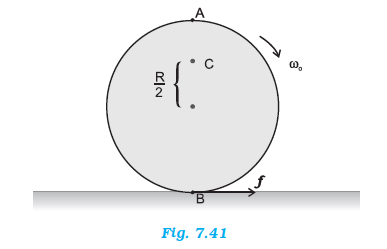
Explain why friction is necessary to make the disc in Fig. 7.41 roll in the direction indicated. (b) What is the force of friction after perfect rolling begins ?

Explain why friction is necessary to make the disc in Fig. 7.41 roll in the direction indicated. (a) Give the direction of frictional force at B, and the sense of frictional torque, before perfect rolling begins.
Worksheet Answers
Solution:
In a case of perfect rolling (rolling without slipping) on an inclined plane, the point of contact between the cylinder and the surface is instantaneously at rest relative to the surface [Per the Kinematic Condition for Pure Rolling].
Since the velocity of the point of contact $v_{contact} = 0$, the force of static friction $f$ acts at this point but does not undergo any displacement relative to the incline during the interval of rolling.
Work done ($W$) by a force $\vec{F}$ is defined by the line integral of the dot product of the force and the infinitesimal displacement vector $d\vec{r}$:
$W = \int \vec{f} \cdot d\vec{r}$
In pure rolling motion, the displacement of the point of contact $d\vec{r}$ is zero at every instant $[d\vec{r} = 0]$. Consequently, the power developed by the static frictional force $P = \vec{f} \cdot \vec{v}_{contact} = 0$.
As established by the principles of classical mechanics, for any object undergoing pure rolling, the work done by the static friction force is identically zero because the point of application of the force does not move relative to the surface [Work-Energy Theorem Application].
| Parameter | Value/Condition |
|---|---|
| Displacement of contact point | $0$ |
| Force of friction | $f$ (Static) |
| Work done ($W = f \cdot \Delta x$) | $f \cdot 0 = 0$ |
Final Solution: The work done against friction during rolling is 0 J.
Solution:
The Theorem of Parallel Axes states that the moment of inertia $I$ of a rigid body about any axis is equal to the sum of the moment of inertia $I_{cm}$ of the body about a parallel axis passing through its centre of mass and the product of the mass of the body $M$ and the square of the perpendicular distance $d$ between the two axes. Mathematically, this is expressed as:
$I = I_{cm} + Md^2$
Let the centre of mass (CM) of a system of $n$ particles be at the origin $(0,0,0)$ of the coordinate system. By the definition of the centre of mass, the sum of the moments of mass about the origin is zero: $\sum m_i \vec{r}_i = 0$ [Definition of Centre of Mass].
Consider two parallel axes: one passing through the CM ($z$-axis) and another passing through a point $P$ at distance $d$ from the CM (let this be the $z'$-axis). Let the position vector of a particle $i$ be $\vec{r}_i$ with coordinates $(x_i, y_i, z_i)$.
The moment of inertia about the axis passing through the CM (the $z$-axis) is:
$I_{cm} = \sum m_i (x_i^2 + y_i^2)$
The distance of the $i$-th particle from the parallel axis passing through point $P$ (let $P$ be at $x=d, y=0$) is given by $[(x_i - d)^2 + y_i^2]$. The moment of inertia $I$ about this new axis is:
$I = \sum m_i ((x_i - d)^2 + y_i^2)$
Expand the quadratic term:
$I = \sum m_i (x_i^2 - 2x_id + d^2 + y_i^2)$
Distribute the summation index:
$I = \sum m_i (x_i^2 + y_i^2) + \sum m_i d^2 - 2d \sum m_i x_i$
1. The first term $\sum m_i (x_i^2 + y_i^2)$ is exactly $I_{cm}$ [By Definition].
2. The second term $\sum m_i d^2$ becomes $d^2 \sum m_i = Md^2$, where $M$ is the total mass of the system.
3. The third term $2d \sum m_i x_i$: Since the CM is at the origin, $\sum m_i x_i = 0$ [Property of Centre of Mass]. Thus, this term vanishes.
Substituting these values back into the expression for $I$:
$I = I_{cm} + Md^2 + 0$
Final Solution: $I = I_{cm} + Md^2$. This completes the proof of the Parallel Axes Theorem.
Solution:
We are provided with the moment of inertia ($I_{diameter}$) of a solid sphere about an axis passing through its center (diameter):
$I_{diameter} = \frac{2}{5}MR^2$
Where:
To determine the moment of inertia about a tangent, we must utilize the Parallel Axis Theorem. [Per the Parallel Axis Theorem, $I = I_{cm} + Mh^2$, where $I_{cm}$ is the moment of inertia about the center of mass, and $h$ is the perpendicular distance between the two parallel axes.]
A tangent to the sphere is parallel to the diameter passing through the center of mass. The distance $h$ between the center of the sphere and its surface (the tangent line) is equal to the radius of the sphere, $R$.
$h = R$
Applying the values to the Parallel Axis Theorem:
$I_{tangent} = I_{cm} + MR^2$
Substitute $I_{cm} = I_{diameter} = \frac{2}{5}MR^2$:
$I_{tangent} = \frac{2}{5}MR^2 + MR^2$
$I_{tangent} = (\frac{2}{5} + 1)MR^2$
$I_{tangent} = (\frac{2 + 5}{5})MR^2$
$I_{tangent} = \frac{7}{5}MR^2$
Final Solution: The moment of inertia of the sphere about a tangent is $\frac{7}{5}MR^2$.
Solution:
To determine which sphere reaches the bottom first, we must analyze the acceleration of a body undergoing pure rolling motion down an inclined plane of angle $\theta$ and height $h$.
The total energy $E$ at the top of the incline is purely potential: $E = mgh$. At the bottom, the energy is the sum of translational and rotational kinetic energy: $E = \frac{1}{2}mv^2 + \frac{1}{2}I\omega^2$.
For a solid sphere, the moment of inertia $I = \frac{2}{5}mR^2$ and the condition for pure rolling is $v = \omega R$. Substituting these into the energy equation [Per the Principle of Conservation of Mechanical Energy]:
$mgh = \frac{1}{2}mv^2 + \frac{1}{2}(\frac{2}{5}mR^2)(\frac{v}{R})^2$
$mgh = \frac{1}{2}mv^2 + \frac{1}{5}mv^2 = \frac{7}{10}mv^2$
$v = \sqrt{\frac{10gh}{7}}$
The acceleration $a$ of a body rolling down an incline is given by [Newton’s Second Law for Rotation]:
$a = \frac{g \sin \theta}{1 + \frac{I}{mR^2}}$
Substituting $I = \frac{2}{5}mR^2$ for the solid sphere:
$a = \frac{g \sin \theta}{1 + \frac{2}{5}} = \frac{5}{7}g \sin \theta$
The distance $s$ along the incline of height $h$ is $s = \frac{h}{\sin \theta}$. Using the kinematic equation $s = \frac{1}{2}at^2$:
$\frac{h}{\sin \theta} = \frac{1}{2} (\frac{5}{7}g \sin \theta) t^2$
$t^2 = \frac{14h}{5g \sin^2 \theta} \implies t = \frac{1}{\sin \theta} \sqrt{\frac{14h}{5g}}$
We observe that time $t$ is inversely proportional to $\sin \theta$:
$t \propto \frac{1}{\sin \theta}$
If there are two inclined planes with angles $\theta_1$ and $\theta_2$, where $\theta_2 > \theta_1$:
Since the time $t$ taken to reach the bottom is inversely proportional to the sine of the angle of inclination ($\sin \theta$), the sphere on the plane with the larger angle of inclination will reach the bottom first. This is because a steeper incline results in a higher component of gravitational force acting along the plane, leading to a greater linear acceleration.
Final Solution: The sphere on the plane with the larger angle of inclination reaches the bottom first, because the time taken is inversely proportional to $\sin \theta$, meaning a steeper angle results in higher acceleration and less transit time.
Solution:
The angular momentum $\vec{L}$ of a particle with respect to the origin is defined as the cross product of its position vector $\vec{r}$ and its linear momentum $\vec{p}$ [Per the definition of rotational dynamics]:
$\vec{L} = \vec{r} \times \vec{p}$
Given the components of the vectors as:
Calculating the cross product using the determinant form [By the properties of vector products]:
$\vec{L} = \begin{vmatrix} \hat{i} & \hat{j} & \hat{k} \\ x & y & z \\ p_x & p_y & p_z \end{vmatrix}$
Expanding the determinant along the first row:
$\vec{L} = \hat{i}(yp_z - zp_y) - \hat{j}(xp_z - zp_x) + \hat{k}(xp_y - yp_x)$
Comparing the result with $\vec{L} = L_x\hat{i} + L_y\hat{j} + L_z\hat{k}$, we extract the components:
If the particle is restricted to the $x-y$ plane, its position and momentum along the $z$-axis must be zero:
$z = 0 \quad \text{and} \quad p_z = 0$
Substituting these constraints into the derived components [By substitution principle]:
Since $L_x = 0$ and $L_y = 0$, the vector $\vec{L}$ simplifies to $\vec{L} = (xp_y - yp_x)\hat{k}$, which is directed entirely along the $z$-axis.
Final Solution: The components are $L_x = yp_z - zp_y$, $L_y = zp_x - xp_z$, and $L_z = xp_y - yp_x$. For motion in the $x-y$ plane ($z=0, p_z=0$), $L_x=0$ and $L_y=0$, proving that $\vec{L}$ resides exclusively along the $z$-axis.
Solution:
Let the position vector of the $i^{th}$ particle in a laboratory frame be $\vec{r}_i$ and the position of the Centre of Mass (CM) be $\vec{R}$. The position of the $i^{th}$ particle relative to the Centre of Mass is defined as:
$\vec{r}'_i = \vec{r}_i - \vec{R}$ [Definition of Relative Position Vector]
To find the corresponding velocities, we differentiate both sides with respect to time $t$:
$\frac{d\vec{r}'_i}{dt} = \frac{d\vec{r}_i}{dt} - \frac{d\vec{R}}{dt}$
$\vec{v}'_i = \vec{v}_i - \vec{V}$ [Where $\vec{v}_i$ is absolute velocity and $\vec{V}$ is the velocity of the CM]
Given the velocity relationship $\vec{v}_i = \vec{v}'_i + \vec{V}$, we multiply both sides by the mass of the $i^{th}$ particle, $m_i$:
$m_i \vec{v}_i = m_i (\vec{v}'_i + \vec{V})$
$m_i \vec{v}_i = m_i \vec{v}'_i + m_i \vec{V}$
Substituting the definition of momentum $\vec{p}_i = m_i \vec{v}_i$ and $\vec{p}'_i = m_i \vec{v}'_i$:
$\vec{p}_i = \vec{p}'_i + m_i \vec{V}$
[This confirms the transformation of momentum into the CM frame components.]
We analyze the sum of the relative momenta: $\sum \vec{p}'_i = \sum m_i \vec{v}'_i$.
Substitute $\vec{v}'_i = \vec{v}_i - \vec{V}$ into the expression:
$\sum \vec{p}'_i = \sum m_i (\vec{v}_i - \vec{V})$
$\sum \vec{p}'_i = \sum m_i \vec{v}_i - \sum m_i \vec{V}$
Since $\vec{V}$ is constant for the system at any instant, we factor it out:
$\sum \vec{p}'_i = \sum \vec{p}_i - \vec{V} \sum m_i$
Using the definition of total mass $M = \sum m_i$ and the definition of CM velocity $\vec{V} = \frac{\sum m_i \vec{v}_i}{M}$:
$\sum \vec{p}_i = M \vec{V}$
Substituting these back into the summation equation:
$\sum \vec{p}'_i = M \vec{V} - \vec{V} (M)$
$\sum \vec{p}'_i = 0$
[Per the definition of the Centre of Mass, the net momentum in the CM frame is identically zero.]
Final Solution: The relation $\vec{p}_i = \vec{p}'_i + m_i \vec{V}$ holds by definition of relative velocity, and the sum of relative momenta $\sum \vec{p}'_i = 0$ is proven by substituting the definition of the Centre of Mass, confirming the CM frame is the inertial frame where total momentum is zero.
Solution:
For the car to be in vertical equilibrium, the sum of all upward normal forces must equal the weight of the car acting downwards [Per Newton's First Law of Motion]:
$F_f + F_b = Mg = 17640 \, \text{N}$ — (Equation 1)
Where $F_f$ is the total force on both front wheels and $F_b$ is the total force on both back wheels.
To find the individual forces, we take the moment of forces about the front axle. For rotational equilibrium, the sum of torques about any point must be zero [Per the Principle of Moments]:
$\sum \tau_{\text{front}} = 0$
$(F_b \times L) - (Mg \times d_f) = 0$
$F_b \times 1.8 = 17640 \times 1.05$
$F_b = \frac{18522}{1.8} = 10290 \, \text{N}$
Using Equation 1 to find $F_f$:
$F_f = 17640 - 10290 = 7350 \, \text{N}$
Since the force is distributed equally between the two wheels on each axle:
The force exerted on each front wheel is 3675 N, and the force exerted on each back wheel is 5145 N.
Solution:
To initiate rolling motion of a disc on a horizontal surface, an external torque must be applied to overcome inertia. Consider a disc of mass $M$ and radius $R$. When a force $F$ is applied at the center, the disc tends to slide forward. [Per Newton's First Law], an object in motion stays in motion; however, to induce rotation, an angular acceleration $\alpha$ is required.
Perfect rolling (rolling without slipping) is defined by the condition $v = \omega R$ and $a = \alpha R$. Let us derive the force of friction $f$ for a disc ($I = \frac{1}{2}MR^2$) being pushed by a force $F$ at its center.
Step 1: Write the equations of motion.
Translational: $F - f = Ma$ [By Newton's Second Law]
Rotational: $fR = I\alpha = \left(\frac{1}{2}MR^2\right) \left(\frac{a}{R}\right)$ [By $\tau = I\alpha$]
Step 2: Simplify the rotational equation.
$fR = \frac{1}{2}MRa \implies f = \frac{1}{2}Ma$
Step 3: Substitute into the translational equation.
$F - \frac{1}{2}Ma = Ma$
$F = \frac{3}{2}Ma \implies a = \frac{2F}{3M}$
Step 4: Solve for friction $f$.
$f = \frac{1}{2}M \left(\frac{2F}{3M}\right) = \frac{1}{3}F$
| Parameter | Expression |
|---|---|
| Linear Acceleration ($a$) | $\frac{2F}{3M}$ |
| Angular Acceleration ($\alpha$) | $\frac{2F}{3MR}$ |
| Frictional Force ($f$) | $\frac{F}{3}$ |
Once perfect rolling is established at a constant velocity, the acceleration $a$ becomes zero if the external driving force $F$ is removed. In the absence of an external force, $f = 0$. However, as long as the accelerating force $F$ is applied to the center of the disc, the frictional force required to maintain the rolling condition is exactly one-third of the applied force.
Final Solution: The force of friction after perfect rolling begins (assuming the force $F$ is maintained) is $f = \frac{1}{3}F$.
Solution:
Rolling motion is defined as the combination of translational motion of the center of mass (CM) and rotational motion about that CM. For a body of radius $R$ and angular velocity $\omega$, the condition for pure rolling without slipping is $v_{CM} = R\omega$.
When a body rolls on a surface, the point of contact experiences a tendency to slip. The direction of the static frictional force $f$ is determined by the requirement to oppose this relative motion at the contact point.
The statement claims the frictional force acts in the same direction as the motion of the CM. Let us evaluate this under standard conditions:
The statement is False. [Per the laws of classical mechanics, specifically Newton's Second Law for rotation and translation], the direction of frictional force is determined by the relative motion of the point of contact. Because it is possible for friction to act in the direction opposite to the motion of the CM (e.g., during braking or when a torque is applied to reduce angular velocity), the assertion that it always acts in the same direction is physically incorrect.
Final Solution: The statement is False. The direction of the force of friction depends on the nature of the motion (accelerating vs. decelerating) and the points of application of external forces/torques. It is not constrained to act in the same direction as the motion of the center of mass.
Solution:
The system comprises a hollow cylinder rotating about its central axis. The following parameters are provided:
For a hollow cylinder, the mass is concentrated at the distance of the radius $R$ from the axis. [By the definition of Moment of Inertia for a thin cylindrical shell/hollow cylinder]:
$I = MR^2$
$I = 3\text{ kg} \times (0.4\text{ m})^2 = 3 \times 0.16 = 0.48\text{ kg}\cdot\text{m}^2$
Torque ($\tau$) is the product of the applied force and the perpendicular distance from the axis of rotation [Per the definition $\vec{\tau} = \vec{r} \times \vec{F}$]:
$\tau = F \times R = 30\text{ N} \times 0.4\text{ m} = 12\text{ N}\cdot\text{m}$
Using Newton’s Second Law for Rotation, $\tau = I\alpha$, where $\alpha$ is the angular acceleration:
$\alpha = \frac{\tau}{I} = \frac{12\text{ N}\cdot\text{m}}{0.48\text{ kg}\cdot\text{m}^2}$
$\alpha = 25\text{ rad/s}^2$
Given the condition of no slipping, the linear acceleration ($a$) of the rope is related to the angular acceleration of the cylinder by the tangential acceleration formula [Per the kinematic constraint $a = r\alpha$]:
$a = R\alpha = 0.4\text{ m} \times 25\text{ rad/s}^2 = 10\text{ m/s}^2$
| Parameter | Value |
|---|---|
| Angular Acceleration ($\alpha$) | $25\text{ rad/s}^2$ |
| Linear Acceleration ($a$) | $10\text{ m/s}^2$ |
Final Solution: The angular acceleration of the cylinder is $25\text{ rad/s}^2$ and the linear acceleration of the rope is $10\text{ m/s}^2$.
Solution:
To determine the new angular speed, we define the initial and final states of the system based on the Principle of Conservation of Angular Momentum [Per Newton's Second Law for Rotation, $\tau_{ext} = \frac{dL}{dt}$; since friction is neglected, $\tau_{ext} = 0$, implying $L_i = L_f$].
The total moment of inertia ($I$) is the sum of the moment of inertia of the man/platform and the point-mass weights ($I = I_p + \sum mr^2$).
Initial Moment of Inertia ($I_i$):
$I_i = I_p + 2(mr_1^2)$ $I_i = 7.6 + 2(5 \times 0.9^2)$ $I_i = 7.6 + 2(5 \times 0.81) = 7.6 + 8.1 = 15.7 \text{ kg m}^2$Final Moment of Inertia ($I_f$):
$I_f = I_p + 2(mr_2^2)$ $I_f = 7.6 + 2(5 \times 0.2^2)$ $I_f = 7.6 + 2(5 \times 0.04) = 7.6 + 0.4 = 8.0 \text{ kg m}^2$Since the net external torque is zero, the angular momentum remains constant [Law of Conservation of Angular Momentum, $L = I\omega$]:
$I_i \omega_i = I_f \omega_f$ $15.7 \times \pi = 8.0 \times \omega_f$Converting back to revolutions per minute (rpm):
$\text{New speed in rpm} = \frac{\omega_f \times 60}{2\pi}$ $\text{New speed in rpm} = \frac{1.9625 \times \pi \times 60}{2\pi} = 1.9625 \times 30 = 58.875 \text{ rpm}$Final Solution: The new angular speed is $58.875 \text{ rpm}$ (or approximately $6.16 \text{ rad/s}$).
Solution:
For a disc to undergo rolling motion, it must satisfy two conditions simultaneously: linear motion of its center of mass ($v_{cm}$) and rotational motion about its center of mass ($\omega$). Pure rolling is defined by the constraint $v_{cm} = R\omega$. When a disc is placed on a surface with an initial velocity $v_0$ but without sufficient initial rotation, the contact point $B$ experiences a relative sliding velocity $v_B = v_{cm} - R\omega$ [Per the principle of relative motion].
Friction is the external agency that provides the torque necessary to change the angular velocity of the disc. Without friction, the disc would continue to slide indefinitely at constant $v_{cm}$ and $\omega = 0$. Friction at the point of contact $B$ acts to oppose the direction of sliding, thereby decelerating the linear motion and accelerating the angular motion [Per Newton’s Second Law for Rotation: $\vec{\tau} = I\vec{\alpha}$].
Given the disc is moving forward with $v_{cm}$ and initially has no rotation or insufficient rotation ($\omega$ is small), the contact point $B$ has a velocity relative to the ground pointing forward. Therefore, the kinetic frictional force $f_k$ acts in the direction opposite to the sliding velocity to oppose it [Per the Law of Kinetic Friction].
The frictional force $f_k$ acts in the direction opposite to the center-of-mass velocity to reduce $v_{cm}$ and simultaneously creates a torque $\tau = f_k R$ about the center of mass. This torque provides the angular acceleration $\alpha = \frac{\tau}{I} = \frac{f_k R}{MR^2/2} = \frac{2f_k}{MR}$, which increases the angular velocity $\omega$ until the condition of pure rolling ($v = R\omega$) is achieved.
Final Solution: The frictional force at point B acts in the backward direction. The frictional torque is directed such that it produces a clockwise angular acceleration to initiate or increase the rotation of the disc.
Solution:
In a rotating system where no external torques act on the body (since the turntable is frictionless and the system is isolated), the total angular momentum $L$ of the system must remain conserved. This is defined by the law of conservation of angular momentum:
$L_i = L_f$ [Per the Principle of Conservation of Angular Momentum]
Where:
Let the initial state of the child and turntable be denoted by subscript $i$ and the final state by subscript $f$.
Substituting the expression for angular momentum into the conservation equation:
$I_i \omega_i = I_f \omega_f$
Rearranging to solve for $\omega_f$:
$\omega_f = \frac{I_i \omega_i}{I_f}$
Substituting the relationship $I_f = \frac{2}{5} I_i$ into the equation:
$\omega_f = \frac{I_i \times 40}{\frac{2}{5} I_i}$
Canceling $I_i$ from the numerator and denominator:
$\omega_f = 40 \times \frac{5}{2}$
$\omega_f = 20 \times 5$
$\omega_f = 100 \text{ rev/min}$
Because the angular momentum is conserved, any reduction in the moment of inertia ($I$) must result in a proportional increase in angular velocity ($\omega$). Since $I_f < I_i$, it is physically necessary that $\omega_f > \omega_i$. The factor of decrease in moment of inertia is $\frac{2}{5}$, which necessitates an inverse increase in velocity by a factor of $\frac{5}{2} = 2.5$.
Final Solution: The angular speed of the child is 100 rev/min.
Solution:
A uniform ring is defined as a circular lamina of negligible thickness with a constant linear mass density ($\lambda$). By definition, the centre of mass ($R_{cm}$) of a system of particles is given by the weighted average of the position vectors of all mass elements $dm$:
$\vec{R}_{cm} = \frac{1}{M} \int \vec{r} \, dm$ [Definition of Centre of Mass]
For a uniform ring of radius $R$ centered at the origin $(0,0)$ in the $xy$-plane:
Consequently, the centre of mass of a uniform ring is located exactly at its geometric center.
Question: Does the centre of mass of a body necessarily lie inside the body?
Answer: No, the centre of mass of a body does not necessarily lie within the material of the body itself.
Theoretical Justification: The centre of mass is a mathematical point defined by the distribution of mass. It represents the point where the total mass of the system could be considered concentrated for the purpose of translational motion analysis [Newton’s Second Law for a system of particles: $\vec{F}_{ext} = M\vec{a}_{cm}$].
| Object | CM Location | Inside Body? |
|---|---|---|
| Uniform Sphere | Geometric Center | Yes |
| Uniform Ring | Geometric Center | No (It is in the empty space) |
| Uniform "L" shaped rod | Intersection of symmetry lines | No (It is in the empty space) |
The position of the centre of mass is dependent solely on the distribution of the mass elements $dm$ and their respective position vectors $\vec{r}$. If the mass distribution is such that there is no matter at the calculated coordinates of the centre of mass, the point will reside in space outside the boundaries of the physical object.
Final Solution: The centre of mass of a uniform ring is at its geometric center. The centre of mass does not necessarily lie inside the body; it is a point that may exist in the empty space surrounding or adjacent to the object, depending on the spatial distribution of its mass.
Solution:
For a body of mass $M$ and radius $R$ rolling down an incline of angle $\theta$ without skidding, the force of static friction $f$ required to provide the necessary torque for rotation is given by the equation of motion:
$Mg \sin\theta - f = Ma$ [Newton's Second Law]
The torque $\tau$ about the center of mass providing angular acceleration $\alpha$ is:
$\tau = fR = I\alpha$
Since the cylinder is rolling without slipping, the kinematic constraint is $a = R\alpha$. For a solid cylinder, the moment of inertia is $I = \frac{1}{2}MR^2$.
Substituting $\alpha = a/R$ into the torque equation:
$fR = \left(\frac{1}{2}MR^2\right) \left(\frac{a}{R}\right) \implies f = \frac{1}{2}Ma$
Substitute $f = \frac{1}{2}Ma$ into the force equation $Mg \sin\theta - f = Ma$:
$Mg \sin\theta - \frac{1}{2}Ma = Ma$
$Mg \sin\theta = \frac{3}{2}Ma \implies a = \frac{2}{3}g \sin\theta$
Now, calculate $f$ in terms of $\theta$:
$f = \frac{1}{2}M\left(\frac{2}{3}g \sin\theta\right) = \frac{1}{3}Mg \sin\theta$
Pure rolling continues as long as the required static friction does not exceed the maximum limiting friction:
$f \leq f_{max} = \mu_s N$
The normal force on the incline is $N = Mg \cos\theta$. Therefore, the condition for rolling without skidding is:
$\frac{1}{3}Mg \sin\theta \leq \mu_s Mg \cos\theta$
$\frac{1}{3} \sin\theta \leq \mu_s \cos\theta \implies \tan\theta \leq 3\mu_s$
The cylinder begins to skid when the required friction exceeds the limit, i.e., when $\tan\theta = 3\mu_s$.
Given $\mu_s = 0.25$:
$\tan\theta = 3 \times 0.25 = 0.75$
$\theta = \arctan(0.75)$
$\theta \approx 36.87^\circ$
Final Solution: The cylinder begins to skid when the inclination angle $\theta$ reaches $\arctan(0.75)$, which is approximately $36.9^\circ$.
Solution:
For a body of uniform mass density (homogeneous body), the centre of mass (CM) coincides with the geometric centre of the body. In a right circular cylinder of uniform density:
Therefore, for a cylinder of length $L$ and radius $R$, if the cylinder is placed with its base on the $xy$-plane, the CM is located at coordinates $(0, 0, \frac{L}{2})$ [By the principle of symmetry for uniform density distributions].
No, the centre of mass of a body does not necessarily lie within the material of the body. The CM is a mathematical point defined by the mass-weighted average position of all particles in the system, given by the formula:
$$\vec{R}_{cm} = \frac{1}{M} \int \vec{r} \, dm$$The location of the CM depends on the distribution of mass, not the existence of material at that specific coordinate. Examples include:
Final Solution: The centre of mass of a uniform cylinder is located at the geometric centre (the midpoint of its longitudinal axis). The centre of mass of a body does not necessarily lie inside the body; it can lie in the empty space surrounding or within the body, depending on the object's geometry and mass distribution.
Solution:
The system under consideration is a solid cylinder rotating about its longitudinal symmetry axis. The parameters provided are as follows:
The moment of inertia ($I$) for a solid cylinder rotating about its central axis is defined by the formula: $I = \frac{1}{2}MR^2$ [Per the definition of the Moment of Inertia for a uniform solid cylinder]
Substitute the given values into the formula:
$I = \frac{1}{2} \times 20\text{ kg} \times (0.25\text{ m})^2$
$I = 10 \times 0.0625\text{ kg m}^2$
$I = 0.625\text{ kg m}^2$
The rotational kinetic energy is governed by the relation: $K_r = \frac{1}{2}I\omega^2$ [Per the Principle of Rotational Kinetic Energy]
$K_r = \frac{1}{2} \times 0.625 \times (100)^2$
$K_r = 0.5 \times 0.625 \times 10,000$
$K_r = 0.5 \times 6,250$
$K_r = 3,125\text{ J}$
The angular momentum is defined as the product of the moment of inertia and angular velocity: $L = I\omega$ [Per the definition of Angular Momentum for a rigid body]
$L = 0.625\text{ kg m}^2 \times 100\text{ rad s}^{-1}$
$L = 62.5\text{ kg m}^2\text{ s}^{-1}$ (or $62.5\text{ J s}$)
Final Solution: The rotational kinetic energy of the cylinder is $3,125\text{ J}$, and the magnitude of its angular momentum is $62.5\text{ kg m}^2\text{ s}^{-1}$.
Solution:
To determine the time taken for a solid cylinder to return to the bottom of an inclined plane, we recognize that the motion is governed by the conservation of mechanical energy and the equations of translational and rotational kinematics. [Per the Law of Conservation of Energy].
The time taken to ascend to the highest point ($t_{up}$) is equal to the time taken to descend from the highest point back to the bottom ($t_{down}$), as the acceleration $a$ is constant throughout both phases. Thus, the total time is $T = 2 \times t_{up}$.
For a rolling body on an incline of angle $\theta$, the acceleration $a$ is given by the formula:
$a = \frac{g \sin\theta}{1 + \frac{K^2}{R^2}}$
Where $K$ is the radius of gyration and $R$ is the radius of the object. For a solid cylinder, the moment of inertia $I = \frac{1}{2}MR^2$. Since $I = MK^2$, we have $K^2 = \frac{1}{2}R^2$, implying $\frac{K^2}{R^2} = 0.5$.
Substituting the values: $\theta = 30^\circ$, $g \approx 9.8 \, m/s^2$:
$a = \frac{9.8 \cdot \sin(30^\circ)}{1 + 0.5} = \frac{9.8 \cdot 0.5}{1.5} = \frac{4.9}{1.5} \approx 3.267 \, m/s^2$
The cylinder moves against gravity. At the maximum height, the final velocity $v = 0$. Using the first equation of motion [By the Definition of Kinematic Acceleration]:
$v = u - at_{up}$
$0 = 5 - (3.267)t_{up}$
$t_{up} = \frac{5}{3.267} \approx 1.53 \, s$
Since the motion is symmetric in a vacuum/ideal rolling condition [Per the Principle of Reversibility of Motion], the total time $T$ is:
$T = 2 \times t_{up} = 2 \times 1.53 = 3.06 \, s$
| Parameter | Value |
|---|---|
| Initial Velocity ($u$) | $5 \, m/s$ |
| Acceleration ($a$) | $3.267 \, m/s^2$ |
| Time to ascend ($t_{up}$) | $1.53 \, s$ |
| Total time ($T$) | $3.06 \, s$ |
Final Solution: The total time taken for the solid cylinder to return to the bottom of the inclined plane is 3.06 seconds.
Solution:
Consider a Cartesian coordinate system where the two particles, $P_1$ and $P_2$, each of mass $m$, move with velocity vectors $\vec{v}_1 = v\hat{i}$ and $\vec{v}_2 = -v\hat{i}$. The particles travel along lines parallel to the x-axis, separated by a distance $d$ along the y-axis.
Let an arbitrary point $O$ be the origin $(0,0,0)$. The angular momentum $\vec{L}$ of the system is the sum of the angular momenta of the individual particles [Per the Principle of Superposition of Angular Momentum]:
$\vec{L} = \vec{r}_1 \times \vec{p}_1 + \vec{r}_2 \times \vec{p}_2$
Substituting $\vec{p}_1 = mv\hat{i}$ and $\vec{p}_2 = -mv\hat{i}$:
$\vec{L} = (x_1\hat{i} + y_1\hat{j}) \times (mv\hat{i}) + (x_2\hat{i} + (y_1 + d)\hat{j}) \times (-mv\hat{i})$
Utilizing the properties of cross products ($\hat{i} \times \hat{i} = 0$ and $\hat{j} \times \hat{i} = -\hat{k}$):
$\vec{L} = [x_1mv(\hat{i} \times \hat{i}) + y_1mv(\hat{j} \times \hat{i})] + [x_2(-mv)(\hat{i} \times \hat{i}) + (y_1 + d)(-mv)(\hat{j} \times \hat{i})]$
$\vec{L} = 0 - y_1mv\hat{k} + 0 + (y_1 + d)mv\hat{k}$
$\vec{L} = (-y_1mv + y_1mv + dmv)\hat{k}$
$\vec{L} = dmv\hat{k}$
The resulting expression $\vec{L} = dmv\hat{k}$ is independent of the coordinates $(x_1, y_1)$ and $(x_2, y_1+d)$. This demonstrates that the choice of the origin (the point about which angular momentum is calculated) does not affect the total angular momentum of the system.
| Parameter | Value |
|---|---|
| Net Angular Momentum | $mv d$ |
| Direction | Perpendicular to the plane of motion |
Final Solution: Since the coordinates $(x, y)$ of the particles cancel out during the vector summation, the angular momentum $\vec{L} = dmv\hat{k}$ is invariant and remains constant regardless of the reference point O.
Solution:
Pure rolling motion is defined as the motion of a rigid body (such as a cylinder, sphere, or disc) on a surface where the point of contact between the body and the surface remains at rest relative to the surface [Per the Kinematic Condition of Rolling]. Mathematically, this condition is satisfied when the velocity of the center of mass ($v_{cm}$) is equal to the product of the angular velocity ($\omega$) and the radius of the body ($R$):
$v_{cm} = R\omega$
Consider a circular object of radius $R$ rolling without slipping on a stationary horizontal surface. The velocity of any point $P$ on the body is given by the vector sum of the translational velocity of the center of mass and the rotational velocity about the center of mass [Per the Principle of Superposition of Velocities]:
$\vec{v}_P = \vec{v}_{cm} + \vec{v}_{rot}$
At the point of contact $C$ with the ground:
Setting the magnitudes in a one-dimensional coordinate system where the direction of motion is positive:
$v_{contact} = v_{cm} - R\omega$
Since the condition for pure rolling is $v_{cm} = R\omega$ [By the No-Slip Constraint], we substitute the value:
$v_{contact} = R\omega - R\omega = 0$
The calculation $v_{cm} - R\omega = 0$ confirms that the instantaneous velocity of the point of contact is zero. If this value were non-zero, the body would be sliding (kinetic friction would be present) rather than purely rolling. Therefore, the statement is scientifically accurate under the conditions of static friction without slipping [Per Newton’s Laws of Motion in the non-inertial frame of the center of mass].
Final Solution: The statement is True. During pure rolling, the translational velocity of the center of mass exactly cancels out the linear velocity contributed by rotation at the point of contact, resulting in an instantaneous velocity of $0 \text{ m/s}$.


