


Your Worksheet is Ready
CBSE - Class 11 Physics Work Worksheet
EXERCISES
Two identical ball bearings in contact with each other and resting on a frictionless table are hit head-on by another ball bearing of the same mass moving initially with a speed V. If the collision is elastic, which of the following is a possible result after collision ?
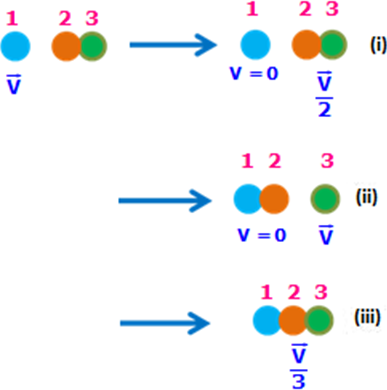
The striking ball stops, the middle ball moves off with speed V, and the last ball remains at rest.
b.The striking ball and the middle ball come to rest, and the last ball moves off with speed V.
c.All three balls move with different velocities after the collision.
Two identical ball bearings in contact with each other and resting on a frictionless table are hit head-on by another ball bearing of the same mass moving initially with a speed $V$. If the collision is elastic, which of the following (Fig. 6.14) is a possible result after collision ?

Worksheet Answers
Solution:
The mass ($m$) of the water pumped is determined by the volume and the density of water [By definition: $m = \rho V$].
$m = 10^3 \, kg/m^3 \times 30 \, m^3 = 30,000 \, kg$
The work done ($W_{out}$) against gravity to raise the water to height $h$ is defined by potential energy [Per the Work-Energy Theorem]:
$W_{out} = mgh$
$W_{out} = 30,000 \, kg \times 9.8 \, m/s^2 \times 40 \, m$
$W_{out} = 11,760,000 \, J = 1.176 \times 10^7 \, J$
Power is the rate at which work is performed ($P = W/t$):
$P_{out} = \frac{1.176 \times 10^7 \, J}{900 \, s}$
$P_{out} = 13,066.67 \, W$
Efficiency is the ratio of useful power output to total power input [Per the Law of Conservation of Energy]:
$\eta = \frac{P_{out}}{P_{in}} \implies P_{in} = \frac{P_{out}}{\eta}$
$P_{in} = \frac{13,066.67 \, W}{0.3}$
$P_{in} = 43,555.57 \, W \approx 43.56 \, kW$
Final Solution: The total electric power consumed by the pump is $43.56 \, kW$.
Solution:
The frictional force ($f_k$) acting on the body is given by:
$f_k = \mu_k \cdot N = \mu_k \cdot mg$ [By the definition of Kinetic Friction]
$f_k = 0.1 \times 2\text{ kg} \times 9.8\text{ m/s}^2 = 1.96\text{ N}$
The net force ($F_{net}$) acting on the body is:
$F_{net} = F_a - f_k = 7\text{ N} - 1.96\text{ N} = 5.04\text{ N}$
Using Newton's Second Law ($F = ma$):
$a = \frac{F_{net}}{m} = \frac{5.04\text{ N}}{2\text{ kg}} = 2.52\text{ m/s}^2$
Using the kinematic equation for displacement under constant acceleration:
$s = ut + \frac{1}{2}at^2$ [Per Kinematic Equations of Motion]
$s = (0)(10) + \frac{1}{2}(2.52)(10)^2$
$s = 0 + 1.26 \times 100 = 126\text{ m}$
$W_a = F_a \cdot s \cdot \cos(0^\circ) = 7\text{ N} \times 126\text{ m} \times 1 = 882\text{ J}$
$W_f = f_k \cdot s \cdot \cos(180^\circ) = 1.96\text{ N} \times 126\text{ m} \times (-1) = -246.96\text{ J}$
$W_{net} = F_{net} \cdot s = 5.04\text{ N} \times 126\text{ m} = 635.04\text{ J}$
First, find the final velocity ($v$):
$v = u + at = 0 + (2.52)(10) = 25.2\text{ m/s}$
$\Delta K = \frac{1}{2}mv^2 - \frac{1}{2}mu^2 = \frac{1}{2}(2)(25.2)^2 - 0 = 635.04\text{ J}$
The results verify the Work-Energy Theorem, which states that the net work done on an object equals the change in its kinetic energy ($W_{net} = \Delta K$). Here, $W_a + W_f = 882 - 246.96 = 635.04\text{ J}$, which is exactly equal to the calculated change in kinetic energy.
Final Solution: (a) $882\text{ J}$, (b) $-246.96\text{ J}$, (c) $635.04\text{ J}$, (d) $635.04\text{ J}$. The results are consistent with the Work-Energy Theorem.
Solution:
The kinetic energy ($K$) of a particle is defined by the classical relation $K = \frac{1}{2}mv^2$ [Per the work-energy theorem for non-relativistic particles].
Solving the kinetic energy formula for velocity ($v$):
$v = \sqrt{\frac{2K}{m}}$
The ratio of the speed of the electron ($v_e$) to the speed of the proton ($v_p$) is given by:
$\frac{v_e}{v_p} = \frac{\sqrt{\frac{2K_e}{m_e}}}{\sqrt{\frac{2K_p}{m_p}}} = \sqrt{\frac{K_e}{K_p} \cdot \frac{m_p}{m_e}}$
Substitute the given values into the ratio equation:
$\frac{v_e}{v_p} = \sqrt{\left(\frac{10\text{ keV}}{100\text{ keV}}\right) \times \left(\frac{1.67 \times 10^{-27}\text{ kg}}{9.11 \times 10^{-31}\text{ kg}}\right)}$
$\frac{v_e}{v_p} = \sqrt{0.1 \times (0.1833 \times 10^4)}$
$\frac{v_e}{v_p} = \sqrt{0.1 \times 1833} = \sqrt{183.3}$
$\frac{v_e}{v_p} \approx 13.54$
Since $\frac{v_e}{v_p} > 1$, it is mathematically evident that the electron moves significantly faster than the proton under the specified energy conditions. [Derived from the inverse proportionality of velocity to the square root of mass for equivalent kinetic energies].
Final Solution: The electron is faster, and the ratio of the speed of the electron to that of the proton is approximately 13.54.
Solution:
The work done $W$ by a constant force $\vec{F}$ on a body undergoing a displacement $\vec{d}$ is defined by the scalar (dot) product:
$W = \vec{F} \cdot \vec{d} = |\vec{F}| |\vec{d}| \cos(\theta)$
where $\theta$ is the angle between the direction of the force vector and the direction of the displacement vector [Per the definition of Scalar Product in Vector Algebra].
Consider a body sliding down an inclined plane of angle $\alpha$ with the horizontal. Let the displacement $\vec{d}$ be directed down the plane. Kinetic friction $\vec{f_k}$ acts in the direction opposing the relative motion [Per Newton’s Third Law of Motion and the nature of dissipative forces].
Since the force of friction is exactly opposite to the direction of displacement, the angle $\theta$ between $\vec{f_k}$ and $\vec{d}$ is exactly $180^\circ$ [By geometric construction of opposing vectors].
Substitute the value of $\theta$ into the work equation:
$W = |\vec{f_k}| |\vec{d}| \cos(180^\circ)$
Given that $\cos(180^\circ) = -1$ [Per Trigonometric Identities]:
$W = |\vec{f_k}| |\vec{d}| (-1)$
$W = -|\vec{f_k}| |\vec{d}|$
Because the magnitude of friction $|\vec{f_k}|$ and displacement $|\vec{d}|$ are strictly positive quantities, the product results in a negative value. This confirms that the work done by friction is negative, signifying a loss of mechanical energy from the system, typically dissipated as thermal energy [Per the Work-Energy Theorem].
Final Solution: The work done by friction on a body sliding down an inclined plane is negative.
Solution:
To determine the rate of change of total momentum ($\vec{P}$) for a many-particle system, we analyze the contribution of both internal and external forces acting on the system. Let the system consist of $N$ particles with individual masses $m_i$ and velocities $\vec{v}_i$.
The total momentum of the system is defined as:
$\vec{P} = \sum_{i=1}^{N} \vec{p}_i = \sum_{i=1}^{N} m_i \vec{v}_i$
The rate of change of the total momentum with respect to time $t$ is given by:
$\frac{d\vec{P}}{dt} = \frac{d}{dt} \sum_{i=1}^{N} \vec{p}_i = \sum_{i=1}^{N} \frac{d\vec{p}_i}{dt}$
[By the Principle of Superposition for linear momentum]
Per Newton’s Second Law applied to each particle $i$, the force acting on it is the sum of internal forces ($\vec{f}_{ij}$, exerted on particle $i$ by particle $j$) and external forces ($\vec{F}_i^{ext}$):
$\frac{d\vec{p}_i}{dt} = \vec{F}_i^{ext} + \sum_{j \neq i} \vec{f}_{ij}$
Summing over all particles $i$ from $1$ to $N$:
$\frac{d\vec{P}}{dt} = \sum_{i=1}^{N} \vec{F}_i^{ext} + \sum_{i=1}^{N} \sum_{j \neq i} \vec{f}_{ij}$
[By Newton’s Third Law, for every internal force $\vec{f}_{ij}$, there exists an equal and opposite force $\vec{f}_{ji}$ such that $\vec{f}_{ij} + \vec{f}_{ji} = 0$. Therefore, the double summation over internal forces vanishes: $\sum \sum \vec{f}_{ij} = 0$.]
Since the sum of all internal forces is zero, the equation simplifies to:
$\frac{d\vec{P}}{dt} = \sum_{i=1}^{N} \vec{F}_i^{ext} = \vec{F}_{ext}^{total}$
This demonstrates that the rate of change of total momentum is strictly dependent on the net external force acting on the system, independent of internal configurations.
Final Solution: The correct alternative is the external force.
Solution:
Let $m$ be the mass of each ball bearing. The incident ball bearing (A) has an initial velocity $\vec{v}_A = V \hat{i}$, while the target ball bearings (B and C) are at rest: $\vec{v}_B = 0$ and $\vec{v}_C = 0$. Since the table is frictionless and the collision is perfectly elastic, two fundamental physical laws must be satisfied:
Initial state variables:
Consider a potential final state where the incident ball (A) comes to rest, and the two target balls (B and C) move forward with velocities $v_B$ and $v_C$.
Applying Conservation of Momentum:
$mV = m(0) + mv_B + mv_C \implies V = v_B + v_C$ [Equation 1]Applying Conservation of Kinetic Energy:
$\frac{1}{2}mV^2 = \frac{1}{2}m(0)^2 + \frac{1}{2}mv_B^2 + \frac{1}{2}mv_C^2 \implies V^2 = v_B^2 + v_C^2$ [Equation 2]We test the validity of the result where balls B and C move together with a common velocity $v$. If $v_B = v_C = v$, then:
Since $V^2 \neq \frac{V^2}{2}$, the case where both target balls move with the same velocity is physically impossible in an elastic collision.
However, if the incident ball stops, and one ball moves off while the other remains stationary or if they move with specific velocities satisfying both equations, we look for solutions to $v_B + v_C = V$ and $v_B^2 + v_C^2 = V^2$.
Squaring Eq 1: $(v_B + v_C)^2 = V^2 \implies v_B^2 + v_C^2 + 2v_Bv_C = V^2$.
Substituting Eq 2 into this expansion: $V^2 + 2v_Bv_C = V^2 \implies 2v_Bv_C = 0$.
This implies either $v_B = 0$ or $v_C = 0$.
| Variable | Result | Physical Significance |
|---|---|---|
| Ball A | $v_A = 0$ | Momentum transfer complete |
| Ball B | $v_B = 0$ | Stationary |
| Ball C | $v_C = V$ | Transmitted velocity |
Final Solution: The only possible result that satisfies both the Law of Conservation of Momentum and the Law of Conservation of Kinetic Energy is for the incident ball A to come to rest, ball B to remain at rest, and ball C to move forward with the initial velocity $V$.
Solution:
To determine the total work done against the gravitational force, we identify the following physical constants and parameters:
According to the work-energy theorem and the definition of gravitational potential energy, the work $W_1$ required to lift a mass against gravity at a constant velocity is equal to the change in gravitational potential energy:
$W_1 = m \cdot g \cdot h$
Substituting the given values:
$W_1 = 10 \text{ kg} \times 9.8 \text{ m/s}^2 \times 0.5 \text{ m}$
$W_1 = 49 \text{ J}$ [Per the definition of Work: $W = Fd \cos(\theta)$, where $F = mg$ and $\theta = 0^\circ$ for upward displacement]
The total work $W_{total}$ performed by the dieter over $n$ repetitions is the product of the work done per lift and the total number of repetitions:
$W_{total} = n \cdot W_1$
$W_{total} = 1000 \times 49 \text{ J}$
$W_{total} = 49,000 \text{ J}$
The problem states that potential energy lost during the lowering phase is dissipated (i.e., converted into heat or sound through non-conservative forces). Therefore, no energy is recovered during the lowering phase. The dieter must perform the full amount of work against gravity during each of the 1000 lifts.
Final Solution: The total work done by the dieter against the gravitational force is $4.9 \times 10^4 \text{ J}$ (or $49 \text{ kJ}$).
Solution:
To determine the kinetic energy of air moving through the swept area of a windmill, we define the parameters of the fluid flow. Let:
[Per the principle of continuity in fluid dynamics, the mass of air passing through the area $A$ in time $t$ forms a cylinder of volume $V = A \cdot l$, where $l$ is the distance covered by air in time $t$.]
The distance $l$ traveled by the air in time $t$ is given by $l = v \cdot t$. Therefore, the volume of air $V$ passing through the blades in time $t$ is:
$V = A \cdot v \cdot t$
The mass $m$ of this air is the product of density and volume:
$m = \rho \cdot V = \rho \cdot A \cdot v \cdot t$ [Definition of mass density $\rho = m/V$]
The kinetic energy ($K$) is defined by the classical mechanics formula:
$K = \frac{1}{2} m v^2$ [Per the Work-Energy Theorem for a particle of mass $m$]
Substituting the expression for mass $m$ derived in Step 2 into the kinetic energy equation:
$K = \frac{1}{2} (\rho A v t) v^2$
$K = \frac{1}{2} \rho A v^3 t$
Often, the kinetic energy of air is expressed as the rate of energy transfer (Power, $P$), where $P = \frac{dK}{dt}$.
Taking the derivative of $K$ with respect to $t$:
$P = \frac{d}{dt} \left( \frac{1}{2} \rho A v^3 t \right) = \frac{1}{2} \rho A v^3$
Final Solution: The kinetic energy of the air passing through the windmill in time $t$ is $K = \frac{1}{2} \rho A v^3 t$.
Solution:
To ensure dimensional homogeneity, we must convert all units to the SI system before calculation.
The mass of air ($m$) passing through the area $A$ in time $t$ is defined by the volume of a cylinder of air moving at velocity $v$. The mass flow rate ($\dot{m}$) is given by:
$\dot{m} = \frac{m}{t} = \rho A v$
Substituting the known values:
$\dot{m} = 1.2 \text{ kg/m}^3 \times 30 \text{ m}^2 \times 10 \text{ m/s} = 360 \text{ kg/s}$
The total kinetic energy ($K$) of a mass $m$ moving with velocity $v$ is given by $K = \frac{1}{2}mv^2$ [Per the Kinetic Energy Theorem]. Consequently, the power ($P_{total}$) available in the wind is:
$P_{total} = \frac{dK}{dt} = \frac{1}{2} \left(\frac{dm}{dt}\right) v^2 = \frac{1}{2} \rho A v \cdot v^2 = \frac{1}{2} \rho A v^3$
Calculating the total power:
$P_{total} = 0.5 \times 1.2 \text{ kg/m}^3 \times 30 \text{ m}^2 \times (10 \text{ m/s})^3$
$P_{total} = 0.5 \times 36 \times 1000 = 18,000 \text{ Watts (or 18 kW)}$
The actual electrical power produced ($P_{elec}$) is the product of the total power and the efficiency ($\eta$) of the conversion process:
$P_{elec} = \eta \times P_{total}$
$P_{elec} = 0.25 \times 18,000 \text{ W}$
$P_{elec} = 4,500 \text{ Watts}$
Final Solution: The electrical power produced by the windmill is 4,500 W or 4.5 kW.
Solution:
To determine the conservation of linear momentum in an elastic collision, we must analyze the forces acting upon the system of two balls ($A$ and $B$) during the collision interval $\Delta t$.
According to Newton's Second Law of Motion in terms of momentum: $\vec{F}_{ext} = \frac{d\vec{p}}{dt}$ [Per Newton's Second Law of Motion].
For any system, the change in total linear momentum ($\Delta \vec{p}$) is given by the impulse delivered by external forces: $\Delta \vec{p} = \int_{t_1}^{t_2} \vec{F}_{ext} dt$ [By the Impulse-Momentum Theorem].
| Factor | Impact on Momentum |
|---|---|
| Sum of Internal Forces | $\vec{F}_{AB} + \vec{F}_{BA} = 0$ |
| Sum of External Forces | $\vec{F}_{ext} \approx 0$ (negligible) |
| Net Force ($\vec{F}_{net}$) | $0$ |
Since the net external force acting on the system during the interval $\Delta t$ is effectively zero, the change in total linear momentum is zero ($\Delta \vec{P} = 0$). This holds true regardless of whether the collision is elastic or inelastic, provided the system is considered isolated during the interaction interval.
Final Solution: Yes, the total linear momentum is conserved. Because the impulsive contact forces during the collision are internal to the system, and external forces (like gravity or friction) are negligible over the infinitesimally small time duration of the impact, the net external force remains zero, thereby ensuring $\Delta \vec{p} = 0$ according to the Law of Conservation of Linear Momentum.
Solution:
The normal reaction force ($N$) on a horizontal surface is given by $N = mg$. [Per Newton's Second Law for vertical equilibrium].
$N = 2\text{ kg} \times 9.8\text{ m/s}^2 = 19.6\text{ N}$
The frictional force ($f_k$) is calculated as:
$f_k = \mu_k \times N$
$f_k = 0.1 \times 19.6\text{ N} = 1.96\text{ N}$
The net force ($F_{net}$) acting on the body is the difference between the applied force and the frictional force:
$F_{net} = F_{app} - f_k$
$F_{net} = 7\text{ N} - 1.96\text{ N} = 5.04\text{ N}$
Using Newton's Second Law ($F = ma$):
$a = \frac{F_{net}}{m} = \frac{5.04\text{ N}}{2\text{ kg}} = 2.52\text{ m/s}^2$
Using the kinematic equation for displacement under constant acceleration: $s = ut + \frac{1}{2}at^2$.
$s = (0 \times 10) + \frac{1}{2} \times 2.52\text{ m/s}^2 \times (10\text{ s})^2$
$s = 0.5 \times 2.52 \times 100 = 126\text{ m}$
Work done is defined as the scalar product of force and displacement ($W = \vec{F} \cdot \vec{s}$). Since kinetic friction acts in the direction opposite to the displacement, the angle ($\theta$) between the frictional force vector and the displacement vector is $180^\circ$.
$W_f = f_k \cdot s \cdot \cos(180^\circ)$
$W_f = 1.96\text{ N} \times 126\text{ m} \times (-1)$
$W_f = -246.96\text{ J}$
Final Solution: The work done by friction in 10 seconds is -246.96 J.
Solution:
The statement "Total energy of a system is always conserved, no matter what internal and external forces on the body are present" is False.
The principle of Conservation of Mechanical Energy states that the total mechanical energy of a system is conserved only if the internal forces are conservative and no external work is performed on the system [Per the Work-Energy Theorem].
The total work done ($W_{total}$) on a system is equal to the change in its kinetic energy ($\Delta K$):
$W_{total} = W_{conservative} + W_{non-conservative} + W_{external} = \Delta K$
[By the Work-Energy Theorem, the change in kinetic energy is the sum of works done by all forces.]
If the system is isolated (no external forces, $W_{external} = 0$) and all internal forces are conservative, then the sum of kinetic energy ($K$) and potential energy ($U$) remains constant:
$E = K + U = \text{constant}$
However, if external forces act on the system, the work done by these external forces ($W_{ext}$) changes the total energy of the system:
$\Delta E = W_{ext}$
[Per the General Law of Conservation of Energy, energy can be transferred into or out of a system via external work or heat.]
When non-conservative forces (e.g., friction, air resistance, or viscous drag) are present, mechanical energy is dissipated into non-mechanical forms such as thermal energy ($Q$).
$W_{non-conservative} = \Delta K + \Delta U = -\Delta Q$
The mechanical energy of the system is not conserved because it is converted into internal energy (heat), which is often excluded from the "mechanical" energy calculation of the system.
| Condition | Energy Conservation Status |
|---|---|
| Isolated system, Conservative internal forces | Mechanical Energy is conserved. |
| Presence of external work ($W_{ext} \neq 0$) | Total energy of the system changes ($\Delta E = W_{ext}$). |
| Presence of non-conservative forces | Mechanical energy is converted to thermal energy; mechanical energy is not conserved. |
Final Solution: The statement is False. Total energy of a system is only conserved if the system is isolated from external work and no non-conservative forces are performing work that dissipates mechanical energy into non-mechanical forms.
Solution:
The mass ($m$) of the water pumped is calculated using the density formula $m = \rho \times V$:
$m = 1000 \text{ kg/m}^3 \times 30 \text{ m}^3 = 30,000 \text{ kg}$
The useful work ($W$) done by the pump to raise the water is equal to the gravitational potential energy gained [Per the Work-Energy Theorem]:
$W = mgh$
$W = 30,000 \text{ kg} \times 9.8 \text{ m/s}^2 \times 40 \text{ m} = 11,760,000 \text{ J}$
Power is defined as the rate of doing work ($P_{\text{out}} = \frac{W}{t}$):
$P_{\text{out}} = \frac{11,760,000 \text{ J}}{900 \text{ s}} \approx 13,066.67 \text{ W}$
Efficiency ($\eta$) is the ratio of useful power output to actual electric power input ($P_{\text{in}}$):
$\eta = \frac{P_{\text{out}}}{P_{\text{in}}} \implies P_{\text{in}} = \frac{P_{\text{out}}}{\eta}$ [Per the definition of Efficiency]
$P_{\text{in}} = \frac{13,066.67 \text{ W}}{0.30} = 43,555.56 \text{ W}$
| Parameter | Value |
|---|---|
| Mass | $3 \times 10^4 \text{ kg}$ |
| Work Done | $1.176 \times 10^7 \text{ J}$ |
| Input Power | $43,555.56 \text{ W}$ |
Final Solution: The electric power consumed by the pump is $43,555.56 \text{ W}$ or approximately $43.56 \text{ kW}$.
Solution:
To determine the work done by the applied force, we must first analyze the dynamics of the system. The following parameters are provided:
First, calculate the frictional force ($f_k$) acting in opposition to the applied force:
$f_k = \mu_k \cdot N = \mu_k \cdot mg$ [By the Law of Kinetic Friction]
$f_k = 0.1 \cdot 2\text{ kg} \cdot 9.8\text{ m/s}^2 = 1.96\text{ N}$
The net force ($F_{net}$) acting on the body is the difference between the applied force and friction:
$F_{net} = F - f_k = 7\text{ N} - 1.96\text{ N} = 5.04\text{ N}$
Applying Newton's Second Law of Motion ($F = ma$):
$a = \frac{F_{net}}{m} = \frac{5.04\text{ N}}{2\text{ kg}} = 2.52\text{ m/s}^2$
Using the kinematic equation for displacement ($s$) under constant acceleration [Per the Equations of Kinematic Motion]:
$s = ut + \frac{1}{2}at^2$
Since $u = 0$:
$s = 0 + \frac{1}{2} \cdot 2.52\text{ m/s}^2 \cdot (10\text{ s})^2$
$s = 1.26 \cdot 100 = 126\text{ meters}$
Work done ($W$) by a constant force is defined as the scalar product of force and displacement vectors ($W = \vec{F} \cdot \vec{s} = Fs \cos \theta$). Given the force is applied horizontally in the direction of displacement ($\theta = 0^\circ, \cos 0^\circ = 1$):
$W = F \cdot s$
$W = 7\text{ N} \cdot 126\text{ m}$
$W = 882\text{ J}$
Final Solution: The work done by the applied force in 10 seconds is 882 Joules.
Solution:
To determine the rate of change of the total momentum of a many-particle system, we define the total momentum $\mathbf{P}$ of a system consisting of $N$ particles as the vector sum of individual momenta: $$\mathbf{P} = \sum_{i=1}^{N} \mathbf{p}_i = \sum_{i=1}^{N} m_i \mathbf{v}_i$$ [By the definition of linear momentum in classical mechanics].
The rate of change of the total momentum is given by the derivative of $\mathbf{P}$ with respect to time $t$: $$\frac{d\mathbf{P}}{dt} = \sum_{i=1}^{N} \frac{d\mathbf{p}_i}{dt}$$ [By the linearity property of the derivative operator].
According to Newton's Second Law for each particle $i$, the force acting on it is the sum of internal forces ($\mathbf{f}_{ij}$, force exerted by particle $j$ on $i$) and external forces ($\mathbf{F}_{i, ext}$): $$\frac{d\mathbf{p}_i}{dt} = \mathbf{F}_{i, ext} + \sum_{j \neq i} \mathbf{f}_{ij}$$ Substituting this into the summation: $$\frac{d\mathbf{P}}{dt} = \sum_{i=1}^{N} \mathbf{F}_{i, ext} + \sum_{i=1}^{N} \sum_{j \neq i} \mathbf{f}_{ij}$$
Per Newton’s Third Law of Motion, for every internal force $\mathbf{f}_{ij}$, there exists an equal and opposite reaction force $\mathbf{f}_{ji}$ such that $\mathbf{f}_{ij} = -\mathbf{f}_{ji}$. When summing over all pairs $(i, j)$ in the system, these forces cancel out exactly: $$\sum_{i=1}^{N} \sum_{j \neq i} \mathbf{f}_{ij} = 0$$ Consequently, the internal forces contribute nothing to the change in total momentum of the system. We are left with: $$\frac{d\mathbf{P}}{dt} = \sum_{i=1}^{N} \mathbf{F}_{i, ext} = \mathbf{F}_{ext}$$ where $\mathbf{F}_{ext}$ is the vector sum of all external forces acting on the system.
The rate of change of total momentum is equal to (and thus proportional to) the sum of external forces acting on the system. Internal forces are irrelevant to the change in the total momentum of the system.
Final Solution: The rate of change of total momentum of a many-particle system is proportional to the external force acting on the system.
Solution:
The statement "In an inelastic collision, the final kinetic energy is always less than the initial kinetic energy of the system" is True.
Collisions are categorized based on the conservation of kinetic energy. [Per the Law of Conservation of Energy and Principles of Classical Mechanics]:
In an inelastic collision, internal forces perform work to deform the colliding bodies or generate heat, sound, or light. This conversion of mechanical energy into other forms is irreversible [Per the First Law of Thermodynamics].
For a system of two particles with masses $m_1$ and $m_2$ moving with velocities $u_1$ and $u_2$ initially, and $v_1$ and $v_2$ finally, the total initial kinetic energy is:
$K_i = \frac{1}{2}m_1 u_1^2 + \frac{1}{2}m_2 u_2^2$
The total final kinetic energy is:
$K_f = \frac{1}{2}m_1 v_1^2 + \frac{1}{2}m_2 v_2^2$
For an inelastic collision, there is a loss of kinetic energy ($\Delta K$), defined as:
$\Delta K = K_i - K_f > 0$
This implies $K_i > K_f$. [Justification: By the principle of work-energy, the lost kinetic energy is equal to the work done against internal dissipative forces $\int F_{int} \cdot dr$].
| Condition | Energy State |
|---|---|
| Elastic Collision | $K_i = K_f$ |
| Inelastic Collision | $K_i > K_f$ |
| Perfectly Inelastic | $K_i > K_f$ (Maximal loss) |
Since the energy is dissipated into non-mechanical forms (heat, deformation, or sound), the final kinetic energy must be strictly less than the initial kinetic energy for any collision categorized as inelastic.
Final Solution: The statement is True, because kinetic energy is dissipated into other forms of energy (thermal, sound, or structural deformation) during the collision process.
Solution:
Statement: "In an elastic collision of two bodies, the momentum and energy of each body is conserved."
Verdict: False.
The definition of an elastic collision is governed by the principles of conservation of momentum and conservation of total kinetic energy for the system, not for the individual bodies involved in the collision [Per the Laws of Conservation in Classical Mechanics].
For a system of two bodies with masses $m_1$ and $m_2$ and velocities $\vec{u}_1, \vec{u}_2$ (initial) and $\vec{v}_1, \vec{v}_2$ (final):
$$\vec{p}_{initial} = \vec{p}_{final}$$
$$m_1\vec{u}_1 + m_2\vec{u}_2 = m_1\vec{v}_1 + m_2\vec{v}_2$$
This law applies to the entire system as a collective unit. Individual bodies experience an impulsive force during the collision, leading to a change in their individual momenta ($\Delta \vec{p}_i \neq 0$).
In an elastic collision, the total kinetic energy of the system is conserved:
$$\sum K_i = \sum K_f$$
$$\frac{1}{2}m_1u_1^2 + \frac{1}{2}m_2u_2^2 = \frac{1}{2}m_1v_1^2 + \frac{1}{2}m_2v_2^2$$
While the system’s energy remains constant, individual bodies undergo energy exchange. Body 1 may gain kinetic energy while Body 2 loses an equal amount (or vice versa), meaning $K_{1,i} \neq K_{1,f}$ and $K_{2,i} \neq K_{2,f}$.
| Conservation Property | Individual Body | System (Total) |
|---|---|---|
| Linear Momentum | Not Conserved | Conserved |
| Kinetic Energy | Not Conserved | Conserved |
Final Solution: The statement is False. In an elastic collision, linear momentum and kinetic energy are conserved only for the system as a whole, whereas individual bodies undergo changes in their respective momentum and kinetic energy due to the interaction forces during collision.
Solution:
In classical mechanics, the work done ($W$) by a constant force ($\vec{F}$) on a body undergoing a displacement ($\vec{d}$) is defined by the dot product of the two vectors: $W = \vec{F} \cdot \vec{d} = |\vec{F}| |\vec{d}| \cos(\theta)$ where $\theta$ is the angle between the direction of the force vector and the direction of the displacement vector [Per the Work-Energy Theorem definitions].
The resistive force of air, commonly known as air drag or air resistance, is an dissipative force that always opposes the instantaneous motion of the object through the fluid medium.
Since the resistive force ($\vec{F}$) and the displacement ($\vec{d}$) are always anti-parallel, the angle between them is precisely $180^\circ$ (or $\pi$ radians). Substituting this into the work formula: $W = |\vec{F}| |\vec{d}| \cos(180^\circ)$ Since $\cos(180^\circ) = -1$: $W = - |\vec{F}| |\vec{d}|$ [By Trigonometric Identity for $\cos(\pi)$]
The negative sign in the work calculation indicates that the force is removing kinetic energy from the system. As the pendulum vibrates, the work done by the resistive force is consistently negative, resulting in the conversion of mechanical energy into thermal energy within the surrounding air molecules. This continuous negative work is exactly why the pendulum's amplitude decays over time until the system is brought to rest [Per the Law of Conservation of Energy].
Final Solution: The work done by the resistive force of air on the vibrating pendulum is negative.
Solution:
We consider three identical ball bearings, each of mass $m$. Let the initial state be defined as:
Total initial momentum $P_i = m(V) + m(0) + m(0) = mV$.
Total initial kinetic energy $K_i = \frac{1}{2}mV^2$.
For an elastic collision, both linear momentum and kinetic energy must be conserved [Per the Law of Conservation of Momentum and the Definition of Elastic Collision].
Let the final velocities of the three balls be $v_1, v_2,$ and $v_3$ respectively.
| Scenario | Final Velocities | Momentum Sum | Kinetic Energy Sum |
|---|---|---|---|
| Case I (Individual motion) | $v_1=0, v_2=0, v_3=V$ | $mV$ (Conserved) | $\frac{1}{2}mV^2$ (Conserved) |
| Case II (Collective motion) | $v_1=0, v_2=V/2, v_3=V/2$ | $mV$ (Conserved) | $\frac{1}{4}mV^2$ (NOT Conserved) |
| Case III (Group motion) | $v_1=V/3, v_2=V/3, v_3=V/3$ | $mV$ (Conserved) | $\frac{1}{6}mV^2$ (NOT Conserved) |
In Case I, where the first ball comes to rest and the third ball carries the total momentum $V$:
Conservation of Momentum: $mv_1 + mv_2 + mv_3 = m(0) + m(0) + m(V) = mV$. This matches the initial momentum [By Conservation of Momentum Principle].
Conservation of Kinetic Energy: $\frac{1}{2}mv_1^2 + \frac{1}{2}mv_2^2 + \frac{1}{2}mv_3^2 = 0 + 0 + \frac{1}{2}mV^2 = \frac{1}{2}mV^2$. This matches the initial kinetic energy [By Conservation of Energy Principle].
Only the scenario where the third ball (the one on the far right) moves away with velocity $V$ while the others remain stationary satisfies both the conservation of linear momentum and the conservation of kinetic energy simultaneously. Any division of energy among multiple balls results in a loss of total kinetic energy compared to the initial state, which violates the definition of a perfectly elastic collision [Per the definition of elastic collisions in one dimension].
Final Solution: The only possible result is Case I, where the first two balls remain at rest and the third ball moves forward with velocity $V$.
Solution:
Let the body of mass $m$ be initially at rest at $t = 0$. The body undergoes one-dimensional motion under a constant acceleration $a$. Based on the first equation of motion [Per Kinematic laws for constant acceleration]:
$v(t) = u + at$
Since the body is initially at rest, $u = 0$. Thus, the velocity at any time $t$ is:
$v(t) = at$
According to Newton's Second Law of Motion, the net force $F$ acting on the body is the product of its mass $m$ and its acceleration $a$ [Per Newton's Second Law, $F = ma$]:
$F = ma$
Since $a$ is constant, the force $F$ is also constant throughout the duration of the motion.
Power $P$ is defined as the dot product of force and velocity, or for one-dimensional motion, the product of the magnitudes [Per the definition of instantaneous power $P = \vec{F} \cdot \vec{v}$]:
$P(t) = F \cdot v(t)$
Substituting the expressions derived in Step 1 and Step 2:
$P(t) = (ma) \cdot (at)$
$P(t) = ma^2t$
From the expression $P(t) = (ma^2)t$, we observe the relationship between Power ($P$) and time ($t$). Since $m$ (mass) and $a$ (acceleration) are constants, the term $(ma^2)$ is a constant factor.
$P \propto t$
The linear relationship indicates that for a body starting from rest under constant acceleration, the instantaneous power delivered increases linearly with time.
Final Solution: The power delivered to the body at time (t) is proportional to $t^1$ (i.e., directly proportional to time $t$).


