


Your Worksheet is Ready
CBSE - Class 11 Physics Laws of Motion Worksheet
EXERCISES
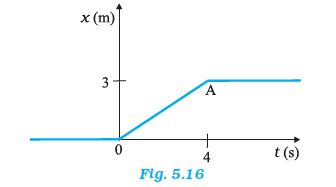
Figure 5.16 shows the position-time graph of a particle of mass 4 kg. What is the (b) impulse at $t = 0$ and $t = 4 s$ ? (Consider one-dimensional motion only).
Worksheet Answers
Solution:
Let the mass of the original nucleus be $M$. Since the nucleus is at rest in the laboratory frame of reference, its initial momentum $\vec{P}_{initial}$ is given by:
$\vec{P}_{initial} = M \times \vec{v} = M \times 0 = 0$
[Per the Principle of Conservation of Linear Momentum, if the net external force on a system is zero, the total linear momentum of the system remains conserved.]
The nucleus disintegrates into two smaller nuclei with masses $m_1$ and $m_2$ and velocities $\vec{v}_1$ and $\vec{v}_2$ respectively. The total final momentum $\vec{P}_{final}$ is the vector sum of the individual momenta of the products:
$\vec{P}_{final} = m_1\vec{v}_1 + m_2\vec{v}_2$
By the Law of Conservation of Momentum, the initial momentum must equal the final momentum:
$\vec{P}_{initial} = \vec{P}_{final}$
$0 = m_1\vec{v}_1 + m_2\vec{v}_2$
$m_1\vec{v}_1 = -m_2\vec{v}_2$
The negative sign in the relation $\vec{v}_1 = -\left(\frac{m_2}{m_1}\right)\vec{v}_2$ indicates that the velocity vector $\vec{v}_1$ points in the exact opposite direction of velocity vector $\vec{v}_2$. Since mass ($m$) is a scalar quantity and $m > 0$, the vectors are antiparallel [By the properties of vector multiplication by a scalar].
For the vector sum of two non-zero vectors to result in a null vector, the components must cancel each other out across all axes. In a one-dimensional disintegration, this necessitates that $\vec{v}_1$ and $\vec{v}_2$ possess equal and opposite directional orientation along the axis of separation.
Final Solution: Because the initial momentum of the stationary nucleus is zero, the total final momentum of the products must also be zero. This requires $m_1\vec{v}_1 = -m_2\vec{v}_2$, which mathematically necessitates that the two products move in opposite directions to satisfy the Law of Conservation of Momentum.
Solution:
The motion of the cricket ball is governed by Newton's Second Law, which states that the net force ($\vec{F}$) acting on an object is equal to the rate of change of its linear momentum ($\vec{p}$):
$F = \frac{dp}{dt} = \frac{m(v_f - v_i)}{\Delta t}$
Where:
From the derived expression $F = \frac{-m \cdot v_i}{\Delta t}$, it is observed that the impulsive force experienced by the cricketer's hands is inversely proportional to the time interval ($\Delta t$) during which the momentum of the ball is reduced to zero.
$F \propto \frac{1}{\Delta t}$ [Per the relationship between Impulse and Momentum]
When the cricketer keeps their hands stationary, the collision happens almost instantaneously. This small $\Delta t$ results in a very high impact force, which may cause injury. By moving the hands backwards, the cricketer increases the time interval ($\Delta t$) over which the ball comes to a complete rest.
| Parameter | Stationary Hands | Moving Hands (Backwards) |
|---|---|---|
| Time Interval ($\Delta t$) | Small | Large |
| Impact Force ($F$) | High ($F = \frac{\Delta p}{\text{small } \Delta t}$) | Low ($F = \frac{\Delta p}{\text{large } \Delta t}$) |
| Injury Risk | High | Minimized |
By increasing the duration ($\Delta t$) of the momentum change, the magnitude of the force ($F$) exerted on the hands is significantly reduced. This application of the Impulse-Momentum Theorem allows the cricketer to absorb the energy of the ball safely.
Final Solution: The cricketer moves his hands backwards to increase the time of impact ($\Delta t$). Since force is inversely proportional to time for a constant change in momentum, increasing the time results in a smaller impact force, thereby protecting the hands from injury.
Solution:
Let $m_1 = 10\text{ kg}$ (Body A) and $m_2 = 20\text{ kg}$ (Body B). Both bodies are connected by a light (massless) string on a smooth (frictionless) horizontal surface. An external force $F = 600\text{ N}$ is applied to body A (the 10 kg mass) in the direction of the string, pulling body B behind it.
Since the bodies are tied together by a light string, they move as a single composite system with common acceleration $a$ [Per Newton's Second Law of Motion].
The total mass of the system is $M = m_1 + m_2 = 10\text{ kg} + 20\text{ kg} = 30\text{ kg}$.
Applying Newton's Second Law to the composite system:
$F = M \cdot a$ $600\text{ N} = 30\text{ kg} \cdot a$ $a = \frac{600}{30} = 20\text{ m/s}^2$To find the tension $T$ in the string, we isolate body B ($m_2 = 20\text{ kg}$). The only horizontal force acting on body B is the tension $T$ exerted by the string [Per Newton's Third Law of Motion].
Applying Newton's Second Law to body B:
$T = m_2 \cdot a$Substituting the known values into the equation derived in Step 2:
$T = 20\text{ kg} \times 20\text{ m/s}^2$ $T = 400\text{ N}$| Parameter | Value |
|---|---|
| Total Mass ($M$) | $30\text{ kg}$ |
| System Acceleration ($a$) | $20\text{ m/s}^2$ |
| Tension ($T$) | $400\text{ N}$ |
Final Solution: The tension in the string when the force is applied to the 10 kg mass is 400 N.
Solution:
To determine the trajectory, we must analyze the kinematic state of the bob at the extreme position. In an oscillating pendulum, the bob reaches its maximum displacement at the extreme positions. At these points, the instantaneous velocity of the bob is zero ($v = 0 \text{ m/s}$) before it reverses direction [Per the Kinematics of Simple Harmonic Motion].
When the string is cut at the extreme position, the centripetal force ($T - mg\cos\theta$) vanishes instantaneously. The only force acting on the bob is the gravitational force ($F_g = mg$) directed vertically downwards [By Newton’s Second Law of Motion].
Since the initial velocity ($u$) is $0 \text{ m/s}$ at the moment of cutting, the bob possesses no horizontal component of velocity to initiate projectile motion. Consequently, the bob will experience free-fall motion solely under the influence of gravity.
Because the initial velocity vector $\vec{v} = 0$, the acceleration vector $\vec{a} = \vec{g}$ (directed downwards) defines the path of the particle. According to the laws of kinematics, if a particle is released from rest in a uniform gravitational field, it follows a straight-line vertical path [Per the Equation of Motion: $s = ut + \frac{1}{2}at^2$ where $u=0$].
| Parameter | Value at Extreme Position |
|---|---|
| Initial Velocity ($v_x$) | $0 \text{ m/s}$ |
| Initial Velocity ($v_y$) | $0 \text{ m/s}$ |
| Acceleration | $g = 9.8 \text{ m/s}^2$ (downward) |
Final Solution: The trajectory of the bob is a straight vertical line directed downwards, representing free-fall motion.
Solution:
To determine the impulse imparted to each billiard ball, we define the initial and final states of the system based on the provided data:
Impulse ($J$) is defined as the change in momentum ($\Delta p$) experienced by an object during a collision [Per the Impulse-Momentum Theorem]:
$J = \Delta p = p_{final} - p_{initial}$
$J = m(v - u)$
Substituting the values for the first ball:
$J_1 = m(v_1 - u_1)$
$J_1 = 0.05 \text{ kg} \times (-6\text{ m s}^{-1} - 6\text{ m s}^{-1})$
$J_1 = 0.05 \times (-12)$
$J_1 = -0.6\text{ kg m s}^{-1} \text{ (or N s)}$
Substituting the values for the second ball:
$J_2 = m(v_2 - u_2)$
$J_2 = 0.05 \text{ kg} \times (6\text{ m s}^{-1} - (-6\text{ m s}^{-1}))$
$J_2 = 0.05 \times (6 + 6)$
$J_2 = 0.05 \times 12$
$J_2 = +0.6\text{ kg m s}^{-1} \text{ (or N s)}$
The impulse imparted to each ball is equal in magnitude but opposite in direction, consistent with [Newton's Third Law of Motion], which dictates that action and reaction forces are equal and opposite.
| Ball | Initial Momentum ($p_i$) | Final Momentum ($p_f$) | Impulse ($J$) |
|---|---|---|---|
| Ball 1 | $+0.3 \text{ kg m/s}$ | $-0.3 \text{ kg m/s}$ | $-0.6 \text{ N s}$ |
| Ball 2 | $-0.3 \text{ kg m/s}$ | $+0.3 \text{ kg m/s}$ | $+0.6 \text{ N s}$ |
Final Solution: The magnitude of the impulse imparted to each ball is $0.6 \text{ kg m s}^{-1}$ (or $0.6 \text{ N s}$).
Solution:
To determine the net force acting on the pebble, we list the given variables based on the parameters provided in the problem statement:
According to [Newton’s Second Law of Motion], the net force ($\vec{F}_{\text{net}}$) acting on an object is the product of its mass ($m$) and its net acceleration ($\vec{a}$):
$\vec{F}_{\text{net}} = m \vec{a}$
During the upward motion of the pebble, ignoring air resistance as is standard in introductory classical mechanics problems of this type, the only force acting on the pebble is the gravitational force ($F_g$) exerted by the Earth, directed downwards [Per the Law of Universal Gravitation].
The magnitude of the gravitational force is calculated as follows:
$|F_g| = m \times g$
$|F_g| = 0.05 \text{ kg} \times 9.8 \text{ m/s}^2$
$|F_g| = 0.49 \text{ N}$
Since the only force acting on the object is gravity, the net force is equivalent to the weight of the pebble. By definition, gravity acts towards the center of the Earth [By the definition of Gravitational Field Vectors]. Therefore, the direction is vertically downwards.
| Parameter | Value/Direction |
|---|---|
| Magnitude | $0.49 \text{ N}$ |
| Direction | Vertically Downwards |
Final Solution: The net force on the pebble is $0.49 \text{ N}$ acting in the vertically downward direction.
Solution:
Mass of the pebble ($m$) = $0.05 \text{ kg}$
The only force acting on the object during its flight (neglecting air resistance) is the gravitational force exerted by the Earth.
Acceleration due to gravity ($g$) $\approx 9.8 \text{ m/s}^2$ [Directed vertically downwards]
According to Newton's Second Law of Motion ($F = ma$), the net force acting on a body is always in the direction of the acceleration [Per Newton's Second Law of Motion].
While the pebble is moving upwards, the gravitational force acts constantly towards the center of the Earth. Therefore, the direction of the net force is vertically downwards throughout the ascent.
The magnitude of the force ($F$) is calculated using the weight formula:
$F = m \times g$
$F = 0.05 \text{ kg} \times 9.8 \text{ m/s}^2$
$F = 0.49 \text{ N}$
Despite the pebble's upward velocity ($v$), the net force remains constant because gravity is an independent field force [Per Newton's Law of Universal Gravitation]. The upward motion is simply a result of the initial momentum imparted to the pebble, which is gradually depleted by the constant downward force.
Final Solution: The magnitude of the net force is $0.49 \text{ N}$ and its direction is vertically downwards.
Solution:
The system comprises a body of mass $m = 5 \text{ kg}$. The forces applied are $F_1 = 8 \text{ N}$ and $F_2 = 6 \text{ N}$, acting perpendicular to each other. [Per Newton's Second Law of Motion: $\vec{F} = m\vec{a}$].
Since the forces are perpendicular, the magnitude of the resultant force $F_{net}$ is calculated using the Pythagorean theorem, treating the forces as vectors in a 2D Cartesian plane [By Vector Addition Rule]:
$F_{net} = \sqrt{F_1^2 + F_2^2}$
$F_{net} = \sqrt{8^2 + 6^2} = \sqrt{64 + 36} = \sqrt{100} = 10 \text{ N}$
Using Newton's Second Law, $a = \frac{F_{net}}{m}$:
$a = \frac{10 \text{ N}}{5 \text{ kg}} = 2 \text{ m/s}^2$
The direction of acceleration $\theta$ coincides with the direction of the net force. Defining $\theta$ as the angle with respect to the $8 \text{ N}$ force:
$\tan(\theta) = \frac{F_2}{F_1} = \frac{6}{8} = 0.75$
$\theta = \arctan(0.75) \approx 36.87^\circ$
| Parameter | Value |
|---|---|
| Resultant Force ($F_{net}$) | $10 \text{ N}$ |
| Mass ($m$) | $5 \text{ kg}$ |
| Acceleration Magnitude ($a$) | $2 \text{ m/s}^2$ |
| Direction ($\theta$) | $36.87^\circ$ from the $8 \text{ N}$ force |
Final Solution: The magnitude of the acceleration is $2 \text{ m/s}^2$, and it is directed at an angle of $36.87^\circ$ from the direction of the $8 \text{ N}$ force.
Solution:
To determine the magnitude and direction of the force, we identify the following physical parameters provided in the problem statement:
Acceleration ($a$) is defined as the rate of change of velocity over time. [Per the definition of average acceleration in kinematics]:
$a = \frac{v - u}{\Delta t}$
Substituting the given values:
$a = \frac{3.5\text{ m s}^{-1} - 2.0\text{ m s}^{-1}}{25\text{ s}}$
$a = \frac{1.5\text{ m s}^{-1}}{25\text{ s}}$
$a = 0.06\text{ m s}^{-2}$
According to Newton's Second Law of Motion, the force ($F$) acting on an object is equal to the product of its mass ($m$) and acceleration ($a$):
$F = m \times a$ [Per Newton's Second Law: $F = \frac{dp}{dt} = ma$]
$F = 3.0\text{ kg} \times 0.06\text{ m s}^{-2}$
$F = 0.18\text{ N}$
Since the acceleration ($a = 0.06\text{ m s}^{-2}$) is positive and the initial velocity ($u = 2.0\text{ m s}^{-1}$) is also positive, the velocity vector is increasing in magnitude while maintaining its original orientation. [Per the relationship $\vec{F} = m\vec{a}$]:
| Parameter | Value |
|---|---|
| Acceleration ($a$) | $0.06\text{ m s}^{-2}$ |
| Force Magnitude ($F$) | $0.18\text{ N}$ |
| Direction | Same as direction of motion |
Final Solution: The magnitude of the force is 0.18 N, and it acts in the direction of the motion of the body.
Solution:
To determine the net force acting on the cork, we identify the following physical parameters:
Per Newton’s First Law of Motion, an object at rest or in uniform linear motion remains in that state unless acted upon by an external net force. Since the cork is floating at rest on the water surface, it is in a state of static equilibrium [Per the First Law of Motion].
The forces acting on the cork are:
In equilibrium, the vector sum of all forces must be zero. Let $\vec{F}_{net}$ be the net force:
$\vec{F}_{net} = \vec{W} + \vec{F}_b = 0$
Substituting the magnitudes:
$\vec{F}_{net} = (-mg)\hat{j} + (F_b)\hat{j} = 0$
Since the cork is floating, by the Law of Flotation, the weight of the displaced water equals the weight of the object. Thus, $F_b = mg$.
Calculating the magnitude of the gravitational force:
$|W| = 0.01\text{ kg} \times 9.8\text{ m/s}^2 = 0.098\text{ N}$
Since the forces are equal in magnitude and opposite in direction ($F_b = 0.098\text{ N}$ upwards, $W = 0.098\text{ N}$ downwards), the net force is:
$F_{net} = 0.098\text{ N} - 0.098\text{ N} = 0\text{ N}$
| Force Component | Magnitude | Direction |
|---|---|---|
| Gravitational (Weight) | $0.098\text{ N}$ | Downward |
| Buoyant | $0.098\text{ N}$ | Upward |
| Net Force | 0 N | N/A |
Final Solution: The magnitude of the net force acting on the cork is 0 N. Consequently, there is no direction for the net force.
Solution:
Based on the standard physics problem description for this figure (where $x=0$ at $t < 0$, $x=3t$ for $0 < t < 4$, and $x=12$ for $t > 4$):
| Time Interval ($s$) | Position Equation ($x$) | Velocity ($v = \frac{dx}{dt}$) |
|---|---|---|
| $t < 0$ | $0$ | $0 \text{ m/s}$ |
| $0 < t < 4$ | $3t$ | $3 \text{ m/s}$ |
| $t > 4$ | $12$ | $0 \text{ m/s}$ |
At $t = 0$, the particle transitions from rest to a velocity of $3 \text{ m/s}$.
At $t = 4$, the particle transitions from a velocity of $3 \text{ m/s}$ to rest ($0 \text{ m/s}$).
Final Solution: The impulse at $t = 0 \text{ s}$ is $12 \text{ kg}\cdot\text{m/s}$, and the impulse at $t = 4 \text{ s}$ is $-12 \text{ kg}\cdot\text{m/s}$.
Solution:
First, we convert all given quantities into SI units for consistency [Per International System of Units standards].
To find the average retarding force, we must first determine the deceleration ($a$) of the vehicle using the first equation of motion [By Kinematic Equation of Motion]:
$v = u + at$
$0 = 10 + a(4.0)$
$4a = -10$
$a = -2.5 \text{ m/s}^2$
The negative sign indicates a retardation (deceleration) of $2.5 \text{ m/s}^2$.
Using Newton's Second Law of Motion, which states that the force acting on an object is equal to the product of its mass and acceleration ($F = ma$) [Per Newton’s Second Law]:
$F = M \times a$
$F = 465 \text{ kg} \times (-2.5 \text{ m/s}^2)$
$F = -1162.5 \text{ N}$
The retarding force represents the resistive force applied by the brakes against the direction of motion. Since the magnitude is requested, we express the force as a positive retarding value.
| Parameter | Value |
|---|---|
| Total Mass | $465 \text{ kg}$ |
| Deceleration | $2.5 \text{ m/s}^2$ |
| Retarding Force | $1162.5 \text{ N}$ |
Final Solution: The average retarding force acting on the vehicle is 1162.5 N.
Solution:
The system under consideration is a high-speed electron located in deep space. The environment is explicitly defined as void of material objects, electric fields ($\vec{E} = 0$), and magnetic fields ($\vec{B} = 0$).
Newton’s First Law of Motion, also known as the Law of Inertia, states that an object will remain at rest or continue to move at a constant velocity unless acted upon by a net external force [Per Newton’s First Law of Motion].
The net force $\vec{F}_{net}$ acting on a charged particle in the presence of electromagnetic fields is defined by the Lorentz Force Law:
$\vec{F}_{net} = q(\vec{E} + \vec{v} \times \vec{B})$
Given the constraints:
Substituting these values into the Lorentz equation:
$\vec{F}_{net} = -e(0 + \vec{v} \times 0)$
$\vec{F}_{net} = 0$
Since the resultant vector of the net force is the null vector ($\vec{0}$), the magnitude of the force is zero. Because the magnitude is zero, the direction of the net force is undefined or irrelevant, as there is no force vector to orient.
In the absence of any external agents capable of doing work or exerting a pressure on the electron, the momentum of the electron remains invariant. Since $\vec{F} = \frac{d\vec{p}}{dt}$ [Per Newton's Second Law], and the rate of change of momentum is zero for an isolated particle moving at constant velocity, the net force must be zero.
Final Solution: The magnitude of the net force is $0 \, \text{N}$. The direction is undefined, as no force is acting upon the electron.
Solution:
To determine the reading on the weighing scale, we must identify the forces acting on the man of mass $m$ within the non-inertial reference frame of the accelerating lift.
The forces acting on the man are:
[Per Newton’s Second Law of Motion: $F_{net} = ma$]
Since the lift is accelerating downwards, the net force is directed downwards. Applying Newton's Second Law along the vertical axis:
$mg - R = ma$
[Rearranging for $R$]:
$R = mg - ma$
$R = m(g - a)$
Substitute the given numerical values into the derived expression:
$R = 70 \times (9.8 - 5)$
$R = 70 \times (4.8)$
$R = 336\text{ N}$
Weighing scales calibrated for mass typically output the value in kg. To find the effective mass ($m_{eff}$) shown on the scale, we divide the normal reaction by the acceleration due to gravity ($g$):
$m_{eff} = \frac{R}{g} = \frac{336}{9.8} \approx 34.28\text{ kg}$
Final Solution: The reading on the scale would be $336\text{ N}$ (or an equivalent mass reading of approximately $34.28\text{ kg}$).
Solution:
To analyze the motion of a horse-cart system, we must apply Newton’s Third Law of Motion: "To every action, there is always an equal and opposite reaction." [Per Newton’s Third Law]. In the context of locomotion, the horse exerts a backward horizontal force ($F_{h}$) on the ground. Simultaneously, the ground exerts an equal and opposite forward reaction force ($F_{g}$) on the horse's hooves. This reaction force is the primary external force responsible for the horse's acceleration.
In "empty space" (vacuum, devoid of a terrestrial surface), the following conditions prevail:
The following diagram illustrates the necessary interaction between the horse and the ground in a standard environment, which is impossible in empty space.
In empty space, the horse lacks the requisite external force to initiate motion. Even if the horse exerts internal effort (muscle contraction), these forces are internal to the horse-cart system. According to the principle of conservation of momentum, internal forces cannot change the total momentum of a system [Per Newton’s Third Law and the Law of Conservation of Momentum].
| Parameter | Terrestrial Environment | Empty Space |
|---|---|---|
| External Force ($F_{g}$) | Available (Friction/Normal) | Zero |
| System Acceleration | Possible | Impossible |
| Newton's 3rd Law Application | Valid via ground interaction | No interaction point |
Final Solution: A horse cannot pull a cart in empty space because locomotion requires an external reaction force from the ground. Since empty space lacks a surface to push against, the reaction force ($F_{g}$) is non-existent, resulting in a net force of zero and, consequently, zero acceleration of the horse-cart system.
Solution:
Given parameters at the mean position ($x = 0$):
At the mean position, the velocity vector $\vec{v}$ is directed horizontally (tangent to the arc of the swing). Thus, $\vec{v} = 1 \, \hat{i} \, \text{m/s}$ (assuming the bob is moving in the $x-y$ plane).
The moment the string is cut, the tension force $T$ becomes zero. The bob is subjected only to the gravitational force $\vec{F}_g = m\vec{g} = -mg \, \hat{j}$.
According to [Newton's First Law of Motion], the object will maintain its current velocity vector unless acted upon by an external force. Per [Newton's Second Law], the acceleration acting on the bob is solely the acceleration due to gravity, $g \approx 9.8 \, \text{m/s}^2$ downward.
The bob acts as a projectile launched horizontally from a height $h = 2 \, \text{m}$ (length of the string) with initial velocity $u_x = 1 \, \text{m/s}$ and $u_y = 0 \, \text{m/s}$.
The position coordinates at time $t$ are given by:
$x(t) = u_x t = 1 \cdot t$
$y(t) = h - \frac{1}{2}gt^2 = 2 - 4.9t^2$
Eliminating $t$ by substituting $t = x$ into the $y$ equation yields the parabolic trajectory:
$y = 2 - 4.9x^2$
Since the bob possesses a horizontal velocity component at the moment of detachment and is subject to a constant downward acceleration, the bob follows a parabolic trajectory. This is defined by the kinematics of horizontal projectile motion under constant gravity [per the Equivalence Principle and Newtonian Dynamics].
Final Solution: The trajectory of the bob is a parabola, as it undergoes horizontal motion with constant velocity while simultaneously accelerating vertically downward under gravity.
Solution:
The raindrop is described as falling with a constant speed. By definition, if the speed of the object is constant and its direction of motion remains vertical (downward), the velocity vector $\vec{v}$ is constant. According to the definition of acceleration, $\vec{a} = \frac{d\vec{v}}{dt}$. Since $\vec{v}$ is constant, the acceleration $\vec{a} = 0$.
According to Newton's Second Law of Motion, the net force $\vec{F}_{net}$ acting on an object is proportional to its mass $m$ and its acceleration $\vec{a}$, expressed as:
$\vec{F}_{net} = m\vec{a}$ [Per Newton's Second Law of Motion]
Substituting $\vec{a} = 0$ m/s² into the equation:
$\vec{F}_{net} = m \times 0$
$\vec{F}_{net} = 0$ N
While the net force is zero, the individual forces acting on the raindrop are non-zero. The system is in a state of dynamic equilibrium. The forces acting on the raindrop are:
Since $\vec{F}_{net} = \vec{W} + \vec{F}_d = 0$, it implies $\vec{F}_d = -\vec{W}$. The upward resistive force is equal in magnitude to the gravitational force.
Given that the object is in terminal velocity (a state where gravity is balanced by drag), the vector sum of all forces is identically zero. Therefore, there is no net force to assign a specific direction to.
Final Solution: The magnitude of the net force is 0 N; as the net force is zero, it has no direction.
Solution:
According to Newton's First Law of Motion (also known as the Law of Inertia), an object remains at rest or in a state of uniform motion in a straight line unless acted upon by a net external force. This is mathematically expressed by the condition of acceleration: $\vec{a} = \frac{d\vec{v}}{dt} = 0$ [Since $\vec{v}$ is constant].
The problem states the car is moving with a constant velocity: $v = 30 \text{ km/h} = \text{constant}$
Since the velocity magnitude and direction are unchanging, the acceleration $\vec{a}$ of the vehicle is zero.
The net force ($\vec{F}_{net}$) acting on an object of mass ($m$) is given by Newton's Second Law of Motion: $\vec{F}_{net} = m \cdot \vec{a}$
Substituting the condition derived from Step 2: $\vec{F}_{net} = m \cdot 0 = 0$
On a rough road, the car experiences several forces: gravity ($mg$) acting downward, the normal reaction ($N$) from the ground, the driving force ($F_d$) provided by the engine, and the retarding force of friction ($f_r$).
For constant velocity, the system is in Dynamic Equilibrium. The sum of all horizontal forces must be zero:
Since the car maintains constant velocity, the magnitude of the forward driving force ($F_d$) perfectly balances the magnitude of the frictional force ($f_r$), resulting in a net force of zero.
| Parameter | Value |
|---|---|
| Magnitude of Net Force | $0 \text{ N}$ |
| Direction | Not defined (since the magnitude is zero) |
Final Solution: The magnitude of the net force acting on the car is 0 N. Because the net force is zero, there is no direction associated with it.
Solution:
Let the initial nucleus have a mass $M$ and be at rest in the laboratory frame of reference. The initial momentum $\vec{p}_i$ of the system is given by:
$\vec{p}_i = M \cdot \vec{v}_i = M \cdot 0 = 0$ [Per the definition of momentum, $\vec{p} = m\vec{v}$]
Upon disintegration, the nucleus splits into two smaller nuclei with masses $m_1$ and $m_2$ and velocities $\vec{v}_1$ and $\vec{v}_2$, respectively. According to the Law of Conservation of Linear Momentum, the total momentum of the system must remain constant in the absence of external forces:
$\vec{p}_i = \vec{p}_f$
$0 = m_1\vec{v}_1 + m_2\vec{v}_2$ [Per the Law of Conservation of Linear Momentum]
Rearranging the conservation equation to solve for the relationship between the final momentum vectors:
$m_1\vec{v}_1 = -m_2\vec{v}_2$
Let $\vec{p}_1 = m_1\vec{v}_1$ and $\vec{p}_2 = m_2\vec{v}_2$. Then:
$\vec{p}_1 = -\vec{p}_2$
This result signifies that the momentum of the second nucleus must be equal in magnitude and opposite in direction to the momentum of the first nucleus to maintain a net system momentum of zero.
Since $m_1$ and $m_2$ are scalar mass values ($m_1, m_2 > 0$), the negative sign in the equation $\vec{v}_1 = -\frac{m_2}{m_1}\vec{v}_2$ mandates that the direction of the velocity vector $\vec{v}_1$ must be $180^\circ$ relative to the velocity vector $\vec{v}_2$. If they did not move in opposite directions, the vector sum of their momenta would yield a non-zero resultant, violating the principle of conservation of linear momentum in an isolated system.
Final Solution: Because the initial momentum of the stationary nucleus is zero, the final total momentum must also be zero. This requires the products to have equal and opposite momentum vectors, $\vec{p}_1 = -\vec{p}_2$, mathematically necessitating movement in exactly opposite directions.
Solution:
According to [Newton's Second Law of Motion], the net force acting on the man is equal to the product of his mass and his acceleration ($\sum F = ma$).
Since the man is moving upward with acceleration $a$, the upward force ($R$) must be greater than the downward force ($mg$).
The equation of motion is:
$R - mg = ma$ [Per the principle of non-inertial frames or force balance in an accelerating reference frame]Rearranging the equation to solve for the reading on the scale ($R$):
$R = m(g + a)$Substituting the given numerical values:
$R = 70 \text{ kg} \times (9.8 \text{ m/s}^2 + 5 \text{ m/s}^2)$ $R = 70 \text{ kg} \times (14.8 \text{ m/s}^2)$ $R = 1036 \text{ N}$Weighing scales in lifts are typically calibrated to display mass in kilograms by dividing the normal force by the standard gravitational acceleration ($g = 9.8\text{ m/s}^2$).
Reading ($m_{apparent}$) = $\frac{R}{g}$
$m_{apparent} = \frac{1036}{9.8} \approx 105.71 \text{ kg}$Final Solution: The reading on the scale would be 1036 N, which corresponds to an apparent mass of approximately 105.71 kg.


