


Your Worksheet is Ready
CBSE - Class 11 Physics Laws of Motion Worksheet
Additional Exercises
Two bodies A and B of masses 5 kg and 10 kg in contact with each other rest on a table against a rigid wall (Fig. 5.21). The coefficient of friction between the bodies and the table is 0.15. A force of 200 N is applied horizontally to A. What are (a) the reaction of the partition

Figure 5.18 shows a man standing stationary with respect to a horizontal conveyor belt that is accelerating with $1 m s^{-2}$. What is the net force on the man? If the coefficient of static friction between the man’s shoes and the belt is 0.2, up to what acceleration of the belt can the man continue to be stationary relative to the belt ? (Mass of the man = 65 kg.)


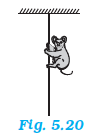
A monkey of mass 40 kg climbs on a rope (Fig. 5.20) which can stand a maximum tension of 600 N. In which of the following cases will the rope break: the monkey (a) climbs up with an acceleration of $6 m s^{-2}$
A block of mass 25 kg is raised by a 50 kg man in two different ways as shown in Fig. 5.19. What is the action on the floor by the man in the two cases ? If the floor yields to a normal force of 700 N, which mode should the man adopt to lift the block without the floor yielding ?

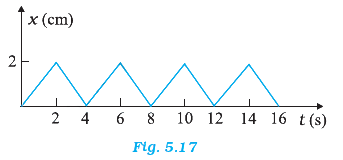
Figure 5.17 shows the position-time graph of a body of mass 0.04 kg. Suggest a suitable physical context for this motion. What is the time between two consecutive impulses received by the body ? What is the magnitude of each impulse ?
A monkey of mass 40 kg climbs on a rope (Fig. 5.20) which can stand a maximum tension of 600 N. In which of the following cases will the rope break: the monkey (b) climbs down with an acceleration of $4 m s^{-2}$

Worksheet Answers
Solution:
The normal force ($N$) exerted by the table on the system is equal to the total weight of the two bodies. [Per Newton's Third Law and Equilibrium condition $\sum F_y = 0$]:
$N_{total} = (m_A + m_B)g = (5 + 10) \times 9.8 = 15 \times 9.8 = 147 \text{ N}$
The total force of limiting friction ($f_{max}$) acting against the applied force is:
$f_{max} = \mu_k \times N_{total} = 0.15 \times 147 = 22.05 \text{ N}$
The system is in contact with a rigid wall. Before calculating the reaction, we must determine if the system moves. If the applied force ($F$) is greater than the frictional force ($f_{max}$), the system would tend to slide. However, the system is blocked by a rigid wall. Thus, the system is in static equilibrium.
Total applied external force: $F = 200 \text{ N}$
Total opposing frictional force: $f_{max} = 22.05 \text{ N}$
Since $F > f_{max}$, the bodies would move if the wall were not present. Because the wall exists, it provides an additional normal reaction ($R$) to maintain static equilibrium.
Applying the condition for static equilibrium ($\sum F_x = 0$):
$F - f_{total} - R = 0$
Where $R$ is the reaction of the wall against the body B.
$R = F - f_{total} = 200 \text{ N} - 22.05 \text{ N} = 177.95 \text{ N}$
The reaction of the wall is the force required to counteract the net imbalance between the applied horizontal force and the frictional resistance provided by the surface of the table. By the Principle of Transmissibility and Static Equilibrium, the wall exerts an equal and opposite force to the net force applied by the blocks onto the wall.
Final Solution: The reaction of the wall (partition) is 177.95 N directed opposite to the applied force.
Solution:
Given parameters for the man:
As the man is stationary with respect to the belt, he moves with the same acceleration as the belt. According to Newton's Second Law of Motion [$\vec{F}_{net} = m\vec{a}$]:
$F_{net} = 65\ kg \times 1\ m/s^2 = 65\ N$
The net force acting on the man is provided by the static frictional force between the shoes and the belt.
The man remains stationary relative to the belt as long as the required frictional force does not exceed the maximum limiting static friction ($f_{s,max}$).
The normal force ($N$) exerted by the belt on the man is equal to his weight [Per Newton's Third Law]:
$N = mg = 65\ kg \times 9.8\ m/s^2 = 637\ N$
The limiting static friction force is calculated as:
$f_{s,max} = \mu_s N = 0.2 \times 637\ N = 127.4\ N$
To remain stationary, the force of friction must satisfy the condition $F_{applied} \leq f_{s,max}$. Thus, the maximum acceleration ($a_{max}$) is constrained by:
$ma_{max} = \mu_s mg$
$a_{max} = \mu_s g$
$a_{max} = 0.2 \times 9.8\ m/s^2 = 1.96\ m/s^2$
Final Solution: The net force on the man is $65\ N$. The man can continue to remain stationary relative to the belt up to a maximum acceleration of $1.96\ m/s^2$.
Solution:
At the lowest point of the vertical circle, the stone is subjected to two primary forces acting along the vertical axis:
The net force provides the necessary centripetal force directed towards the center. Therefore, the equation of motion is:
$T_1 - mg = \frac{mv_1^2}{R}$ [Per Newton's Second Law of Motion]
The question asks for the net force directed downwards. Since the centripetal force is directed upwards (towards the center at the bottom), the downward force is the negative of the centripetal force:
$F_{\text{net, down}} = -(T_1 - mg) = mg - T_1$
At the highest point of the vertical circle, both forces act in the same direction:
The sum of these forces provides the centripetal force required for circular motion:
$T_2 + mg = \frac{mv_2^2}{R}$ [Per Newton's Second Law of Motion]
Since both forces are acting vertically downwards, the net force directed downwards is simply the sum:
$F_{\text{net, down}} = T_2 + mg$
| Point | Net Force (Downwards) |
|---|---|
| Lowest Point | $mg - T_1$ |
| Highest Point | $T_2 + mg$ |
Final Solution: The net force directed vertically downwards at the lowest point is $(mg - T_1)$ and at the highest point is $(T_2 + mg)$.
Solution:
When the floor is removed, the man is held against the wall by the normal reaction ($N$) provided by the wall. The forces acting on the man are:
For the man to remain in equilibrium vertically, the static friction must balance the weight:
$f = mg$ [Condition for equilibrium]
We know the maximum limiting friction is $f \leq \mu_s N$. Therefore, to prevent sliding:
$\mu_s N \geq mg$
The normal force provides the centripetal acceleration ($a_c = \omega^2 r$):
$N = m\omega^2 r$ [By Newton’s Second Law for circular motion]
Substituting $N$ into the friction inequality:
$\mu_s (m\omega^2 r) \geq mg$
$\omega^2 \geq \frac{g}{\mu_s r}$
$\omega_{min} = \sqrt{\frac{g}{\mu_s r}}$
$\omega_{min} = \sqrt{\frac{9.8}{0.15 \times 3}}$
$\omega_{min} = \sqrt{\frac{9.8}{0.45}} \approx \sqrt{21.777} \approx 4.667 \text{ rad/s}$
Relationship: $\omega = 2\pi n$ where $n$ is in rev/s.
For rev/min ($N_{rpm}$): $N_{rpm} = \frac{\omega \times 60}{2\pi}$
$N_{rpm} = \frac{4.667 \times 60}{2 \times 3.14159} \approx \frac{280.02}{6.283} \approx 44.57 \text{ rev/min}$
| Variable | Calculated Value |
|---|---|
| Min Angular Velocity ($\omega$) | $4.67 \text{ rad/s}$ |
| Min Rotational Speed ($n$) | $44.57 \text{ rev/min}$ |
Final Solution: The minimum rotational speed required for the man to remain stuck to the wall is approximately 44.57 rev/min.
Solution:
To determine if the rope breaks, we must calculate the tension $T$ exerted on the rope by the monkey. The system is governed by Newton's Second Law of Motion.
The forces acting on the monkey are the upward tension ($T$) of the rope and the downward force of gravity ($mg$). Per Newton's Second Law ($\sum F = ma$), where the upward direction is considered positive:
Applying the equation of motion:
$T - mg = ma$ [Per Newton's Second Law]Substituting the given values into the equation:
$T = 40 \text{ kg} \times (9.8 \text{ m/s}^2 + 6 \text{ m/s}^2)$We compare the calculated tension $T$ with the given maximum threshold $T_{max}$:
| Parameter | Value |
|---|---|
| Calculated Tension ($T$) | $632 \text{ N}$ |
| Max Tension ($T_{max}$) | $600 \text{ N}$ |
Since $T > T_{max}$ ($632 \text{ N} > 600 \text{ N}$), the tension exerted exceeds the physical limit of the material integrity of the rope.
Final Solution: The rope will break, as the tension exerted ($632 \text{ N}$) exceeds the maximum breaking tension of the rope ($600 \text{ N}$).
Solution:
To determine the force exerted by the air on the helicopter, we define the following parameters:
We apply Newton's Second Law of Motion. The forces acting on the helicopter system are the gravitational force acting downwards ($F_g = Mg$) and the upward lift force exerted by the surrounding air ($F_a$).
Per [Newton's Second Law of Motion], the net force is the product of the total mass and the acceleration:
$\sum F = Ma$
$F_a - Mg = Ma$
Where $F_a$ is the upward force of the air and $Mg$ is the downward gravitational force.
Rearranging the equation to solve for $F_a$:
$F_a = M(g + a)$
Substituting the known values:
$F_a = 1300 \, \text{kg} \times (9.8 \, \text{m s}^{-2} + 15 \, \text{m s}^{-2})$
$F_a = 1300 \, \text{kg} \times (24.8 \, \text{m s}^{-2})$
$F_a = 32240 \, \text{N}$
The calculation yields a value of $3.224 \times 10^4 \, \text{N}$. Because the result is positive, the direction of the force must be consistent with the upward acceleration of the helicopter system.
Final Solution: The magnitude of the force on the helicopter due to the surrounding air is $3.224 \times 10^4 \, \text{N}$, directed vertically upwards.
Solution:
In this problem, we analyze the motion of a mass $m = 15 \text{ kg}$ placed on a trolley. We are tasked with describing the motion from the perspective of an observer moving with the trolley. The trolley's acceleration is $a_t = 0.5 \text{ m s}^{-2}$.
The maximum force of static friction available to keep the block stationary relative to the trolley is:
$f_{s,max} = \mu_s N = \mu_s mg$ [By the definition of static friction]
$f_{s,max} = 0.18 \times 15 \text{ kg} \times 9.8 \text{ m s}^{-2} = 26.46 \text{ N}$
An observer on the trolley is in a non-inertial frame of reference because the trolley accelerates. To apply Newton’s Laws in this frame, we must introduce a pseudo-force $F_p$ acting on the block in the direction opposite to the trolley's acceleration [Per D'Alembert's Principle].
$F_p = m \times a_t$
$F_p = 15 \text{ kg} \times 0.5 \text{ m s}^{-2} = 7.5 \text{ N}$
The pseudo-force $F_p = 7.5 \text{ N}$ acts on the block. Since $F_p < f_{s,max}$ ($7.5 \text{ N} < 26.46 \text{ N}$), the force of static friction $f_s$ exactly balances the pseudo-force to keep the block at rest relative to the trolley.
At $t = 20 \text{ s}$, the trolley stops accelerating ($a_t = 0$) and moves with a uniform velocity. Consequently, the pseudo-force $F_p$ becomes zero.
| Phase | Status of Block relative to Trolley | Reasoning |
|---|---|---|
| $0 \le t \le 20 \text{ s}$ | Stationary | Static friction ($7.5 \text{ N}$) exceeds pseudo-force ($7.5 \text{ N}$). |
| $t > 20 \text{ s}$ | Stationary | Pseudo-force vanishes; no net force acting. |
Final Solution: An observer moving with the trolley will perceive the block to be at rest at all times, as the static friction is sufficient to counteract the pseudo-force during acceleration, and no forces act once the trolley moves with uniform velocity.
Solution:
To determine the force exerted by a stream of water on a wall, we apply Newton’s Second Law of Motion in terms of momentum [Per Newton's Second Law of Motion, $F = \frac{dp}{dt}$].
The mass ($m$) of the water hitting the wall per unit time ($t$) is determined by the volume of the water stream passing through the cross-section per second, multiplied by the density.
Volume of water per second ($V/t$) = $A \times v$
Mass flow rate ($\frac{dm}{dt}$) = $\rho \times A \times v$
Substituting the given values:
$\frac{dm}{dt} = (10^3 \, kg \, m^{-3}) \times (10^{-2} \, m^2) \times (15 \, ms^{-1})$
$\frac{dm}{dt} = 10 \times 15 = 150 \, kg \, s^{-1}$
According to the impulse-momentum theorem, the force ($F$) exerted on the wall is equal to the rate of change of momentum of the water stream.
$F = \frac{dp}{dt} = \frac{d(mv)}{dt} = v \frac{dm}{dt}$
Since the water stops upon hitting the wall, the change in velocity is $(\Delta v) = v - 0 = v$.
$F = \left(\frac{dm}{dt}\right) \times v$
$F = 150 \, kg \, s^{-1} \times 15 \, ms^{-1}$
$F = 2250 \, N$
| Parameter | Value |
|---|---|
| Density ($\rho$) | $10^3 \, kg/m^3$ |
| Mass Flow Rate ($dm/dt$) | $150 \, kg/s$ |
| Force ($F$) | $2250 \, N$ |
Final Solution: The force exerted on the wall by the impact of water is 2250 N.
Solution:
We consider a vertical stack of $n = 10$ identical coins, each of mass $m$. The force exerted on a specific coin due to the coins resting above it is determined solely by the weight of those coins acting under the influence of gravity ($g = 9.8 \, \text{m/s}^2$).
To find the number of coins resting on top of the 7th coin, we subtract its position from the total number of coins in the stack [Per the principle of vertical superposition].
Number of coins above the 7th coin ($n_{above}$):
$n_{above} = N - k$
$n_{above} = 10 - 7 = 3$
There are exactly 3 coins (the 8th, 9th, and 10th coins) resting on top of the 7th coin.
The force exerted on the 7th coin by the coins above it is the gravitational force exerted by the combined mass of those 3 coins [Per Newton’s Second Law of Motion: $F = ma$].
Total mass above the 7th coin ($M_{above}$):
$M_{above} = n_{above} \times m = 3m$
The magnitude of the force ($F$):
$F = M_{above} \times g = 3mg$
Since the force is due to gravity acting on the mass above the 7th coin, the direction is vertically downward [Per the definition of the gravitational field direction].
| Parameter | Value |
|---|---|
| Number of coins above | $3$ |
| Magnitude of force | $3mg$ |
| Direction | Vertically downward |
Final Solution: The magnitude of the force on the 7th coin is $3mg$, and the direction is vertically downward.
Solution:
To analyze the motion of a block of mass $m$ placed on an accelerating trolley, we define the following parameters:
The maximum static frictional force $f_{s,max}$ is defined by the normal reaction $N = mg$ acting on the block:
$f_{s,max} = \mu_s \cdot N = \mu_s \cdot mg$
$f_{s,max} = 0.18 \times 15 \, \text{kg} \times 9.8 \, \text{ms}^{-2} = 26.46 \, \text{N}$
The force required to keep the block accelerating with the trolley at $a = 0.5 \, \text{ms}^{-2}$ is:
$F_{required} = m \cdot a = 15 \, \text{kg} \times 0.5 \, \text{ms}^{-2} = 7.5 \, \text{N}$
Since $F_{required} < f_{s,max}$ ($7.5 \, \text{N} < 26.46 \, \text{N}$), the block does not slide relative to the trolley. It moves with the same acceleration $a$ as the trolley [By Newton’s First Law, since no relative motion occurs, the block acts as a part of the trolley system].
The motion as viewed by an observer on the ground is divided into two distinct phases:
| Phase | Time Interval | Observed Motion |
|---|---|---|
| Phase 1 | $0 \leq t \leq 20 \, \text{s}$ | The block accelerates with $a = 0.5 \, \text{ms}^{-2}$. Velocity $v(t) = a \cdot t$. |
| Phase 2 | $t > 20 \, \text{s}$ | The trolley reaches a constant velocity $v = 0.5 \times 20 = 10 \, \text{ms}^{-1}$. The block moves with uniform velocity $10 \, \text{ms}^{-1}$. |
From the ground frame:
Final Solution: The observer on the ground sees the block accelerate at $0.5 \, \text{ms}^{-2}$ for $20 \, \text{s}$ until it reaches a velocity of $10 \, \text{ms}^{-1}$, after which it continues to move at a constant velocity of $10 \, \text{ms}^{-1}$.
Solution:
We consider a vertical stack of $10$ identical one-rupee coins, each of mass $m$, arranged such that coin 1 is at the bottom and coin 10 is at the top. The gravitational force acting on each coin is $W = mg$. We define the reaction force as the upward normal force exerted by one coin on the coin immediately above it to support the weight of the coins above that interface [Per Newton’s Third Law of Motion].
For any coin $n$ (where $n=1$ being the bottom-most and $n=10$ being the top-most), the coin is in a state of static equilibrium [Per Newton’s First Law of Motion]. The forces acting on coin $n$ are:
To determine the reaction of the 6th coin on the 7th coin, we must isolate the system consisting of the 7th, 8th, 9th, and 10th coins. The total mass of this subsystem is:
$M_{total} = m_7 + m_8 + m_9 + m_{10} = 4m$
The total downward force exerted by this subsystem on the 6th coin is the weight of these 4 coins:
$F_{down} = 4mg$ [Calculated by the force of gravity equation $F = ma$, where $a=g$]
The 6th coin exerts an upward reaction force $R$ on the 7th coin to counteract the weight of the coins above it (7 through 10) to maintain equilibrium [Per Newton’s Third Law: For every action, there is an equal and opposite reaction].
$R = \text{Weight of coins } \{7, 8, 9, 10\}$
$R = 4mg$
The magnitude of the reaction force is the weight of all coins supported by the 6th coin. Since there are 4 coins resting on the 6th coin, the magnitude is $4mg$. The direction of the reaction force exerted by the 6th coin on the 7th coin is vertically upward.
Final Solution: The magnitude of the reaction of the 6th coin on the 7th coin is $4mg$, and the direction is vertically upward.
Solution:
To maintain consistency in SI units, we convert the aircraft's velocity from $\text{km/h}$ to $\text{m/s}$.
For an aircraft banking at an angle $\theta$ during a horizontal loop, the forces acting are:
Resolving the lift force into components:
Rearranging the formula to solve for $R$:
$$R = \frac{v^2}{g \tan \theta}$$Substituting the values:
$$R = \frac{(200)^2}{9.8 \times \tan(15^\circ)}$$Using $\tan(15^\circ) \approx 0.2679$:
$$R = \frac{40000}{9.8 \times 0.2679}$$ $$R = \frac{40000}{2.62542} \approx 15235.67 \text{ m}$$Given the magnitude of the velocity and the banking angle, the radius of the circular path is approximately $15.24 \text{ km}$.
Final Solution: $R \approx 1.52 \times 10^4 \text{ m}$ or $15.24 \text{ km}$
Solution:
To perform calculations in the SI system, we convert the speed from $\text{km/h}$ to $\text{m/s}$.
In the case of a train on an unbanked circular track, the centripetal force required to keep the train in circular motion is provided by the lateral thrust of the outer rail against the wheel flanges [Per Newton’s Third Law of Motion]. The engine provides the tractive force (tangential force) to overcome rolling friction and air resistance, but it does not provide the radial centripetal force required for turning. The rails exert a normal reaction force on the flanges, which acts as the centripetal force.
To prevent the lateral wear of the rails, the track should be banked at an angle $\theta$ such that the necessary centripetal force is provided by the horizontal component of the normal reaction force. The formula for the banking angle is given by:
$\tan(\theta) = \frac{v^2}{rg}$
Substitute the values into the banking equation:
$\tan(\theta) = \frac{(15)^2}{30 \times 9.8}$
$\tan(\theta) = \frac{225}{294}$
$\tan(\theta) \approx 0.7653$
Calculating the inverse tangent: $\theta = \arctan(0.7653) \approx 37.43^\circ$
| Parameter | Value |
|---|---|
| Centripetal Source | Lateral thrust of outer rail |
| Required $\theta$ | $37.43^\circ$ |
Final Solution: The centripetal force is provided by the lateral thrust of the outer rail against the wheel flanges. The required angle of banking to prevent rail wear is approximately $37.43^\circ$.
Solution:
In this configuration, the man pulls the rope downwards to lift the block. To lift the block, the man must exert a force equal to the block's weight ($T = W_m = 245\text{ N}$).
Step 1: Calculating the Normal Force ($R_1$)
Per the free-body diagram of the man: the man experiences his own weight ($W_M$) downward, the reaction force from the floor ($R_1$) upward, and the tension force of the rope ($T$) upward (as he pulls down on the rope, the rope pulls up on his hands).
Equation of equilibrium: $R_1 + T = W_M$
$R_1 + 245 = 490$
$R_1 = 490 - 245 = 245\text{ N}$
[By Newton's Third Law, the action on the floor is equal to the normal reaction $R_1$.]
In this configuration, the man holds the block directly, effectively adding the weight of the block to his own weight acting on the floor.
Step 1: Calculating the Normal Force ($R_2$)
The man and the block are in static equilibrium as a combined system resting on the floor.
Equation of equilibrium: $R_2 = W_M + W_m$
$R_2 = 490 + 245 = 735\text{ N}$
[By Newton's Third Law, the action on the floor is $735\text{ N}$.]
| Method | Action on Floor ($N$) | Floor Status |
|---|---|---|
| Case 1 (Pulley) | $245$ | Safe ($< 700\text{ N}$) |
| Case 2 (Direct) | $735$ | Yields ($> 700\text{ N}$) |
Final Solution: The man should adopt Case 1 (the pulley system) to lift the block. In Case 1, the action on the floor is 245 N. In Case 2, the action on the floor is 735 N, which exceeds the floor's capacity of 700 N, causing it to yield.
Solution:
Based on the provided motion profile, the particle undergoes periodic motion where the position $x$ varies linearly with time $t$ between fixed bounds. The slope of the $x$-$t$ graph represents velocity $v = \frac{dx}{dt}$.
The motion corresponds to a particle of mass $m = 0.04\text{ kg}$ undergoing one-dimensional elastic collisions against a rigid wall at $x = 2\text{ cm}$ (or $0.02\text{ m}$) and a reflecting surface at $x = 0\text{ m}$. Alternatively, it represents a ball bouncing vertically between two horizontal plates or a particle constrained to move between two elastic buffers.
An impulse is received whenever the direction of velocity changes instantaneously. From the graph, the velocity changes from $1\text{ m/s}$ to $-1\text{ m/s}$ at $t = 2\text{ s}$, $6\text{ s}$, $10\text{ s}$, etc., and from $-1\text{ m/s}$ to $1\text{ m/s}$ at $t = 4\text{ s}$, $8\text{ s}$, $12\text{ s}$.
The time interval $\Delta t$ between two consecutive impulses is:
$\Delta t = 4\text{ s} - 2\text{ s} = 2\text{ s}$ [Observation of periodicity from graph].Impulse ($J$) is defined as the change in linear momentum ($\Delta p$):
$J = |\Delta p| = m |v_f - v_i|$ [Per the Impulse-Momentum Theorem].| Parameter | Value |
|---|---|
| Mass ($m$) | $0.04\text{ kg}$ |
| Velocity change ($\Delta v$) | $2\text{ m/s}$ |
| Impulse ($J$) | $0.08\text{ N}\cdot\text{s}$ |
Final Solution: The motion represents a body undergoing elastic collisions between two rigid walls. The time between consecutive impulses is $2\text{ s}$, and the magnitude of each impulse is $0.08\text{ kg}\cdot\text{m/s}$ (or $0.08\text{ N}\cdot\text{s}$).
Solution:
Consider a circular loop of radius $R$ rotating about its vertical diameter (z-axis) with angular frequency $\omega$. Let a bead of mass $m$ be located at an angular position $\theta$ measured from the vertical downward direction. The forces acting on the bead are:
The bead undergoes circular motion with a horizontal radius $r = R \sin\theta$. The centripetal acceleration is $a_c = \omega^2 r = \omega^2 R \sin\theta$.
Resolving forces along the radial and vertical directions:
Vertical (y-axis): $N \sin\theta - mg = 0 \implies N \sin\theta = mg$ [Per Newton's Second Law]
Horizontal (radial): $N \cos\theta = m \omega^2 (R \sin\theta)$ [Centripetal Force Requirement]
Dividing the radial equation by the vertical equation:
$\frac{N \cos\theta}{N \sin\theta} = \frac{m \omega^2 R \sin\theta}{mg}$
$\cot\theta = \frac{\omega^2 R \sin\theta}{g}$
$\frac{\cos\theta}{\sin\theta} = \frac{\omega^2 R \sin\theta}{g} \implies \cos\theta = \frac{\omega^2 R \sin^2\theta}{g}$
Using $\sin^2\theta = 1 - \cos^2\theta$:
$g \cos\theta = \omega^2 R (1 - \cos^2\theta)$
$\omega^2 R \cos^2\theta + g \cos\theta - \omega^2 R = 0$
At the lowermost point ($\theta = 0$), $\cos\theta = 1$. Substituting $\cos\theta = 1$ into the force balance reveals the threshold: the bead stays at the bottom if the outward force generated by rotation is insufficient to lift the bead against gravity. The stability condition $\omega \leq \sqrt{g/R}$ emerges from the derivative of the effective potential energy $U(\theta) = -mgR\cos\theta - \frac{1}{2}m\omega^2R^2\sin^2\theta$.
Given $\omega^2 = \frac{2g}{R}$, substitute this into the equation derived in Step 3:
$g \cos\theta = (\frac{2g}{R}) R (1 - \cos^2\theta)$
$\cos\theta = 2(1 - \cos^2\theta)$
$2 \cos^2\theta + \cos\theta - 2 = 0$
Applying the quadratic formula $\cos\theta = \frac{-b \pm \sqrt{b^2 - 4ac}}{2a}$:
$\cos\theta = \frac{-1 \pm \sqrt{1^2 - 4(2)(-2)}}{2(2)} = \frac{-1 \pm \sqrt{17}}{4}$
Since $\theta$ is between $0$ and $\pi/2$, $\cos\theta$ must be positive:
$\cos\theta = \frac{\sqrt{17} - 1}{4} \approx \frac{4.123 - 1}{4} \approx 0.78075$
$\theta = \arccos(0.78075) \approx 38.66^\circ$
Final Solution: The bead remains at the lowest point for $\omega \leq \sqrt{g/R}$. For $\omega = \sqrt{2g/R}$, the angle is $\theta = \arccos\left(\frac{\sqrt{17}-1}{4}\right) \approx 38.7^\circ$.
Solution:
When the monkey climbs down, two forces act upon it along the vertical axis:
Since the monkey is accelerating downwards with magnitude $a$, the net force ($F_{net}$) is directed downwards. According to Newton's Second Law of Motion ($F_{net} = ma$):
$$mg - T = ma$$ [By Newton's Second Law of Motion]We rearrange the equation to solve for the tension ($T$):
$$T = mg - ma$$ $$T = m(g - a)$$Substituting the given values into the derived equation:
$$T = 40\text{ kg} \times (9.8\text{ m/s}^2 - 4\text{ m/s}^2)$$ $$T = 40 \times 5.8$$ $$T = 232\text{ N}$$To determine if the rope breaks, we compare the calculated tension ($T$) with the maximum threshold ($T_{max}$):
| Calculated Tension ($T$) | Breaking Tension ($T_{max}$) | Status |
|---|---|---|
| $232\text{ N}$ | $600\text{ N}$ | $T < T_{max}$ |
Conclusion: Since the calculated tension ($232\text{ N}$) is significantly less than the maximum allowable tension ($600\text{ N}$), the rope will not break under these conditions.
Final Solution: The rope will not break, as the tension induced by the downward acceleration ($232\text{ N}$) is less than the breaking limit ($600\text{ N}$).
Solution:
To determine the action of the rotor on the surrounding air, we must first define the system and the forces acting upon it. The total mass $M$ of the helicopter system is given by:
The helicopter rises due to a vertical force $F$ exerted by the rotor on the air (reaction) and air on the rotor (action). Per [Newton's Third Law of Motion], the force of the rotor on the air is equal in magnitude and opposite in direction to the force of the air on the rotor (the lift force, $F_L$).
Applying [Newton's Second Law of Motion] to the vertical axis, the net force acting on the helicopter is:
$F_{net} = F_L - Mg = Ma$ [Equation of Motion]
Rearranging for the lift force ($F_L$):
$F_L = M(g + a)$
Substituting the known values into the derived equation:
$F_L = 1300\text{ kg} \times (9.8\text{ m s}^{-2} + 15\text{ m s}^{-2})$
$F_L = 1300\text{ kg} \times (24.8\text{ m s}^{-2})$
$F_L = 32240\text{ N}$
Per [Newton's Third Law], the force exerted by the rotor on the surrounding air is equal to $F_L$ in magnitude but acts in the downward direction (downwash).
| Parameter | Value |
|---|---|
| Magnitude | $3.22 \times 10^4\text{ N}$ |
| Direction | Vertically Downward |
Final Solution: The magnitude of the force exerted by the rotor on the air is $3.22 \times 10^4\text{ N}$, directed vertically downward.
Solution:
At the highest point of a vertical loop of radius $R$, two primary forces act on the motorcyclist (of combined mass $m$):
[Per Newton's Second Law of Motion], the net centripetal force ($F_c$) required to maintain circular motion is provided by the sum of these radial forces:
$F_c = \frac{mv^2}{R} = N + mg$
For the motorcyclist to avoid dropping, the normal reaction $N$ must be $\ge 0$. If $N$ becomes negative, the motorcyclist loses contact with the surface. The critical condition (minimum speed) occurs when the motorcyclist is on the verge of losing contact, i.e., $N = 0$.
Substituting $N = 0$ into the force equation:
$\frac{mv_{min}^2}{R} = 0 + mg$
Simplifying for $v_{min}$:
$v_{min}^2 = Rg$
$v_{min} = \sqrt{Rg}$
Given: Radius $R = 25\text{ m}$, Acceleration due to gravity $g \approx 9.8\text{ m/s}^2$.
Substituting values into the derived formula:
$v_{min} = \sqrt{25 \times 9.8}$
$v_{min} = \sqrt{245}$
$v_{min} \approx 15.65\text{ m/s}$
Explanation: The motorcyclist does not fall because at the critical velocity, the downward acceleration required to keep the body in a circular path is exactly equal to the acceleration due to gravity ($g$). The weight of the rider provides the necessary centripetal force to maintain the loop, effectively making the rider "weightless" with respect to the surface at that precise speed.
Final Solution: The minimum speed required is $15.65\text{ m/s}$.
Solution:
First, we convert the given parameters into Standard International (SI) units to ensure dimensional consistency [Per the SI system of measurement].
For a coin to revolve with the disc without slipping, the centripetal force required for circular motion must be provided by the static frictional force [By Newton’s Second Law of Motion].
$F_{centripetal} \le F_{friction(max)}$
$m r \omega^2 \le \mu_s m g$
Simplifying for the critical radius ($r_c$):
$r \le \frac{\mu_s g}{\omega^2}$
Using the derived formula to find the boundary of the safe zone for placement:
$r_c = \frac{0.15 \times 9.8}{(\frac{10\pi}{9})^2}$
$r_c = \frac{1.47}{(\frac{100 \times 9.8696}{81})} = \frac{1.47}{12.1847} \approx 0.1206 \text{ m}$
$r_c \approx 12.06 \text{ cm}$
| Coin | Distance from Center ($r$) | Condition ($r \le 12.06 \text{ cm}$) | Status |
|---|---|---|---|
| Coin A | $4 \text{ cm}$ | $4 < 12.06$ | Revolves |
| Coin B | $14 \text{ cm}$ | $14 > 12.06$ | Slips |
Final Solution: Since the maximum radius for which friction can provide sufficient centripetal force is approximately 12.06 cm, the coin placed at 4 cm will revolve with the record, whereas the coin placed at 14 cm will slip.


