


Your Worksheet is Ready
CBSE - Class 11 Mathematics Complex Numbers Worksheet
EXERCISE 4.1
Find the multiplicative inverse of the complex number  .
Express the following expression in the form of $a + ib$: 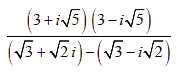
Express the complex number 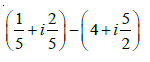 in the form $a + ib$.
Express the complex number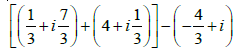 in the form $a + ib$.
Express the complex number  in the form $a + ib$.
Express the complex number  in the form $a + ib$.
Express the complex number  in the form $a + ib$.
Worksheet Answers
Solution:
Let the given complex number be $z$. Based on the expression $\sqrt{5} + 3i$, we define:
$z = \sqrt{5} + 3i$
The objective is to find the multiplicative inverse, denoted as $z^{-1}$ or $\frac{1}{z}$, such that $z \cdot z^{-1} = 1$.
The multiplicative inverse of a complex number $z = a + bi$ is given by the formula:
$z^{-1} = \frac{1}{a + bi} = \frac{a - bi}{(a + bi)(a - bi)}$
[Per the property of complex conjugates where $z \cdot \bar{z} = |z|^2 = a^2 + b^2$]
Identify the real part $a = \sqrt{5}$ and the imaginary part $b = 3$.
The conjugate of $z$ is $\bar{z} = \sqrt{5} - 3i$.
Substitute these into the multiplicative inverse expression:
$z^{-1} = \frac{\sqrt{5} - 3i}{(\sqrt{5} + 3i)(\sqrt{5} - 3i)}$
Calculate the squared modulus $|z|^2 = a^2 + b^2$:
$|z|^2 = (\sqrt{5})^2 + (3)^2$
$|z|^2 = 5 + 9$
$|z|^2 = 14$
[By the identity $(a+bi)(a-bi) = a^2 + b^2$]
Distribute the denominator across the numerator terms:
$z^{-1} = \frac{\sqrt{5}}{14} - \frac{3}{14}i$
Final Solution: The multiplicative inverse of $\sqrt{5} + 3i$ is $\frac{\sqrt{5}}{14} - \frac{3}{14}i$.
Solution:
The powers of the imaginary unit $i$ (where $i = \sqrt{-1}$) follow a cyclic pattern of four:
To evaluate $i^{-39}$, we first rewrite the negative exponent using the law of exponents: $a^{-n} = \frac{1}{a^n}$.
$$i^{-39} = \frac{1}{i^{39}}$$
To simplify $i^{39}$, we divide the exponent $39$ by $4$ to find the remainder [By Division Algorithm: $a = bq + r$]: $$39 = 4 \times 9 + 3$$ Therefore, $i^{39} = i^{4(9) + 3} = (i^4)^9 \cdot i^3$.
Substitute the known values of the powers of $i$: $$i^{39} = (1)^9 \cdot i^3$$ $$i^{39} = 1 \cdot (-i) = -i$$ [Since $i^3 = -i$].
Now, substitute this result back into the expression from Step 2: $$i^{-39} = \frac{1}{-i}$$
To express the complex number in $a + ib$ form, we eliminate $i$ from the denominator by multiplying the numerator and denominator by the conjugate or by $i$ itself: $$\frac{1}{-i} \times \frac{i}{i} = \frac{i}{-i^2}$$ Since $i^2 = -1$, the denominator becomes $-(-1) = 1$: $$\frac{i}{-(-1)} = \frac{i}{1} = i$$
The resulting value is $i$. Expressing this in the standard form $a + ib$: $$0 + 1i$$ Where $a = 0$ and $b = 1$.
Final Solution: 0 + i
Solution:
For any non-zero complex number $z = a + bi$, the multiplicative inverse is denoted by $z^{-1}$ or $\frac{1}{z}$ and is defined such that $z \cdot z^{-1} = 1$. [Per the algebraic property of fields in the complex number system $\mathbb{C}$].
Given the complex number $z = -i$. In standard rectangular form $a + bi$, this is represented as: $z = 0 - 1i$ Where $a = 0$ and $b = -1$.
The inverse is calculated as follows: $z^{-1} = \frac{1}{-i}$
To rationalize the denominator, multiply the numerator and the denominator by the conjugate of the denominator, or more simply, multiply by $\frac{i}{i}$ to simplify the imaginary unit in the denominator [By the Property of Division in Complex Numbers]:
$z^{-1} = \frac{1}{-i} \times \frac{i}{i}$
Performing the multiplication: $z^{-1} = \frac{i}{-i^2}$
Recall the fundamental definition of the imaginary unit: $i^2 = -1$. Substituting this into the equation:
$z^{-1} = \frac{i}{-(-1)}$ $z^{-1} = \frac{i}{1}$ $z^{-1} = i$
Check the result using the product identity $z \cdot z^{-1} = 1$: $(-i) \cdot (i) = -(i^2)$ $= -(-1)$ $= 1$ The condition $z \cdot z^{-1} = 1$ is satisfied. [By Identity Property of Multiplication].
Final Solution: The multiplicative inverse of $-i$ is $i$.
Solution:
The expression provided is $Z = i^9 + i^{19}$. The goal is to simplify this expression into the standard form $a + ib$, where $a, b \in \mathbb{R}$ and $i = \sqrt{-1}$.
Recall that the powers of the imaginary unit $i$ follow a cyclic pattern of period 4:
Divide the exponent 9 by 4: $9 = 4 \times 2 + 1$ Therefore: $i^9 = i^{4(2) + 1} = (i^4)^2 \cdot i^1$ Substituting $i^4 = 1$: $i^9 = (1)^2 \cdot i = i$
Divide the exponent 19 by 4: $19 = 4 \times 4 + 3$ Therefore: $i^{19} = i^{4(4) + 3} = (i^4)^4 \cdot i^3$ Substituting $i^4 = 1$ and $i^3 = -i$: $i^{19} = (1)^4 \cdot (-i) = -i$
Substitute the simplified terms back into the original expression: $Z = i^9 + i^{19}$ $Z = i + (-i)$ $Z = 0$
To express this in the requested form $a + ib$: $a = 0$ $b = 0$ Thus, $Z = 0 + i(0)$.
Final Solution: 0 + 0i
Solution:
The expression to be simplified is:
$$Z = \frac{(3 + i\sqrt{5})(3 - i\sqrt{5})}{(\sqrt{3} + \sqrt{2}i) - (\sqrt{3} - i\sqrt{2})}$$
The numerator is of the form $(x + iy)(x - iy)$, which follows the identity $(x + y)(x - y) = x^2 - y^2$ [Algebraic Difference of Squares].
The denominator involves the subtraction of two complex numbers:
Now, substitute the simplified numerator and denominator back into $Z$:
$$Z = \frac{14}{2\sqrt{2}i} = \frac{7}{\sqrt{2}i}$$
To express this in $a + ib$ form, multiply the numerator and denominator by $i$:
Rationalize the denominator by multiplying by $\frac{\sqrt{2}}{\sqrt{2}}$ [Property of Real Numbers]:
Final Solution: $0 - \frac{7\sqrt{2}}{2}i$
Solution:
The expression to be simplified is:
$z = \left( \frac{1}{5} + i \frac{2}{5} \right) - \left( 4 + i \frac{5}{2} \right)$
To perform complex subtraction, we treat the real and imaginary components separately. We distribute the negative sign across the second parenthesis [Per the Associative and Distributive Properties of Complex Numbers]:
$z = \left( \frac{1}{5} + i \frac{2}{5} \right) - 4 - i \frac{5}{2}$
We rearrange the expression to isolate real terms ($a$) and imaginary terms ($ib$):
$z = \left( \frac{1}{5} - 4 \right) + i \left( \frac{2}{5} - \frac{5}{2} \right)$
For the real part ($a$):
$a = \frac{1}{5} - \frac{20}{5} = -\frac{19}{5}$
For the imaginary part ($b$):
Finding a common denominator of 10:
$b = \left( \frac{2 \times 2}{5 \times 2} - \frac{5 \times 5}{2 \times 5} \right) = \left( \frac{4}{10} - \frac{25}{10} \right) = -\frac{21}{10}$
Combining the calculated real and imaginary coefficients into the standard form $z = a + ib$:
$z = -\frac{19}{5} + i \left( -\frac{21}{10} \right)$
Final Solution: $-\frac{19}{5} - \frac{21}{10}i$
Solution:
The objective is to simplify the expression $Z = (1 - i) - (-1 + i6)$ into the standard algebraic form $a + ib$. Given the expression:
$Z = (1 - i) - (-1 + 6i)$
Here, $a$ and $b$ are real numbers, and $i = \sqrt{-1}$ represents the imaginary unit.
Apply the distributive property of real numbers over complex subtraction [Per the Distributive Property of Multiplication]:
$Z = 1 - i - (-1) - (6i)$
$Z = 1 - i + 1 - 6i$
According to the commutative and associative properties of addition for complex numbers, we group the real components together and the imaginary components together [By the closure property of complex numbers under addition]:
$Z = (1 + 1) + (-i - 6i)$
Perform the addition for the real part and the subtraction for the imaginary coefficients:
$Z = 2 + (-1 - 6)i$
$Z = 2 + (-7)i$
$Z = 2 - 7i$
Final Solution: 2 - 7i
Solution:
The expression to be simplified is:
$\left[ \left( 3 + 7i \right) + \left( \frac{1}{3} + \frac{7}{3}i \right) \right] - \left[ \left( 4 + \frac{1}{3}i \right) - \left( -\frac{4}{3} + i \right) \right]$
To express this in the form $a + ib$, we apply the Algebra of Complex Numbers [Per the Closure Property under addition and subtraction of complex numbers].
Grouping the real parts and imaginary parts of $\left( 3 + 7i \right) + \left( \frac{1}{3} + \frac{7}{3}i \right)$:
$= \left( 3 + \frac{1}{3} \right) + i\left( 7 + \frac{7}{3} \right)$
$= \left( \frac{9 + 1}{3} \right) + i\left( \frac{21 + 7}{3} \right)$
$= \frac{10}{3} + \frac{28}{3}i$
Distributing the negative sign in $\left[ \left( 4 + \frac{1}{3}i \right) - \left( -\frac{4}{3} + i \right) \right]$:
$= \left( 4 + \frac{1}{3}i + \frac{4}{3} - i \right)$
$= \left( 4 + \frac{4}{3} \right) + i\left( \frac{1}{3} - 1 \right)$
$= \left( \frac{12 + 4}{3} \right) + i\left( \frac{1 - 3}{3} \right)$
$= \frac{16}{3} - \frac{2}{3}i$
Now, perform the final subtraction between the two resulting complex numbers:
$\left( \frac{10}{3} + \frac{28}{3}i \right) - \left( \frac{16}{3} - \frac{2}{3}i \right)$
$= \left( \frac{10}{3} - \frac{16}{3} \right) + i\left( \frac{28}{3} - (-\frac{2}{3}) \right)$
$= \left( \frac{10 - 16}{3} \right) + i\left( \frac{28 + 2}{3} \right)$
$= \left( -\frac{6}{3} \right) + i\left( \frac{30}{3} \right)$
$= -2 + 10i$
Final Solution: -2 + 10i
Solution:
For any non-zero complex number $z = a + bi$, the multiplicative inverse is denoted by $z^{-1}$ or $\frac{1}{z}$ [Definition of Multiplicative Inverse]. The inverse is defined such that $z \cdot z^{-1} = 1 + 0i$.
Given the complex number $z = 4 - 3i$, we seek $z^{-1} = \frac{1}{4 - 3i}$.
To express the quotient in the standard form $a + bi$, we multiply the numerator and the denominator by the conjugate of the complex number in the denominator. The conjugate of $z = a + bi$ is $\bar{z} = a - bi$ [Complex Conjugate Theorem].
The conjugate of $4 - 3i$ is $4 + 3i$.
$$z^{-1} = \frac{1}{4 - 3i} \times \frac{4 + 3i}{4 + 3i}$$Perform the multiplication in the numerator and the denominator:
Numerator: $1 \times (4 + 3i) = 4 + 3i$
Denominator: $(4 - 3i)(4 + 3i)$. Using the identity $(a - b)(a + b) = a^2 - b^2$:
$$(4)^2 - (3i)^2 = 16 - 9i^2$$Since $i^2 = -1$ [Definition of the Imaginary Unit]:
$$16 - 9(-1) = 16 + 9 = 25$$Combine the results into the standard form $a + bi$:
$$z^{-1} = \frac{4 + 3i}{25}$$ $$z^{-1} = \frac{4}{25} + \frac{3}{25}i$$Final Solution: \frac{4}{25} + \frac{3}{25}i
Solution:
The expression provided is $z = \left( -2 - \frac{1}{3}i \right)^3$. We aim to express this in the standard algebraic form $z = a + ib$, where $a, b \in \mathbb{R}$.
To expand a cube of the form $(x + y)^3$, we use the algebraic identity [Binomial Theorem for $n=3$]:
$(x + y)^3 = x^3 + y^3 + 3xy(x + y)$
Substituting $x = -2$ and $y = -\frac{1}{3}i$:
$z = (-2)^3 + \left( -\frac{1}{3}i \right)^3 + 3(-2)\left( -\frac{1}{3}i \right) \left( -2 - \frac{1}{3}i \right)$
Since $i^2 = -1$, it follows that $i^3 = i^2 \cdot i = -i$. Therefore, $-\frac{1}{27}(-i) = \frac{1}{27}i$.
Now substitute these values back into the expanded equation:
$z = -8 + \frac{1}{27}i + 2i(-2 - \frac{1}{3}i)$
Distribute $2i$ into the binomial expression:
$z = -8 + \frac{1}{27}i + (2i \cdot -2) + (2i \cdot -\frac{1}{3}i)$
$z = -8 + \frac{1}{27}i - 4i - \frac{2}{3}i^2$
Applying the property $i^2 = -1$ [Fundamental Theorem of Complex Numbers]:
$z = -8 + \frac{1}{27}i - 4i - \frac{2}{3}(-1)$
$z = -8 + \frac{1}{27}i - 4i + \frac{2}{3}$
Group the real parts and the imaginary parts separately:
Real part ($a$): $-8 + \frac{2}{3} = \frac{-24 + 2}{3} = -\frac{22}{3}$
Imaginary part ($b$): $\left( \frac{1}{27} - 4 \right)i = \left( \frac{1 - 108}{27} \right)i = -\frac{107}{27}i$
Final Solution: -\frac{22}{3} - \frac{107}{27}i
Solution:
To simplify the complex expression $3(7 + i7) + i(7 + i7)$, we must first distribute the scalar and imaginary multipliers across the terms within the parentheses [Per the Distributive Property of Multiplication over Addition: $a(b + c) = ab + ac$].
$3(7 + i7) = (3 \times 7) + (3 \times i7) = 21 + 21i$
$i(7 + i7) = (i \times 7) + (i \times i7) = 7i + 7i^2$
We recall the fundamental property of the imaginary unit, where $i^2 = -1$ [Per the definition of the Imaginary Unit in the Complex Number System].
Substituting $i^2 = -1$ into the second expanded expression:
$7i + 7(-1) = 7i - 7 = -7 + 7i$
Now, we sum the results from Step 1 and Step 2 to achieve the form $a + ib$:
Expression $= (21 + 21i) + (-7 + 7i)$
Group the real parts and the imaginary parts separately [Per the Associative and Commutative properties of complex addition]:
$= (21 - 7) + (21i + 7i)$
$= 14 + 28i$
| Operation | Resulting Expression |
|---|---|
| Initial Distribution | $21 + 21i + 7i + 7i^2$ |
| Substitute $i^2 = -1$ | $21 + 21i + 7i - 7$ |
| Combine Real Components | $21 - 7 = 14$ |
| Combine Imaginary Components | $21i + 7i = 28i$ |
Final Solution: $14 + 28i$
Solution:
We are tasked with evaluating the expression $z = \left( \frac{1}{3} + 3i \right)^3$ and expressing it in the standard algebraic form $a + ib$.
To expand a binomial of the form $(x + y)^3$, we utilize the Binomial Theorem identity: $[(x+y)^3 = x^3 + 3x^2y + 3xy^2 + y^3]$.
Assign $x = \frac{1}{3}$ and $y = 3i$. Applying the expansion formula:
$z = \left( \frac{1}{3} \right)^3 + 3\left( \frac{1}{3} \right)^2(3i) + 3\left( \frac{1}{3} \right)(3i)^2 + (3i)^3$
Proceeding with the arithmetic evaluation of each term:
Combine the calculated terms to form the final expression:
$z = \frac{1}{27} + i - 9 - 27i$
Group the real parts and the imaginary parts:
Real Part: $\frac{1}{27} - 9 = \frac{1 - 243}{27} = -\frac{242}{27}$
Imaginary Part: $i - 27i = -26i$
The expression is now in the form $a + ib$ where $a = -\frac{242}{27}$ and $b = -26$.
Final Solution: $-\frac{242}{27} - 26i$
Solution:
To evaluate the complex number $z = (1 - i)^4$, we utilize the algebraic property of exponents, specifically $(x^n)^m = x^{n \cdot m}$. We can express the expression as a squared binomial, squared again: $z = [(1 - i)^2]^2$ [Per the Laws of Indices]
We expand the expression $(1 - i)^2$ using the algebraic identity $(a - b)^2 = a^2 - 2ab + b^2$: $(1 - i)^2 = (1)^2 - 2(1)(i) + (i)^2$ Substituting the fundamental definition of the imaginary unit, where $i^2 = -1$: $(1 - i)^2 = 1 - 2i + (-1)$ $(1 - i)^2 = 1 - 2i - 1$ $(1 - i)^2 = -2i$ [By the definition of the imaginary unit $i = \sqrt{-1}$]
Substitute the simplified inner binomial back into the outer exponentiation: $z = (-2i)^2$ $z = (-2)^2 \cdot (i)^2$ [Per the Power of a Product Rule $(ab)^n = a^n b^n$]
Evaluating the squares: $(-2)^2 = 4$ $(i)^2 = -1$ $z = 4 \cdot (-1) = -4$
The standard form $a + ib$ requires both a real component ($a$) and an imaginary component ($b$). Since $z = -4$, the real part $a = -4$ and the imaginary part $b = 0$: $z = -4 + 0i$
Final Solution: -4 + 0i
Solution:
The objective is to express the complex number $z = 5i \times \left(-\frac{3}{5}i\right)$ in the standard form $a + ib$, where $a$ and $b$ are real numbers and $i = \sqrt{-1}$.
Utilize the associative and commutative properties of complex multiplication [Per the Field Properties of Complex Numbers].
$z = 5 \times \left(-\frac{3}{5}\right) \times i \times i$
$z = -3 \times i^2$
By definition, the imaginary unit is defined as $i = \sqrt{-1}$, which implies the fundamental identity $i^2 = -1$ [By definition of the Complex Number System].
Substitute $i^2 = -1$ into the expression:
$z = -3 \times (-1)$
$z = 3$
To satisfy the requirement of the form $a + ib$, the real part $a$ is identified as $3$ and the imaginary part $b$ is identified as $0$.
$z = 3 + 0i$
Final Solution: 3 + 0i


