


Your Worksheet is Ready
CBSE - Class 11 Mathematics Relations and Functions Worksheet
EXERCISE 2.2
The Fig2.7 shows a relationship between the sets $P$ and $Q$. Write this relation (ii) roster form. What is its domain and range?
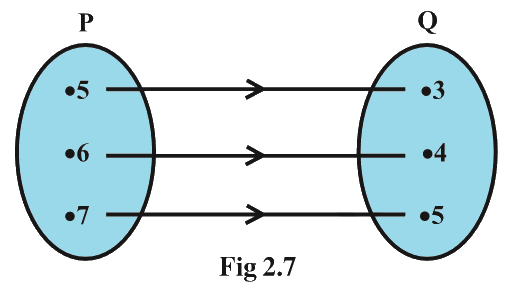
The Fig2.7 shows a relationship between the sets $P$ and $Q$. Write this relation (i) in set-builder form. What is its domain and range?
Worksheet Answers
Solution:
Based on the standard representation of the provided function diagram (Figure 2.7), we observe the following mapping between set $P$ and set $Q$:
A relation in roster form is represented as a set of ordered pairs $(x, y)$ such that $x \in P$ and $y \in Q$, and $x$ is related to $y$ [Per Definition of a Relation in Set Theory].
From the visual mapping:
Thus, the Roster Form $R$ is:
$R = \{(5, 3), (6, 4), (7, 5)\}$
The domain of a relation is the set of all first components of the ordered pairs in $R$ [Per Definition of Domain].
Extracting the first components from $R$:
$\text{Domain} = \{5, 6, 7\}$
The range of a relation is the set of all second components of the ordered pairs in $R$ [Per Definition of Range].
Extracting the second components from $R$:
$\text{Range} = \{3, 4, 5\}$
Final Solution: The relation in roster form is $\{(5, 3), (6, 4), (7, 5)\}$. The domain is $\{5, 6, 7\}$ and the range is $\{3, 4, 5\}$.
Solution:
Given the sets $A = \{x, y, z\}$ and $B = \{1, 2\}$, we define the cardinal number (the number of elements in a set) as follows:
The Cartesian product $A \times B$ is the set of all possible ordered pairs $(a, b)$ such that $a \in A$ and $b \in B$. The total number of elements in $A \times B$ is given by the product of the cardinalities of the individual sets:
$n(A \times B) = n(A) \times n(B)$
$n(A \times B) = 3 \times 2 = 6$
[Per the definition of the Cartesian product of two finite sets]
A relation $R$ from set $A$ to set $B$ is defined as any subset of the Cartesian product $A \times B$. [By the definition of a relation: $R \subseteq A \times B$].
The total number of relations from $A$ to $B$ is equivalent to the number of possible subsets of the Cartesian product $A \times B$.
If a set has $m$ elements, the number of its subsets is given by $2^m$. Here, $m = n(A \times B) = 6$.
Total number of relations = $2^{n(A \times B)}$
Total number of relations = $2^6$
$2^6 = 2 \times 2 \times 2 \times 2 \times 2 \times 2 = 64$
Final Solution: The total number of relations from set $A$ to set $B$ is $64$.
Solution:
Given set $A = \{1, 2, 3, 4, 6\}$. The relation $R$ is defined as $R = \{(a, b) : a, b \in A \text{ and } b \equiv 0 \pmod{a}\}$, where the notation $b \equiv 0 \pmod{a}$ denotes that $b$ is exactly divisible by $a$. This implies that the quotient $\frac{b}{a}$ must be an integer, which is equivalent to saying $a$ is a factor of $b$ [Definition of Divisibility in Number Theory].
We test each element $a \in A$ against every element $b \in A$ to determine if $\frac{b}{a} \in \mathbb{Z}$:
| $a$ | Potential $b$ (such that $b$ is a multiple of $a$) | Valid Ordered Pairs $(a, b)$ |
|---|---|---|
| $1$ | $1, 2, 3, 4, 6$ | $(1, 1), (1, 2), (1, 3), (1, 4), (1, 6)$ |
| $2$ | $2, 4, 6$ | $(2, 2), (2, 4), (2, 6)$ |
| $3$ | $3, 6$ | $(3, 3), (3, 6)$ |
| $4$ | $4$ | $(4, 4)$ |
| $6$ | $6$ | $(6, 6)$ |
By collecting all ordered pairs identified in the systematic verification, we define the relation $R$ in roster form. We ensure that every pair satisfies the condition $b = k \cdot a$ for some $k \in \{1, 2, 3, \dots\}$ [Property of Divisibility].
The collection of all valid pairs $(a, b)$ constitutes the roster form of the relation $R$.
Final Solution: $R = \{(1, 1), (1, 2), (1, 3), (1, 4), (1, 6), (2, 2), (2, 4), (2, 6), (3, 3), (3, 6), (4, 4), (6, 6)\}$
Solution:
The relation $R$ is defined on the set of integers $\mathbb{Z}$ as follows:
$R = \{(a, b) : a, b \in \mathbb{Z}, a - b \in \mathbb{Z}\}$
[By the property of closure under subtraction for integers: If $a, b \in \mathbb{Z}$, then $(a - b)$ is always an integer $\mathbb{Z}$.]
The domain of a relation $R$ consists of all the first elements of the ordered pairs $(a, b)$ that belong to $R$.
Thus, the domain of $R$ is the set of all integers, $\mathbb{Z}$.
The range of a relation $R$ consists of all the second elements of the ordered pairs $(a, b)$ that belong to $R$.
Thus, the range of $R$ is the set of all integers, $\mathbb{Z}$.
| Set | Definition |
|---|---|
| Domain | $\{x : x \in \mathbb{Z}\}$ |
| Range | $\{y : y \in \mathbb{Z}\}$ |
Final Solution: The domain of $R$ is $\mathbb{Z}$ and the range of $R$ is $\mathbb{Z}$.
Solution:
Given the sets:
The relation $R$ is defined as $R = \{(x, y) : |x - y| \in \{ \text{odd numbers} \}; x \in A, y \in B\}$. [Per the definition of relation in Cartesian product $A \times B$].
To determine if the difference $|x - y|$ is odd, we utilize the parity property: The difference between two integers is odd if and only if one integer is even and the other is odd. [Parity Law: $Odd - Even = Odd$ and $Even - Odd = Odd$].
| $x \in A$ | $y \in B$ | Difference $|x - y|$ | Parity | Include in $R$? |
|---|---|---|---|---|
| 1 | 4 | $|1-4| = 3$ | Odd | Yes |
| 1 | 6 | $|1-6| = 5$ | Odd | Yes |
| 1 | 9 | $|1-9| = 8$ | Even | No |
| 2 | 4 | $|2-4| = 2$ | Even | No |
| 2 | 6 | $|2-6| = 4$ | Even | No |
| 2 | 9 | $|2-9| = 7$ | Odd | Yes |
| 3 | 4 | $|3-4| = 1$ | Odd | Yes |
| 3 | 6 | $|3-6| = 3$ | Odd | Yes |
| 3 | 9 | $|3-9| = 6$ | Even | No |
| 5 | 4 | $|5-4| = 1$ | Odd | Yes |
| 5 | 6 | $|5-6| = 1$ | Odd | Yes |
| 5 | 9 | $|5-9| = 4$ | Even | No |
Collecting all identified pairs $(x, y)$ where the difference is odd:
$R = \{(1, 4), (1, 6), (2, 9), (3, 4), (3, 6), (5, 4), (5, 6)\}$
Final Solution: $R = \{(1, 4), (1, 6), (2, 9), (3, 4), (3, 6), (5, 4), (5, 6)\}$
Solution:
Based on the provided relationship diagram (Fig 2.7), we identify the sets $P$ and $Q$ and their corresponding mapping pairs $(x, y)$ where $x \in P$ and $y \in Q$:
Observe the numerical correspondence between each input $x \in P$ and output $y \in Q$:
The universal rule governing this relation is $y = x - 2$, or equivalently, $x - y = 2$. [Per the Definition of a Relation as a subset of the Cartesian Product $P \times Q$].
The set-builder form defines the relation $R$ by specifying the properties that the elements $(x, y)$ must satisfy.
$R = \{ (x, y) : y = x - 2, x \in P, y \in Q \}$
The Domain is defined as the set of all first components of the ordered pairs in the relation, and the Range is the set of all second components [Per the Set-Theoretic definition of functions/relations].
| Component | Definition | Result |
|---|---|---|
| Domain | $\{x : (x, y) \in R\}$ | $\{5, 6, 7\}$ |
| Range | $\{y : (x, y) \in R\}$ | $\{3, 4, 5\}$ |
Final Solution:
Set-Builder Form: $R = \{ (x, y) : y = x - 2, x \in \{5, 6, 7\}, y \in \{3, 4, 5\} \}$
Domain: $\{5, 6, 7\}$
Range: $\{3, 4, 5\}$
Solution:
Given the set $A = \{1, 2, 3, 4, 5, 6, 7, 8, 9, 10, 11, 12, 13, 14\}$. The relation $R$ is defined on $A$ as $R = \{(x, y) : 3x - y = 0, \text{ where } x, y \in A\}$.
The condition $3x - y = 0$ can be rewritten as $y = 3x$. This establishes that for every element $x \in A$, the corresponding image $y$ must be three times the value of $x$, provided $y$ is also an element of set $A$ [Per the definition of a relation from set $A$ to set $A$].
We test each value of $x \in A$ to determine if $y = 3x$ results in an element within $A$:
| $x$ | $y = 3x$ | Valid $(x, y) \in R$? |
|---|---|---|
| $1$ | $3$ | Yes, $(1, 3)$ |
| $2$ | $6$ | Yes, $(2, 6)$ |
| $3$ | $9$ | Yes, $(3, 9)$ |
| $4$ | $12$ | Yes, $(4, 12)$ |
| $5$ | $15$ | No, $15 \notin A$ |
For all $x \geq 5$, $y \geq 15$, which exceeds the upper bound of set $A$. Thus, the relation in Roster form is: $R = \{(1, 3), (2, 6), (3, 9), (4, 12)\}$.
Final Solution: Domain = {1, 2, 3, 4}; Codomain = {1, 2, 3, ..., 14}; Range = {3, 6, 9, 12}
Solution:
The relation $R$ is defined as $R = \{(x, x^3) : x \text{ is a prime number less than } 10\}$. To determine the elements of the domain, we must identify all prime numbers $p$ such that $p < 10$.
For each element $x \in S$, we calculate the corresponding output $y = x^3$ to form the ordered pairs $(x, y)$.
| $x$ (Prime) | $y = x^3$ (Calculation) | Ordered Pair $(x, y)$ |
|---|---|---|
| 2 | $2^3 = 8$ | $(2, 8)$ |
| 3 | $3^3 = 27$ | $(3, 27)$ |
| 5 | $5^3 = 125$ | $(5, 125)$ |
| 7 | $7^3 = 343$ | $(7, 343)$ |
The roster form is the representation of a set by listing all its elements between curly braces. [By Definition of Roster/Tabular Form of Sets]
Combining the ordered pairs derived in Step 2:
$R = \{(2, 8), (3, 27), (5, 125), (7, 343)\}$
Final Solution: $R = \{(2, 8), (3, 27), (5, 125), (7, 343)\}$
Solution:
The relation $R$ is defined as $R = \{(x, x + 5) : x \in \{0, 1, 2, 3, 4, 5\}\}$.
The domain of a relation consists of all the first elements (the inputs $x$) of the ordered pairs present in the relation. [By the definition of the domain of a relation in set theory, $\text{Dom}(R) = \{x : (x, y) \in R\}$].
Given the set of values for $x$ is $\{0, 1, 2, 3, 4, 5\}$, the domain is explicitly stated as the set of these input values:
$\text{Domain}(R) = \{0, 1, 2, 3, 4, 5\}$
To find the range, we must map each element of the domain to its corresponding image under the relation $y = f(x) = x + 5$.
| $x$ (Domain) | $y = x + 5$ (Image) |
|---|---|
| $0$ | $0 + 5 = 5$ |
| $1$ | $1 + 5 = 6$ |
| $2$ | $2 + 5 = 7$ |
| $3$ | $3 + 5 = 8$ |
| $4$ | $4 + 5 = 9$ |
| $5$ | $5 + 5 = 10$ |
The relation $R$ in roster form is: $R = \{(0, 5), (1, 6), (2, 7), (3, 8), (4, 9), (5, 10)\}$.
The range of a relation consists of all the second elements (the outputs $y$) of the ordered pairs in $R$. [By the definition of the range of a relation in set theory, $\text{Ran}(R) = \{y : (x, y) \in R\}$].
Based on the calculations in Step 2, the set of all second coordinates is $\{5, 6, 7, 8, 9, 10\}$.
Final Solution: The domain of the relation $R$ is $\{0, 1, 2, 3, 4, 5\}$ and the range is $\{5, 6, 7, 8, 9, 10\}$.
Solution:
The relation $R$ is defined on the set $A = \{1, 2, 3, 4, 6\}$ such that $R = \{(a, b) : a, b \in A \text{ and } b \text{ is exactly divisible by } a\}$. This implies that $a$ must be a factor of $b$ for the ordered pair $(a, b)$ to belong to the set $R$ [Per the definition of divisibility in integers, $b$ is divisible by $a$ if $b = ka$ for some $k \in \mathbb{Z}$].
We evaluate each element $a \in A$ to determine its multiples $b$ that are also contained within set $A$:
Combining all identified pairs, we define $R$ as:
$R = \{(1, 1), (1, 2), (1, 3), (1, 4), (1, 6), (2, 2), (2, 4), (2, 6), (3, 3), (3, 6), (4, 4), (6, 6)\}$
The range of a relation $R$ is defined as the set of all second elements in the ordered pairs of $R$ [By the definition of the range of a binary relation, $\text{Range}(R) = \{b : (a, b) \in R\}$].
Listing the second components of every ordered pair in $R$:
Final Solution: The range of $R$ is $\{1, 2, 3, 4, 6\}$.
Solution:
The relation $R$ is defined on the set of natural numbers $\mathbb{N} = \{1, 2, 3, \dots\}$. The condition states that $x$ must be a natural number less than $4$. Therefore, the possible values for $x$ are:
$x \in \{1, 2, 3\}$ [Definition of Natural Numbers and inequality constraint].
Using the governing equation $y = x + 5$, we determine the image of each $x$ under the relation $R$:
Since $\{6, 7, 8\} \subset \mathbb{N}$, all calculated pairs satisfy the condition $x, y \in \mathbb{N}$ [Closure property of natural numbers under addition].
The roster form of a relation is the set of all ordered pairs $(x, y)$ that satisfy the defined rule.
$R = \{(1, 6), (2, 7), (3, 8)\}$
The Domain is the set of all first elements of the ordered pairs in $R$, and the Range is the set of all second elements of the ordered pairs in $R$.
Final Solution: The relation in roster form is $R = \{(1, 6), (2, 7), (3, 8)\}$. The Domain is $\{1, 2, 3\}$ and the Range is $\{6, 7, 8\}$.
Solution:
Given the set $A = \{1, 2, 3, 4, 6\}$, the relation $R$ is defined as:
$R = \{(a, b) : a, b \in A, b \text{ is exactly divisible by } a\}$
The condition "$b$ is exactly divisible by $a$" implies that $\frac{b}{a} \in \mathbb{Z}$, or equivalently, $a$ is a divisor of $b$. [By the definition of divisibility in number theory].
We test each element $a \in A$ to determine which elements $b \in A$ satisfy the condition $a|b$:
The complete set $R$ is:
$R = \{(1, 1), (1, 2), (1, 3), (1, 4), (1, 6), (2, 2), (2, 4), (2, 6), (3, 3), (3, 6), (4, 4), (6, 6)\}$
The domain of a relation $R$ is defined as the set of all first components of the ordered pairs in $R$. [Per the definition of the Domain of a Relation: $Dom(R) = \{a \in A : \exists b \in A \text{ such that } (a, b) \in R\}$].
From the set $R$ derived in Step 2, the unique first components are $\{1, 2, 3, 4, 6\}$.
Since every element $a \in A$ appears as a first component in at least one ordered pair (specifically, $(a, a) \in R$ for all $a \in A$ due to the reflexive property of the "divides" relation), the domain is the entire set $A$.
Final Solution: The domain of $R$ is $\{1, 2, 3, 4, 6\}$.


