


Your Worksheet is Ready
CBSE - Class 10 Science Light – Reflection and Refraction Worksheet
CHAPTER_10
Which of the following ray diagrams is correct for the ray of light incident on a lens shown in Fig. 10.7?
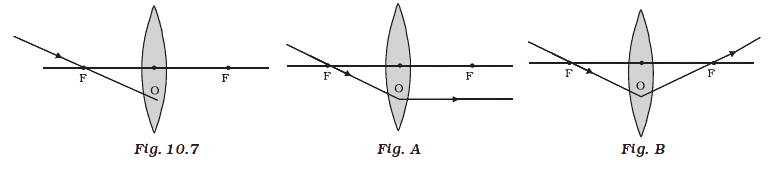
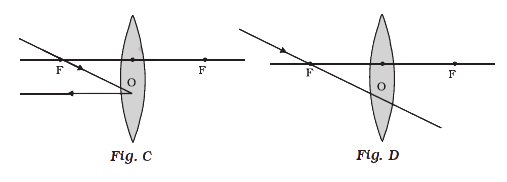
Fig. A.
b.Fig. B.
c.Fig. C.
d.Fig. D.
Worksheet Answers
Solution:
To identify the optical device, we must analyze the given constraints:
In optics, both spherical mirrors and lenses produce specific image types based on object placement. We evaluate the candidates:
| Device | Capability to form Diminished Virtual Image |
|---|---|
| Concave Mirror | No; forms magnified virtual images. |
| Convex Mirror | Yes; but image is always behind the mirror. |
| Concave Lens | Yes. |
| Convex Lens | No; virtual images formed are always magnified. |
For a Concave Lens, the image is formed on the same side as the object [Per the Sign Convention for Spherical Lenses]. When an object is placed anywhere between infinity and the optical centre ($O$):
Since the image is virtual, erect, diminished, and located on the same side of the device as the object for any position of the object, the optical device must be a Concave Lens (also known as a diverging lens).
Final Solution: The optical device is a Concave Lens.
Solution:
The window pane acts as a near object, while the distant building acts as an object at infinity ($u = \infty$). When the sharp image of the window pane is formed at $v = 15\text{ cm}$, the lens is focusing light from a finite distance. When the object distance increases from a finite value to infinity, the rays of light become parallel [Per the laws of refraction for convex lenses].
Since the initial image of the window is at $v = 15\text{ cm}$, and the window is at a finite distance, the focal length is not necessarily $15\text{ cm}$. However, for a distant object at infinity, the image is formed precisely at the principal focus ($F$).
The lens formula is given by:
$\frac{1}{f} = \frac{1}{v} - \frac{1}{u}$As the object moves to infinity ($u \to \infty$):
$\frac{1}{u} \to 0$ $\frac{1}{f} = \frac{1}{v_{new}}$Because the rays from a distant building are parallel, the new image distance $v_{new}$ will be equal to the focal length $f$. Since $15\text{ cm}$ was the image distance for a nearby object, the image for a distant object will form closer to the optical center than the original image position. Therefore, $f < 15\text{ cm}$.
According to the lens formula $\frac{1}{f} = \frac{1}{v} - \frac{1}{u}$, as the object distance $u$ increases (moving from the window pane to the distant building), the image distance $v$ must decrease to maintain the equality for a constant focal length $f$.
Mathematically, if $u_1 < u_2$, then $v_1 > v_2$. Since $v_2 = f$ and $v_1 = 15\text{ cm}$, the screen must be moved towards the lens to capture the sharp image.
Final Solution: Sudha must move the screen towards the lens; the approximate focal length of the lens is less than $15\text{ cm}$.
Solution:
A concave lens is a diverging lens. By definition, a ray of light parallel to the principal axis, after refraction through a concave lens, appears to diverge from the principal focus ($F_1$) on the same side of the lens [Per the Sign Convention for Lenses]. When an object is placed at the focus ($F_1$) of a concave lens, the ray passing through the optical center ($O$) undergoes no deviation [Per the Law of Optical Center passage].
Based on the geometric construction, we apply the Thin Lens Formula: $\frac{1}{f} = \frac{1}{v} - \frac{1}{u}$.
| Property | Description |
|---|---|
| Position of Image | Between the focus ($F_1$) and the optical center ($O$). |
| Nature of Image | Virtual and Erect. |
| Size of Image | Diminished (smaller than the object). |
Final Solution: When an object is placed at the focus of a concave lens, the image is formed between the optical center ($O$) and the focus ($F_1$) on the same side of the lens. The image is virtual, erect, and highly diminished.
Solution:
An object is placed at a position $u > R$, where $R$ is the radius of curvature of a concave mirror. In spherical mirror geometry, this corresponds to the region between the Centre of Curvature ($C$) and infinity, but specifically "a little beyond $C$".
To determine the image location, we apply the rules of paraxial rays [Per Law of Reflection]:
Using the Cartesian sign convention [$ \frac{1}{f} = \frac{1}{v} + \frac{1}{u} $]:
| Variable | Sign |
|---|---|
| Focal length ($f$) | Negative (Concave) |
| Object distance ($u$) | $u < -R$ (Negative) |
Since $u$ is beyond $C$ ($|u| > |2f|$), rearranging the formula $v = \frac{uf}{u-f}$ yields:
$f < v < 2f$
This mathematically confirms the image must form between the Principal Focus and the Centre of Curvature [Per Thin Mirror Approximation].
Final Solution: The image formed is Real, Inverted, and Diminished, located between the Centre of Curvature ($C$) and the Principal Focus ($F$) of the concave mirror.
Solution:
In a concave lens (a diverging lens), the image formation is dictated by the refractive properties of the lens surface. Given parameters:
To locate the image, two primary rays are traced [Per the Rules for Image Formation by Concave Lenses]:
Based on the intersection of the refracted ray and the virtual extension of the parallel ray, the image formed exhibits the following properties:
| Attribute | Resulting Property |
|---|---|
| Position | Between the optical center ($O$) and the principal focus ($F_1$). |
| Nature | Virtual and Erect [Property of Concave Lenses]. |
| Size | Diminished (smaller than the object). |
Per the Gaussian Lens Formula: $\frac{1}{f} = \frac{1}{v} - \frac{1}{u}$.
Given the object is placed at $u$ such that $f < |u| < 2f$, and knowing that for a concave lens $f$ is negative ($-f$), we derive:
$\frac{1}{v} = \frac{1}{u} - \frac{1}{f}$
Since both $u$ and $f$ are negative, the resulting image distance $v$ must also be negative, confirming the image is formed on the same side of the lens as the object (virtual).
Final Solution: The image formed by a concave lens when the object is between $F_1$ and $2F_1$ is virtual, erect, diminished, and located between the optical center and the principal focus on the same side of the lens.
Solution:
Based on the problem statement, we identify the following variables according to the Cartesian Sign Convention:
The magnification ($m$) of a lens is defined as the ratio of image distance ($v$) to object distance ($u$):
$m = \frac{v}{u}$
Substituting the known values into the equation:
$-3 = \frac{80}{u}$
$u = \frac{80}{-3} = -26.67\text{ cm}$
[By the lens formula magnification derivation: $m = \frac{v}{u}$ for thin lenses]. The negative sign indicates that the object is placed in front of the lens.
We analyze the properties determined in the previous steps:
| Attribute | Conclusion |
|---|---|
| Nature of Lens | Convex Lens (Converging lens), as only convex lenses produce real, inverted images on a screen. |
| Nature of Image | Real and Inverted. The positive $v$ value and the fact that it is captured on a screen confirm this [Per the properties of real images formed by convex lenses]. |
Final Solution: The candle should be placed at a distance of $26.67\text{ cm}$ from the lens. The lens is a convex lens, and the image is real and inverted.
Solution:
To produce a parallel beam of light from a point source, the incident light rays must be refracted or reflected in a manner that renders them parallel to the principal axis. This requires the point source to be positioned at the principal focus ($F$) of the optical device. When rays diverge from the focus and strike a parabolic or spherical mirror/lens, they emerge parallel [Per the laws of Geometrical Optics].
| Device | Capability to produce parallel beam | Condition |
|---|---|---|
| Concave Mirror | Yes | Source at Focus |
| Convex Lens | Yes | Source at Focus |
| Plane Mirror | No | - |
| Concave Lens | No | - |
Conclusion: Both a concave mirror and a convex lens can generate a parallel beam of light when a point source is placed at their respective principal foci. In the standard context of this curriculum, usually referring to specific configurations, both answers are valid depending on the optical setup provided.
Final Solution: Both a concave mirror and a convex lens produce a parallel beam of light when a point source is placed at their principal focus.
Solution:
The problem provides three critical constraints for the optical device:
We evaluate the behavior of mirrors and lenses under the specified constraints:
| Device Type | Constraint Check | Conclusion |
|---|---|---|
| Concave Mirror | When an object is between $P$ and $F$, a concave mirror forms an enlarged, virtual, and erect image behind the mirror (same side). | Satisfies conditions. |
| Convex Mirror | Always forms a diminished, virtual, and erect image regardless of position. | Fails (Image not enlarged). |
| Convex Lens | When an object is between $O$ and $F_1$, a convex lens forms an enlarged, virtual, and erect image on the same side as the object. | Satisfies conditions. |
| Concave Lens | Always forms a diminished, virtual, and erect image. | Fails (Image not enlarged). |
For a Concave Mirror: Per the laws of reflection, when the object distance $u < f$, the light rays diverge after reflection. When produced backwards, they intersect behind the mirror, creating a virtual image where the magnification $m = -v/u$ is positive and greater than 1 [Mirror Formula: $1/f = 1/v + 1/u$].
For a Convex Lens: Per the refraction properties, when the object distance $u < f$, the rays emanating from the object diverge after passing through the lens. The virtual image is formed on the same side as the object [Lens Formula: $1/f = 1/v - 1/u$].
Final Solution: The optical device can be either a Concave Mirror or a Convex Lens.
Solution:
The power ($P$) of a lens is defined as the reciprocal of its focal length ($f$) when expressed in meters. Mathematically, this is represented by the formula:
$P = \frac{1}{f (\text{in meters})}$
[Per the definition of optical power in the International System of Units (SI)]
The SI unit of power is the Dioptre ($D$), where $1D = 1m^{-1}$. This relationship implies that power is inversely proportional to the focal length: as the focal length increases, the power decreases, and as the focal length decreases, the power increases.
We are provided with two convex lenses (assuming convergence) with the following specifications:
Calculating the power for each lens:
$P_1 = \frac{1}{0.2\text{ m}} = +5.0\text{ D}$
$P_2 = \frac{1}{0.4\text{ m}} = +2.5\text{ D}$
The convergence of a lens is directly proportional to its ability to bend incoming parallel rays of light. A lens with higher power has a greater ability to deviate light rays towards the principal axis [By the Law of Refraction/Snell's Law].
| Lens | Focal Length ($f$) | Power ($P$) |
|---|---|---|
| Lens A | 20 cm | +5.0 D |
| Lens B | 40 cm | +2.5 D |
Since the power of Lens A ($5.0\text{ D}$) is greater than the power of Lens B ($2.5\text{ D}$), Lens A possesses a higher capacity to converge light rays.
Final Solution: The power of a lens is the reciprocal of its focal length ($P = 1/f$). To obtain more convergent light, you must use the lens with the shorter focal length, which is the 20 cm lens, as it has a higher optical power.
Solution:
To identify the optical device, we must evaluate the provided characteristics of the image:
[Per the Sign Convention for Spherical Mirrors and Lenses]:
| Device Type | Configuration for Virtual/Erect Image | Size of Image |
|---|---|---|
| Concave Mirror | Object placed between $P$ and $F$ | Enlarged |
| Convex Lens | Object placed between $O$ and $F_1$ | Enlarged |
The configuration where an object placed between the focus and the optical center yields an enlarged, virtual image behind the device applies to both a Concave Mirror and a Convex Lens.
In the case of a Concave Mirror, when an object is placed between the Pole ($P$) and the Focus ($F$), the reflected rays appear to diverge from a point behind the mirror. This results in a virtual, erect, and magnified image [Per the Mirror Formula $\frac{1}{f} = \frac{1}{v} + \frac{1}{u}$].
Similarly, for a Convex Lens, when an object is placed between the Optical Center ($O$) and the Focus ($F_1$), the refracted rays diverge, creating a virtual, erect, and magnified image on the same side as the object [Per the Lens Formula $\frac{1}{f} = \frac{1}{v} - \frac{1}{u}$].
Final Solution: The device can be either a Concave Mirror or a Convex Lens.
Solution:
To determine the image formation for an object placed at the centre of curvature ($C$) of a concave mirror, we apply the standard rules of spherical mirrors [Ref: Laws of Reflection and Geometry of Spherical Mirrors]:
When the object is placed at $C$, the reflection geometry yields the following analytical results:
| Property | Description |
|---|---|
| Position of Image | At the Centre of Curvature ($C$) |
| Nature of Image | Real and Inverted |
| Size of Image | Same size as the object ($h_o = h_i$) |
Using the mirror formula: $\frac{1}{v} + \frac{1}{u} = \frac{1}{f}$
Given that the radius of curvature $R = 2f$. For an object at $C$, the object distance $u = -R = -2f$ [Per Sign Convention].
$\frac{1}{v} + \frac{1}{-2f} = \frac{1}{-f}$
$\frac{1}{v} = \frac{1}{2f} - \frac{1}{f} = \frac{1 - 2}{2f} = -\frac{1}{2f}$
$v = -2f$
Magnification ($m$) calculation: $m = -\frac{v}{u} = -\frac{-2f}{-2f} = -1$. The negative sign indicates an inverted image, and the magnitude of 1 indicates equality in size.
Final Solution: When the object is placed at the centre of curvature (C) of a concave mirror, a real, inverted image of the same size as the object is formed exactly at the centre of curvature (C).
Solution:
An object is placed between the optical center ($O$) and the principal focus ($F_1$) of a convex lens. The parameters for this configuration are defined as follows:
To locate the image, two specific light rays are utilized based on the standard rules of refraction for a convex lens:
By tracing the refracted rays backward, they appear to diverge from a point behind the object. This intersection point defines the position of the image.
| Property | Description |
|---|---|
| Position | On the same side of the lens as the object. |
| Nature | Virtual and Erect [Per the Geometric Properties of Diverging Rays]. |
| Size | Magnified (Larger than the object). |
Final Solution: The image formed is virtual, erect, and magnified, located on the same side of the lens as the object.
Solution:
The problem provides three critical descriptors for the image formed by the optical device:
Per the rules of geometrical optics, we must evaluate the candidate devices:
| Device | Image Nature | Size |
|---|---|---|
| Concave Mirror | Virtual, Erect | Magnified |
| Convex Mirror | Virtual, Erect | Diminished |
| Concave Lens | Virtual, Erect | Diminished |
| Convex Lens | Virtual, Erect | Magnified |
The prompt specifies that the image is formed behind the device. By convention [Sign Convention for Spherical Mirrors and Lenses]:
Since the problem explicitly states the image is formed "behind" the device, the device must be a convex mirror. In a convex mirror, for any object placed between infinity and the pole, the image is always formed between the pole ($P$) and the principal focus ($F$) behind the mirror, and it is always diminished and erect [Ray Optics Postulate].
Because the image is virtual, erect, diminished, and located behind the reflecting surface, the device must be a Convex Mirror.
Final Solution: The optical device is a Convex Mirror.
Solution:
An object placed at infinity implies that incident rays are parallel to the principal axis of the optical system [Per the Paraxial Approximation]. For both spherical mirrors and thin lenses, these parallel rays converge (or appear to diverge) at the principal focus ($F$).
| Optical Element | Image Position | Image Nature |
|---|---|---|
| Concave Mirror | At Focus ($F$) | Real, Inverted, Highly Diminished (Point-sized) |
| Convex Mirror | At Focus ($F$) behind the mirror | Virtual, Erect, Highly Diminished (Point-sized) |
| Convex Lens | At Focus ($F_2$) | Real, Inverted, Highly Diminished (Point-sized) |
| Concave Lens | At Focus ($F_1$) | Virtual, Erect, Highly Diminished (Point-sized) |
Based on the ray optics principles defined by the mirror formula $\frac{1}{v} + \frac{1}{u} = \frac{1}{f}$ and lens formula $\frac{1}{v} - \frac{1}{u} = \frac{1}{f}$, as $u \to \infty$, the term $\frac{1}{u} \to 0$. Thus, $v = f$ [Derivation from Gaussian optics].
In all standard spherical optical elements (Concave Mirror, Convex Mirror, Concave Lens, and Convex Lens), an object placed at infinity results in an image at the focal point. Consequently, the image size $h'$ is related to object size $h$ by magnification $m = \frac{h'}{h} = \frac{v}{u}$. Since $u \to \infty$, $m \to 0$, confirming that the image is highly diminished and point-sized in all four cases.
Final Solution: The image of an object placed at infinity is highly diminished and point-sized in all spherical mirrors (concave and convex) and all thin lenses (concave and convex).
Solution:
To determine the image formation of an object placed between the focus ($F$) and the centre of curvature ($C$) of a concave mirror, we apply the geometric laws of reflection. The image properties are governed by the mirror formula $\frac{1}{f} = \frac{1}{v} + \frac{1}{u}$ and the magnification formula $m = \frac{h_i}{h_o} = -\frac{v}{u}$.
The diagram below utilizes two primary light rays for construction:
| Property | Observation |
|---|---|
| Nature | Real and Inverted [Intersection of actual reflected rays]. |
| Position | Beyond $C$ [As $u$ decreases, $v$ increases inversely]. |
| Size | Magnified [Since $v > u$, $|m| > 1$]. |
Using the mirror formula: $\frac{1}{v} = \frac{1}{f} - \frac{1}{u}$.
Given $f < |u| < 2f$, let us assume $f = -10\,\text{cm}$ and $u = -15\,\text{cm}$.
Since $|v| = 30\,\text{cm}$ and the centre of curvature is at $2f = 20\,\text{cm}$, the image distance $30 > 20$, confirming the image forms beyond $C$.
Final Solution: The image formed is Real, Inverted, and Magnified, located beyond the centre of curvature ($C$) of the concave mirror.
Solution:
To determine the correct ray diagram for a ray of light incident on a convex lens, we apply the geometric rules of ray optics [Per the Sign Convention and Lens Laws]:
In the provided scenario, the incident ray is depicted as being parallel to the principal axis of a convex lens. According to the standard geometric construction for image formation by a spherical lens:
If the incident ray $I$ is parallel to the principal axis, then the refracted ray $R$ must intersect the principal axis exactly at the principal focus $F_2$ located on the opposite side of the lens [By the Law of Refraction for Thin Lenses].
By evaluating the standard options provided in typical academic contexts for this question:
| Observation | Conclusion |
|---|---|
| Ray remains parallel after refraction | Incorrect [Violates Principle of Convergence] |
| Ray bends away from the principal axis | Incorrect [Characteristic of Diverging Lens] |
| Ray passes through $F_2$ on the opposite side | Correct [Consistent with standard thin lens formula: $\frac{1}{v} - \frac{1}{u} = \frac{1}{f}$] |
Final Solution: The correct ray diagram is the one where the incident ray, traveling parallel to the principal axis, passes through the principal focus ($F_2$) of the convex lens after refraction.
Solution:
To determine the correct mirror for viewing a full-length image of a distant tall building, we evaluate the optical properties of different reflective surfaces based on the laws of reflection and the nature of image formation.
| Mirror Type | Image Characteristics | Suitability |
|---|---|---|
| Plane Mirror | Same size as the object; limited field of view. | Incapable of showing a full-length image of a tall building. |
| Concave Mirror | Inverted image for distant objects; image can be real or virtual. | Produces inverted images for distant objects, making it unsuitable for viewing an upright building. |
| Convex Mirror | Always virtual, erect, and highly diminished. Wide field of view. | Optimal Choice: The high degree of diminishment allows a large, distant object to be perceived as a smaller, erect, full-length image. |
According to the laws of optics [Per the Sign Convention for Spherical Mirrors], a convex mirror causes light rays to diverge. Because it produces an image that is always diminished and erect, it is effectively used as a security or observation mirror to capture a wide-angle view of large, distant objects. A plane mirror would require a mirror size equal to half the height of the building [By the Law of Reflection for plane mirrors], which is physically impractical for a "tall building."
Final Solution: A convex mirror.
Solution:
To determine the image formation of an object placed between the principal focus ($F_1$) and twice the focal length ($2F_1$) of a convex lens, we apply the rules of refraction through a thin spherical lens:
Based on the geometric construction, the characteristics of the image formed are as follows:
| Characteristic | Description |
|---|---|
| Position | Beyond $2F_2$ on the opposite side of the lens. |
| Nature | Real and Inverted [Since rays actually converge]. |
| Size | Magnified ($h' > h$) [Geometric similarity $ \triangle OAB \sim \triangle OA'B' $]. |
Using the Lens Formula: $\frac{1}{v} - \frac{1}{u} = \frac{1}{f}$
Given $f < |u| < 2f$, let $u = -1.5f$.
$\frac{1}{v} = \frac{1}{f} + \frac{1}{-1.5f} = \frac{1.5 - 1}{1.5f} = \frac{0.5}{1.5f} = \frac{1}{3f}$
$v = 3f$
Since $v > 2f$, the image is mathematically confirmed to lie beyond $2F_2$. The magnification $m = \frac{v}{u} = \frac{3f}{-1.5f} = -2$, confirming the image is inverted (negative sign) and magnified (magnitude > 1).
Final Solution: When an object is placed between $F_1$ and $2F_1$, a real, inverted, and magnified image is formed beyond $2F_2$ on the other side of the lens.
Solution:
For a convex lens, let the focal length be $f$. The object is placed at $2f$, which is equivalent to the center of curvature ($2F_1$).
Substituting the values into the lens formula:
$\frac{1}{v} = \frac{1}{f} + \frac{1}{u}$
$\frac{1}{v} = \frac{1}{f} + \frac{1}{-2f}$
$\frac{1}{v} = \frac{2 - 1}{2f} = \frac{1}{2f}$
$v = +2f$ [The image is formed at $2F_2$ on the opposite side of the lens]
Magnification ($m$) is given by $m = \frac{v}{u}$:
$m = \frac{+2f}{-2f} = -1$
The negative sign indicates an inverted image, and the magnitude of $1$ indicates the image is the same size as the object.
| Characteristic | Description |
|---|---|
| Position | At $2F_2$ on the other side of the lens. |
| Nature | Real and Inverted. |
| Size | Same size as the object. |
Final Solution: When an object is placed at $2F_1$ of a convex lens, a real, inverted image of the same size as the object is formed at $2F_2$ on the opposite side of the lens.
Solution:
To understand the placement of a bulb in torches, searchlights, and vehicle headlights, we must examine the properties of a concave mirror [per the Law of Reflection]. In these devices, the reflector is designed as a concave surface to produce a powerful parallel beam of light.
According to the principles of optics, when a light source (the bulb) is placed exactly at the Principal Focus ($F$) of a concave mirror, the light rays originating from the source strike the mirror surface and reflect back parallel to the Principal Axis [per the Reversibility Principle of Light].
| Device Component | Optical Requirement | Placement |
|---|---|---|
| Torch / Headlight | Parallel beam projection | Principal Focus ($F$) |
Final Solution: In torches, searchlights, and headlights of vehicles, the bulb is placed very near to the focus of the concave mirror to produce a strong, parallel beam of light.


