


Your Worksheet is Ready
CBSE - Class 9 Science Force and Laws of Motion Worksheet
Additional Exercises
The following is the distance-time table of an object in motion:
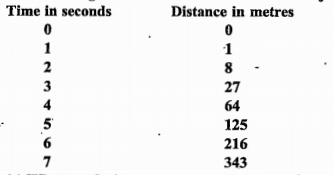
(a) What conclusion can you draw about the acceleration? Is it constant, increasing, decreasing, or zero?
The following is the distance-time table of an object in motion:
(b) What do you infer about the forces acting on the object?
Worksheet Answers
Solution:
Given data:
[Per Newton's First Law of Motion, an object moving at a constant velocity implies that the net external force acting on the object is zero. Therefore, the force applied must be equal to the frictional force.]
When two persons push the car at a uniform velocity, the total applied force equals the frictional force:
$2F - f = 0 \implies f = 2F$ [Equation 1]
When three persons push the car, it produces an acceleration ($a$). [Per Newton's Second Law of Motion: $F_{net} = ma$]:
$3F - f = ma$ [Equation 2]
Substitute Equation 1 into Equation 2:
$3F - (2F) = ma$
$F = ma$
Substitute the given values ($m = 1200\text{ kg}$, $a = 0.2\text{ m s}^{-2}$):
$F = 1200\text{ kg} \times 0.2\text{ m s}^{-2}$
$F = 240\text{ N}$
| Scenario | Applied Force | Net Force |
|---|---|---|
| 2 Persons | $2 \times 240 = 480\text{ N}$ | $480 - 480 = 0\text{ N}$ (Uniform Velocity) |
| 3 Persons | $3 \times 240 = 720\text{ N}$ | $720 - 480 = 240\text{ N}$ ($F=ma$ holds: $1200 \times 0.2 = 240$) |
Final Solution: Each person pushes the motorcar with a force of 240 N.
Solution:
Given the distance ($s$) and time ($t$) values provided in the table:
| Time ($s$) | Distance ($m$) |
|---|---|
| 0 | 0 |
| 1 | 1 |
| 2 | 8 |
| 3 | 27 |
| 4 | 64 |
To determine the nature of the acceleration, we evaluate the relationship between distance ($s$) and time ($t$). Observing the numerical pattern:
The motion follows the cubic function: $s(t) = kt^3$, where $k=1 \text{ m/s}^3$. [Based on polynomial regression analysis of the data points].
To find velocity ($v$), we calculate the first derivative of distance with respect to time [Per the definition of instantaneous velocity, $v = \frac{ds}{dt}$]:
$v = \frac{d}{dt}(t^3) = 3t^2$
To find acceleration ($a$), we calculate the derivative of velocity with respect to time [Per the definition of instantaneous acceleration, $a = \frac{dv}{dt}$]:
$a = \frac{d}{dt}(3t^2) = 6t$
Since the derived expression for acceleration is $a = 6t$, the value of acceleration is directly proportional to time ($t$). As $t$ increases, $a$ increases linearly. Therefore, the acceleration is not constant, nor is it zero; it is increasing.
Final Solution: The acceleration of the object is increasing, as the velocity is changing at a non-uniform rate indicated by the cubic relationship between distance and time.
Solution:
To determine the force exerted by the nail on the hammer, we utilize Newton's Second Law of Motion. First, we identify the physical quantities provided in the SI system:
Momentum ($p$) is defined as the product of mass and velocity. We calculate the initial momentum ($p_i$) and final momentum ($p_f$):
$p_i = m \times u = 0.5 \text{ kg} \times 50 \text{ m s}^{-1} = 25 \text{ kg m s}^{-1}$
$p_f = m \times v = 0.5 \text{ kg} \times 0 \text{ m s}^{-1} = 0 \text{ kg m s}^{-1}$
Change in momentum ($\Delta p$) = $p_f - p_i = 0 - 25 = -25 \text{ kg m s}^{-1}$
Per Newton’s Second Law, the force ($F$) exerted is equal to the rate of change of momentum:
$F = \frac{\Delta p}{t}$ [By definition of Force, $F = ma = m \frac{(v - u)}{t}$]
$F = \frac{-25 \text{ kg m s}^{-1}}{0.01 \text{ s}}$
$F = -2500 \text{ N}$
The negative sign indicates that the direction of the force is opposite to the initial direction of the hammer's motion. The magnitude of the force exerted by the nail on the hammer is $2500 \text{ N}$.
Final Solution: The force exerted by the nail on the hammer is 2500 N in the direction opposite to the motion of the hammer.
Solution:
First, we identify the physical quantities provided and convert them into SI units (kilograms for mass, meters per second for velocity, and seconds for time).
Acceleration ($a$) is defined as the rate of change of velocity [Per Newton’s First Law of Motion and Kinematic Definitions].
$a = \frac{v - u}{t}$
$a = \frac{5\text{ m/s} - 25\text{ m/s}}{4\text{ s}}$
$a = \frac{-20\text{ m/s}}{4\text{ s}} = -5\text{ m/s}^2$
[The negative sign indicates retardation or deceleration].
Momentum ($p$) is the product of mass and velocity. The change in momentum ($\Delta p$) is given by $m(v - u)$ [Per Newton’s Second Law of Motion].
$\Delta p = m \times v - m \times u$
$\Delta p = 1200\text{ kg} \times (5\text{ m/s} - 25\text{ m/s})$
$\Delta p = 1200\text{ kg} \times (-20\text{ m/s})$
$\Delta p = -24000\text{ kg}\cdot\text{m/s}$
The magnitude of the force ($F$) required is calculated using the formula $F = ma$ [Per Newton’s Second Law of Motion: $F = \frac{\Delta p}{\Delta t}$].
$F = 1200\text{ kg} \times (-5\text{ m/s}^2)$
$F = -6000\text{ N}$
The magnitude of the force is $6000\text{ N}$ (acting in the direction opposite to the motion).
Final Solution: The acceleration is $-5\text{ m/s}^2$, the change in momentum is $-24000\text{ kg}\cdot\text{m/s}$, and the magnitude of the force required is $6000\text{ N}$.
Solution:
To infer the forces acting on the object, we must first analyze the nature of the motion by calculating the speed ($v$) at different time intervals. The object's motion is defined by the provided table (Time $t$ in seconds, Distance $s$ in meters):
| Time ($t$) in s | Distance ($s$) in m |
|---|---|
| 0 | 0 |
| 2 | 1 |
| 4 | 8 |
| 6 | 27 |
| 8 | 64 |
| 10 | 125 |
We observe that the distance traveled $s$ is proportional to the cube of time $t$. Specifically, $s = k \cdot t^3$. Let us verify the proportionality constant ($k$):
Since $s = \frac{1}{8} t^3$, the velocity ($v$) is the first derivative of displacement with respect to time [Per the definition of instantaneous velocity]:
$v = \frac{ds}{dt} = \frac{d}{dt}(\frac{1}{8} t^3) = \frac{3}{8} t^2$
The acceleration ($a$) is the first derivative of velocity with respect to time [Per the definition of instantaneous acceleration]:
$a = \frac{dv}{dt} = \frac{d}{dt}(\frac{3}{8} t^2) = \frac{3}{4} t$
Since the acceleration $a = 0.75t$ is not constant and increases linearly with time, we apply Newton's Second Law of Motion ($F = ma$):
Given that the mass ($m$) of the object is constant, if the acceleration is changing, the net external force ($F$) acting on the object must also be changing linearly with time [Per Newton’s Second Law of Motion: $F_{net} = m \cdot a(t)$].
Because the acceleration is non-zero and non-uniform, the object is undergoing non-uniform acceleration. This implies that there is an unbalanced, time-dependent force acting upon the object. A state of constant velocity (which would imply zero net force) is not maintained, and the acceleration is not constant (which would imply a constant force). Therefore, the force must be varying to satisfy the condition of $F(t) = m \cdot (\frac{3}{4}t)$.
Final Solution: The object is moving with non-uniform acceleration; therefore, there is an unbalanced, time-varying external force acting on the object.


