


Your Worksheet is Ready
CBSE - Class 10 Mathematics Probability Worksheet
EXERCISE 14.1
A game of chance consists of spinning an arrow which comes to rest pointing at one of the numbers 1, 2, 3, 4, 5, 6, 7, 8 (see Fig. 14.5 ), and these are equally likely outcomes. What is the probability that it will point at (iii) a number greater than 2?

A game of chance consists of spinning an arrow which comes to rest pointing at one of the numbers 1, 2, 3, 4, 5, 6, 7, 8 (see Fig. 14.5 ), and these are equally likely outcomes. What is the probability that it will point at (ii) an odd number?

Complete the following statements: (ii) The probability of an event that cannot happen is . Such an event is called .
Complete the following statements: (iv) The sum of the probabilities of all the elementary events of an experiment is .
A game of chance consists of spinning an arrow which comes to rest pointing at one of the numbers 1, 2, 3, 4, 5, 6, 7, 8 (see Fig. 14.5 ), and these are equally likely outcomes. What is the probability that it will point at (i) 8 ?

Complete the following statements: (iii) The probability of an event that is certain to happen is . Such an event is called .
Which of the following cannot be the probability of an event?
$\frac{2}{3}$
b.–1.5
c.15%
d.0.7
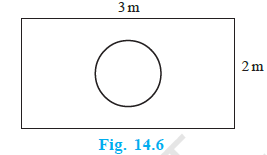
Suppose you drop a die at random on the rectangular region shown in Fig. 14.6. What is the probability that it will land inside the circle with diameter $1$m?
Worksheet Answers
Solution:
Given: An experiment where a driver attempts to start a car. The possible outcomes are defined as:
1. The car starts.
2. The car does not start.
To Find: Determine whether the outcomes of this experiment are "equally likely" and provide a logical explanation.
Definition: In probability theory, outcomes of an experiment are said to be equally likely if each outcome has the same probability of occurring. That is, if an experiment has $n$ possible outcomes, each outcome must have a probability of $\frac{1}{n}$.
Step 1: Analyzing the nature of the experiment
The experiment involves a mechanical process (starting a car). The outcome depends on various factors such as:
a) The condition of the car's battery.
b) The condition of the fuel system.
c) The condition of the ignition system.
d) The ambient temperature and maintenance history.
Step 2: Evaluating the probability of outcomes
Let $E_1$ be the event that the car starts.
Let $E_2$ be the event that the car does not start.
For the outcomes to be equally likely, we would require $P(E_1) = P(E_2) = 0.5$.
Step 3: Logical Deduction
In a real-world scenario, a car is designed to start. If the car is in good working condition, the probability of it starting ($P(E_1)$) is significantly higher than the probability of it not starting ($P(E_2)$). Conversely, if the car is broken, the probability of it not starting ($P(E_2)$) is significantly higher. Since the probability of the car starting is not necessarily equal to the probability of it not starting, the outcomes are dependent on external conditions rather than being inherently balanced.
Step 4: Conclusion
Since the likelihood of the car starting is not fixed at 50% and varies based on the mechanical state of the vehicle, the outcomes are not equally likely.
Final Answer: The outcomes are not equally likely because the probability of the car starting depends on various mechanical factors and is not necessarily equal to the probability of the car not starting.
Solution:
Given: A game of chance involves a spinner with numbers $1, 2, 3, 4, 5, 6, 7, 8$. The outcomes are equally likely.
To Find: The probability that the arrow points at a number greater than $2$.
Step 1: Identify the Sample Space
The sample space $S$ consists of all possible outcomes of the spinner. Since the spinner has numbers from $1$ to $8$, we have:
$S = \{1, 2, 3, 4, 5, 6, 7, 8\}$
The total number of possible outcomes, denoted by $n(S)$, is $8$.
Step 2: Define the Event
Let $E$ be the event of getting a number greater than $2$.
The numbers in the sample space that are greater than $2$ are $\{3, 4, 5, 6, 7, 8\}$.
Therefore, $E = \{3, 4, 5, 6, 7, 8\}$.
Step 3: Count the Favorable Outcomes
The number of favorable outcomes, denoted by $n(E)$, is the count of elements in set $E$.
$n(E) = 6$
Step 4: Apply the Probability Formula
The probability of an event $P(E)$ is defined as the ratio of the number of favorable outcomes to the total number of possible outcomes:
$P(E) = \frac{n(E)}{n(S)}$
[Using the classical definition of probability]
Step 5: Calculate the Probability
Substitute the values obtained in Step 1 and Step 3 into the formula:
$P(E) = \frac{6}{8}$
To simplify the fraction, divide both the numerator and the denominator by their greatest common divisor, which is $2$:
$P(E) = \frac{6 \div 2}{8 \div 2} = \frac{3}{4}$
Final Answer: The probability that the arrow will point at a number greater than 2 is $\frac{3}{4}$ (or $0.75$).
Solution:
Given: A game of chance involves a spinner with numbers $1, 2, 3, 4, 5, 6, 7, 8$. The outcomes are equally likely.
To Find: The probability that the arrow points at an odd number.
Step 1: Define the Sample Space
The sample space $S$ consists of all possible outcomes of the spinner.
$S = \{1, 2, 3, 4, 5, 6, 7, 8\}$
The total number of possible outcomes, denoted by $n(S)$, is $8$.
Step 2: Identify the Favorable Outcomes
Let $E$ be the event of getting an odd number.
An odd number is an integer that is not divisible by $2$.
From the set $S$, the odd numbers are $\{1, 3, 5, 7\}$.
The number of favorable outcomes, denoted by $n(E)$, is $4$.
Step 3: Apply the Probability Formula
The probability of an event $P(E)$ is defined as the ratio of the number of favorable outcomes to the total number of possible outcomes.
Formula: $P(E) = \frac{n(E)}{n(S)}$
[Since all outcomes are equally likely]
Step 4: Calculation
Substitute the values into the formula:
$P(E) = \frac{4}{8}$
Simplify the fraction by dividing both the numerator and the denominator by their greatest common divisor, which is $4$:
$P(E) = \frac{4 \div 4}{8 \div 4} = \frac{1}{2}$
Final Answer: The probability that the arrow will point at an odd number is $\frac{1}{2}$ or $0.5$.
Solution:
Given: An event in the context of probability theory that is impossible to occur.
To Find: The numerical probability of such an event and the specific terminology used to describe it.
Step 1: Defining the Probability of an Event
In probability theory, the probability of an event $E$, denoted by $P(E)$, is defined as the ratio of the number of favorable outcomes to the total number of equally likely outcomes in the sample space $S$.
Mathematically, $P(E) = \frac{\text{Number of favorable outcomes}}{\text{Total number of possible outcomes}}$.
Step 2: Analyzing an Impossible Event
An event that cannot happen is defined as an event with zero favorable outcomes. Let $E$ be an impossible event.
Since the event cannot occur, the number of favorable outcomes is $0$.
Let $n(S)$ be the total number of possible outcomes in the sample space, where $n(S) > 0$.
Applying the probability formula:
$P(E) = \frac{0}{n(S)}$
$P(E) = 0$
Step 3: Terminology
In the axiomatic definition of probability, an event that has no possibility of occurring is formally referred to as an impossible event. By definition, the probability of an impossible event is always $0$.
Step 4: Completing the Statement
Based on the deductions above:
1. The probability of an event that cannot happen is $0$.
2. Such an event is called an impossible event.
Final Answer: The probability of an event that cannot happen is 0. Such an event is called an impossible event.
Solution:
Given: A box contains 90 discs, numbered from 1 to 90. One disc is drawn at random.
To Find: The probability that the drawn disc bears a perfect square number.
Step 1: Determine the Total Number of Possible Outcomes
Let $S$ be the sample space of all possible outcomes. Since the discs are numbered from 1 to 90, the total number of discs is 90.
Total number of outcomes, $n(S) = 90$.
Step 2: Identify the Favorable Outcomes
Let $E$ be the event of drawing a disc that bears a perfect square number. We list all perfect square numbers between 1 and 90 inclusive:
$1^2 = 1$
$2^2 = 4$
$3^2 = 9$
$4^2 = 16$
$5^2 = 25$
$6^2 = 36$
$7^2 = 49$
$8^2 = 64$
$9^2 = 81$
$10^2 = 100$ (Since $100 > 90$, this is excluded.)
The set of favorable outcomes is $E = \{1, 4, 9, 16, 25, 36, 49, 64, 81\}$.
Step 3: Count the Number of Favorable Outcomes
Counting the elements in set $E$:
Number of favorable outcomes, $n(E) = 9$.
Step 4: Apply the Probability Formula
The probability of an event $E$ is given by the ratio of the number of favorable outcomes to the total number of possible outcomes:
$P(E) = \frac{n(E)}{n(S)}$ [Definition of Probability for equally likely outcomes]
$P(E) = \frac{9}{90}$
Step 5: Simplify the Fraction
$P(E) = \frac{9 \div 9}{90 \div 9}$
$P(E) = \frac{1}{10}$
Final Answer: The probability that the drawn disc bears a perfect square number is $\frac{1}{10}$ or $0.1$.
Solution:
Given: An experiment with a set of all possible elementary events.
To Find: The sum of the probabilities of all the elementary events of the experiment.
Step 1: Defining Elementary Events
An elementary event is defined as an event which has only one possible outcome of an experiment. Let the set of all possible elementary events of a random experiment be denoted by $E_1, E_2, E_3, \dots, E_n$.
Step 2: Applying the Axioms of Probability
According to the fundamental axioms of probability theory, for any random experiment, the sum of the probabilities of all the elementary events must equal the probability of the sure event (the sample space itself).
Step 3: Mathematical Representation
Let $P(E_i)$ represent the probability of the occurrence of the $i$-th elementary event. The sum of all such probabilities is given by:
$\sum_{i=1}^{n} P(E_i) = P(E_1) + P(E_2) + P(E_3) + \dots + P(E_n)$
Step 4: Logical Deduction
Since the set $\{E_1, E_2, \dots, E_n\}$ encompasses all possible outcomes of the experiment, the union of these events constitutes the sample space $S$. The probability of the sample space $P(S)$ is always $1$, as it represents a sure or certain event.
Therefore, $\sum_{i=1}^{n} P(E_i) = 1$.
Conclusion:
The sum of the probabilities of all the elementary events of an experiment is always equal to $1$.
Final Answer: 1
Solution:
Given: A game of chance involves a spinner with 8 equal sectors labeled with the numbers $\{1, 2, 3, 4, 5, 6, 7, 8\}$. The arrow is equally likely to stop at any of these numbers.
To Find: The probability that the arrow points at the number $8$.
Visual Representation:
Step 1: Define the Sample Space
The sample space $S$ is the set of all possible outcomes of the experiment. Since the spinner has 8 numbers, the sample space is:
$S = \{1, 2, 3, 4, 5, 6, 7, 8\}$
The total number of possible outcomes, denoted by $n(S)$, is $8$.
Step 2: Define the Favorable Event
Let $E$ be the event that the arrow points at the number $8$.
The set of favorable outcomes is $E = \{8\}$.
The number of favorable outcomes, denoted by $n(E)$, is $1$.
Step 3: Apply the Probability Formula
The theoretical probability of an event $P(E)$ is defined as the ratio of the number of favorable outcomes to the total number of equally likely outcomes:
$P(E) = \frac{\text{Number of favorable outcomes}}{\text{Total number of possible outcomes}}$
$P(E) = \frac{n(E)}{n(S)}$
Step 4: Calculation
Substituting the values obtained in Step 1 and Step 2 into the formula:
$P(E) = \frac{1}{8}$
Final Answer: The probability that the arrow will point at 8 is $\frac{1}{8}$.
Solution:
Given: Two dice are thrown simultaneously. The possible sums of the numbers appearing on the top faces range from $2$ to $12$. The student argues that since there are $11$ possible outcomes ($2, 3, 4, 5, 6, 7, 8, 9, 10, 11, 12$), the probability of each sum is $\frac{1}{11}$.
To Find/Justify: Determine whether the student's argument is correct and provide a mathematical justification.
Visual Representation: Sample Space of Two Dice
Step 1: Analyze the Total Number of Possible Outcomes
When two dice are thrown, each die has $6$ faces. The total number of elementary outcomes is calculated as $6 \times 6 = 36$. These outcomes are represented as ordered pairs $(d_1, d_2)$, where $d_1, d_2 \in \{1, 2, 3, 4, 5, 6\}$.
Step 2: Determine the Frequency of Each Sum
We calculate the number of ways to obtain each sum $S$ where $S \in \{2, 3, \dots, 12\}$:
| Sum ($S$) | Possible Outcomes | Number of Outcomes |
|---|---|---|
| 2 | (1,1) | 1 |
| 3 | (1,2), (2,1) | 2 |
| 4 | (1,3), (2,2), (3,1) | 3 |
| 5 | (1,4), (2,3), (3,2), (4,1) | 4 |
| 6 | (1,5), (2,4), (3,3), (4,2), (5,1) | 5 |
| 7 | (1,6), (2,5), (3,4), (4,3), (5,2), (6,1) | 6 |
| 8 | (2,6), (3,5), (4,4), (5,3), (6,2) | 5 |
| 9 | (3,6), (4,5), (5,4), (6,3) | 4 |
| 10 | (4,6), (5,5), (6,4) | 3 |
| 11 | (5,6), (6,5) | 2 |
| 12 | (6,6) | 1 |
Step 3: Evaluate the Student's Argument
The probability of an event $E$ is defined as $P(E) = \frac{\text{Number of favorable outcomes}}{\text{Total number of outcomes}}$.
For the sum to be $2$, $P(S=2) = \frac{1}{36}$.
For the sum to be $7$, $P(S=7) = \frac{6}{36} = \frac{1}{6}$.
Since $P(S=2) \neq P(S=7)$, the outcomes are not equally likely. The student's assumption that each sum has a probability of $\frac{1}{11}$ is incorrect because the sums are not equally likely events.
Final Answer: No, I do not agree with the argument. The 11 possible sums are not equally likely because they have different frequencies of occurrence within the 36 total possible outcomes of the two dice.
Solution:
Given: A statement regarding the probability of an event that is certain to occur.
To Find: The numerical value of the probability of a certain event and the specific terminology used to describe such an event.
Step 1: Understanding the Definition of Probability
In probability theory, the probability of an event $E$, denoted by $P(E)$, is defined as the ratio of the number of favorable outcomes to the total number of possible outcomes in a sample space $S$. Mathematically, this is expressed as:
$P(E) = \frac{\text{Number of favorable outcomes}}{\text{Total number of possible outcomes}}$
Step 2: Analyzing a Certain Event
A "certain event" is defined as an event that is guaranteed to occur in any trial of an experiment. If an event $E$ is certain to happen, then every possible outcome of the experiment is a favorable outcome. Therefore, the number of favorable outcomes is equal to the total number of possible outcomes.
Let $n(E)$ be the number of favorable outcomes and $n(S)$ be the total number of possible outcomes.
Since the event is certain, $n(E) = n(S)$.
Step 3: Calculating the Probability
Substituting the equality $n(E) = n(S)$ into the probability formula:
$P(E) = \frac{n(E)}{n(S)}$
$P(E) = \frac{n(S)}{n(S)}$
$P(E) = 1$ [Since any non-zero number divided by itself equals 1]
Step 4: Terminology
In the axiomatic definition of probability, an event that is certain to occur is formally referred to as a sure event or a certain event. The sample space $S$ itself is considered the sure event because it contains all possible outcomes.
Conclusion:
The probability of an event that is certain to happen is $1$. Such an event is called a sure event (or certain event).
Final Answer: The probability of an event that is certain to happen is 1. Such an event is called a sure event.
Solution:
Given: A football game begins with a coin toss to decide which team gets the ball first. The coin has two distinct faces: Heads (H) and Tails (T).
To Find: The logical and mathematical justification for why a coin toss is considered a "fair" method of decision-making.
Visual Representation of the Sample Space:
Step 1: Defining the Sample Space
When a fair coin is tossed, there are only two possible outcomes: Heads ($H$) and Tails ($T$). Therefore, the sample space $S$ is defined as:
$S = \{H, T\}$
The total number of possible outcomes, denoted by $n(S)$, is $2$.
Step 2: Calculating Probabilities of Individual Events
Let $E_1$ be the event of getting Heads and $E_2$ be the event of getting Tails.
The probability of an event $P(E)$ is given by the formula:
$P(E) = \frac{\text{Number of favorable outcomes}}{\text{Total number of possible outcomes}}$
For Heads ($E_1$):
$P(E_1) = \frac{n(E_1)}{n(S)} = \frac{1}{2} = 0.5$
For Tails ($E_2$):
$P(E_2) = \frac{n(E_2)}{n(S)} = \frac{1}{2} = 0.5$
Step 3: Justification of Fairness
A process is considered "fair" in probability theory if all possible outcomes are equally likely.
Since $P(E_1) = P(E_2) = 0.5$, neither outcome has a mathematical advantage over the other. Because the probability of obtaining Heads is exactly equal to the probability of obtaining Tails, the outcome of the toss is entirely dependent on chance and cannot be predicted or manipulated by either team.
Step 4: Conclusion
Because the two outcomes are mutually exclusive and collectively exhaustive with equal probabilities, the coin toss provides an unbiased mechanism to decide which team gains possession of the ball. This eliminates any subjective bias or preference, ensuring that both teams have an equal opportunity ($50\%$) to win the toss.
Final Answer: Tossing a coin is considered a fair way to decide because the two possible outcomes, Heads and Tails, are equally likely, each having a probability of $\frac{1}{2}$. This ensures that neither team has an advantage, making the decision process unbiased and purely based on chance.
Solution:
Given:
A set of five cards consisting of the ten, jack, queen, king, and ace of diamonds. One card (the queen) is drawn and put aside.
To Find:
The probability that the second card picked up is a queen.
Step 1: Defining the Sample Space
Initially, the set of cards is $S = \{10, J, Q, K, A\}$. The total number of cards is $n(S) = 5$.
Step 2: Analyzing the Condition after the First Draw
It is given that the queen is drawn and put aside. We must update the sample space for the second draw.
Let $S'$ be the set of remaining cards after the queen is removed:
$S' = \{10, J, K, A\}$
The total number of remaining cards is $n(S') = 5 - 1 = 4$.
Step 3: Identifying the Favorable Outcomes
We are looking for the probability of drawing a queen as the second card.
Let $E$ be the event of drawing a queen from the remaining cards $S'$.
Looking at the set $S' = \{10, J, K, A\}$, we observe that there are no queens remaining in the deck because the only queen was already removed in the first step.
Therefore, the number of favorable outcomes $n(E) = 0$.
Step 4: Applying the Probability Formula
The probability of an event $P(E)$ is defined as the ratio of the number of favorable outcomes to the total number of possible outcomes:
$P(E) = \frac{n(E)}{n(S')}$
[Substituting the values identified in Step 2 and Step 3]
$P(E) = \frac{0}{4}$
$P(E) = 0$
[Since the event is impossible, the probability is 0]
Final Answer:
Final Answer: 0
Solution:
Given: A set of values representing potential probabilities of an event: (A) $2/3$, (B) $-1.5$, (C) $15\%$, (D) $0.7$.
To Find: Identify which of the given values cannot represent the probability of an event.
Theoretical Background:
In the theory of probability, for any event $E$, the probability $P(E)$ must satisfy the following fundamental axiom:
$0 \leq P(E) \leq 1$
This implies that:
1. The probability of an event cannot be negative ($P(E) \geq 0$).
2. The probability of an event cannot exceed $1$ ($P(E) \leq 1$).
Step 1: Analyzing the given options
We evaluate each option against the condition $0 \leq P(E) \leq 1$.
| Option | Value | Decimal Equivalent | Validity ($0 \leq P \leq 1$) |
|---|---|---|---|
| (A) | $2/3$ | $\approx 0.66$ | Valid |
| (B) | $-1.5$ | $-1.5$ | Invalid |
| (C) | $15\%$ | $0.15$ | Valid |
| (D) | $0.7$ | $0.7$ | Valid |
Step 2: Justification for the invalid value
The value $-1.5$ is less than $0$. Since the probability of an event is defined as the ratio of the number of favorable outcomes to the total number of possible outcomes, it must always be a non-negative value. Therefore, a negative value is mathematically impossible for a probability.
Conclusion:
Since $-1.5 < 0$, it violates the axiom $P(E) \geq 0$. Thus, it cannot be the probability of an event.
Final Answer: The value that cannot be the probability of an event is -1.5.
Solution:
Given:
A group of 3 students is considered. The probability that 2 students do not have the same birthday is given as $P(\text{not same birthday}) = 0.992$.
To find:
The probability that the 2 students have the same birthday, denoted as $P(\text{same birthday})$.
Step 1: Identifying the relationship between complementary events
In probability theory, for any event $E$, the event "not $E$" (denoted as $\overline{E}$) represents the complement of event $E$. The sum of the probability of an event occurring and the probability of the event not occurring is always equal to 1.
Formula: $P(E) + P(\overline{E}) = 1$
[Since the sum of probabilities of all elementary events in a sample space is 1]
Step 2: Defining the variables
Let $E$ be the event that 2 students have the same birthday.
Let $\overline{E}$ be the event that 2 students do not have the same birthday.
Given: $P(\overline{E}) = 0.992$
Step 3: Substituting the values into the formula
Using the identity $P(E) + P(\overline{E}) = 1$:
$P(E) + 0.992 = 1$
Step 4: Solving for $P(E)$
To isolate $P(E)$, subtract $0.992$ from both sides of the equation:
$P(E) = 1 - 0.992$
[Performing the subtraction: $1.000 - 0.992 = 0.008$]
$P(E) = 0.008$
Final Answer: The probability that the 2 students have the same birthday is 0.008.
Solution:
Given:
A rectangular region with dimensions length $l = 3$ m and breadth $b = 2$ m. A circular region is inscribed within this rectangle with a diameter $d = 1$ m.
To Find:
The probability that a die dropped at random on the rectangular region will land inside the circle.
Visual Representation:
Step 1: Calculate the Area of the Rectangular Region
The formula for the area of a rectangle is $Area = length \times breadth$.
Given $l = 3$ m and $b = 2$ m:
$Area_{rectangle} = 3 \text{ m} \times 2 \text{ m} = 6 \text{ m}^2$.
Step 2: Calculate the Area of the Circular Region
The formula for the area of a circle is $Area = \pi r^2$, where $r$ is the radius.
Given the diameter $d = 1$ m, the radius $r$ is calculated as:
$r = \frac{d}{2} = \frac{1}{2} = 0.5 \text{ m}$.
Now, calculate the area:
$Area_{circle} = \pi \times (0.5 \text{ m})^2$
$Area_{circle} = \pi \times 0.25 \text{ m}^2 = \frac{\pi}{4} \text{ m}^2$.
Step 3: Apply the Probability Formula for Geometric Regions
The probability $P(E)$ of an event occurring in a geometric region is defined as:
$P(E) = \frac{\text{Favorable Area}}{\text{Total Area}}$
[Since the die is dropped at random, the probability is proportional to the area of the target region relative to the total area].
Step 4: Perform the Final Calculation
$P(\text{landing inside circle}) = \frac{Area_{circle}}{Area_{rectangle}}$
$P = \frac{\frac{\pi}{4}}{6}$
$P = \frac{\pi}{4 \times 6}$
$P = \frac{\pi}{24}$
Final Answer: The probability that the die will land inside the circle is $\frac{\pi}{24}$.
Solution:
Given: A trial is conducted to answer a true-false question. The possible outcomes are that the answer is either 'right' or 'wrong'.
To Find: Determine whether the outcomes of this experiment are 'equally likely' and provide a logical explanation.
Definition: Outcomes of an experiment are said to be equally likely if each outcome has the same probability of occurring. In a sample space $S$, if $P(A) = P(B) = \dots = P(n)$, then the outcomes are equally likely.
Step 1: Identifying the Sample Space
Let the possible outcomes of the experiment be represented by the set $S$.
$S = \{ \text{Right}, \text{Wrong} \}$
The total number of possible outcomes is $n(S) = 2$.
Step 2: Analyzing the Nature of the Experiment
In a true-false question, the correctness of the answer depends on the knowledge or the choice of the person answering the question. Unlike a fair coin toss where the physical properties of the coin ensure a $50\%$ chance for heads or tails, the probability of answering a true-false question correctly is dependent on external factors:
Step 3: Evaluating the Condition for Equally Likely Outcomes
For the outcomes to be equally likely, the probability of getting the answer 'Right' ($P(R)$) must equal the probability of getting the answer 'Wrong' ($P(W)$).
$P(R) = \frac{\text{Number of favorable outcomes for Right}}{\text{Total number of outcomes}}$
$P(W) = \frac{\text{Number of favorable outcomes for Wrong}}{\text{Total number of outcomes}}$
Since the probability of answering correctly is not inherently fixed at $0.5$ for every individual or every question (as it is not a random physical process like tossing a balanced die), we cannot assume $P(R) = P(W) = 0.5$.
Step 4: Conclusion
Because the likelihood of the answer being 'Right' or 'Wrong' depends on the knowledge of the person answering the question and is not determined by a uniform random process, the outcomes are not necessarily equally likely.
Final Answer: The outcomes are not equally likely because the probability of answering correctly depends on the knowledge of the person attempting the question, and it is not a random event with a fixed probability of $0.5$ for each outcome.
Solution:
Given: A fair six-faced die is thrown twice. The possible outcomes for each throw are $\{1, 2, 3, 4, 5, 6\}$.
To Find: The probability that the number 5 will not come up in either of the two throws.
Step 1: Determining the Total Number of Possible Outcomes
When a die is thrown once, there are $6$ possible outcomes. When a die is thrown twice, the total number of outcomes is calculated by the product of the outcomes of each throw [Fundamental Counting Principle].
Total outcomes = $6 \times 6 = 36$.
The sample space $S$ consists of all ordered pairs $(a, b)$ where $a$ is the result of the first throw and $b$ is the result of the second throw:
$S = \{(1,1), (1,2), (1,3), (1,4), (1,5), (1,6),$
$(2,1), (2,2), (2,3), (2,4), (2,5), (2,6),$
$(3,1), (3,2), (3,3), (3,4), (3,5), (3,6),$
$(4,1), (4,2), (4,3), (4,4), (4,5), (4,6),$
$(5,1), (5,2), (5,3), (5,4), (5,5), (5,6),$
$(6,1), (6,2), (6,3), (6,4), (6,5), (6,6)\}$
Step 2: Identifying Favorable Outcomes
Let $E$ be the event that 5 does not come up in either throw. This means that for any outcome $(a, b)$, $a \neq 5$ and $b \neq 5$.
If $a \neq 5$, then $a \in \{1, 2, 3, 4, 6\}$ (5 possibilities).
If $b \neq 5$, then $b \in \{1, 2, 3, 4, 6\}$ (5 possibilities).
The number of favorable outcomes $n(E)$ is the product of the number of choices for the first throw and the second throw:
$n(E) = 5 \times 5 = 25$.
Step 3: Calculating the Probability
The probability of an event $P(E)$ is defined as the ratio of the number of favorable outcomes to the total number of possible outcomes [Classical Definition of Probability].
$P(E) = \frac{\text{Number of favorable outcomes}}{\text{Total number of outcomes}}$
$P(E) = \frac{n(E)}{n(S)}$
$P(E) = \frac{25}{36}$
Alternative Method (Using Complementary Events):
Let $A$ be the event that 5 comes up at least once. The outcomes where 5 appears are:
$(5,1), (5,2), (5,3), (5,4), (5,5), (5,6), (1,5), (2,5), (3,5), (4,5), (6,5)$.
Counting these, we find $n(A) = 11$.
$P(A) = \frac{11}{36}$.
Since the event "5 does not come up" is the complement of event $A$ (denoted as $A'$), we use the property $P(A') = 1 - P(A)$:
$P(A') = 1 - \frac{11}{36} = \frac{36 - 11}{36} = \frac{25}{36}$.
Final Answer: The probability that 5 will not come up either time is $\frac{25}{36}$.
Solution:
Given: A bag contains only lemon-flavoured candies. Malini takes out one candy from the bag without looking.
To Find: The probability that the candy taken out is a lemon-flavoured candy.
Step 1: Defining the Sample Space and Event
Let the total number of candies in the bag be $n$. Since the bag contains only lemon-flavoured candies, the number of lemon-flavoured candies in the bag is also $n$.
Let $E$ be the event of taking out a lemon-flavoured candy.
Step 2: Applying the Probability Formula
The theoretical probability of an event $E$, denoted by $P(E)$, is defined by the ratio of the number of favourable outcomes to the total number of possible outcomes:
$P(E) = \frac{\text{Number of favourable outcomes}}{\text{Total number of possible outcomes}}$
Step 3: Calculating the Probability
In this scenario:
Substituting these values into the formula:
$P(E) = \frac{n}{n}$
$P(E) = 1$
Step 4: Theoretical Justification
[Since the event of picking a lemon-flavoured candy is a sure event or certain event because the bag contains no other types of candies, the probability must be 1.]
Final Answer: The probability that she takes out a lemon-flavoured candy is 1.
Solution:
Given:
To Find:
The probability that Nuri will buy the pen. Nuri buys the pen if and only if it is a good pen.
Step 1: Determine the number of good pens.
Let $N_{total}$ be the total number of pens and $N_{defective}$ be the number of defective pens.
The number of good pens ($N_{good}$) is calculated as:
$N_{good} = N_{total} - N_{defective}$
$N_{good} = 144 - 20$
$N_{good} = 124$
[Since the total lot consists only of good and defective pens, subtracting the defective count from the total yields the count of good pens.]
Step 2: Define the event and the probability formula.
Let $E$ be the event that Nuri buys the pen. Nuri buys the pen if it is good.
The number of favorable outcomes for event $E$ is the number of good pens, which is $124$.
The total number of possible outcomes is the total number of pens, which is $144$.
The probability of an event $P(E)$ is given by the formula:
$P(E) = \frac{\text{Number of favorable outcomes}}{\text{Total number of possible outcomes}}$
Step 3: Calculate the probability.
$P(\text{She will buy it}) = \frac{124}{144}$
To simplify the fraction, we find the greatest common divisor (GCD) of $124$ and $144$.
Divide both numerator and denominator by $4$:
$124 \div 4 = 31$
$144 \div 4 = 36$
$P(E) = \frac{31}{36}$
[Since $31$ is a prime number and does not divide $36$, the fraction is in its simplest form.]
Final Answer: The probability that she will buy the pen is $\frac{31}{36}$.
Solution:
Given: An experiment where a baby is born, and the outcome is either a boy or a girl.
To Find: Determine whether the outcomes of this experiment are "equally likely" and provide a logical explanation.
Definition of Equally Likely Outcomes:
Outcomes of an experiment are said to be equally likely if each outcome has the same probability of occurring. If an experiment has $n$ possible outcomes, each outcome is equally likely if the probability of each is $\frac{1}{n}$.
Step 1: Identifying the Sample Space
Let $S$ be the sample space of the experiment.
The possible outcomes are:
$E_1$: The baby is a boy.
$E_2$: The baby is a girl.
Thus, $S = \{ \text{Boy, Girl} \}$. The total number of possible outcomes is $n = 2$.
Step 2: Analyzing the Probability of Each Outcome
In biological terms, the sex of a baby is determined by the combination of sex chromosomes (XX for female, XY for male). During fertilization, there is an approximately equal chance of a sperm carrying an X chromosome or a Y chromosome fertilizing the egg.
Let $P(E_1)$ be the probability that the baby is a boy.
Let $P(E_2)$ be the probability that the baby is a girl.
Step 3: Evaluating the Likelihood
Based on biological principles and statistical data collected over large populations, the ratio of male births to female births is approximately $1:1$.
Therefore:
$P(E_1) \approx 0.5$
$P(E_2) \approx 0.5$
Since $P(E_1) = P(E_2) = \frac{1}{2}$, the outcomes are considered to have an equal chance of occurrence.
Step 4: Conclusion
Because the probability of the baby being a boy is equal to the probability of the baby being a girl, the outcomes are equally likely.
Final Answer: Yes, the outcomes are equally likely because, biologically, the chance of a baby being a boy or a girl is approximately equal ($50\%$ each).
Solution:
Given: A game involves tossing a fair one-rupee coin 3 times. Hanif wins if all three tosses result in the same outcome (HHH or TTT). Hanif loses if the outcomes are not all the same.
To Find: The probability that Hanif will lose the game.
Step 1: Determining the Sample Space
When a coin is tossed once, there are 2 possible outcomes: Head (H) or Tail (T). When a coin is tossed 3 times, the total number of possible outcomes is $2^3 = 2 \times 2 \times 2 = 8$.
Let $S$ be the sample space representing all possible outcomes:
$S = \{HHH, HHT, HTH, HTT, THH, THT, TTH, TTT\}$
The total number of elementary events, $n(S) = 8$.
Step 2: Identifying Winning Outcomes
Hanif wins if all tosses result in the same outcome. These outcomes are:
Winning outcomes = $\{HHH, TTT\}$
Number of winning outcomes, $n(W) = 2$.
Step 3: Identifying Losing Outcomes
Hanif loses if the outcome is not one of the winning outcomes. These outcomes are:
Losing outcomes = $\{HHT, HTH, HTT, THH, THT, TTH\}$
Number of losing outcomes, $n(L) = n(S) - n(W) = 8 - 2 = 6$.
Step 4: Calculating the Probability of Losing
The probability of an event $E$ is given by the formula:
$P(E) = \frac{\text{Number of favorable outcomes}}{\text{Total number of possible outcomes}}$
Let $L$ be the event that Hanif loses the game.
$P(L) = \frac{n(L)}{n(S)}$
$P(L) = \frac{6}{8}$
Step 5: Simplifying the Fraction
To simplify $\frac{6}{8}$, we divide both the numerator and the denominator by their greatest common divisor, which is 2:
$P(L) = \frac{6 \div 2}{8 \div 2} = \frac{3}{4}$
Alternatively, using the complement rule:
$P(W) = \frac{n(W)}{n(S)} = \frac{2}{8} = \frac{1}{4}$
$P(L) = 1 - P(W)$ [Since the sum of probabilities of complementary events is 1]
$P(L) = 1 - \frac{1}{4} = \frac{3}{4}$
Final Answer: The probability that Hanif will lose the game is $\frac{3}{4}$ or $0.75$.


