


Your Worksheet is Ready
CBSE - Class 10 Mathematics Statistics Worksheet
EXERCISE 13.1
The following distribution shows the daily pocket allowance of children of a locality. The mean pocket allowance is Rs 18. Find the missing frequency $f$.

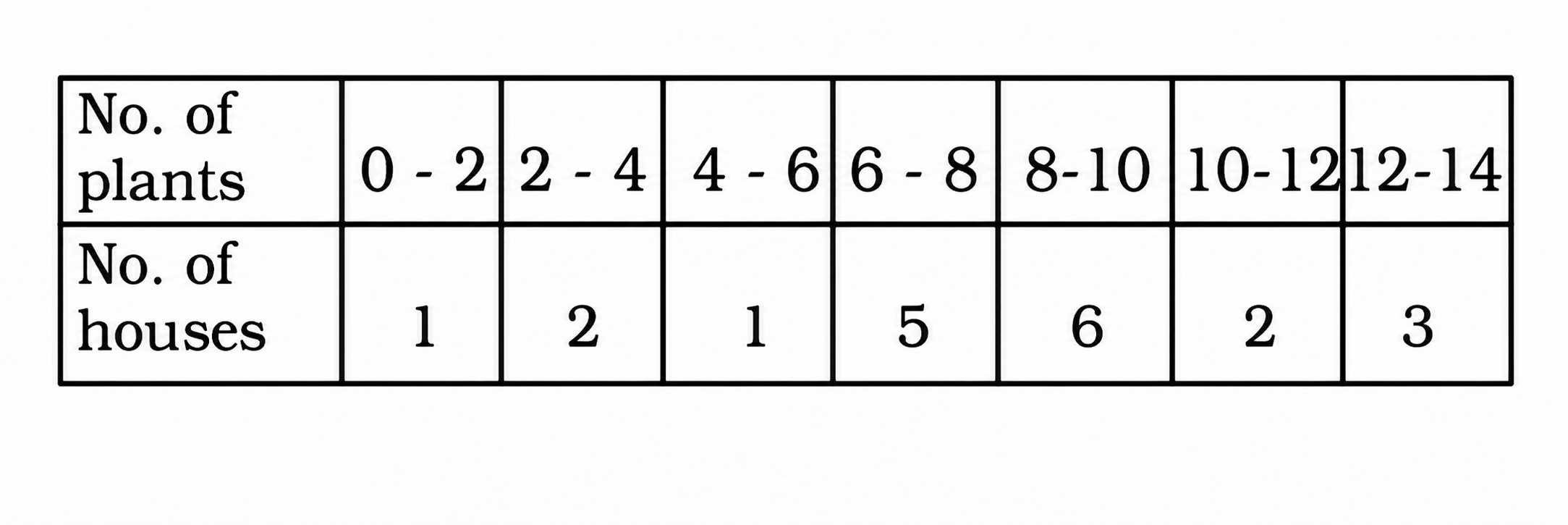
A survey was conducted by a group of students as a part of their environment awareness programme, in which they collected the following data regarding the number of plants in 20 houses in a locality. Find the mean number of plants per house.
Which method did you use for finding the mean, and why?
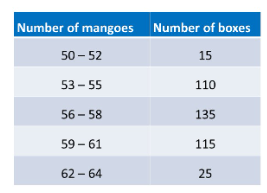
In a retail market, fruit vendors were selling mangoes kept in packing boxes. These boxes contained varying number of mangoes. The following was the distribution of mangoes according to the number of boxes.
Find the mean number of mangoes kept in a packing box. Which method of finding the mean did you choose?
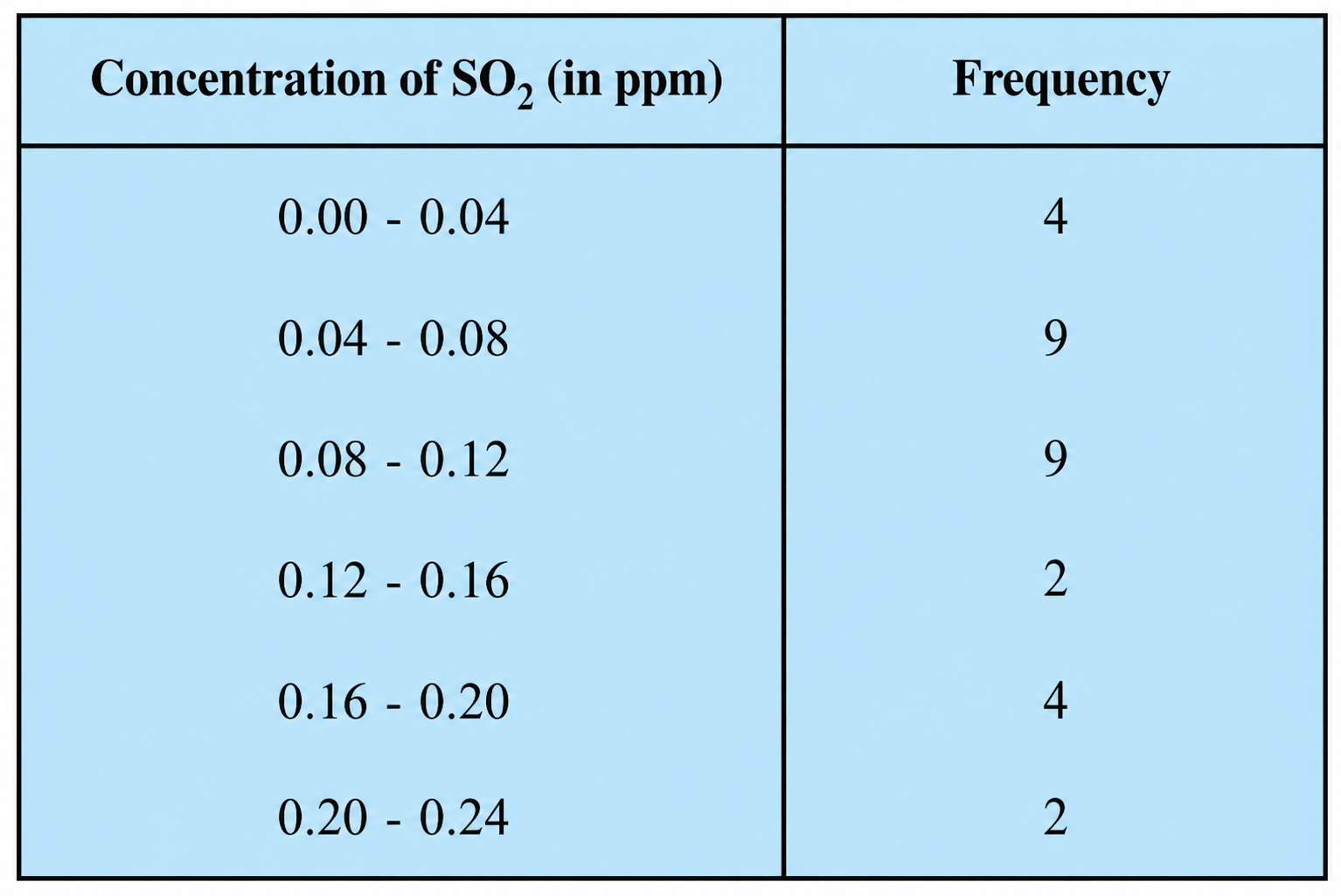
To find out the concentration of $SO_2$ in the air (in parts per million, i.e., ppm), the data was collected for 30 localities in a certain city and is presented below:
Find the mean concentration of $SO_2$ in the air.
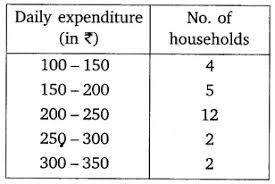
The table below shows the daily expenditure on food of 25 households in a locality.
Find the mean daily expenditure on food by a suitable method.
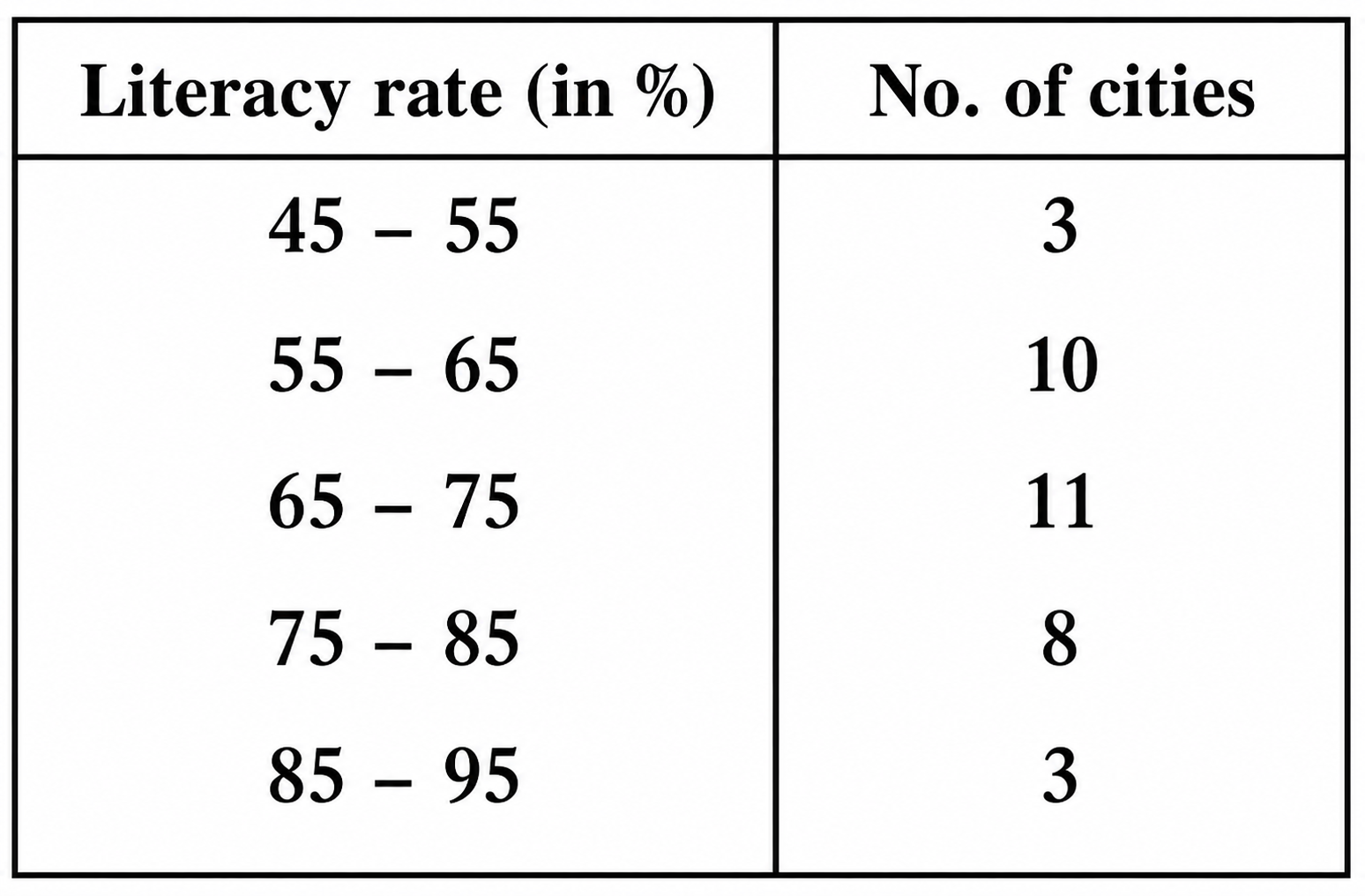
The following table gives the literacy rate (in percentage) of 35 cities. Find the mean literacy rate.
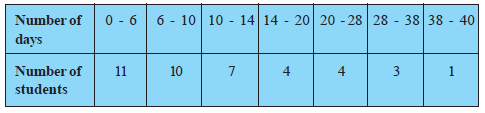
A class teacher has the following absentee record of 40 students of a class for the whole term. Find the mean number of days a student was absent.
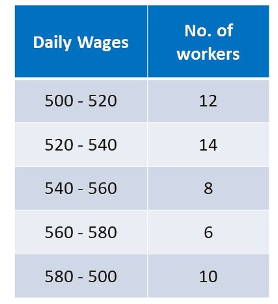
Consider the following distribution of daily wages of 50 workers of a factory.
Find the mean daily wages of the workers of the factory by using an appropriate method.
Thirty women were examined in a hospital by a doctor and the number of heartbeats per minute were recorded and summarised as follows. Find the mean heartbeats per minute for these women, choosing a suitable method.

Worksheet Answers
Solution:
Given: The frequency distribution of daily pocket allowance of children, where the mean ($\bar{x}$) is Rs 18. The data is as follows:
| Daily Pocket Allowance (Rs) | 11-13 | 13-15 | 15-17 | 17-19 | 19-21 | 21-23 | 23-25 |
|---|---|---|---|---|---|---|---|
| Number of Children ($f_i$) | 7 | 6 | 9 | 13 | $f$ | 5 | 4 |
To Find: The value of the missing frequency $f$.
Step 1: Constructing the Frequency Distribution Table
To calculate the mean using the Direct Method, we first find the class mark ($x_i$) for each interval, where $x_i = \frac{\text{Upper Limit} + \text{Lower Limit}}{2}$.
| Class Interval | Frequency ($f_i$) | Class Mark ($x_i$) | $f_i \cdot x_i$ |
|---|---|---|---|
| 11-13 | 7 | 12 | 84 |
| 13-15 | 6 | 14 | 84 |
| 15-17 | 9 | 16 | 144 |
| 17-19 | 13 | 18 | 234 |
| 19-21 | $f$ | 20 | $20f$ |
| 21-23 | 5 | 22 | 110 |
| 23-25 | 4 | 24 | 96 |
| Total | $\sum f_i = 44 + f$ | - | $\sum f_i x_i = 752 + 20f$ |
Step 2: Applying the Mean Formula
The formula for the mean ($\bar{x}$) using the direct method is given by:
$\bar{x} = \frac{\sum f_i x_i}{\sum f_i}$
Step 3: Substituting the Values and Solving for $f$
Given $\bar{x} = 18$, we substitute the values from our table:
$18 = \frac{752 + 20f}{44 + f}$
Multiply both sides by $(44 + f)$ to clear the denominator:
$18(44 + f) = 752 + 20f$
Distribute the 18 on the left side:
$792 + 18f = 752 + 20f$
Rearrange the terms to isolate $f$ on one side:
$792 - 752 = 20f - 18f$
$40 = 2f$
Divide by 2:
$f = \frac{40}{2}$
$f = 20$
Final Answer: The missing frequency $f$ is 20.
Solution:
Given: A frequency distribution table representing the number of plants in 20 houses.
| Number of plants | 0-2 | 2-4 | 4-6 | 6-8 | 8-10 | 10-12 | 12-14 |
|---|---|---|---|---|---|---|---|
| Number of houses ($f_i$) | 1 | 2 | 1 | 5 | 6 | 2 | 3 |
To Find: The mean number of plants per house and the justification for the chosen method.
Step 1: Choosing the Method
Since the class intervals are small and the frequencies are manageable, we will use the Direct Method to calculate the mean. The formula for the mean ($\bar{x}$) using the direct method is:
$\bar{x} = \frac{\sum f_i x_i}{\sum f_i}$
where $x_i$ is the class mark of each interval.
Step 2: Constructing the Calculation Table
We calculate the class mark ($x_i$) for each interval using the formula: $x_i = \frac{\text{Upper Limit} + \text{Lower Limit}}{2}$.
| Number of plants (Class Interval) | Number of houses ($f_i$) | Class mark ($x_i$) | $f_i \times x_i$ |
|---|---|---|---|
| 0-2 | 1 | 1 | 1 |
| 2-4 | 2 | 3 | 6 |
| 4-6 | 1 | 5 | 5 |
| 6-8 | 5 | 7 | 35 |
| 8-10 | 6 | 9 | 54 |
| 10-12 | 2 | 11 | 22 |
| 12-14 | 3 | 13 | 39 |
| Total | $\sum f_i = 20$ | - | $\sum f_i x_i = 162$ |
Step 3: Calculating the Mean
Using the values obtained from the table:
$\sum f_i = 20$
$\sum f_i x_i = 1 + 6 + 5 + 35 + 54 + 22 + 39 = 162$
Substituting these into the mean formula:
$\bar{x} = \frac{162}{20}$
$\bar{x} = 8.1$
Step 4: Justification
The Direct Method was used because the numerical values of the class marks ($x_i$) and the frequencies ($f_i$) are small, making the multiplication $f_i x_i$ straightforward and easy to compute without the need for complex deviations or assumed mean methods.
Final Answer: The mean number of plants per house is 8.1.
Solution:
Given: The frequency distribution of mangoes in packing boxes is as follows:
| Number of Mangoes | 50-52 | 53-55 | 56-58 | 59-61 | 62-64 |
|---|---|---|---|---|---|
| Number of Boxes ($f_i$) | 15 | 110 | 135 | 115 | 25 |
To Find: The mean number of mangoes kept in a packing box. We will use the Step-Deviation Method as it simplifies calculations when class intervals are continuous and frequencies are large.
Step 1: Prepare the Frequency Distribution Table
First, we observe that the class intervals are not continuous (e.g., 52 to 53). We adjust them by subtracting 0.5 from the lower limit and adding 0.5 to the upper limit. Then, we calculate the class mark ($x_i$) for each interval using the formula: $x_i = \frac{\text{Lower Limit} + \text{Upper Limit}}{2}$.
| Class Interval | $f_i$ | $x_i$ | $d_i = x_i - a$ | $u_i = \frac{x_i - a}{h}$ | $f_i u_i$ |
|---|---|---|---|---|---|
| 49.5-52.5 | 15 | 51 | -6 | -2 | -30 |
| 52.5-55.5 | 110 | 54 | -3 | -1 | -110 |
| 55.5-58.5 | 135 | 57 (a) | 0 | 0 | 0 |
| 58.5-61.5 | 115 | 60 | 3 | 1 | 115 |
| 61.5-64.5 | 25 | 63 | 6 | 2 | 50 |
| Total | $\sum f_i = 400$ | - | - | - | $\sum f_i u_i = 25$ |
Step 2: Identify Variables for Step-Deviation Method
Let the assumed mean ($a$) = $57$.
The class size ($h$) = $52.5 - 49.5 = 3$.
Sum of frequencies ($\sum f_i$) = $400$.
Sum of product of frequencies and deviations ($\sum f_i u_i$) = $25$.
Step 3: Apply the Mean Formula
The formula for the mean ($\bar{x}$) using the Step-Deviation Method is:
$\bar{x} = a + \left( \frac{\sum f_i u_i}{\sum f_i} \right) \times h$
Substituting the values:
$\bar{x} = 57 + \left( \frac{25}{400} \right) \times 3$
Step 4: Perform Arithmetic Calculations
$\bar{x} = 57 + \left( \frac{1}{16} \right) \times 3$ [Since $25/400 = 1/16$]
$\bar{x} = 57 + \frac{3}{16}$
$\bar{x} = 57 + 0.1875$
$\bar{x} = 57.1875$
Conclusion on Method: The Step-Deviation method was chosen because the class intervals are uniform and the values of $f_i$ and $x_i$ are large, making manual multiplication cumbersome. This method reduces the magnitude of the numbers, facilitating easier calculation.
Final Answer: The mean number of mangoes kept in a packing box is 57.19 (rounded to two decimal places).
Solution:
Given: The frequency distribution of the concentration of $SO_2$ (in ppm) for 30 localities.
| Concentration of $SO_2$ (ppm) | Number of Localities ($f_i$) |
|---|---|
| 0.00 - 0.04 | 4 |
| 0.04 - 0.08 | 9 |
| 0.08 - 0.12 | 9 |
| 0.12 - 0.16 | 2 |
| 0.16 - 0.20 | 4 |
| 0.20 - 0.24 | 2 |
To Find: The mean concentration of $SO_2$ in the air.
Step 1: Determine the Class Marks ($x_i$)
The class mark ($x_i$) for each interval is calculated using the formula: $x_i = \frac{\text{Upper Class Limit} + \text{Lower Class Limit}}{2}$.
| Concentration ($SO_2$) | Frequency ($f_i$) | Class Mark ($x_i$) | $f_i \cdot x_i$ |
|---|---|---|---|
| 0.00 - 0.04 | 4 | 0.02 | 0.08 |
| 0.04 - 0.08 | 9 | 0.06 | 0.54 |
| 0.08 - 0.12 | 9 | 0.10 | 0.90 |
| 0.12 - 0.16 | 2 | 0.14 | 0.28 |
| 0.16 - 0.20 | 4 | 0.18 | 0.72 |
| 0.20 - 0.24 | 2 | 0.22 | 0.44 |
| Total | $\sum f_i = 30$ | - | $\sum f_i x_i = 2.96$ |
Step 2: Apply the Direct Method Formula for Mean
The mean ($\bar{x}$) is given by the formula: $\bar{x} = \frac{\sum f_i x_i}{\sum f_i}$.
Step 3: Perform the Calculation
Substitute the values obtained from the table into the formula:
$\sum f_i = 4 + 9 + 9 + 2 + 4 + 2 = 30$
$\sum f_i x_i = 0.08 + 0.54 + 0.90 + 0.28 + 0.72 + 0.44 = 2.96$
$\bar{x} = \frac{2.96}{30}$
To simplify the division:
$\bar{x} = \frac{2.96}{30} = \frac{296}{3000}$
$\bar{x} = \frac{148}{1500} = \frac{74}{750} = \frac{37}{375}$
Performing the division $37 \div 375 \approx 0.09866...$
Rounding to four decimal places, we get $\bar{x} \approx 0.0987$.
Final Answer: The mean concentration of $SO_2$ in the air is 0.0987 ppm.
Solution:
Given: The frequency distribution of daily expenditure on food for 25 households.
| Daily Expenditure (in ₹) | 100-150 | 150-200 | 200-250 | 250-300 | 300-350 |
|---|---|---|---|---|---|
| Number of Households ($f_i$) | 4 | 5 | 12 | 2 | 2 |
To Find: The mean daily expenditure on food using a suitable method.
Methodology: Since the class intervals and frequencies are provided, we will use the Step-Deviation Method to calculate the mean, as it simplifies the arithmetic calculations significantly.
Step 1: Construct the Frequency Distribution Table
Let the assumed mean ($a$) be the midpoint of the central class interval. Here, the class intervals are $100-150, 150-200, 200-250, 250-300, 300-350$.
The class mark ($x_i$) is calculated as: $x_i = \frac{\text{Upper Limit} + \text{Lower Limit}}{2}$.
The class size ($h$) is $150 - 100 = 50$.
Let assumed mean $a = 225$.
The deviation $u_i = \frac{x_i - a}{h}$.
| Class Interval | Frequency ($f_i$) | Class Mark ($x_i$) | $u_i = \frac{x_i - 225}{50}$ | $f_i u_i$ |
|---|---|---|---|---|
| 100-150 | 4 | 125 | -2 | -8 |
| 150-200 | 5 | 175 | -1 | -5 |
| 200-250 | 12 | 225 | 0 | 0 |
| 250-300 | 2 | 275 | 1 | 2 |
| 300-350 | 2 | 325 | 2 | 4 |
| Total | $\sum f_i = 25$ | - | - | $\sum f_i u_i = -7$ |
Step 2: Apply the Step-Deviation Formula
The formula for the mean ($\bar{x}$) using the step-deviation method is:
$\bar{x} = a + \left( \frac{\sum f_i u_i}{\sum f_i} \right) \times h$
Step 3: Substitute the Values
Given: $a = 225$, $\sum f_i u_i = -7$, $\sum f_i = 25$, $h = 50$.
$\bar{x} = 225 + \left( \frac{-7}{25} \right) \times 50$
[Simplifying the fraction: $\frac{50}{25} = 2$]
$\bar{x} = 225 + (-7 \times 2)$
$\bar{x} = 225 - 14$
$\bar{x} = 211$
Final Answer: The mean daily expenditure on food is ₹ 211.
Solution:
Given: The frequency distribution of the literacy rate (in percentage) for 35 cities is as follows:
| Literacy Rate (%) | 45-55 | 55-65 | 65-75 | 75-85 | 85-95 |
|---|---|---|---|---|---|
| Number of Cities ($f_i$) | 3 | 10 | 11 | 8 | 3 |
To Find: The mean literacy rate of the 35 cities.
Step 1: Choosing the Method
To calculate the mean, we use the Step-Deviation Method, which is efficient for grouped data. The formula for the mean ($\bar{x}$) is:
$\bar{x} = a + h \left( \frac{\sum f_i u_i}{\sum f_i} \right)$
Where:
$a$ = Assumed mean
$h$ = Class size
$f_i$ = Frequency of the $i^{th}$ class
$u_i = \frac{x_i - a}{h}$
Step 2: Constructing the Calculation Table
| Literacy Rate (%) | Class Mark ($x_i$) | Frequency ($f_i$) | $u_i = \frac{x_i - a}{h}$ | $f_i u_i$ |
|---|---|---|---|---|
| 45-55 | 50 | 3 | -2 | -6 |
| 55-65 | 60 | 10 | -1 | -10 |
| 65-75 | 70 | 11 | 0 | 0 |
| 75-85 | 80 | 8 | 1 | 8 |
| 85-95 | 90 | 3 | 2 | 6 |
| Total | - | $\sum f_i = 35$ | - | $\sum f_i u_i = -2$ |
Step 3: Identifying Variables
- Class size ($h$) = $55 - 45 = 10$
- Assumed mean ($a$) = $70$ (the class mark of the middle class)
- Sum of frequencies ($\sum f_i$) = $35$
- Sum of products ($\sum f_i u_i$) = $(-6) + (-10) + 0 + 8 + 6 = -2$
Step 4: Applying the Formula
Substitute the values into the Step-Deviation formula:
$\bar{x} = 70 + 10 \left( \frac{-2}{35} \right)$
[Simplifying the fraction inside the parentheses]
$\bar{x} = 70 + 10 \left( \frac{-0.4}{7} \right)$
$\bar{x} = 70 - \frac{20}{35}$
$\bar{x} = 70 - \frac{4}{7}$
[Performing the division $4 \div 7 \approx 0.5714$]
$\bar{x} = 70 - 0.5714$
$\bar{x} = 69.4286$
Rounding to two decimal places, we get $69.43$.
Final Answer: The mean literacy rate is 69.43%.
Solution:
Given: The frequency distribution of the number of days 40 students were absent during a term.
To Find: The mean number of days a student was absent.
Data Representation:
| Number of days | Number of students ($f_i$) |
|---|---|
| 0 - 6 | 11 |
| 6 - 10 | 10 |
| 10 - 14 | 7 |
| 14 - 20 | 4 |
| 20 - 28 | 4 |
| 28 - 38 | 3 |
| 38 - 40 | 1 |
| Total | $\sum f_i = 40$ |
Step 1: Calculate the Class Mark ($x_i$) for each interval.
The class mark is calculated using the formula: $x_i = \frac{\text{Upper Limit} + \text{Lower Limit}}{2}$.
Step 2: Calculate the product of frequency and class mark ($f_i x_i$).
| Class Interval | $f_i$ | $x_i$ | $f_i x_i$ |
|---|---|---|---|
| 0 - 6 | 11 | 3 | 33 |
| 6 - 10 | 10 | 8 | 80 |
| 10 - 14 | 7 | 12 | 84 |
| 14 - 20 | 4 | 17 | 68 |
| 20 - 28 | 4 | 24 | 96 |
| 28 - 38 | 3 | 33 | 99 |
| 38 - 40 | 1 | 39 | 39 |
| Total | 40 | - | 499 |
Step 3: Apply the Direct Method formula for Mean ($\bar{x}$).
The formula for the mean is given by: $\bar{x} = \frac{\sum f_i x_i}{\sum f_i}$
Substituting the values obtained from the table:
$\sum f_i x_i = 33 + 80 + 84 + 68 + 96 + 99 + 39 = 499$
$\sum f_i = 40$
$\bar{x} = \frac{499}{40}$
Step 4: Final Calculation.
$\bar{x} = 12.475$
Final Answer: The mean number of days a student was absent is 12.475 days.
Solution:
Given: The frequency distribution of daily wages of 50 workers in a factory is as follows:
| Daily Wages (in ₹) | Number of Workers ($f_i$) |
|---|---|
| 500 - 520 | 12 |
| 520 - 540 | 14 |
| 540 - 560 | 8 |
| 560 - 580 | 6 |
| 580 - 600 | 10 |
To Find: The mean daily wages of the workers using an appropriate method.
Method Selection: Since the values of the class marks ($x_i$) and frequencies ($f_i$) are relatively large, we will use the Assumed Mean Method to simplify the calculations. The formula for the mean ($\bar{x}$) is:
$\bar{x} = a + \frac{\sum f_i d_i}{\sum f_i}$
Where $a$ is the assumed mean, $d_i = x_i - a$, and $h$ is the class size.
Step 1: Constructing the Frequency Distribution Table
| Class Interval | Frequency ($f_i$) | Class Mark ($x_i$) | Deviation ($d_i = x_i - a$) | $f_i d_i$ |
|---|---|---|---|---|
| 500 - 520 | 12 | 510 | -40 | -480 |
| 520 - 540 | 14 | 530 | -20 | -280 |
| 540 - 560 | 8 | 550 | 0 | 0 |
| 560 - 580 | 6 | 570 | 20 | 120 |
| 580 - 600 | 10 | 590 | 40 | 400 |
| Total | $\sum f_i = 50$ | - | - | $\sum f_i d_i = -240$ |
Step 2: Calculations
1. Class Mark ($x_i$): Calculated as $\frac{\text{Upper Limit} + \text{Lower Limit}}{2}$. For example, $\frac{500+520}{2} = 510$.
2. Assumed Mean ($a$): Let us choose the middle value of the class marks as the assumed mean. Here, $a = 550$.
3. Deviation ($d_i$): Calculated as $x_i - 550$.
4. Summation of $f_i d_i$:
$\sum f_i d_i = (-480) + (-280) + 0 + 120 + 400$
$\sum f_i d_i = -760 + 520 = -240$
Step 3: Applying the Formula
$\bar{x} = a + \frac{\sum f_i d_i}{\sum f_i}$
$\bar{x} = 550 + \frac{-240}{50}$
$\bar{x} = 550 - \frac{24}{5}$
$\bar{x} = 550 - 4.8$
$\bar{x} = 545.2$
Final Answer: The mean daily wages of the workers of the factory is ₹ 545.20.
Solution:
Given: A frequency distribution of the number of heartbeats per minute for 30 women.
To Find: The mean number of heartbeats per minute using a suitable method.
Data Table:
| Number of heartbeats per minute (Class Interval) | Number of women ($f_i$) |
|---|---|
| 65 - 68 | 2 |
| 68 - 71 | 4 |
| 71 - 74 | 3 |
| 74 - 77 | 8 |
| 77 - 80 | 7 |
| 80 - 83 | 4 |
| 83 - 86 | 2 |
Method Selection: Since the class intervals are uniform and the values are manageable, we will use the Assumed Mean Method to calculate the mean ($\bar{x}$).
Formula: $\bar{x} = a + \frac{\sum f_i d_i}{\sum f_i}$, where $a$ is the assumed mean and $d_i = x_i - a$.
Step 1: Constructing the Calculation Table
| Class Interval | Frequency ($f_i$) | Class Mark ($x_i$) | Deviation ($d_i = x_i - a$) | $f_i d_i$ |
|---|---|---|---|---|
| 65 - 68 | 2 | 66.5 | -9 | -18 |
| 68 - 71 | 4 | 69.5 | -6 | -24 |
| 71 - 74 | 3 | 72.5 | -3 | -9 |
| 74 - 77 | 8 | 75.5 (a) | 0 | 0 |
| 77 - 80 | 7 | 78.5 | 3 | 21 |
| 80 - 83 | 4 | 81.5 | 6 | 24 |
| 83 - 86 | 2 | 84.5 | 9 | 18 |
| Total | $\sum f_i = 30$ | - | - | $\sum f_i d_i = 12$ |
Step 2: Defining Variables
Let the assumed mean $a = 75.5$.
The class size $h = 68 - 65 = 3$.
The sum of frequencies $\sum f_i = 30$.
The sum of deviations $\sum f_i d_i = (-18) + (-24) + (-9) + 0 + 21 + 24 + 18 = 12$.
Step 3: Applying the Formula
$\bar{x} = a + \frac{\sum f_i d_i}{\sum f_i}$
$\bar{x} = 75.5 + \frac{12}{30}$ [Substituting the values]
$\bar{x} = 75.5 + 0.4$ [Simplifying the fraction $12/30 = 2/5 = 0.4$]
$\bar{x} = 75.9$
Final Answer: The mean number of heartbeats per minute for these women is 75.9.


