


Your Worksheet is Ready
CBSE - Class 10 Mathematics Surface Areas and Volumes Worksheet
EXERCISE 12.2
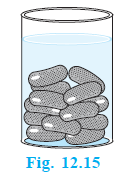
A gulab jamun, contains sugar syrup up to about $30\%$ of its volume. Find approximately how much syrup would be found in $45$ gulab jamuns, each shaped like a cylinder with two hemispherical ends with length $5$ cm and diameter $2.8$ cm (see Fig. 12.15).
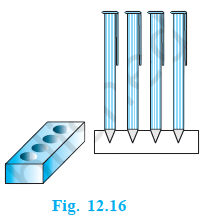
A pen stand made of wood is in the shape of a cuboid with four conical depressions to hold pens. The dimensions of the cuboid are $15$ cm by $10$ cm by $3.5$ cm. The radius of each of the depressions is $0.5$ cm and the depth is $1.4$ cm. Find the volume of wood in the entire stand (see Fig. 12.16).
Worksheet Answers
Solution:
Given:
To Find:
The volume of water left in the cylinder after the solid is submerged in it.
Step 1: Calculate the volume of the cylinder.
The formula for the volume of a cylinder is $V_{cyl} = \pi R^2 H$.
$V_{cyl} = \pi \times (60)^2 \times 180$
$V_{cyl} = \pi \times 3600 \times 180 = 648,000\pi \text{ cm}^3$.
Step 2: Calculate the volume of the solid.
The solid consists of a cone and a hemisphere. The total volume $V_{solid} = V_{cone} + V_{hemisphere}$.
Formula for volume of a cone: $V_{cone} = \frac{1}{3}\pi r^2 h_{cone}$.
$V_{cone} = \frac{1}{3} \times \pi \times (60)^2 \times 120 = \pi \times 3600 \times 40 = 144,000\pi \text{ cm}^3$.
Formula for volume of a hemisphere: $V_{hemisphere} = \frac{2}{3}\pi r^3$.
$V_{hemisphere} = \frac{2}{3} \times \pi \times (60)^3 = \frac{2}{3} \times \pi \times 216,000 = 2 \times \pi \times 72,000 = 144,000\pi \text{ cm}^3$.
Total volume of the solid $V_{solid} = 144,000\pi + 144,000\pi = 288,000\pi \text{ cm}^3$.
Step 3: Calculate the volume of water left in the cylinder.
When the solid is placed in the cylinder, it displaces a volume of water equal to its own volume. The volume of water left is the difference between the volume of the cylinder and the volume of the solid.
$V_{left} = V_{cyl} - V_{solid}$
$V_{left} = 648,000\pi - 288,000\pi = 360,000\pi \text{ cm}^3$.
Step 4: Convert to numerical value using $\pi \approx \frac{22}{7}$.
$V_{left} = 360,000 \times \frac{22}{7} \approx 360,000 \times 3.14159 \approx 1,131,428.57 \text{ cm}^3$.
Converting to cubic meters ($1 \text{ m}^3 = 1,000,000 \text{ cm}^3$):
$V_{left} \approx 1.131 \text{ m}^3$.
Final Answer: The volume of water left in the cylinder is $360,000\pi \text{ cm}^3$ or approximately $1.131 \text{ m}^3$.
Solution:
Given:
To Find:
Whether the child's measurement of $345$ cm$^3$ is correct by calculating the actual volume of the vessel.
Step 1: Calculate the volume of the cylindrical neck.
The radius of the cylinder ($r_1$) is half of its diameter ($d_1$).
$r_1 = \frac{d_1}{2} = \frac{2 \text{ cm}}{2} = 1 \text{ cm}$.
The formula for the volume of a cylinder is $V_{cylinder} = \pi r_1^2 h$.
$V_{cylinder} = 3.14 \times (1)^2 \times 8$
$V_{cylinder} = 3.14 \times 1 \times 8 = 25.12 \text{ cm}^3$.
Step 2: Calculate the volume of the spherical part.
The radius of the sphere ($r_2$) is half of its diameter ($d_2$).
$r_2 = \frac{d_2}{2} = \frac{8.5 \text{ cm}}{2} = 4.25 \text{ cm}$.
The formula for the volume of a sphere is $V_{sphere} = \frac{4}{3} \pi r_2^3$.
$V_{sphere} = \frac{4}{3} \times 3.14 \times (4.25)^3$
$V_{sphere} = \frac{4}{3} \times 3.14 \times 76.765625$
$V_{sphere} = \frac{12.56 \times 76.765625}{3}$
$V_{sphere} = \frac{964.21625}{3} = 321.3920833... \text{ cm}^3 \approx 321.39 \text{ cm}^3$.
Step 3: Calculate the total volume of the vessel.
Total Volume ($V_{total}$) = $V_{cylinder} + V_{sphere}$.
$V_{total} = 25.12 + 321.3920833...$
$V_{total} = 346.5120833... \text{ cm}^3$.
Step 4: Comparison and Conclusion.
The calculated volume is approximately $346.51$ cm$^3$.
The child measured the volume as $345$ cm$^3$.
Since $346.51 \text{ cm}^3 \neq 345 \text{ cm}^3$, the child's measurement is incorrect.
Final Answer: The child is incorrect; the actual volume of the vessel is approximately 346.51 cm$^3$.
Solution:
Given:
To Find:
The volume of air contained in the model.
Step 1: Determine the dimensions of the cylinder and cones.
Since the diameter of the model is $3$ cm, the radius ($r$) of the cylinder and the cones is the same:
$r = \frac{d}{2} = \frac{3}{2} = 1.5$ cm.
The height of the cylinder ($h_{cyl}$) is the total length of the model minus the heights of the two cones:
$h_{cyl} = H_{total} - (2 \times h_{cone})$
$h_{cyl} = 12 - (2 \times 2) = 12 - 4 = 8$ cm.
Step 2: Formulate the total volume of the model.
The total volume of air ($V_{total}$) is the sum of the volume of the cylinder ($V_{cyl}$) and the volumes of the two cones ($2 \times V_{cone}$):
$V_{total} = V_{cyl} + 2 \times V_{cone}$
Using the formulas for volume: $V_{cyl} = \pi r^2 h_{cyl}$ and $V_{cone} = \frac{1}{3} \pi r^2 h_{cone}$
$V_{total} = \pi r^2 h_{cyl} + 2 \times \left( \frac{1}{3} \pi r^2 h_{cone} \right)$
Step 3: Calculate the volume.
Substitute the values $r = 1.5$, $h_{cyl} = 8$, and $h_{cone} = 2$:
$V_{total} = \pi (1.5)^2 (8) + \frac{2}{3} \pi (1.5)^2 (2)$
$V_{total} = \pi (2.25)(8) + \frac{2}{3} \pi (2.25)(2)$
$V_{total} = 18\pi + \frac{2}{3} \pi (4.5)$
$V_{total} = 18\pi + 2\pi (1.5)$
$V_{total} = 18\pi + 3\pi = 21\pi$
Step 4: Final numerical evaluation.
Using $\pi \approx \frac{22}{7}$:
$V_{total} = 21 \times \frac{22}{7} = 3 \times 22 = 66$ cm$^3$.
Final Answer: The volume of air contained in the model is 66 cm$^3$.
Solution:
Given:
To Find:
The total volume of sugar syrup in $45$ gulab jamuns.
Step 1: Determine the dimensions of the cylindrical and hemispherical parts.
The radius ($r$) of the cylinder and the hemispheres is half of the diameter:
$r = \frac{d}{2} = \frac{2.8}{2} = 1.4$ cm.
The length of the cylindrical part ($h$) is the total length minus the radii of the two hemispherical ends:
$h = L - (r + r) = 5 - (1.4 + 1.4) = 5 - 2.8 = 2.2$ cm.
Step 2: Calculate the volume of one gulab jamun.
The volume of one gulab jamun ($V_{total}$) is the sum of the volume of the cylinder and the volumes of the two hemispheres:
$V_{total} = V_{cylinder} + 2 \times V_{hemisphere}$
$V_{total} = \pi r^2 h + 2 \times (\frac{2}{3} \pi r^3)$
$V_{total} = \pi r^2 (h + \frac{4}{3} r)$
Substituting the values ($r = 1.4$, $h = 2.2$, $\pi \approx \frac{22}{7}$):
$V_{total} = \frac{22}{7} \times (1.4)^2 \times (2.2 + \frac{4}{3} \times 1.4)$
$V_{total} = \frac{22}{7} \times 1.96 \times (2.2 + 1.8667)$
$V_{total} = 22 \times 0.28 \times (4.0667) = 6.16 \times 4.0667 \approx 25.05$ cm$^3$.
Step 3: Calculate the total volume of 45 gulab jamuns.
$V_{45} = 45 \times V_{total} = 45 \times 25.05 = 1127.25$ cm$^3$.
Step 4: Calculate the volume of sugar syrup.
The syrup is $30\%$ of the total volume:
$V_{syrup} = 30\% \times V_{45} = 0.30 \times 1127.25$
$V_{syrup} = 338.175$ cm$^3$.
Rounding to the nearest whole number as per standard approximation in such problems:
Final Answer: The total volume of sugar syrup in 45 gulab jamuns is approximately 338 cm$^3$.
Solution:
Given:
Dimensions of the cuboidal pen stand: Length ($l$) = $15$ cm, Breadth ($b$) = $10$ cm, Height ($h_{cuboid}$) = $3.5$ cm.
Number of conical depressions ($n$) = $4$.
Radius of each conical depression ($r$) = $0.5$ cm.
Depth (height) of each conical depression ($h_{cone}$) = $1.4$ cm.
To Find:
The volume of wood remaining in the entire pen stand.
Step 1: Calculate the volume of the cuboidal block.
The formula for the volume of a cuboid is $V_{cuboid} = l \times b \times h$.
$V_{cuboid} = 15 \text{ cm} \times 10 \text{ cm} \times 3.5 \text{ cm}$
$V_{cuboid} = 150 \times 3.5 = 525 \text{ cm}^3$
Step 2: Calculate the volume of one conical depression.
The formula for the volume of a cone is $V_{cone} = \frac{1}{3}\pi r^2 h$.
Using $\pi \approx \frac{22}{7}$:
$V_{cone} = \frac{1}{3} \times \frac{22}{7} \times (0.5)^2 \times 1.4$
$V_{cone} = \frac{1}{3} \times \frac{22}{7} \times 0.25 \times 1.4$
$V_{cone} = \frac{1}{3} \times 22 \times 0.25 \times 0.2$ [Since $1.4 / 7 = 0.2$]
$V_{cone} = \frac{1}{3} \times 22 \times 0.05 = \frac{1.1}{3} \text{ cm}^3$
Step 3: Calculate the total volume of four conical depressions.
$V_{total\_cones} = 4 \times V_{cone}$
$V_{total\_cones} = 4 \times \frac{1.1}{3} = \frac{4.4}{3} \text{ cm}^3$
$V_{total\_cones} \approx 1.4667 \text{ cm}^3$
Step 4: Calculate the volume of wood in the stand.
The volume of wood is the volume of the cuboid minus the volume of the four conical depressions.
$V_{wood} = V_{cuboid} - V_{total\_cones}$
$V_{wood} = 525 - \frac{4.4}{3}$
$V_{wood} = \frac{1575 - 4.4}{3}$
$V_{wood} = \frac{1570.6}{3}$
$V_{wood} = 523.5333... \text{ cm}^3$
Final Answer: The volume of wood in the entire stand is approximately $523.53 \text{ cm}^3$.
Solution:
Given:
1. A vessel in the shape of an inverted cone with height $h_c = 8$ cm and radius $r_c = 5$ cm.
2. The vessel is filled with water to the brim.
3. Lead shots are spherical in shape with radius $r_s = 0.5$ cm.
4. When lead shots are dropped, $\frac{1}{4}$ of the water in the cone flows out.
To Find:
The number of lead shots ($n$) dropped into the vessel.
Step 1: Calculate the volume of the conical vessel.
The formula for the volume of a cone is $V_c = \frac{1}{3}\pi r_c^2 h_c$.
$V_c = \frac{1}{3} \times \pi \times (5)^2 \times 8$
$V_c = \frac{1}{3} \times \pi \times 25 \times 8$
$V_c = \frac{200}{3}\pi \text{ cm}^3$
Step 2: Determine the volume of water that flows out.
According to the problem, the volume of water that flows out is equal to $\frac{1}{4}$ of the total volume of the cone.
$V_{out} = \frac{1}{4} \times V_c$
$V_{out} = \frac{1}{4} \times \frac{200}{3}\pi = \frac{50}{3}\pi \text{ cm}^3$
Step 3: Calculate the volume of one spherical lead shot.
The formula for the volume of a sphere is $V_s = \frac{4}{3}\pi r_s^3$.
$V_s = \frac{4}{3} \times \pi \times (0.5)^3$
$V_s = \frac{4}{3} \times \pi \times 0.125$
$V_s = \frac{4}{3} \times \pi \times \frac{1}{8} = \frac{1}{6}\pi \text{ cm}^3$
Step 4: Formulate the equation to find the number of lead shots ($n$).
The volume of water displaced is equal to the total volume of the $n$ lead shots dropped into the vessel [By Archimedes' Principle].
$n \times V_s = V_{out}$
$n \times (\frac{1}{6}\pi) = \frac{50}{3}\pi$
Step 5: Solve for $n$.
Divide both sides by $\pi$:
$n \times \frac{1}{6} = \frac{50}{3}$
Multiply both sides by 6:
$n = \frac{50}{3} \times 6$
$n = 50 \times 2$
$n = 100$
Final Answer: The number of lead shots dropped in the vessel is 100.
Solution:
Given:
1. A solid consists of a cone mounted on a hemisphere.
2. The radius of the hemisphere ($r$) = $1$ cm.
3. The radius of the base of the cone ($r$) = $1$ cm.
4. The height of the cone ($h$) = radius of the cone = $1$ cm.
To Find:
The total volume of the solid in terms of $\pi$.
Step 1: Formulae Identification
The total volume of the solid ($V_{total}$) is the sum of the volume of the cone ($V_{cone}$) and the volume of the hemisphere ($V_{hemisphere}$).
Formula for the volume of a cone: $V_{cone} = \frac{1}{3}\pi r^2 h$
Formula for the volume of a hemisphere: $V_{hemisphere} = \frac{2}{3}\pi r^3$
Step 2: Calculating the Volume of the Cone
Substitute $r = 1$ cm and $h = 1$ cm into the formula:
$V_{cone} = \frac{1}{3} \times \pi \times (1)^2 \times 1$
$V_{cone} = \frac{1}{3} \times \pi \times 1 \times 1$
$V_{cone} = \frac{\pi}{3} \text{ cm}^3$
Step 3: Calculating the Volume of the Hemisphere
Substitute $r = 1$ cm into the formula:
$V_{hemisphere} = \frac{2}{3} \times \pi \times (1)^3$
$V_{hemisphere} = \frac{2}{3} \times \pi \times 1$
$V_{hemisphere} = \frac{2\pi}{3} \text{ cm}^3$
Step 4: Calculating the Total Volume
$V_{total} = V_{cone} + V_{hemisphere}$
$V_{total} = \frac{\pi}{3} + \frac{2\pi}{3}$
$V_{total} = \frac{\pi + 2\pi}{3}$
$V_{total} = \frac{3\pi}{3}$
$V_{total} = \pi \text{ cm}^3$
Final Answer: The volume of the solid is $\pi \text{ cm}^3$.
Solution:
Given:
A solid iron pole composed of two cylinders:
To Find:
The total mass of the iron pole in grams (or kilograms).
Step 1: Determine the dimensions of the cylinders.
For the base cylinder (Cylinder 1):
Radius ($r_1$) = $\frac{\text{Diameter}}{2} = \frac{24 \text{ cm}}{2} = 12$ cm.
Height ($h_1$) = $220$ cm.
For the top cylinder (Cylinder 2):
Radius ($r_2$) = $8$ cm.
Height ($h_2$) = $60$ cm.
Step 2: Calculate the volume of the pole.
The volume of a cylinder is given by the formula: $V = \pi r^2 h$.
Total Volume ($V_{total}$) = Volume of Cylinder 1 + Volume of Cylinder 2
$V_{total} = (\pi \cdot r_1^2 \cdot h_1) + (\pi \cdot r_2^2 \cdot h_2)$
$V_{total} = \pi [ (12)^2 \cdot 220 + (8)^2 \cdot 60 ]$
$V_{total} = 3.14 [ (144 \cdot 220) + (64 \cdot 60) ]$
$V_{total} = 3.14 [ 31680 + 3840 ]$
$V_{total} = 3.14 [ 35520 ]$
$V_{total} = 111532.8$ cm$^3$.
Step 3: Calculate the mass of the pole.
Given that $1$ cm$^3$ of iron has a mass of $8$ g.
Total Mass = $V_{total} \times 8$ g/cm$^3$
Total Mass = $111532.8 \times 8$
Total Mass = $892262.4$ g.
Step 4: Convert to kilograms (optional but standard).
Since $1000$ g = $1$ kg:
Total Mass = $\frac{892262.4}{1000} = 892.2624$ kg.
Final Answer: The mass of the pole is 892262.4 g or approximately 892.26 kg.


