


Your Worksheet is Ready
CBSE - Class 10 Mathematics Areas Related to Circles Worksheet
EXERCISE 11.1
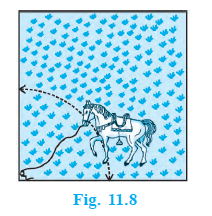
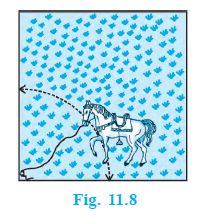
A horse is tied to a peg at one corner of a square shaped grass field of side 15 m by means of a 5 m long rope (see Fig. 11.8). Find (i) the area of that part of the field in which the horse can graze. (Use $\pi = 3.14$)
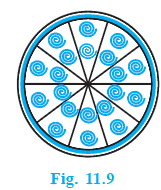
A brooch is made with silver wire in the form of a circle with diameter 35 mm. The wire is also used in making 5 diameters which divide the circle into 10 equal sectors as shown in Fig. 11.9. Find : (ii) the area of each sector of the brooch. (Unless stated otherwise, use $\pi = \frac{22}{7}$)
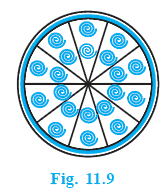
A brooch is made with silver wire in the form of a circle with diameter 35 mm. The wire is also used in making 5 diameters which divide the circle into 10 equal sectors as shown in Fig. 11.9. Find : (i) the total length of the silver wire required. (Unless stated otherwise, use $\pi = \frac{22}{7}$)
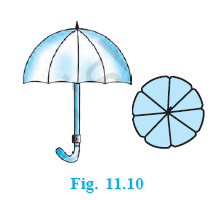
An umbrella has 8 ribs which are equally spaced (see Fig. 11.10). Assuming umbrella to be a flat circle of radius 45 cm, find the area between the two consecutive ribs of the umbrella. (Unless stated otherwise, use $\pi = \frac{22}{7}$)
A horse is tied to a peg at one corner of a square shaped grass field of side 15 m by means of a 5 m long rope (see Fig. 11.8). Find (ii) the increase in the grazing area if the rope were 10 m long instead of 5 m. (Use $\pi = 3.14$)
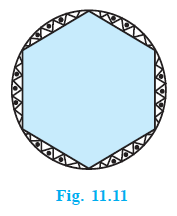
A round table cover has six equal designs as shown in Fig. 11.11. If the radius of the cover is 28 cm, find the cost of making the designs at the rate of ` 0.35 per cm$^2$. (Use $\sqrt{3} = 1.7$)
Tick the correct answer in the following : Area of a sector of angle $p$ (in degrees) of a circle with radius $R$ is
$\frac{p}{180} \times 2 \pi R$
b.$\frac{p}{180} \times \pi R^2$
c.$\frac{p}{360} \times 2 \pi R$
d.$\frac{p}{720} \times 2 \pi R^2$
Worksheet Answers
Solution:
Given:
To Find:
The area of the part of the field in which the horse can graze.
Step 1: Understanding the Geometry of the Grazing Area
Since the horse is tied to a corner of a square field, the angle at the corner of the square is $90^\circ$. The horse can move within a circular sector defined by the length of the rope. Therefore, the grazing area is a sector of a circle with radius $r = 5\text{ m}$ and central angle $\theta = 90^\circ$.
Step 2: Formula for the Area of a Sector
The formula for the area of a sector of a circle is given by:
$\text{Area of Sector} = \frac{\theta}{360^\circ} \times \pi r^2$
[Where $\theta$ is the central angle in degrees and $r$ is the radius of the circle.]
Step 3: Substituting the Given Values
Given values: $\theta = 90^\circ$, $r = 5\text{ m}$, and $\pi = 3.14$.
$\text{Area} = \frac{90^\circ}{360^\circ} \times 3.14 \times (5)^2$
Step 4: Performing the Calculation
First, simplify the fraction:
$\frac{90}{360} = \frac{1}{4}$
Next, calculate the square of the radius:
$(5)^2 = 25$
Now, substitute these back into the equation:
$\text{Area} = \frac{1}{4} \times 3.14 \times 25$
$\text{Area} = \frac{78.5}{4}$
$\text{Area} = 19.625\text{ m}^2$
Final Answer: The area of the part of the field in which the horse can graze is 19.625 m².
Solution:
Given:
Radius of the circle ($r$) = $12\text{ cm}$
Angle subtended by the chord at the centre ($\theta$) = $120^\circ$
Constants: $\pi = 3.14$, $\sqrt{3} = 1.73$
To Find:
Area of the corresponding segment of the circle.
Step 1: Formula for the Area of a Segment
The area of a segment of a circle is given by the formula:
$\text{Area of Segment} = \text{Area of Sector} - \text{Area of Triangle}$
$\text{Area of Segment} = \left( \frac{\theta}{360^\circ} \times \pi r^2 \right) - \left( \frac{1}{2} r^2 \sin \theta \right)$
Step 2: Calculating the Area of the Sector
Substitute the given values into the sector area formula:
$\text{Area of Sector} = \frac{120}{360} \times 3.14 \times (12)^2$
$\text{Area of Sector} = \frac{1}{3} \times 3.14 \times 144$
$\text{Area of Sector} = 3.14 \times 48$
$\text{Area of Sector} = 150.72\text{ cm}^2$
Step 3: Calculating the Area of the Triangle
The area of the triangle formed by two radii and the chord is $\frac{1}{2} r^2 \sin \theta$.
$\text{Area of Triangle} = \frac{1}{2} \times (12)^2 \times \sin(120^\circ)$
Since $\sin(120^\circ) = \sin(180^\circ - 60^\circ) = \sin(60^\circ) = \frac{\sqrt{3}}{2}$:
$\text{Area of Triangle} = \frac{1}{2} \times 144 \times \frac{\sqrt{3}}{2}$
$\text{Area of Triangle} = 72 \times \frac{1.73}{2}$
$\text{Area of Triangle} = 36 \times 1.73$
$\text{Area of Triangle} = 62.28\text{ cm}^2$
Step 4: Calculating the Area of the Segment
Subtract the area of the triangle from the area of the sector:
$\text{Area of Segment} = 150.72 - 62.28$
$\text{Area of Segment} = 88.44\text{ cm}^2$
Final Answer: The area of the corresponding segment of the circle is 88.44 cm².
Solution:
Given:
Radius of the circle ($r$) = $6\text{ cm}$
Angle of the sector ($\theta$) = $60^\circ$
Value of $\pi = \frac{22}{7}$
To find:
The area of the sector of the circle.
Step 1: State the formula for the area of a sector.
The area of a sector of a circle with radius $r$ and central angle $\theta$ (in degrees) is given by the formula:
$\text{Area of sector} = \frac{\theta}{360^\circ} \times \pi r^2$
[Justification: The area of a sector is a fraction of the total area of the circle ($\pi r^2$), where the fraction is determined by the ratio of the sector's angle to the total angle of a circle ($360^\circ$)]
Step 2: Substitute the given values into the formula.
Substituting $r = 6$, $\theta = 60^\circ$, and $\pi = \frac{22}{7}$:
$\text{Area} = \frac{60}{360} \times \frac{22}{7} \times (6)^2$
Step 3: Perform the arithmetic calculations.
First, simplify the fraction $\frac{60}{360}$:
$\frac{60}{360} = \frac{1}{6}$
[Since $60 \times 6 = 360$]
Next, calculate the square of the radius:
$6^2 = 36$
Now, substitute these back into the expression:
$\text{Area} = \frac{1}{6} \times \frac{22}{7} \times 36$
Step 4: Simplify the final expression.
$\text{Area} = \frac{1 \times 22 \times 36}{6 \times 7}$
Divide $36$ by $6$:
$\text{Area} = \frac{22 \times 6}{7}$
[Since $36 \div 6 = 6$]
$\text{Area} = \frac{132}{7}$
[Since $22 \times 6 = 132$]
Converting to decimal form (optional, but standard for verification):
$\text{Area} \approx 18.857\text{ cm}^2$
Final Answer: The area of the sector is $\frac{132}{7}\text{ cm}^2$ (or approximately $18.86\text{ cm}^2$).
Solution:
Given:
To Find:
Step 1: Stating the Formula
The length of an arc ($l$) of a circle that subtends an angle $\theta$ at the centre is given by the formula:
$l = \frac{\theta}{360^\circ} \times 2\pi r$
[Where $\theta$ is the central angle in degrees, and $r$ is the radius of the circle.]
Step 2: Substituting the Given Values
Substitute $\theta = 60^\circ$, $r = 21 \text{ cm}$, and $\pi = \frac{22}{7}$ into the formula:
$l = \frac{60^\circ}{360^\circ} \times 2 \times \frac{22}{7} \times 21$
Step 3: Simplifying the Expression
First, simplify the fraction representing the portion of the circumference:
$\frac{60}{360} = \frac{1}{6}$
Now, substitute this back into the equation:
$l = \frac{1}{6} \times 2 \times \frac{22}{7} \times 21$
Step 4: Performing Arithmetic Calculations
Calculate the product of the constants:
$l = \frac{1}{6} \times 44 \times \frac{21}{7}$
[Since $2 \times 22 = 44$]
$l = \frac{1}{6} \times 44 \times 3$
[Since $21 \div 7 = 3$]
$l = \frac{132}{6}$
[Since $44 \times 3 = 132$]
$l = 22 \text{ cm}$
Final Answer: The length of the arc is 22 cm.
Solution:
Given:
1. The brooch is circular in shape.
2. The diameter of the circle ($d$) = $35\text{ mm}$.
3. The wire is used to form the circumference and 5 diameters.
4. The 5 diameters divide the circle into 10 equal sectors.
To Find:
The area of each sector of the brooch.
Step 1: Determine the radius of the circle.
The radius ($r$) is half of the diameter ($d$).
$r = \frac{d}{2}$
$r = \frac{35}{2}\text{ mm} = 17.5\text{ mm}$
Step 2: Determine the area of the entire circle.
The formula for the area of a circle is $A = \pi r^2$.
Using $\pi = \frac{22}{7}$:
$A = \frac{22}{7} \times \left(\frac{35}{2}\right) \times \left(\frac{35}{2}\right)$
$A = \frac{22}{7} \times \frac{1225}{4}$
$A = \frac{22 \times 175}{4}$ [Since $1225 \div 7 = 175$]
$A = \frac{3850}{4} = 962.5\text{ mm}^2$
Step 3: Calculate the area of each sector.
Since the 5 diameters divide the circle into 10 equal sectors, the area of each sector is $\frac{1}{10}$ of the total area of the circle.
Area of each sector = $\frac{\text{Total Area}}{10}$
Area of each sector = $\frac{962.5}{10}$
Area of each sector = $96.25\text{ mm}^2$
Alternative Method (Using Central Angle):
The total angle of a circle is $360^\circ$.
Since there are 10 equal sectors, the central angle ($\theta$) of each sector is:
$\theta = \frac{360^\circ}{10} = 36^\circ$
Area of sector = $\frac{\theta}{360^\circ} \times \pi r^2$
Area of sector = $\frac{36}{360} \times \frac{22}{7} \times \frac{35}{2} \times \frac{35}{2}$
Area of sector = $\frac{1}{10} \times \frac{22}{7} \times \frac{1225}{4}$
Area of sector = $\frac{1}{10} \times 962.5 = 96.25\text{ mm}^2$
Final Answer: The area of each sector of the brooch is 96.25 mm².
Solution:
Given:
1. The brooch is circular in shape.
2. The diameter of the circle ($d$) = $35\text{ mm}$.
3. The number of diameters used to divide the circle = $5$.
4. The value of $\pi = \frac{22}{7}$.
To Find:
The total length of the silver wire required to make the brooch.
Step 1: Calculate the circumference of the circle.
The silver wire forms the outer boundary (circumference) of the circle. The formula for the circumference ($C$) of a circle is given by:
$C = \pi \times d$
Substituting the given values:
$C = \frac{22}{7} \times 35\text{ mm}$
$C = 22 \times 5\text{ mm}$ [Since $35 \div 7 = 5$]
$C = 110\text{ mm}$
Step 2: Calculate the length of the 5 diameters.
The wire is also used to make 5 diameters. The length of one diameter is $35\text{ mm}$.
Total length of 5 diameters = $5 \times d$
Total length of 5 diameters = $5 \times 35\text{ mm}$
Total length of 5 diameters = $175\text{ mm}$
Step 3: Calculate the total length of the silver wire.
The total length of the wire required is the sum of the circumference of the circle and the length of the 5 diameters.
Total Length = Circumference + (5 $\times$ Diameter)
Total Length = $110\text{ mm} + 175\text{ mm}$
Total Length = $285\text{ mm}$
Final Answer: The total length of the silver wire required is 285 mm.
Solution:
Given:
1. The umbrella is assumed to be a flat circle.
2. The radius of the circle ($r$) = $45\text{ cm}$.
3. The number of ribs in the umbrella ($n$) = $8$.
4. The ribs are equally spaced, meaning the circle is divided into $8$ equal sectors.
To Find:
The area between two consecutive ribs of the umbrella.
Step 1: Determine the central angle of each sector.
Since the umbrella is a full circle, the total angle at the center is $360^\circ$. Because there are $8$ equally spaced ribs, the circle is divided into $8$ equal sectors.
Let $\theta$ be the central angle of the sector between two consecutive ribs.
$\theta = \frac{360^\circ}{n}$
$\theta = \frac{360^\circ}{8}$
$\theta = 45^\circ$
Step 2: State the formula for the area of a sector.
The area of a sector of a circle with radius $r$ and central angle $\theta$ is given by the formula:
$\text{Area of sector} = \frac{\theta}{360^\circ} \times \pi r^2$
Step 3: Substitute the given values into the formula.
Given $r = 45\text{ cm}$, $\theta = 45^\circ$, and $\pi = \frac{22}{7}$:
$\text{Area} = \frac{45^\circ}{360^\circ} \times \frac{22}{7} \times (45)^2$
Step 4: Perform the arithmetic calculations.
Simplify the fraction $\frac{45}{360}$:
$\frac{45}{360} = \frac{1}{8}$
Now, calculate $45^2$:
$45 \times 45 = 2025$
Substitute these back into the area equation:
$\text{Area} = \frac{1}{8} \times \frac{22}{7} \times 2025$
$\text{Area} = \frac{1 \times 22 \times 2025}{8 \times 7}$
$\text{Area} = \frac{44550}{56}$
Divide both numerator and denominator by $2$:
$\text{Area} = \frac{22275}{28}\text{ cm}^2$
Converting to decimal form:
$\text{Area} \approx 795.5357\text{ cm}^2$
Final Answer: The area between two consecutive ribs of the umbrella is $\frac{22275}{28}\text{ cm}^2$ or approximately $795.54\text{ cm}^2$.
Solution:
Given:
Number of wipers = $2$
Length of each wiper blade ($r$) = $25\text{ cm}$
Angle of sweep ($\theta$) = $115^\circ$
Value of $\pi = \frac{22}{7}$
To Find:
The total area cleaned by the two wipers at each sweep.
Step 1: Understanding the Geometry
Each wiper sweeps out a sector of a circle. The area of a sector of a circle with radius $r$ and central angle $\theta$ is given by the formula:
$\text{Area of a sector} = \frac{\theta}{360^\circ} \times \pi r^2$
Step 2: Calculating the area cleaned by one wiper
Substitute the given values into the formula:
$\text{Area of one sector} = \frac{115}{360} \times \frac{22}{7} \times (25)^2$
$\text{Area of one sector} = \frac{115}{360} \times \frac{22}{7} \times 625$
Simplifying the fraction $\frac{115}{360}$ by dividing by 5: $\frac{23}{72}$
$\text{Area of one sector} = \frac{23}{72} \times \frac{22}{7} \times 625$
$\text{Area of one sector} = \frac{23 \times 11 \times 625}{36 \times 7}$ [Dividing 22 and 72 by 2]
$\text{Area of one sector} = \frac{158125}{252} \text{ cm}^2$
Step 3: Calculating the total area cleaned by two wipers
Since there are two wipers that do not overlap, the total area is twice the area of one sector:
$\text{Total Area} = 2 \times \left( \frac{158125}{252} \right)$
$\text{Total Area} = \frac{158125}{126} \text{ cm}^2$
Step 4: Final Calculation
Performing the division:
$158125 \div 126 \approx 1254.96 \text{ cm}^2$
Final Answer: The total area cleaned at each sweep of the blades is $\frac{158125}{126} \text{ cm}^2$ or approximately $1254.96 \text{ cm}^2$.
Solution:
Given:
To Find:
The increase in the grazing area if the rope length is increased from $5\text{ m}$ to $10\text{ m}$.
Step 1: Understanding the Geometry of Grazing
Since the horse is tied to a corner of a square field, the area it can graze is a sector of a circle with radius $r$ and a central angle $\theta = 90^\circ$ (the angle of a square corner). The formula for the area of a sector is:
$\text{Area} = \frac{\theta}{360^\circ} \times \pi r^2$
[Since $\theta = 90^\circ$, the area simplifies to $\frac{90}{360} \times \pi r^2 = \frac{1}{4} \pi r^2$]
Step 2: Calculating the Initial Grazing Area ($A_1$)
Given $r_1 = 5\text{ m}$:
$A_1 = \frac{1}{4} \times 3.14 \times (5)^2$
$A_1 = \frac{1}{4} \times 3.14 \times 25$
$A_1 = \frac{78.5}{4} = 19.625\text{ m}^2$
Step 3: Calculating the New Grazing Area ($A_2$)
Given $r_2 = 10\text{ m}$:
$A_2 = \frac{1}{4} \times 3.14 \times (10)^2$
$A_2 = \frac{1}{4} \times 3.14 \times 100$
$A_2 = \frac{314}{4} = 78.5\text{ m}^2$
Step 4: Calculating the Increase in Grazing Area
The increase in area is the difference between the new area and the initial area:
$\text{Increase} = A_2 - A_1$
$\text{Increase} = 78.5 - 19.625$
$\text{Increase} = 58.875\text{ m}^2$
Final Answer: The increase in the grazing area is 58.875 m².
Solution:
Given:
1. A circular table cover with radius $r = 28$ cm.
2. There are six equal designs on the table cover, which are segments of the circle.
3. The rate of making the designs is ₹ $0.35$ per cm$^2$.
4. The value of $\sqrt{3} = 1.7$.
To Find:
The total cost of making the six designs.
Step 1: Determine the central angle of each sector.
Since there are 6 equal designs, the circle is divided into 6 equal sectors. The central angle $\theta$ for each sector is:
$\theta = \frac{360^\circ}{6} = 60^\circ$
Step 2: Calculate the area of one design (segment).
The area of a segment is given by the formula: Area of sector - Area of the triangle formed by the two radii and the chord.
Area of one sector = $\frac{\theta}{360^\circ} \times \pi r^2$
Using $\pi = \frac{22}{7}$ and $r = 28$:
Area of one sector = $\frac{60}{360} \times \frac{22}{7} \times 28 \times 28$
Area of one sector = $\frac{1}{6} \times 22 \times 4 \times 28 = \frac{2464}{6} = \frac{1232}{3} \text{ cm}^2$
Since the central angle is $60^\circ$ and the two sides are equal (radii), the triangle is equilateral. The area of an equilateral triangle is $\frac{\sqrt{3}}{4} \times \text{side}^2$.
Area of triangle = $\frac{\sqrt{3}}{4} \times 28 \times 28 = \sqrt{3} \times 7 \times 28 = 196\sqrt{3}$
Given $\sqrt{3} = 1.7$, Area of triangle = $196 \times 1.7 = 333.2 \text{ cm}^2$
Area of one design = $\frac{1232}{3} - 333.2 = 410.67 - 333.2 = 77.47 \text{ cm}^2$
Step 3: Calculate the total area of the six designs.
Total Area = $6 \times (\text{Area of one design})$
Total Area = $6 \times (\frac{1232}{3} - 333.2) = 2 \times 1232 - 6 \times 333.2$
Total Area = $2464 - 1999.2 = 464.8 \text{ cm}^2$
Step 4: Calculate the total cost.
Cost = Total Area $\times$ Rate
Cost = $464.8 \times 0.35$
Cost = $162.68$
Final Answer: The total cost of making the designs is ₹ 162.68.
Solution:
Given:
A circle with radius $R$ and a sector subtending an angle $p$ (in degrees) at the center.
To Find:
The area of the sector of the circle.
Step 1: Understanding the relationship between the angle and the area of a circle.
The total angle subtended by a circle at its center is $360^\circ$. The area of a full circle with radius $R$ is given by the formula:
$\text{Area of circle} = \pi R^2$
Step 2: Applying the Unitary Method.
We know that an angle of $360^\circ$ corresponds to an area of $\pi R^2$.
Therefore, an angle of $1^\circ$ corresponds to an area of:
$\text{Area for } 1^\circ = \frac{\pi R^2}{360^\circ}$
Step 3: Calculating the area for angle $p$.
To find the area of a sector subtending an angle $p$ at the center, we multiply the area per degree by $p$:
$\text{Area of sector} = \left( \frac{\pi R^2}{360^\circ} \right) \times p$
$\text{Area of sector} = \frac{p}{360^\circ} \times \pi R^2$
Step 4: Verification with standard options.
Often, this formula is represented by multiplying the numerator and denominator by $2$ to relate it to the circumference or specific sector properties, resulting in:
$\text{Area of sector} = \frac{p}{720^\circ} \times 2\pi R^2$
However, the standard derived formula remains $\frac{p}{360} \times \pi R^2$.
Final Answer: The area of the sector is $\frac{p}{360} \times \pi R^2$.
Solution:
Given:
Radius of the circle ($r$) = $10\text{ cm}$
Angle subtended by the chord at the centre ($\theta$) = $90^\circ$
Value of $\pi$ = $3.14$
To Find:
Area of the major sector.
Step 1: Calculate the area of the entire circle.
The formula for the area of a circle is $A = \pi r^2$.
$A = 3.14 \times (10)^2$
$A = 3.14 \times 100$
$A = 314\text{ cm}^2$
Step 2: Calculate the area of the minor sector.
The formula for the area of a sector with angle $\theta$ is $\text{Area} = \frac{\theta}{360^\circ} \times \pi r^2$.
$\text{Area}_{\text{minor}} = \frac{90^\circ}{360^\circ} \times 314$
$\text{Area}_{\text{minor}} = \frac{1}{4} \times 314$
$\text{Area}_{\text{minor}} = 78.5\text{ cm}^2$
Step 3: Calculate the area of the major sector.
The area of the major sector is the difference between the area of the circle and the area of the minor sector.
$\text{Area}_{\text{major}} = \text{Area}_{\text{circle}} - \text{Area}_{\text{minor}}$
$\text{Area}_{\text{major}} = 314 - 78.5$
$\text{Area}_{\text{major}} = 235.5\text{ cm}^2$
Alternative Method (Using the reflex angle):
The angle of the major sector is $360^\circ - 90^\circ = 270^\circ$.
$\text{Area}_{\text{major}} = \frac{270^\circ}{360^\circ} \times \pi r^2$
$\text{Area}_{\text{major}} = \frac{3}{4} \times 314$
$\text{Area}_{\text{major}} = 3 \times 78.5 = 235.5\text{ cm}^2$
Final Answer: The area of the major sector is 235.5 cm².
Solution:
Given:
To find:
The area of the minor segment.
Step 1: Formula for the Area of a Minor Segment
The area of a minor segment is calculated by subtracting the area of the triangle formed by the chord and the radii from the area of the corresponding sector.
Formula: $\text{Area of minor segment} = \text{Area of sector} - \text{Area of } \triangle OAB$
Step 2: Calculate the Area of the Sector
The formula for the area of a sector is given by: $\text{Area} = \frac{\theta}{360^\circ} \times \pi r^2$
Substituting the given values:
$\text{Area of sector} = \frac{90}{360} \times 3.14 \times (10)^2$
$\text{Area of sector} = \frac{1}{4} \times 3.14 \times 100$
$\text{Area of sector} = 0.25 \times 314 = 78.5\text{ cm}^2$
Step 3: Calculate the Area of the Triangle ($\triangle OAB$)
Since the angle at the center is $90^\circ$, $\triangle OAB$ is a right-angled triangle with base $OA = 10\text{ cm}$ and height $OB = 10\text{ cm}$.
Formula: $\text{Area of } \triangle OAB = \frac{1}{2} \times \text{base} \times \text{height}$
$\text{Area of } \triangle OAB = \frac{1}{2} \times 10 \times 10$
$\text{Area of } \triangle OAB = \frac{1}{2} \times 100 = 50\text{ cm}^2$
Step 4: Calculate the Area of the Minor Segment
$\text{Area of minor segment} = \text{Area of sector} - \text{Area of } \triangle OAB$
$\text{Area of minor segment} = 78.5\text{ cm}^2 - 50\text{ cm}^2$
$\text{Area of minor segment} = 28.5\text{ cm}^2$
Final Answer: The area of the minor segment is 28.5 cm²
Solution:
Given:
The length of the minute hand of the clock, which acts as the radius ($r$) of the circular path, is $14\text{ cm}$.
The time duration for which the area is swept is $5\text{ minutes}$.
To Find:
The area swept by the minute hand in $5\text{ minutes}$.
Step 1: Determine the angle swept by the minute hand in 60 minutes.
A minute hand completes one full rotation in $60\text{ minutes}$. A full rotation corresponds to an angle of $360^\circ$.
Angle swept in $60\text{ minutes} = 360^\circ$.
Step 2: Calculate the angle swept by the minute hand in 1 minute.
Using the unitary method:
Angle swept in $1\text{ minute} = \frac{360^\circ}{60} = 6^\circ$.
Step 3: Calculate the angle swept ($\theta$) in 5 minutes.
$\theta = 5 \times 6^\circ = 30^\circ$.
Step 4: Apply the formula for the area of a sector.
The area swept by the minute hand is the area of a sector of a circle with radius $r$ and central angle $\theta$.
Formula: $\text{Area of sector} = \frac{\theta}{360^\circ} \times \pi r^2$
[Where $\theta = 30^\circ$, $r = 14\text{ cm}$, and $\pi = \frac{22}{7}$]
Step 5: Perform the calculation.
$\text{Area} = \frac{30}{360} \times \frac{22}{7} \times 14 \times 14$
Simplify the fraction $\frac{30}{360}$:
$\text{Area} = \frac{1}{12} \times \frac{22}{7} \times 14 \times 14$
Cancel terms ($14$ divided by $7$ is $2$):
$\text{Area} = \frac{1}{12} \times 22 \times 2 \times 14$
$\text{Area} = \frac{1}{12} \times 616$
$\text{Area} = \frac{616}{12} = \frac{154}{3}\text{ cm}^2$
Converting to decimal form:
$\text{Area} \approx 51.33\text{ cm}^2$
Final Answer: The area swept by the minute hand in 5 minutes is $\frac{154}{3}\text{ cm}^2$ or approximately $51.33\text{ cm}^2$.
Solution:
Given: The circumference of a circle is $C = 22 \text{ cm}$.
To find: The area of a quadrant of the circle.
Step 1: Finding the radius of the circle.
The formula for the circumference of a circle is given by:
$C = 2\pi r$
Substituting the given value $C = 22 \text{ cm}$ and $\pi = \frac{22}{7}$:
$22 = 2 \times \left(\frac{22}{7}\right) \times r$
To isolate $r$, multiply both sides by $7$ and divide by $(2 \times 22)$:
$r = \frac{22 \times 7}{2 \times 22}$
$r = \frac{7}{2} \text{ cm}$
$r = 3.5 \text{ cm}$
Step 2: Defining the area of a quadrant.
A quadrant is one-fourth of a circle. Therefore, the area of a quadrant ($A_q$) is given by:
$A_q = \frac{1}{4} \times \text{Area of the circle}$
$A_q = \frac{1}{4} \times \pi r^2$
Step 3: Calculating the area.
Substitute $r = \frac{7}{2}$ and $\pi = \frac{22}{7}$ into the formula:
$A_q = \frac{1}{4} \times \frac{22}{7} \times \left(\frac{7}{2}\right)^2$
$A_q = \frac{1}{4} \times \frac{22}{7} \times \frac{7}{2} \times \frac{7}{2}$
Cancel the common factors ($7$ in the numerator and denominator):
$A_q = \frac{1}{4} \times \frac{22 \times 7}{2 \times 2}$
$A_q = \frac{1}{4} \times \frac{154}{4}$
$A_q = \frac{154}{16}$
Simplify the fraction by dividing both numerator and denominator by $2$:
$A_q = \frac{77}{8} \text{ cm}^2$
Converting to decimal form:
$A_q = 9.625 \text{ cm}^2$
Final Answer: The area of the quadrant is 9.625 cm² (or $\frac{77}{8}$ cm²).
Solution:
Given:
Radius of the circle ($r$) = $21\text{ cm}$
Angle subtended by the arc at the centre ($\theta$) = $60^\circ$
Value of $\pi$ = $\frac{22}{7}$
To Find:
Area of the sector formed by the arc.
Step 1: Stating the Formula
The area of a sector of a circle with radius $r$ and central angle $\theta$ (in degrees) is given by the formula:
$\text{Area of Sector} = \frac{\theta}{360^\circ} \times \pi r^2$
[Where $\theta$ is the angle subtended at the centre and $r$ is the radius of the circle.]
Step 2: Substituting the Given Values
Substitute $\theta = 60^\circ$, $r = 21\text{ cm}$, and $\pi = \frac{22}{7}$ into the formula:
$\text{Area} = \frac{60}{360} \times \frac{22}{7} \times (21)^2$
Step 3: Simplifying the Expression
First, simplify the fraction $\frac{60}{360}$:
$\frac{60}{360} = \frac{1}{6}$
Now, expand $(21)^2$:
$(21)^2 = 21 \times 21 = 441$
Substitute these back into the equation:
$\text{Area} = \frac{1}{6} \times \frac{22}{7} \times 441$
Step 4: Performing the Arithmetic Calculation
Divide $441$ by $7$:
$441 \div 7 = 63$
Now the expression is:
$\text{Area} = \frac{1}{6} \times 22 \times 63$
Simplify $\frac{63}{6}$ by dividing both by $3$:
$\frac{63}{6} = \frac{21}{2} = 10.5$
Now multiply the remaining terms:
$\text{Area} = 22 \times 10.5$
$22 \times 10.5 = 231$
Final Answer:
The area of the sector formed by the arc is $231\text{ cm}^2$.
Solution:
Given:
To Find:
The area of the segment formed by the corresponding chord.
Step 1: Understanding the Formula
The area of a segment of a circle is calculated by subtracting the area of the triangle formed by the two radii and the chord from the area of the corresponding sector.
Formula: $\text{Area of Segment} = \text{Area of Sector} - \text{Area of } \triangle OAB$
Step 2: Calculating the Area of the Sector
The formula for the area of a sector is $\frac{\theta}{360^\circ} \times \pi r^2$.
Substituting the given values:
$\text{Area of Sector} = \frac{60}{360} \times \frac{22}{7} \times 21 \times 21$
$\text{Area of Sector} = \frac{1}{6} \times 22 \times 3 \times 21$ [Since $\frac{21}{7} = 3$]
$\text{Area of Sector} = \frac{1}{2} \times 22 \times 3 \times 7$ [Simplifying $\frac{3}{6} = \frac{1}{2}$]
$\text{Area of Sector} = 11 \times 3 \times 7 = 231\text{ cm}^2$
Step 3: Calculating the Area of $\triangle OAB$
Since the central angle $\theta = 60^\circ$ and the two sides $OA = OB = r = 21\text{ cm}$, the triangle is an equilateral triangle.
The formula for the area of an equilateral triangle is $\frac{\sqrt{3}}{4} \times (\text{side})^2$.
$\text{Area of } \triangle OAB = \frac{\sqrt{3}}{4} \times (21)^2$
$\text{Area of } \triangle OAB = \frac{\sqrt{3}}{4} \times 441$
$\text{Area of } \triangle OAB = 110.25\sqrt{3}\text{ cm}^2$
Step 4: Calculating the Area of the Segment
$\text{Area of Segment} = \text{Area of Sector} - \text{Area of } \triangle OAB$
$\text{Area of Segment} = 231 - 110.25\sqrt{3}$
Using $\sqrt{3} \approx 1.732$:
$\text{Area of Segment} = 231 - 110.25(1.732)$
$\text{Area of Segment} = 231 - 190.953 = 40.047\text{ cm}^2$
Final Answer: The area of the segment is $(231 - 110.25\sqrt{3})\text{ cm}^2$ or approximately $40.05\text{ cm}^2$.
Solution:
Given:
Radius of the circle ($r$) = $15\text{ cm}$
Angle subtended by the chord at the centre ($\theta$) = $60^\circ$
Constants: $\pi = 3.14$, $\sqrt{3} = 1.73$
To Find:
1. Area of the minor segment.
2. Area of the major segment.
Step 1: Calculate the Area of the Sector
The formula for the area of a sector is: $A_{sector} = \frac{\theta}{360^\circ} \times \pi r^2$
$A_{sector} = \frac{60}{360} \times 3.14 \times (15)^2$
$A_{sector} = \frac{1}{6} \times 3.14 \times 225$
$A_{sector} = \frac{706.5}{6} = 117.75\text{ cm}^2$
Step 2: Calculate the Area of the Triangle (OAB)
Since the angle at the centre is $60^\circ$ and the two sides are radii ($OA = OB = 15\text{ cm}$), the triangle is equilateral. The area of an equilateral triangle is given by: $A_{triangle} = \frac{\sqrt{3}}{4} \times r^2$
$A_{triangle} = \frac{1.73}{4} \times (15)^2$
$A_{triangle} = \frac{1.73}{4} \times 225$
$A_{triangle} = \frac{389.25}{4} = 97.3125\text{ cm}^2$
Step 3: Calculate the Area of the Minor Segment
The area of the minor segment is the difference between the area of the sector and the area of the triangle.
$A_{minor\_segment} = A_{sector} - A_{triangle}$
$A_{minor\_segment} = 117.75 - 97.3125 = 20.4375\text{ cm}^2$
Step 4: Calculate the Area of the Major Segment
The area of the major segment is the total area of the circle minus the area of the minor segment.
$A_{circle} = \pi r^2 = 3.14 \times (15)^2 = 3.14 \times 225 = 706.5\text{ cm}^2$
$A_{major\_segment} = A_{circle} - A_{minor\_segment}$
$A_{major\_segment} = 706.5 - 20.4375 = 686.0625\text{ cm}^2$
Final Answer: The area of the minor segment is 20.4375 cm² and the area of the major segment is 686.0625 cm².
Solution:
Given:
To Find:
The area of the sea over which the ships are warned, which is equivalent to the area of the sector formed by the lighthouse light.
Step 1: State the Formula for the Area of a Sector
The area of a sector of a circle with radius $r$ and central angle $\theta$ (in degrees) is given by the formula:
$\text{Area of Sector} = \frac{\theta}{360^\circ} \times \pi r^2$
Step 2: Substitute the Given Values into the Formula
Substitute $\theta = 80^\circ$, $r = 16.5 \text{ km}$, and $\pi = 3.14$ into the equation:
$\text{Area} = \frac{80}{360} \times 3.14 \times (16.5)^2$
Step 3: Simplify the Fraction and Calculate the Square
First, simplify the fraction $\frac{80}{360}$:
$\frac{80}{360} = \frac{8}{36} = \frac{2}{9}$
Next, calculate $(16.5)^2$:
$16.5 \times 16.5 = 272.25$
Step 4: Perform the Final Multiplication
Now, substitute these values back into the expression:
$\text{Area} = \frac{2}{9} \times 3.14 \times 272.25$
Multiply $3.14$ by $272.25$:
$3.14 \times 272.25 = 854.865$
Now, multiply by $\frac{2}{9}$:
$\text{Area} = \frac{2 \times 854.865}{9}$
$\text{Area} = \frac{1709.73}{9}$
$\text{Area} = 189.97 \text{ km}^2$
Final Answer: The area of the sea over which the ships are warned is 189.97 km².


