


Your Worksheet is Ready
CBSE - Class 10 Mathematics Circles Worksheet
EXERCISE 10.2
Choose the correct option and give justification. In Fig. 10.11, if $TP$ and $TQ$ are the two tangents to a circle with centre $O$ so that $\angle POQ = 110^{\circ}$, then $\angle PTQ$ is equal to
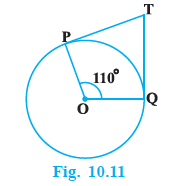
$60^{\circ}$
b.$70^{\circ}$
c.$80^{\circ}$
d.$90^{\circ}$
Choose the correct option and give justification. If tangents $PA$ and $PB$ from a point $P$ to a circle with centre $O$ are inclined to each other at angle of $80^{\circ}$, then $\angle POA$ is equal to
$50^{\circ}$
b.$60^{\circ}$
c.$70^{\circ}$
d.$80^{\circ}$
Choose the correct option and give justification. From a point $Q$, the length of the tangent to a circle is $24$ cm and the distance of $Q$ from the centre is $25$ cm. The radius of the circle is
7 cm
b.12 cm
c.15 cm
d.24.5 cm
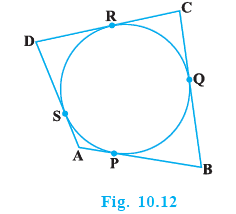
A quadrilateral $ABCD$ is drawn to circumscribe a circle (see Fig. 10.12). Prove that $AB + CD = AD + BC$.
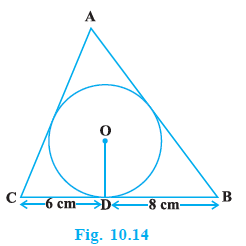
A triangle $ABC$ is drawn to circumscribe a circle of radius $4$ cm such that the segments $BD$ and $DC$ into which $BC$ is divided by the point of contact $D$ are of lengths $8$ cm and $6$ cm respectively (see Fig. 10.14). Find the sides $AB$ and $AC$.
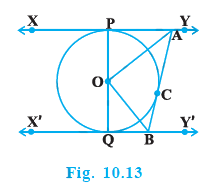
In Fig. 10.13, $XY$ and $X'Y'$ are two parallel tangents to a circle with centre $O$ and another tangent $AB$ with point of contact $C$ intersecting $XY$ at $A$ and $X'Y'$ at $B$. Prove that $\angle AOB = 90^{\circ}$.
Worksheet Answers
Solution:
Given: A quadrilateral $ABCD$ circumscribing a circle with center $O$. The sides $AB, BC, CD,$ and $DA$ touch the circle at points $P, Q, R,$ and $S$ respectively.
To Prove: The opposite sides subtend supplementary angles at the center $O$. That is, $\angle AOB + \angle COD = 180^\circ$ and $\angle BOC + \angle DOA = 180^\circ$.
Step 1: Joining the points of contact to the center.
Join the center $O$ to the points of contact $P, Q, R,$ and $S$. Also, join $OA, OB, OC,$ and $OD$.
Step 2: Identifying congruent triangles.
Consider $\triangle OAP$ and $\triangle OAS$:
Step 3: Applying the same logic to other pairs.
Similarly, we can prove:
Step 4: Summing the angles around the center.
The sum of all angles around the center $O$ is $360^\circ$:
$\angle 1 + \angle 2 + \angle 3 + \angle 4 + \angle 5 + \angle 6 + \angle 7 + \angle 8 = 360^\circ$
Step 5: Substituting the equal angles.
Since $\angle 1 = \angle 2$, $\angle 3 = \angle 4$, $\angle 5 = \angle 6$, and $\angle 7 = \angle 8$, we substitute these into the equation:
$2\angle 2 + 2\angle 3 + 2\angle 6 + 2\angle 7 = 360^\circ$
Dividing by 2:
$\angle 2 + \angle 3 + \angle 6 + \angle 7 = 180^\circ$
Step 6: Grouping the angles.
Rearranging the terms:
$(\angle 2 + \angle 3) + (\angle 6 + \angle 7) = 180^\circ$
From the figure, $\angle 2 + \angle 3 = \angle AOB$ and $\angle 6 + \angle 7 = \angle COD$.
Thus, $\angle AOB + \angle COD = 180^\circ$.
Similarly, it can be shown that $\angle BOC + \angle DOA = 180^\circ$.
Final Answer: The opposite sides of the quadrilateral subtend supplementary angles at the center of the circle, as $\angle AOB + \angle COD = 180^\circ$ and $\angle BOC + \angle DOA = 180^\circ$.
Solution:
Given: A circle with center $O$. Let $AB$ be a diameter of the circle. Let $PQ$ be a tangent at point $A$ and $RS$ be a tangent at point $B$.
To Prove: $PQ \parallel RS$.
Step 1: Applying the Tangent-Radius Theorem
According to the theorem: "The tangent at any point of a circle is perpendicular to the radius through the point of contact."
Since $PQ$ is a tangent at $A$ and $OA$ is the radius, we have:
$OA \perp PQ \implies \angle OAP = 90^\circ$ and $\angle OAQ = 90^\circ$.
Similarly, since $RS$ is a tangent at $B$ and $OB$ is the radius, we have:
$OB \perp RS \implies \angle OBR = 90^\circ$ and $\angle OBS = 90^\circ$.
Step 2: Analyzing the Angles
Consider the lines $PQ$ and $RS$ intersected by the transversal $AB$.
From Step 1, we have:
$\angle OAP = 90^\circ$
$\angle OBS = 90^\circ$
Therefore, $\angle OAP = \angle OBS = 90^\circ$.
Step 3: Establishing Parallelism
Observe that $\angle OAP$ and $\angle OBS$ are alternate interior angles with respect to lines $PQ$ and $RS$ and transversal $AB$.
[Theorem: If a transversal intersects two lines such that a pair of alternate interior angles are equal, then the two lines are parallel.]
Since $\angle OAP = \angle OBS = 90^\circ$, the alternate interior angles are equal.
Thus, $PQ \parallel RS$.
Final Answer: Since the alternate interior angles formed by the transversal $AB$ with lines $PQ$ and $RS$ are equal ($90^\circ$), the tangents $PQ$ and $RS$ are parallel to each other.
Solution:
Given:
A circle with centre $O$. $TP$ and $TQ$ are two tangents drawn from an external point $T$ to the circle. The angle between the radii at the points of contact is $\angle POQ = 110^{\circ}$.
To Find:
The measure of $\angle PTQ$.
Visual Representation:
Step 1: Identifying Geometric Properties
According to the theorem: "The tangent at any point of a circle is perpendicular to the radius through the point of contact."
Therefore, $OP \perp TP$ and $OQ \perp TQ$.
This implies that $\angle OPT = 90^{\circ}$ and $\angle OQT = 90^{\circ}$.
Step 2: Analyzing the Quadrilateral
Consider the quadrilateral $OPTQ$. The sum of the interior angles of a quadrilateral is always $360^{\circ}$.
The sum of the angles is given by:
$\angle POQ + \angle OPT + \angle PTQ + \angle OQT = 360^{\circ}$
Step 3: Substituting Known Values
Substitute the known values into the equation:
$110^{\circ} + 90^{\circ} + \angle PTQ + 90^{\circ} = 360^{\circ}$
Step 4: Solving for $\angle PTQ$
Combine the constant terms:
$110^{\circ} + 180^{\circ} + \angle PTQ = 360^{\circ}$
$290^{\circ} + \angle PTQ = 360^{\circ}$
Subtract $290^{\circ}$ from both sides:
$\angle PTQ = 360^{\circ} - 290^{\circ}$
$\angle PTQ = 70^{\circ}$
Final Answer: The measure of $\angle PTQ$ is $70^{\circ}$.
Solution:
Given:
1. A circle with center $O$.
2. Two tangents $PA$ and $PB$ drawn from an external point $P$ to the circle.
3. The angle between the tangents, $\angle APB = 80^{\circ}$.
To Find:
The measure of $\angle POA$.
Step 1: Analyzing the Geometry of the Quadrilateral
Consider the quadrilateral $OAPB$. In this figure:
1. $OA \perp PA$ [Since the tangent at any point of a circle is perpendicular to the radius through the point of contact]. Thus, $\angle OAP = 90^{\circ}$.
2. $OB \perp PB$ [Since the tangent at any point of a circle is perpendicular to the radius through the point of contact]. Thus, $\angle OBP = 90^{\circ}$.
Step 2: Calculating the sum of angles in the quadrilateral
The sum of the interior angles of a quadrilateral is $360^{\circ}$.
$\angle OAP + \angle OBP + \angle APB + \angle AOB = 360^{\circ}$
Substituting the known values:
$90^{\circ} + 90^{\circ} + 80^{\circ} + \angle AOB = 360^{\circ}$
$260^{\circ} + \angle AOB = 360^{\circ}$
$\angle AOB = 360^{\circ} - 260^{\circ} = 100^{\circ}$
Step 3: Using Congruency to find $\angle POA$
Consider $\triangle OAP$ and $\triangle OBP$:
1. $OA = OB$ (Radii of the same circle)
2. $OP = OP$ (Common side)
3. $PA = PB$ (Tangents drawn from an external point to a circle are equal in length)
By SSS congruency criterion, $\triangle OAP \cong \triangle OBP$.
By CPCT (Corresponding Parts of Congruent Triangles), $\angle POA = \angle POB$.
Since $\angle AOB = \angle POA + \angle POB$, we have:
$\angle AOB = 2 \times \angle POA$
$100^{\circ} = 2 \times \angle POA$
$\angle POA = \frac{100^{\circ}}{2} = 50^{\circ}$
Final Answer: The value of $\angle POA$ is $50^{\circ}$.
Solution:
Given:
A circle with center $O$. A point $Q$ lies outside the circle such that the distance from the center $O$ to point $Q$ is $OQ = 25$ cm. A tangent is drawn from $Q$ to the circle, touching the circle at point $P$, such that the length of the tangent $QP = 24$ cm.
To Find:
The radius of the circle, denoted as $OP$.
Step 1: Applying the Tangent-Radius Theorem
According to the theorem: "The tangent at any point of a circle is perpendicular to the radius through the point of contact."
Therefore, $OP \perp QP$. This implies that $\angle OPQ = 90^\circ$.
Step 2: Identifying the Triangle
Since $\angle OPQ = 90^\circ$, the triangle $\triangle OPQ$ is a right-angled triangle, where $OQ$ is the hypotenuse, and $OP$ and $QP$ are the legs of the triangle.
Step 3: Applying the Pythagorean Theorem
In a right-angled triangle, the square of the hypotenuse is equal to the sum of the squares of the other two sides. [Pythagorean Theorem: $a^2 + b^2 = c^2$]
Substituting the known values into the equation:
$OP^2 + QP^2 = OQ^2$
$OP^2 + (24)^2 = (25)^2$
Step 4: Algebraic Calculation
Calculate the squares of the given lengths:
$OP^2 + 576 = 625$
Isolate $OP^2$ by subtracting 576 from both sides:
$OP^2 = 625 - 576$
$OP^2 = 49$
Take the square root of both sides:
$OP = \sqrt{49}$
$OP = 7$ cm
Conclusion:
The radius of the circle $OP$ is $7$ cm.
Final Answer: 7 cm
Solution:
Given:
Two concentric circles with a common center $O$.
Radius of the larger circle, $R = 5$ cm.
Radius of the smaller circle, $r = 3$ cm.
A chord $AB$ of the larger circle touches the smaller circle at point $P$.
To Find:
The length of the chord $AB$.
Step 1: Establishing Geometric Relationships
Let $O$ be the center of the concentric circles. Let $AB$ be the chord of the larger circle that is tangent to the smaller circle at point $P$.
By the property of tangents: A tangent at any point of a circle is perpendicular to the radius through the point of contact. Therefore, $OP \perp AB$. [Theorem: The tangent at any point of a circle is perpendicular to the radius through the point of contact.]
Step 2: Applying the Perpendicular Bisector Theorem
In the larger circle, $OP$ is a line segment from the center $O$ perpendicular to the chord $AB$.
According to the theorem: A perpendicular drawn from the center of a circle to a chord bisects the chord. [Theorem: The perpendicular from the center of a circle to a chord bisects the chord.]
Therefore, $AP = PB$.
Step 3: Calculating the Length of $AP$ using the Pythagorean Theorem
Consider the right-angled triangle $\triangle OPA$, where $\angle OPA = 90^\circ$.
Using the Pythagorean Theorem: $OA^2 = OP^2 + AP^2$.
Given $OA = R = 5$ cm and $OP = r = 3$ cm.
$5^2 = 3^2 + AP^2$
$25 = 9 + AP^2$
$AP^2 = 25 - 9$
$AP^2 = 16$
$AP = \sqrt{16} = 4$ cm.
Step 4: Determining the Total Length of the Chord $AB$
Since $AP = PB$ and $AP = 4$ cm, then $PB = 4$ cm.
The total length of the chord $AB = AP + PB$.
$AB = 4 \text{ cm} + 4 \text{ cm} = 8 \text{ cm}$.
Final Answer: The length of the chord of the larger circle is 8 cm.
Solution:
Given: A quadrilateral $ABCD$ circumscribing a circle with center $O$. The circle touches the sides $AB$, $BC$, $CD$, and $DA$ at points $P$, $Q$, $R$, and $S$ respectively.
To Prove: $AB + CD = AD + BC$
Step 1: Applying the Tangent Theorem
We use the theorem: The lengths of tangents drawn from an external point to a circle are equal.
Considering the external points $A, B, C,$ and $D$:
1. From point $A$: $AP = AS$ --- (Equation 1)
2. From point $B$: $BP = BQ$ --- (Equation 2)
3. From point $C$: $CQ = CR$ --- (Equation 3)
4. From point $D$: $DR = DS$ --- (Equation 4)
Step 2: Summing the Equations
Adding Equations 1, 2, 3, and 4 together:
$AP + BP + CQ + DR = AS + BQ + CR + DS$
Step 3: Rearranging the Terms
Group the segments that form the sides of the quadrilateral:
$(AP + BP) + (CQ + DR) = (AS + DS) + (BQ + CR)$
Step 4: Substituting Side Lengths
Based on the geometry of the quadrilateral:
$AP + BP = AB$
$CQ + DR = CD$
$AS + DS = AD$
$BQ + CR = BC$
Substituting these into the equation from Step 3:
$AB + CD = AD + BC$
Conclusion:
Since the sum of the lengths of opposite sides is equal, the identity is proven.
Final Answer: Hence, it is proved that $AB + CD = AD + BC$.
Solution:
Given:
A circle with center $O$ and radius $r = 4$ cm is inscribed in $\triangle ABC$. The circle touches the sides $BC$, $AC$, and $AB$ at points $D$, $E$, and $F$ respectively. The segments $BD = 8$ cm and $DC = 6$ cm.
To Find:
The lengths of sides $AB$ and $AC$.
Step 1: Applying the Tangent Properties
According to the theorem: "The lengths of tangents drawn from an external point to a circle are equal."
Let $AF = AE = x$ cm.
Since $BD = 8$ cm, then $BF = BD = 8$ cm.
Since $DC = 6$ cm, then $CE = DC = 6$ cm.
Therefore, the sides of the triangle are:
$BC = BD + DC = 8 + 6 = 14$ cm
$AB = AF + FB = x + 8$ cm
$AC = AE + EC = x + 6$ cm
Step 2: Calculating the Area of $\triangle ABC$ using Heron's Formula
The semi-perimeter $s$ is given by:
$s = \frac{AB + BC + AC}{2} = \frac{(x + 8) + 14 + (x + 6)}{2} = \frac{2x + 28}{2} = x + 14$
Area of $\triangle ABC = \sqrt{s(s-a)(s-b)(s-c)}$
Area $= \sqrt{(x+14)(x+14 - 14)(x+14 - (x+6))(x+14 - (x+8))}$
Area $= \sqrt{(x+14)(x)(8)(6)} = \sqrt{48x(x+14)}$
Step 3: Calculating the Area using the Incenter Method
The area of $\triangle ABC$ is the sum of the areas of $\triangle OBC$, $\triangle OCA$, and $\triangle OAB$.
Area $= \text{Area}(\triangle OBC) + \text{Area}(\triangle OCA) + \text{Area}(\triangle OAB)$
Area $= \frac{1}{2} \times BC \times r + \frac{1}{2} \times AC \times r + \frac{1}{2} \times AB \times r$
Area $= \frac{1}{2} \times 4 \times (14 + x + 6 + x + 8) = 2 \times (2x + 28) = 4(x + 14)$
Step 4: Equating the Areas and Solving for $x$
$\sqrt{48x(x+14)} = 4(x+14)$
Squaring both sides:
$48x(x+14) = 16(x+14)^2$
Divide both sides by $16(x+14)$ (since $x+14 \neq 0$):
$3x = x + 14$
$2x = 14 \implies x = 7$
Step 5: Determining Final Side Lengths
$AB = x + 8 = 7 + 8 = 15$ cm
$AC = x + 6 = 7 + 6 = 13$ cm
Final Answer: The sides are $AB = 15$ cm and $AC = 13$ cm.
Solution:
Given: A circle with center $O$. Let $XY$ be a tangent to the circle at the point of contact $P$.
To Prove: The perpendicular to the tangent $XY$ at the point of contact $P$ passes through the center $O$.
Step 1: Assumption for Proof by Contradiction
Let us assume that the perpendicular to the tangent $XY$ at point $P$ does not pass through the center $O$. Instead, let it pass through another point $O'$ such that $O'P \perp XY$.
Step 2: Utilizing the Tangent-Radius Theorem
We know from the theorem: "The tangent at any point of a circle is perpendicular to the radius through the point of contact."
Therefore, the radius $OP$ must be perpendicular to the tangent $XY$.
Mathematically, $OP \perp XY$.
This implies that $\angle OPX = 90^\circ$. [Since $OP$ is the radius at point of contact $P$]
Step 3: Analyzing the Assumption
By our initial assumption in Step 1, we stated that $O'P \perp XY$.
This implies that $\angle O'PX = 90^\circ$.
Step 4: Logical Deduction
Comparing the results from Step 2 and Step 3:
$\angle OPX = 90^\circ$
$\angle O'PX = 90^\circ$
Therefore, $\angle OPX = \angle O'PX$.
Step 5: Conclusion
The equality $\angle OPX = \angle O'PX$ is only possible if the line $O'P$ coincides with the line $OP$.
This means that the point $O'$ must be the same as point $O$.
Thus, our assumption that the perpendicular does not pass through the center is false.
Final Answer: Hence, it is proved that the perpendicular at the point of contact to the tangent to a circle must pass through the center.
Solution:
Given: A parallelogram $ABCD$ circumscribing a circle with center $O$. The sides $AB$, $BC$, $CD$, and $DA$ touch the circle at points $P$, $Q$, $R$, and $S$ respectively.
To Prove: Parallelogram $ABCD$ is a rhombus (i.e., $AB = BC = CD = DA$).
Step 1: Applying the Tangent Theorem
We know that the lengths of tangents drawn from an external point to a circle are equal. [Theorem: Tangents from an external point to a circle are equal in length.]
From point $A$: $AP = AS$ --- (i)
From point $B$: $BP = BQ$ --- (ii)
From point $C$: $CQ = CR$ --- (iii)
From point $D$: $DR = DS$ --- (iv)
Step 2: Summing the Equations
Adding equations (i), (ii), (iii), and (iv):
$(AP + BP) + (CQ + DR) = (AS + DS) + (BQ + CQ)$
Rearranging the terms based on the sides of the parallelogram:
$(AP + BP) + (CQ + DR) = (AS + DS) + (BQ + CQ)$
$AB + CD = AD + BC$ --- (v)
Step 3: Utilizing Parallelogram Properties
Since $ABCD$ is a parallelogram, we know that opposite sides are equal:
$AB = CD$ and $BC = AD$ [Property of a parallelogram]
Step 4: Substitution and Simplification
Substitute $CD = AB$ and $AD = BC$ into equation (v):
$AB + AB = BC + BC$
$2AB = 2BC$
$AB = BC$
Step 5: Conclusion
Since $AB = BC$ and we already know $AB = CD$ and $BC = AD$ (opposite sides of a parallelogram), it follows that:
$AB = BC = CD = DA$.
A parallelogram with all sides equal is defined as a rhombus. Therefore, $ABCD$ is a rhombus.
Final Answer: Since all sides of the parallelogram $ABCD$ are equal ($AB = BC = CD = DA$), the parallelogram is proven to be a rhombus.
Solution:
Given:
1. A circle with center $O$.
2. A point $A$ outside the circle such that the distance from the center $O$ to point $A$ is $OA = 5$ cm.
3. A tangent $AB$ from point $A$ to the circle at point $B$, where the length of the tangent $AB = 4$ cm.
To find:
The radius of the circle, denoted as $OB$.
Step 1: Applying the Tangent-Radius Theorem
According to the theorem: "The tangent at any point of a circle is perpendicular to the radius through the point of contact."
Therefore, $OB \perp AB$. This implies that $\angle OBA = 90^\circ$.
Step 2: Identifying the Geometric Figure
Since $\angle OBA = 90^\circ$, the triangle $\triangle OBA$ is a right-angled triangle, where $OA$ is the hypotenuse, $OB$ is the radius (base/height), and $AB$ is the tangent.
Step 3: Applying the Pythagorean Theorem
In a right-angled triangle, the square of the hypotenuse is equal to the sum of the squares of the other two sides. [Using Pythagoras Theorem: $Hypotenuse^2 = Base^2 + Height^2$]
$OA^2 = OB^2 + AB^2$
Step 4: Substituting the Given Values
Given $OA = 5$ cm and $AB = 4$ cm.
$(5)^2 = OB^2 + (4)^2$
Step 5: Solving for the Radius ($OB$)
$25 = OB^2 + 16$
Subtract 16 from both sides:
$OB^2 = 25 - 16$
$OB^2 = 9$
Taking the square root on both sides:
$OB = \sqrt{9}$
$OB = 3$ cm
[Since length cannot be negative, we take the positive root.]
Final Answer: The radius of the circle is 3 cm.
Solution:
Given: A circle with center $O$. An external point $P$ from which two tangents $PA$ and $PB$ are drawn to the circle, touching the circle at points $A$ and $B$ respectively. The line segment $AB$ joins the points of contact.
To Prove: $\angle APB + \angle AOB = 180^\circ$ (i.e., they are supplementary).
Step 1: Identify the properties of tangents to a circle.
According to the theorem: "The tangent at any point of a circle is perpendicular to the radius through the point of contact."
Therefore, $OA \perp PA$ and $OB \perp PB$.
This implies that $\angle OAP = 90^\circ$ and $\angle OBP = 90^\circ$.
Step 2: Consider the quadrilateral $OAPB$.
In the quadrilateral $OAPB$, the sum of the interior angles is given by the angle sum property of a quadrilateral.
$\angle OAP + \angle APB + \angle OBP + \angle AOB = 360^\circ$ [Sum of interior angles of a quadrilateral is $360^\circ$].
Step 3: Substitute the known values into the equation.
Substitute $\angle OAP = 90^\circ$ and $\angle OBP = 90^\circ$ into the equation:
$90^\circ + \angle APB + 90^\circ + \angle AOB = 360^\circ$
Step 4: Simplify the algebraic expression.
Combine the constant terms:
$180^\circ + \angle APB + \angle AOB = 360^\circ$
Subtract $180^\circ$ from both sides of the equation:
$\angle APB + \angle AOB = 360^\circ - 180^\circ$
$\angle APB + \angle AOB = 180^\circ$
Conclusion:
Since the sum of $\angle APB$ and $\angle AOB$ is $180^\circ$, the angle between the two tangents and the angle subtended by the line segment joining the points of contact at the center are supplementary.
Final Answer: Hence, it is proved that $\angle APB + \angle AOB = 180^\circ$.
Solution:
Given:
1. A circle with center $O$.
2. Two parallel tangents $XY$ and $X'Y'$ touching the circle at points $P$ and $Q$ respectively.
3. A third tangent $AB$ touching the circle at point $C$, intersecting $XY$ at $A$ and $X'Y'$ at $B$.
To Prove:
$\angle AOB = 90^{\circ}$
Step 1: Construction and Identification of Congruent Triangles
Join $OC$. Consider $\triangle OPA$ and $\triangle OCA$.
In $\triangle OPA$ and $\triangle OCA$:
$OP = OC$ [Radii of the same circle]
$OA = OA$ [Common side]
$AP = AC$ [Tangents drawn from an external point $A$ to the circle are equal in length]
Therefore, $\triangle OPA \cong \triangle OCA$ [By SSS Congruence Criterion].
Consequently, $\angle POA = \angle COA$ (Equation 1) [By CPCT - Corresponding Parts of Congruent Triangles].
Step 2: Applying Congruence to the Second Set of Triangles
Similarly, consider $\triangle OQB$ and $\triangle OCB$.
In $\triangle OQB$ and $\triangle OCB$:
$OQ = OC$ [Radii of the same circle]
$OB = OB$ [Common side]
$BQ = BC$ [Tangents drawn from an external point $B$ to the circle are equal in length]
Therefore, $\triangle OQB \cong \triangle OCB$ [By SSS Congruence Criterion].
Consequently, $\angle QOB = \angle COB$ (Equation 2) [By CPCT].
Step 3: Summing the Angles on the Straight Line
$PQ$ is a diameter of the circle because $XY \parallel X'Y'$ and the tangents are perpendicular to the diameter at the points of contact. Thus, $POQ$ is a straight line.
The sum of all angles formed at the center $O$ on the straight line $PQ$ is $180^{\circ}$:
$\angle POA + \angle COA + \angle COB + \angle QOB = 180^{\circ}$
Step 4: Substitution and Final Calculation
Using Equation 1 ($\angle POA = \angle COA$) and Equation 2 ($\angle QOB = \angle COB$):
$\angle COA + \angle COA + \angle COB + \angle COB = 180^{\circ}$
$2\angle COA + 2\angle COB = 180^{\circ}$
$2(\angle COA + \angle COB) = 180^{\circ}$
$\angle COA + \angle COB = \frac{180^{\circ}}{2}$
$\angle AOB = 90^{\circ}$ [Since $\angle COA + \angle COB = \angle AOB$]
Final Answer: $\angle AOB = 90^{\circ}$


