


Your Worksheet is Ready
CBSE - Class 10 Mathematics Applications of Trigonometry Worksheet
EXERCISE 9.1
A circus artist is climbing a $20$ m long rope, which is tightly stretched and tied from the top of a vertical pole to the ground. Find the height of the pole, if the angle made by the rope with the ground level is $30°$ (see Fig. 9.11).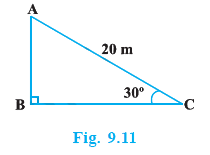
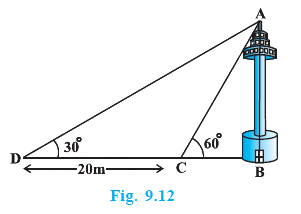
A TV tower stands vertically on a bank of a canal. From a point on the other bank directly opposite the tower, the angle of elevation of the top of the tower is $60°$. From another point $20$ m away from this point on the line joing this point to the foot of the tower, the angle of elevation of the top of the tower is $30°$ (see Fig. 9.12). Find the height of the tower and the width of the canal.
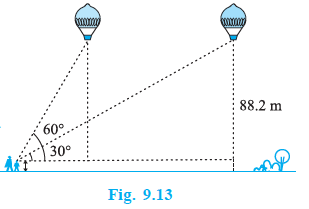
A $1.2$ m tall girl spots a balloon moving with the wind in a horizontal line at a height of $88.2$ m from the ground. The angle of elevation of the balloon from the eyes of the girl at any instant is $60°$. After some time, the angle of elevation reduces to $30°$ (see Fig. 9.13). Find the distance travelled by the balloon during the interval.
Worksheet Answers
Solution:
Given:
To Find:
The distance between the two ships, i.e., the length of segment $CD$.
Step 1: Defining Variables and Geometric Relationships
Let $AB$ be the lighthouse of height $75$ m. Let $C$ and $D$ be the positions of the two ships. Since the angles of depression are $45^\circ$ and $30^\circ$, the angles of elevation from the ships to the top of the lighthouse are also $45^\circ$ and $30^\circ$ respectively [By the property of alternate interior angles].
Let $BC = x$ and $BD = y$. The distance between the ships is $CD = y - x$.
Step 2: Calculating distance $BC$ in $\triangle ABC$
In right-angled triangle $\triangle ABC$:
$\tan(45^\circ) = \frac{\text{Opposite}}{\text{Adjacent}} = \frac{AB}{BC}$
We know $\tan(45^\circ) = 1$ and $AB = 75$ m.
$1 = \frac{75}{x}$
$x = 75$ m
Step 3: Calculating distance $BD$ in $\triangle ABD$
In right-angled triangle $\triangle ABD$:
$\tan(30^\circ) = \frac{\text{Opposite}}{\text{Adjacent}} = \frac{AB}{BD}$
We know $\tan(30^\circ) = \frac{1}{\sqrt{3}}$ and $AB = 75$ m.
$\frac{1}{\sqrt{3}} = \frac{75}{y}$
$y = 75\sqrt{3}$ m
Step 4: Finding the distance between the ships ($CD$)
The distance between the two ships is $CD = BD - BC$.
$CD = y - x$
$CD = 75\sqrt{3} - 75$
$CD = 75(\sqrt{3} - 1)$
Using the approximation $\sqrt{3} \approx 1.732$:
$CD = 75(1.732 - 1)$
$CD = 75(0.732)$
$CD = 54.9$ m
Final Answer: The distance between the two ships is $75(\sqrt{3} - 1)$ m or approximately $54.9$ m.
Solution:
Given:
To Find:
Step 1: Defining the Variables and Assumptions
Let $AB$ be the tower of height $h$ meters. Let $C$ be the point on the ground at a distance of $30$ m from the foot of the tower $B$. Thus, $BC = 30$ m. The angle of elevation $\angle ACB = 30^\circ$. We assume the tower stands vertically on the ground, making $\triangle ABC$ a right-angled triangle at $B$.
Step 2: Selecting the Trigonometric Ratio
In the right-angled triangle $\triangle ABC$, we have the side adjacent to the angle $\angle C$ (which is $BC$) and we need to find the side opposite to the angle $\angle C$ (which is $AB$). The trigonometric ratio that relates the opposite side and the adjacent side is the tangent function:
$\tan(\theta) = \frac{\text{Opposite}}{\text{Adjacent}} = \frac{AB}{BC}$
Step 3: Substituting the Values
Substitute $\theta = 30^\circ$, $BC = 30$ m, and $AB = h$ into the formula:
$\tan(30^\circ) = \frac{h}{30}$
Step 4: Solving for $h$
We know from trigonometric standard values that $\tan(30^\circ) = \frac{1}{\sqrt{3}}$.
$\frac{1}{\sqrt{3}} = \frac{h}{30}$
Multiply both sides by $30$ to isolate $h$:
$h = \frac{30}{\sqrt{3}}$
Step 5: Rationalizing the Denominator
To simplify the expression, multiply the numerator and the denominator by $\sqrt{3}$:
$h = \frac{30}{\sqrt{3}} \times \frac{\sqrt{3}}{\sqrt{3}}$
$h = \frac{30\sqrt{3}}{3}$
$h = 10\sqrt{3}$
Step 6: Final Calculation
Using the approximate value of $\sqrt{3} \approx 1.732$:
$h = 10 \times 1.732 = 17.32$ m
Final Answer: The height of the tower is $10\sqrt{3}$ m or approximately $17.32$ m.
Solution:
Given:
To find:
The height of the building ($AB = h$).
Step 1: Define variables and identify triangles.
Let the height of the building $AB = h$ meters.
Let the distance between the foot of the building ($B$) and the foot of the tower ($D$) be $BD = x$ meters.
We have two right-angled triangles: $\triangle ABD$ and $\triangle CDB$.
Step 2: Analyze $\triangle CDB$ to find the distance $x$.
In $\triangle CDB$, the angle of elevation is $\angle CBD = 60^\circ$.
Using the trigonometric ratio tangent: $\tan(\theta) = \frac{\text{Opposite}}{\text{Adjacent}}$
$\tan(60^\circ) = \frac{CD}{BD}$
Since $\tan(60^\circ) = \sqrt{3}$ [Trigonometric table value]:
$\sqrt{3} = \frac{50}{x}$
$x = \frac{50}{\sqrt{3}}$ --- (Equation 1)
Step 3: Analyze $\triangle ABD$ to find the height $h$.
In $\triangle ABD$, the angle of elevation is $\angle ADB = 30^\circ$.
Using the trigonometric ratio tangent:
$\tan(30^\circ) = \frac{AB}{BD}$
Since $\tan(30^\circ) = \frac{1}{\sqrt{3}}$ [Trigonometric table value]:
$\frac{1}{\sqrt{3}} = \frac{h}{x}$
$h = \frac{x}{\sqrt{3}}$ --- (Equation 2)
Step 4: Substitute Equation 1 into Equation 2.
$h = \frac{\frac{50}{\sqrt{3}}}{\sqrt{3}}$
$h = \frac{50}{\sqrt{3} \times \sqrt{3}}$
$h = \frac{50}{3}$
$h = 16.666...$ meters
Final Answer: The height of the building is $\frac{50}{3}$ m or approximately $16.67$ m.
Solution:
Given:
To Find:
Step 1: Define variables and set up the geometry.
Let the two poles be $AC$ and $BD$ such that $AC = BD = h$.
Let the width of the road $CD = 80$ m.
Let $P$ be a point on $CD$ such that $CP = x$ meters. Then, $PD = (80 - x)$ meters.
Step 2: Apply trigonometric ratios in the right-angled triangles.
In $\triangle ACP$, using the tangent ratio $\tan(\theta) = \frac{\text{Opposite}}{\text{Adjacent}}$:
$\tan(60^\circ) = \frac{AC}{CP}$
$\sqrt{3} = \frac{h}{x}$
$h = x\sqrt{3}$ --- (Equation 1)
In $\triangle BDP$:
$\tan(30^\circ) = \frac{BD}{PD}$
$\frac{1}{\sqrt{3}} = \frac{h}{80 - x}$
$h = \frac{80 - x}{\sqrt{3}}$ --- (Equation 2)
Step 3: Solve for $x$.
Equating Equation 1 and Equation 2:
$x\sqrt{3} = \frac{80 - x}{\sqrt{3}}$
Multiply both sides by $\sqrt{3}$:
$3x = 80 - x$
$3x + x = 80$
$4x = 80$
$x = 20$ m
Step 4: Calculate the height $h$ and the remaining distance.
Substitute $x = 20$ into Equation 1:
$h = 20\sqrt{3}$ m
The distance of point $P$ from the first pole is $CP = x = 20$ m.
The distance of point $P$ from the second pole is $PD = 80 - x = 80 - 20 = 60$ m.
Final Answer: The height of the poles is $20\sqrt{3}$ m (approx. $34.64$ m), and the distances of the point from the poles are $20$ m and $60$ m respectively.
Solution:
Given:
Case 1 (Children below 5 years):
Case 2 (Elder children):
To find:
The length of the slide for each case (i.e., the length of the hypotenuse $AC$ and $PR$).
Step 1: Calculating the length of the slide for children below 5 years.
In the right-angled triangle $\triangle ABC$, where $\angle B = 90^\circ$:
We use the trigonometric ratio that relates the opposite side to the hypotenuse, which is the sine function:
$\sin(\theta) = \frac{\text{Opposite}}{\text{Hypotenuse}}$
Substituting the given values:
$\sin(30^\circ) = \frac{AB}{AC}$
Since $\sin(30^\circ) = \frac{1}{2}$ [Standard trigonometric value]:
$\frac{1}{2} = \frac{1.5}{AC}$
By cross-multiplication:
$AC = 1.5 \times 2$
$AC = 3$ m
Step 2: Calculating the length of the slide for elder children.
In the right-angled triangle $\triangle PQR$, where $\angle Q = 90^\circ$:
Using the sine function again:
$\sin(60^\circ) = \frac{PQ}{PR}$
Since $\sin(60^\circ) = \frac{\sqrt{3}}{2}$ [Standard trigonometric value]:
$\frac{\sqrt{3}}{2} = \frac{3}{PR}$
By cross-multiplication:
$PR \times \sqrt{3} = 3 \times 2$
$PR \times \sqrt{3} = 6$
$PR = \frac{6}{\sqrt{3}}$
Rationalizing the denominator by multiplying the numerator and denominator by $\sqrt{3}$:
$PR = \frac{6 \times \sqrt{3}}{\sqrt{3} \times \sqrt{3}}$
$PR = \frac{6\sqrt{3}}{3}$
$PR = 2\sqrt{3}$ m
Using the approximation $\sqrt{3} \approx 1.732$:
$PR \approx 2 \times 1.732 = 3.464$ m
Final Answer: The length of the slide for children below 5 years is $3$ m, and the length of the slide for elder children is $2\sqrt{3}$ m (approximately $3.46$ m).
Solution:
Given:
1. The height of the kite above the ground ($AB$) = $60$ m.
2. The angle of inclination of the string with the ground ($\angle ACB$) = $60^\circ$.
3. The string is assumed to be taut (no slack), forming a straight line.
To Find:
The length of the string ($AC$).
Step 1: Defining the Geometric Model
Let the position of the kite be point $A$, the point on the ground directly below the kite be $B$, and the point where the string is tied to the ground be $C$.
This forms a right-angled triangle $\triangle ABC$, where:
Step 2: Selecting the Trigonometric Ratio
In a right-angled triangle, the relationship between the side opposite to an angle and the hypotenuse is given by the sine function:
$\sin(\theta) = \frac{\text{Opposite}}{\text{Hypotenuse}}$
Applying this to $\triangle ABC$:
$\sin(60^\circ) = \frac{AB}{AC}$
Step 3: Substituting Known Values
We know that $\sin(60^\circ) = \frac{\sqrt{3}}{2}$ [Standard trigonometric value].
Substituting the values into the equation:
$\frac{\sqrt{3}}{2} = \frac{60}{AC}$
Step 4: Solving for $AC$
To isolate $AC$, we perform cross-multiplication:
$\sqrt{3} \times AC = 60 \times 2$
$\sqrt{3} \times AC = 120$
$AC = \frac{120}{\sqrt{3}}$
Step 5: Rationalizing the Denominator
To simplify the expression, multiply the numerator and denominator by $\sqrt{3}$:
$AC = \frac{120}{\sqrt{3}} \times \frac{\sqrt{3}}{\sqrt{3}}$
$AC = \frac{120\sqrt{3}}{3}$
$AC = 40\sqrt{3}$
Step 6: Final Calculation
Using the approximation $\sqrt{3} \approx 1.732$:
$AC = 40 \times 1.732 = 69.28$ m
Final Answer: The length of the string is $40\sqrt{3}$ m or approximately $69.28$ m.
Solution:
Given:
To Find:
The height of the pedestal ($BC = h$ meters).
Step 1: Define Variables and Assumptions
Let $BC = h$ be the height of the pedestal in meters.
Let $CD = x$ be the distance from the point $D$ to the base of the pedestal $C$ in meters.
The total height of the statue and pedestal is $AC = AB + BC = 1.6 + h$.
Step 2: Analyze the smaller triangle $\triangle BCD$
In the right-angled triangle $\triangle BCD$, the angle $\angle CDB = 45^\circ$.
Using the trigonometric ratio $\tan(\theta) = \frac{\text{Opposite}}{\text{Adjacent}}$:
$\tan(45^\circ) = \frac{BC}{CD}$
Since $\tan(45^\circ) = 1$:
$1 = \frac{h}{x} \implies x = h$ --- (Equation 1)
Step 3: Analyze the larger triangle $\triangle ACD$
In the right-angled triangle $\triangle ACD$, the angle $\angle ADB = 60^\circ$.
Using the trigonometric ratio $\tan(\theta) = \frac{\text{Opposite}}{\text{Adjacent}}$:
$\tan(60^\circ) = \frac{AC}{CD}$
Substitute $AC = 1.6 + h$ and $CD = x$:
$\sqrt{3} = \frac{1.6 + h}{x}$ --- (Equation 2)
Step 4: Solve for $h$
Substitute $x = h$ (from Equation 1) into Equation 2:
$\sqrt{3} = \frac{1.6 + h}{h}$
Multiply both sides by $h$:
$h\sqrt{3} = 1.6 + h$
Rearrange the terms to isolate $h$:
$h\sqrt{3} - h = 1.6$
$h(\sqrt{3} - 1) = 1.6$
$h = \frac{1.6}{\sqrt{3} - 1}$
Step 5: Rationalize the denominator
To simplify, multiply the numerator and denominator by the conjugate $(\sqrt{3} + 1)$:
$h = \frac{1.6(\sqrt{3} + 1)}{(\sqrt{3} - 1)(\sqrt{3} + 1)}$
Using the identity $(a-b)(a+b) = a^2 - b^2$:
$h = \frac{1.6(\sqrt{3} + 1)}{3 - 1}$
$h = \frac{1.6(\sqrt{3} + 1)}{2}$
$h = 0.8(\sqrt{3} + 1)$
Using $\sqrt{3} \approx 1.732$:
$h = 0.8(1.732 + 1) = 0.8(2.732) = 2.1856$ m.
Final Answer: The height of the pedestal is $0.8(\sqrt{3} + 1)$ m or approximately $2.186$ m.
Solution:
Given:
To find:
The distance the boy walked towards the building, which is the distance $EF$.
Step 1: Determine the height of the triangle above the boy's eye level.
Let the building be $AB$ and the boy's positions be $EF$ and $DC$. The height of the building $AB = 30$ m. Since the boy is $1.5$ m tall, the height of the triangle $AF$ (where $F$ is the point on $AB$ at the eye level of the boy) is:
$AF = AB - FB = 30 - 1.5 = 28.5$ m.
Step 2: Define the variables for the horizontal distances.
Let $DF = x$ and $EF = y$. We need to find $x$.
Step 3: Apply trigonometry in $\triangle ADF$.
In the right-angled triangle $\triangle ADF$, the angle of elevation is $60^\circ$.
Using the tangent ratio: $\tan(\theta) = \frac{\text{Opposite}}{\text{Adjacent}}$
$\tan(60^\circ) = \frac{AF}{DF}$
Since $\tan(60^\circ) = \sqrt{3}$:
$\sqrt{3} = \frac{28.5}{x}$
$x = \frac{28.5}{\sqrt{3}}$
Rationalizing the denominator: $x = \frac{28.5 \times \sqrt{3}}{3} = 9.5\sqrt{3}$ m.
Step 4: Apply trigonometry in $\triangle AEF$.
In the right-angled triangle $\triangle AEF$, the angle of elevation is $30^\circ$.
$\tan(30^\circ) = \frac{AF}{EF} = \frac{AF}{ED + DF}$
Since $\tan(30^\circ) = \frac{1}{\sqrt{3}}$:
$\frac{1}{\sqrt{3}} = \frac{28.5}{y + x}$
$y + x = 28.5\sqrt{3}$
Step 5: Calculate the distance walked ($y$).
$y = 28.5\sqrt{3} - x$
$y = 28.5\sqrt{3} - 9.5\sqrt{3}$
$y = 19\sqrt{3}$ m.
Final Answer: The distance the boy walked towards the building is $19\sqrt{3}$ m.
Solution:
Given:
To Find:
The total height of the tree ($H = AB + AC$, where $A$ is the top, $B$ is the foot, and $C$ is the point where the top touches the ground, with the break occurring at point $D$).
Step 1: Define the variables and model the triangle.
Let the original tree be $AD$. Let it break at point $D$. The part $AD$ bends such that the top $A$ touches the ground at point $C$. Let $B$ be the foot of the tree. Thus, $BD$ is the vertical part remaining standing, and $DC$ is the broken part that touches the ground. The total height of the tree is $H = BD + DC$.
In the right-angled triangle $\triangle DBC$ (right-angled at $B$):
Step 2: Calculate the height of the standing part ($BD$).
Using the trigonometric ratio for tangent: $\tan(\theta) = \frac{\text{Opposite}}{\text{Adjacent}}$
$\tan(30^\circ) = \frac{BD}{BC}$
Since $\tan(30^\circ) = \frac{1}{\sqrt{3}}$ [Standard trigonometric value]:
$\frac{1}{\sqrt{3}} = \frac{BD}{8}$
$BD = \frac{8}{\sqrt{3}}$ m
Step 3: Calculate the length of the broken part ($DC$).
Using the trigonometric ratio for cosine: $\cos(\theta) = \frac{\text{Adjacent}}{\text{Hypotenuse}}$
$\cos(30^\circ) = \frac{BC}{DC}$
Since $\cos(30^\circ) = \frac{\sqrt{3}}{2}$ [Standard trigonometric value]:
$\frac{\sqrt{3}}{2} = \frac{8}{DC}$
$DC = \frac{16}{\sqrt{3}}$ m
Step 4: Calculate the total height of the tree ($H$).
$H = BD + DC$
$H = \frac{8}{\sqrt{3}} + \frac{16}{\sqrt{3}}$
$H = \frac{24}{\sqrt{3}}$
Rationalizing the denominator by multiplying the numerator and denominator by $\sqrt{3}$:
$H = \frac{24 \times \sqrt{3}}{\sqrt{3} \times \sqrt{3}} = \frac{24\sqrt{3}}{3} = 8\sqrt{3}$ m
Using $\sqrt{3} \approx 1.732$:
$H = 8 \times 1.732 = 13.856$ m
Final Answer: The height of the tree is $8\sqrt{3}$ m (or approximately $13.86$ m).
Solution:
Given:
To Find:
Visual Representation:
Step 1: Defining the Variables and Trigonometric Relationship
Let $AB$ be the height of the vertical pole. Let $AC$ be the length of the rope. In the right-angled triangle $\triangle ABC$, where $\angle B = 90^\circ$:
We use the trigonometric ratio that relates the opposite side and the hypotenuse, which is the sine function:
$\sin(\theta) = \frac{\text{Opposite}}{\text{Hypotenuse}}$
Step 2: Setting up the Equation
Substituting the known values into the sine formula:
$\sin(30^\circ) = \frac{AB}{AC}$
Given that $AC = 20$ m and $\sin(30^\circ) = \frac{1}{2}$ [Standard trigonometric value]:
$\frac{1}{2} = \frac{AB}{20}$
Step 3: Solving for $AB$
To isolate $AB$, multiply both sides of the equation by $20$:
$AB = 20 \times \frac{1}{2}$
$AB = 10$
Step 4: Conclusion
The height of the pole is $10$ meters.
Final Answer: The height of the pole is 10 m.
Solution:
Given:
1. Height of the building ($AB$) = $7$ m.
2. Angle of elevation of the top of the tower ($EC$) from the top of the building ($A$) = $60^\circ$.
3. Angle of depression of the foot of the tower ($D$) from the top of the building ($A$) = $45^\circ$.
To find:
The total height of the cable tower ($CD$).
Step 1: Define the variables and geometric relationships.
Let $AB$ be the building of height $7$ m. Let $CD$ be the cable tower. Let $A$ be the top of the building and $B$ be its foot. Let $C$ be the top of the tower and $D$ be its foot. Let $E$ be a point on $CD$ such that $AE$ is horizontal. Thus, $AE = BD$ and $ED = AB = 7$ m.
Step 2: Analyze triangle $\triangle ABD$.
In the right-angled triangle $\triangle ABD$, the angle of depression from $A$ to $D$ is $45^\circ$. Therefore, the angle of elevation from $D$ to $A$ is also $45^\circ$ (alternate interior angles).
Using the trigonometric ratio tangent:
$\tan(45^\circ) = \frac{\text{Opposite}}{\text{Adjacent}} = \frac{AB}{BD}$
Since $\tan(45^\circ) = 1$:
$1 = \frac{7}{BD}$
$BD = 7$ m
[Since $AE$ is parallel to $BD$, $AE = BD = 7$ m].
Step 3: Analyze triangle $\triangle AEC$.
In the right-angled triangle $\triangle AEC$, the angle of elevation is $60^\circ$.
$\tan(60^\circ) = \frac{\text{Opposite}}{\text{Adjacent}} = \frac{CE}{AE}$
We know $\tan(60^\circ) = \sqrt{3}$ and $AE = 7$ m:
$\sqrt{3} = \frac{CE}{7}$
$CE = 7\sqrt{3}$ m
Step 4: Calculate the total height of the tower.
The total height of the tower $CD = CE + ED$.
We know $ED = AB = 7$ m.
$CD = 7\sqrt{3} + 7$
$CD = 7(\sqrt{3} + 1)$ m
Using the approximation $\sqrt{3} \approx 1.732$:
$CD \approx 7(1.732 + 1) = 7(2.732) = 19.124$ m.
Final Answer: The height of the tower is $7(\sqrt{3} + 1)$ m or approximately $19.12$ m.
Solution:
Given:
A TV tower $AB$ stands vertically on the bank of a canal. Let $BC$ be the width of the canal. From a point $C$ on the other bank, the angle of elevation of the top of the tower $A$ is $60^\circ$. From another point $D$, which is $20\text{ m}$ away from $C$ on the line joining $C$ to the foot of the tower $B$, the angle of elevation of the top of the tower $A$ is $30^\circ$.
To Find:
1. The height of the tower ($h = AB$).
2. The width of the canal ($x = BC$).
Step 1: Defining Variables and Assumptions
Let the height of the tower $AB = h$ meters.
Let the width of the canal $BC = x$ meters.
The distance $BD = BC + CD = x + 20$ meters.
Step 2: Analyzing Triangle ABC
In the right-angled triangle $\triangle ABC$, the angle of elevation at $C$ is $60^\circ$.
Using the trigonometric ratio $\tan(\theta) = \frac{\text{Opposite}}{\text{Adjacent}}$:
$\tan(60^\circ) = \frac{AB}{BC}$
Since $\tan(60^\circ) = \sqrt{3}$:
$\sqrt{3} = \frac{h}{x}$
$h = x\sqrt{3}$ --- (Equation 1)
Step 3: Analyzing Triangle ABD
In the right-angled triangle $\triangle ABD$, the angle of elevation at $D$ is $30^\circ$.
Using the trigonometric ratio $\tan(\theta) = \frac{\text{Opposite}}{\text{Adjacent}}$:
$\tan(30^\circ) = \frac{AB}{BD}$
Since $\tan(30^\circ) = \frac{1}{\sqrt{3}}$ and $BD = x + 20$:
$\frac{1}{\sqrt{3}} = \frac{h}{x + 20}$
$x + 20 = h\sqrt{3}$ --- (Equation 2)
Step 4: Solving the System of Equations
Substitute the value of $h$ from Equation 1 into Equation 2:
$x + 20 = (x\sqrt{3})\sqrt{3}$
$x + 20 = 3x$ [Since $\sqrt{3} \times \sqrt{3} = 3$]
$20 = 3x - x$
$20 = 2x$
$x = 10$
Thus, the width of the canal is $10\text{ m}$.
Step 5: Calculating the Height of the Tower
Substitute $x = 10$ back into Equation 1:
$h = 10\sqrt{3}$
Using $\sqrt{3} \approx 1.732$:
$h = 10 \times 1.732 = 17.32\text{ m}$
Final Answer: The height of the tower is $10\sqrt{3}\text{ m}$ (or approximately $17.32\text{ m}$) and the width of the canal is $10\text{ m}$.
Solution:
Given:
To Find:
The distance travelled by the balloon during the interval, let this be $d$.
Step 1: Determine the effective height of the balloon from the girl's eye level.
Since the girl is $1.2$ m tall, the height of the balloon from her eye level ($h$) is the total height minus the girl's height.
$h = 88.2\text{ m} - 1.2\text{ m} = 87\text{ m}$.
Step 2: Analyze the first position of the balloon (Triangle 1).
Let the first position of the balloon be $C$ and the girl's eye position be $E$. Let the point on the ground directly below the balloon be $F$.
In the right-angled triangle formed by the eye level, the balloon, and the vertical line:
$\tan(60^\circ) = \frac{\text{Opposite}}{\text{Adjacent}} = \frac{h}{x_1}$
$\sqrt{3} = \frac{87}{x_1}$
$x_1 = \frac{87}{\sqrt{3}} = \frac{87\sqrt{3}}{3} = 29\sqrt{3}\text{ m}$.
Step 3: Analyze the second position of the balloon (Triangle 2).
Let the second position of the balloon be $D$.
In the right-angled triangle formed by the eye level, the new balloon position, and the vertical line:
$\tan(30^\circ) = \frac{\text{Opposite}}{\text{Adjacent}} = \frac{h}{x_2}$
$\frac{1}{\sqrt{3}} = \frac{87}{x_2}$
$x_2 = 87\sqrt{3}\text{ m}$.
Step 4: Calculate the distance travelled by the balloon.
The distance travelled ($d$) is the difference between the two horizontal distances $x_2$ and $x_1$.
$d = x_2 - x_1$
$d = 87\sqrt{3} - 29\sqrt{3}$
$d = (87 - 29)\sqrt{3}$
$d = 58\sqrt{3}\text{ m}$.
Using the approximation $\sqrt{3} \approx 1.732$:
$d = 58 \times 1.732 = 100.456\text{ m}$.
Final Answer: The distance travelled by the balloon is $58\sqrt{3}$ m (or approximately $100.46$ m).
Solution:
Given:
To find:
The height of the transmission tower ($h = CD$).
Step 1: Define variables and identify triangles.
Let $AB = x$ be the distance from the point on the ground to the base of the building. Let $CD = h$ be the height of the tower. The total height of the building and tower is $BD = BC + CD = 20 + h$.
Step 2: Analyze $\triangle ABC$ (Right-angled at $B$).
In $\triangle ABC$, the angle of elevation $\angle BAC = 45^\circ$.
Using the trigonometric ratio: $\tan(\theta) = \frac{\text{Opposite}}{\text{Adjacent}}$
$\tan(45^\circ) = \frac{BC}{AB}$
Since $\tan(45^\circ) = 1$ [Trigonometric table value]:
$1 = \frac{20}{x}$
$x = 20$ m [Equation 1]
Step 3: Analyze $\triangle ABD$ (Right-angled at $B$).
In $\triangle ABD$, the angle of elevation $\angle BAD = 60^\circ$.
$\tan(60^\circ) = \frac{BD}{AB}$
Since $\tan(60^\circ) = \sqrt{3}$ [Trigonometric table value]:
$\sqrt{3} = \frac{20 + h}{x}$
Step 4: Solve for $h$.
Substitute $x = 20$ from Equation 1 into the equation from Step 3:
$\sqrt{3} = \frac{20 + h}{20}$
$20\sqrt{3} = 20 + h$ [Multiplying both sides by 20]
$h = 20\sqrt{3} - 20$
$h = 20(\sqrt{3} - 1)$
Using $\sqrt{3} \approx 1.732$:
$h = 20(1.732 - 1)$
$h = 20(0.732)$
$h = 14.64$ m
Final Answer: The height of the transmission tower is $20(\sqrt{3} - 1)$ m or approximately $14.64$ m.
Solution:
Given:
1. A tower $AB$ of height $h$ stands vertically on a horizontal plane.
2. A car is moving towards the foot of the tower ($B$) along a straight highway.
3. At point $C$, the angle of depression from the top of the tower ($A$) is $30^\circ$.
4. After $6$ seconds, the car reaches point $D$, where the angle of depression is $60^\circ$.
To Find:
The time taken by the car to travel from point $D$ to the foot of the tower $B$.
Step 1: Define Variables and Geometric Relationships
Let $AB = h$ be the height of the tower. Let the speed of the car be $v$ (units/sec).
Distance covered by the car from $C$ to $D$ in $6$ seconds is $CD = v \times 6 = 6v$.
Let the time taken to travel from $D$ to $B$ be $t$ seconds. Then, $DB = v \times t = vt$.
Step 2: Apply Trigonometric Ratios in Right-Angled Triangles
In $\triangle ABD$ (where $\angle ADB = 60^\circ$):
$\tan(60^\circ) = \frac{\text{Opposite}}{\text{Adjacent}} = \frac{AB}{DB}$
Since $\tan(60^\circ) = \sqrt{3}$, we have:
$\sqrt{3} = \frac{h}{vt} \implies h = vt\sqrt{3}$ --- (Equation 1)
In $\triangle ABC$ (where $\angle ACB = 30^\circ$):
$\tan(30^\circ) = \frac{AB}{CB} = \frac{AB}{CD + DB}$
Since $\tan(30^\circ) = \frac{1}{\sqrt{3}}$, we have:
$\frac{1}{\sqrt{3}} = \frac{h}{6v + vt}$
$h\sqrt{3} = 6v + vt$ --- (Equation 2)
Step 3: Solve the System of Equations
Substitute the value of $h$ from Equation 1 into Equation 2:
$(vt\sqrt{3})\sqrt{3} = 6v + vt$
$vt(3) = 6v + vt$
$3vt = 6v + vt$
Subtract $vt$ from both sides:
$2vt = 6v$
Divide both sides by $2v$ (assuming $v \neq 0$):
$t = \frac{6v}{2v}$
$t = 3$
Conclusion:
The time taken by the car to travel from point $D$ to the foot of the tower $B$ is $3$ seconds.
Final Answer: 3 seconds


