


Your Worksheet is Ready
CBSE - Class 10 Mathematics Introduction to Trigonometry Worksheet
EXERCISE 8.1
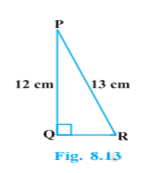
In Fig. 8.13, find $\tan P – \cot R$.
Worksheet Answers
Solution:
Given: A right-angled triangle $ABC$ where $\angle B = 90^\circ$, side $AB = 24$ cm, and side $BC = 7$ cm.
To find: The values of $\sin C$ and $\cos C$.
Step 1: Calculating the Hypotenuse ($AC$)
In a right-angled triangle, the square of the hypotenuse is equal to the sum of the squares of the other two sides [Pythagoras Theorem].
$AC^2 = AB^2 + BC^2$
Substitute the given values:
$AC^2 = (24)^2 + (7)^2$
$AC^2 = 576 + 49$
$AC^2 = 625$
$AC = \sqrt{625} = 25$ cm
Step 2: Defining Trigonometric Ratios for $\angle C$
For $\angle C$, the side opposite is $AB$ and the side adjacent is $BC$. The hypotenuse is $AC$.
$\sin C = \frac{\text{Opposite side}}{\text{Hypotenuse}} = \frac{AB}{AC}$
$\cos C = \frac{\text{Adjacent side}}{\text{Hypotenuse}} = \frac{BC}{AC}$
Step 3: Substituting the values
Using $AB = 24$ cm, $BC = 7$ cm, and $AC = 25$ cm:
$\sin C = \frac{24}{25}$
$\cos C = \frac{7}{25}$
Final Answer: $\sin C = \frac{24}{25}$ and $\cos C = \frac{7}{25}$
Solution:
Given: $\cot \theta = \frac{7}{8}$
To find: The value of $\frac{(1 + \sin \theta) (1 - \sin \theta)}{(1 + \cos \theta) (1 - \cos \theta)}$
Step 1: Define the trigonometric ratio in terms of sides.
In a right-angled triangle, $\cot \theta = \frac{\text{Adjacent side}}{\text{Opposite side}}$.
Given $\cot \theta = \frac{7}{8}$, let the adjacent side $AB = 7k$ and the opposite side $BC = 8k$, where $k$ is a positive constant.
Step 2: Calculate the hypotenuse using the Pythagorean Theorem.
According to the Pythagorean Theorem: $AC^2 = AB^2 + BC^2$.
$AC^2 = (7k)^2 + (8k)^2$
$AC^2 = 49k^2 + 64k^2$
$AC^2 = 113k^2$
$AC = \sqrt{113}k$
Step 3: Determine $\sin \theta$ and $\cos \theta$.
$\sin \theta = \frac{\text{Opposite}}{\text{Hypotenuse}} = \frac{8k}{\sqrt{113}k} = \frac{8}{\sqrt{113}}$
$\cos \theta = \frac{\text{Adjacent}}{\text{Hypotenuse}} = \frac{7k}{\sqrt{113}k} = \frac{7}{\sqrt{113}}$
Step 4: Simplify the expression using algebraic identities.
The expression is $\frac{(1 + \sin \theta) (1 - \sin \theta)}{(1 + \cos \theta) (1 - \cos \theta)}$.
Using the algebraic identity $(a+b)(a-b) = a^2 - b^2$:
Numerator: $(1 + \sin \theta)(1 - \sin \theta) = 1 - \sin^2 \theta$
Denominator: $(1 + \cos \theta)(1 - \cos \theta) = 1 - \cos^2 \theta$
Expression = $\frac{1 - \sin^2 \theta}{1 - \cos^2 \theta}$
Step 5: Substitute the values and calculate.
$1 - \sin^2 \theta = 1 - (\frac{8}{\sqrt{113}})^2 = 1 - \frac{64}{113} = \frac{113 - 64}{113} = \frac{49}{113}$
$1 - \cos^2 \theta = 1 - (\frac{7}{\sqrt{113}})^2 = 1 - \frac{49}{113} = \frac{113 - 49}{113} = \frac{64}{113}$
Expression = $\frac{49/113}{64/113} = \frac{49}{113} \times \frac{113}{64} = \frac{49}{64}$
Final Answer: \frac{49}{64}
Solution:
Given: A trigonometric ratio $\sec A = \frac{12}{5}$ for an angle $A$.
To Find: Determine whether the statement "$\sec A = \frac{12}{5}$ for some value of angle $A$" is true or false, and provide a justification.
Step 1: Definition of the Secant Ratio
In a right-angled triangle, for an acute angle $A$, the trigonometric ratio $\sec A$ is defined as the ratio of the length of the hypotenuse to the length of the side adjacent to angle $A$.
$\sec A = \frac{\text{Hypotenuse}}{\text{Adjacent side}}$
Step 2: Analyzing the given value
Given $\sec A = \frac{12}{5}$.
Comparing this to the definition, we can assume:
Hypotenuse $= 12k$
Adjacent side $= 5k$
where $k$ is a positive constant.
Step 3: Applying the Pythagorean Theorem
In any right-angled triangle, the hypotenuse is the longest side. Let the third side (opposite to angle $A$) be $BC$. According to the Pythagorean theorem:
$(\text{Hypotenuse})^2 = (\text{Adjacent side})^2 + (\text{Opposite side})^2$
$(12k)^2 = (5k)^2 + (BC)^2$
$144k^2 = 25k^2 + (BC)^2$
$(BC)^2 = 144k^2 - 25k^2$
$(BC)^2 = 119k^2$
$BC = \sqrt{119}k \approx 10.9k$
Step 4: Logical Justification
Since $12k > 5k$ and $12k > 10.9k$, the hypotenuse is indeed the longest side of the triangle. In a right-angled triangle, the ratio $\frac{\text{Hypotenuse}}{\text{Adjacent}}$ must always be greater than or equal to $1$ because the hypotenuse is always greater than or equal to any other side. Since $\frac{12}{5} = 2.4$, which is greater than $1$, this value is mathematically possible for an angle $A$.
Final Answer: The statement is True. Since the hypotenuse is the longest side in a right-angled triangle, the ratio $\sec A = \frac{\text{Hypotenuse}}{\text{Adjacent}}$ can take any value greater than or equal to $1$. As $\frac{12}{5} = 2.4 > 1$, it is a valid value for $\sec A$.
Solution:
Given: The statement "$\cos A$ is the abbreviation used for the cosecant of angle $A$."
To Find: Determine whether the given statement is True or False and provide a mathematical justification.
Step 1: Defining Trigonometric Abbreviations
In trigonometry, the six primary trigonometric functions are defined by specific abbreviations derived from the names of the ratios of sides in a right-angled triangle. Let us define them formally:
Step 2: Analyzing the Statement
The statement claims that $\cos A$ is the abbreviation for the cosecant of angle $A$. Based on the definitions established in Step 1:
1. The abbreviation $\cos A$ corresponds to the cosine of angle $A$.
2. The abbreviation for the cosecant of angle $A$ is $\csc A$ or $\text{cosec } A$.
Step 3: Logical Comparison
Since $\cos A$ represents the cosine function and not the cosecant function, the statement provided is mathematically incorrect. The term "cosecant" is the reciprocal of the sine function ($\csc A = \frac{1}{\sin A}$), whereas "cosine" is a distinct trigonometric ratio ($\cos A = \frac{\text{adjacent side}}{\text{hypotenuse}}$).
Conclusion:
The statement is False because $\cos A$ is the abbreviation for the cosine of angle $A$, while the abbreviation for the cosecant of angle $A$ is $\text{cosec } A$.
Final Answer: False. $\cos A$ is the abbreviation for the cosine of angle $A$, whereas the abbreviation for the cosecant of angle $A$ is $\text{cosec } A$.
Solution:
Given: A statement regarding the trigonometric ratio $\tan A$, where $A$ is an acute angle in a right-angled triangle.
To Find/Prove: Determine whether the statement "The value of $\tan A$ is always less than 1" is True or False, and provide a mathematical justification.
Visual Representation:
Step 1: Definition of Tangent Ratio
In a right-angled triangle $ABC$ right-angled at $B$, the tangent of angle $A$ is defined as the ratio of the length of the side opposite to angle $A$ to the length of the side adjacent to angle $A$.
Mathematically: $\tan A = \frac{\text{Opposite side}}{\text{Adjacent side}} = \frac{BC}{AB}$
Step 2: Analyzing the Ratio
In a right-angled triangle, the lengths of the sides $BC$ (opposite) and $AB$ (adjacent) are independent of each other, provided they are both positive real numbers. There is no geometric constraint that forces the opposite side to be smaller than the adjacent side.
Step 3: Counter-Example Verification
Let us consider a specific case where the opposite side is greater than the adjacent side. Suppose $BC = 4$ units and $AB = 3$ units.
Then, $\tan A = \frac{4}{3}$
Performing the division: $\frac{4}{3} = 1.333...$
Since $1.333... > 1$, we have found a case where $\tan A$ is greater than 1.
Step 4: Theoretical Justification
The tangent function $\tan \theta$ is defined for $0^\circ \le \theta < 90^\circ$. As $\theta$ approaches $90^\circ$, the value of $\tan \theta$ increases without bound (tends to infinity). For example, $\tan 60^\circ = \sqrt{3} \approx 1.732$, which is clearly greater than 1.
Conclusion:
Since there exist values of $A$ for which $\tan A > 1$, the statement "The value of $\tan A$ is always less than 1" is incorrect.
Final Answer: False. The value of $\tan A$ can take any real value. For instance, if $\angle A = 60^\circ$, then $\tan 60^\circ = \sqrt{3} \approx 1.732$, which is greater than 1.
Solution:
Given: The statement "$\cot A$ is the product of $\cot$ and $A$".
To Find: Determine whether the given statement is True or False and provide a mathematical justification.
Step 1: Understanding Trigonometric Notation
In trigonometry, the notation $\cot A$ is a shorthand representation for the "cotangent of the angle $A$". Here, $\cot$ is not a separate algebraic variable or a numerical constant, but rather a functional operator (a trigonometric ratio) that acts upon the argument $A$.
Step 2: Analyzing the Relationship
Let us consider a right-angled triangle $\triangle ABC$ where $\angle B = 90^\circ$ and $\angle A$ is one of the acute angles. By definition, the cotangent of angle $A$ is the ratio of the length of the side adjacent to angle $A$ to the length of the side opposite to angle $A$.
Mathematically, $\cot A = \frac{\text{Adjacent side}}{\text{Opposite side}} = \frac{AB}{BC}$.
Step 3: Evaluating the "Product" Claim
If $\cot A$ were the product of $\cot$ and $A$, then $\cot$ would have to be a value that could be multiplied by $A$. However, $\cot$ by itself has no independent numerical value. It is an operator that requires an angle (the argument) to produce a ratio. If we were to separate them, the expression $\cot$ would be meaningless in the context of geometry and trigonometry.
Step 4: Logical Conclusion
Since $\cot A$ represents a single functional entity where $A$ is the angle associated with the cotangent ratio, it cannot be interpreted as the algebraic product of two distinct factors, $\cot$ and $A$. Therefore, the assertion that $\cot A$ is the product of $\cot$ and $A$ is mathematically incorrect.
Final Answer: False. The term $\cot A$ is a single trigonometric ratio representing the cotangent of angle $A$. The symbol $\cot$ is not a separate variable, and thus $\cot A$ is not the product of $\cot$ and $A$.
Solution:
Given: In $\triangle ABC$, $\angle B = 90^\circ$ and $\tan A = \frac{1}{\sqrt{3}}$.
To find: The value of $\sin A \cos C + \cos A \sin C$.
Step 1: Determine the sides of the triangle.
In a right-angled triangle, $\tan A = \frac{\text{Opposite side to } A}{\text{Adjacent side to } A} = \frac{BC}{AB}$.
Given $\tan A = \frac{1}{\sqrt{3}}$, we can assume $BC = 1k$ and $AB = \sqrt{3}k$, where $k$ is a positive constant.
Step 2: Calculate the hypotenuse using the Pythagoras Theorem.
The Pythagoras Theorem states: $AC^2 = AB^2 + BC^2$.
$AC^2 = (\sqrt{3}k)^2 + (1k)^2$
$AC^2 = 3k^2 + 1k^2 = 4k^2$
$AC = \sqrt{4k^2} = 2k$.
Step 3: Determine the trigonometric ratios.
For angle $A$:
$\sin A = \frac{\text{Opposite}}{\text{Hypotenuse}} = \frac{BC}{AC} = \frac{1k}{2k} = \frac{1}{2}$
$\cos A = \frac{\text{Adjacent}}{\text{Hypotenuse}} = \frac{AB}{AC} = \frac{\sqrt{3}k}{2k} = \frac{\sqrt{3}}{2}$
For angle $C$:
$\sin C = \frac{\text{Opposite to } C}{\text{Hypotenuse}} = \frac{AB}{AC} = \frac{\sqrt{3}k}{2k} = \frac{\sqrt{3}}{2}$
$\cos C = \frac{\text{Adjacent to } C}{\text{Hypotenuse}} = \frac{BC}{AC} = \frac{1k}{2k} = \frac{1}{2}$
Step 4: Evaluate the expression $\sin A \cos C + \cos A \sin C$.
Substitute the values obtained in Step 3:
$= (\frac{1}{2}) \times (\frac{1}{2}) + (\frac{\sqrt{3}}{2}) \times (\frac{\sqrt{3}}{2})$
$= \frac{1}{4} + \frac{3}{4}$
$= \frac{1 + 3}{4}$
$= \frac{4}{4} = 1$.
Final Answer: 1
Solution:
Given: $3 \cot A = 4$
To Check: Whether $\frac{1 - \tan^2 A}{1 + \tan^2 A} = \cos^2 A - \sin^2 A$
Step 1: Determine the sides of the right-angled triangle.
Given $3 \cot A = 4$, we can write $\cot A = \frac{4}{3}$.
In a right-angled triangle, $\cot A = \frac{\text{Adjacent side}}{\text{Opposite side}} = \frac{AB}{BC}$.
Let $AB = 4k$ and $BC = 3k$, where $k$ is a positive constant.
Using the Pythagoras Theorem ($AC^2 = AB^2 + BC^2$):
$AC^2 = (4k)^2 + (3k)^2$
$AC^2 = 16k^2 + 9k^2 = 25k^2$
$AC = \sqrt{25k^2} = 5k$
Step 2: Calculate the trigonometric ratios.
$\tan A = \frac{1}{\cot A} = \frac{3}{4}$
$\sin A = \frac{\text{Opposite}}{\text{Hypotenuse}} = \frac{BC}{AC} = \frac{3k}{5k} = \frac{3}{5}$
$\cos A = \frac{\text{Adjacent}}{\text{Hypotenuse}} = \frac{AB}{AC} = \frac{4k}{5k} = \frac{4}{5}$
Step 3: Evaluate the Left Hand Side (LHS).
LHS = $\frac{1 - \tan^2 A}{1 + \tan^2 A}$
Substitute $\tan A = \frac{3}{4}$:
LHS = $\frac{1 - (\frac{3}{4})^2}{1 + (\frac{3}{4})^2} = \frac{1 - \frac{9}{16}}{1 + \frac{9}{16}}$
LHS = $\frac{\frac{16-9}{16}}{\frac{16+9}{16}} = \frac{\frac{7}{16}}{\frac{25}{16}} = \frac{7}{25}$
Step 4: Evaluate the Right Hand Side (RHS).
RHS = $\cos^2 A - \sin^2 A$
Substitute $\cos A = \frac{4}{5}$ and $\sin A = \frac{3}{5}$:
RHS = $(\frac{4}{5})^2 - (\frac{3}{5})^2$
RHS = $\frac{16}{25} - \frac{9}{25} = \frac{16 - 9}{25} = \frac{7}{25}$
Step 5: Conclusion.
Since LHS = $\frac{7}{25}$ and RHS = $\frac{7}{25}$, the equation holds true.
Final Answer: Yes, $\frac{1 - \tan^2 A}{1 + \tan^2 A} = \cos^2 A - \sin^2 A$ is true.
Solution:
Given: $\sec \theta = \frac{13}{12}$
To find: All other trigonometric ratios, i.e., $\sin \theta, \cos \theta, \tan \theta, \csc \theta,$ and $\cot \theta$.
Step 1: Defining the Trigonometric Ratio
In a right-angled triangle, $\sec \theta = \frac{\text{Hypotenuse}}{\text{Adjacent side}}$.
Given $\sec \theta = \frac{13}{12}$, let the Hypotenuse ($AC$) = $13k$ and the Adjacent side ($AB$) = $12k$, where $k$ is a positive constant.
Step 2: Finding the Third Side using Pythagoras Theorem
According to the Pythagoras Theorem: $AC^2 = AB^2 + BC^2$
Substituting the known values:
$(13k)^2 = (12k)^2 + BC^2$
$169k^2 = 144k^2 + BC^2$
$BC^2 = 169k^2 - 144k^2$
$BC^2 = 25k^2$
$BC = \sqrt{25k^2} = 5k$ (Perpendicular/Opposite side)
Step 3: Calculating the Trigonometric Ratios
Using the definitions of trigonometric ratios based on the sides of the triangle:
1. $\sin \theta = \frac{\text{Opposite}}{\text{Hypotenuse}} = \frac{BC}{AC} = \frac{5k}{13k} = \frac{5}{13}$
2. $\cos \theta = \frac{\text{Adjacent}}{\text{Hypotenuse}} = \frac{AB}{AC} = \frac{12k}{13k} = \frac{12}{13}$
3. $\tan \theta = \frac{\text{Opposite}}{\text{Adjacent}} = \frac{BC}{AB} = \frac{5k}{12k} = \frac{5}{12}$
4. $\csc \theta = \frac{1}{\sin \theta} = \frac{13}{5}$
5. $\cot \theta = \frac{1}{\tan \theta} = \frac{12}{5}$
Final Answer: The trigonometric ratios are $\sin \theta = \frac{5}{13}, \cos \theta = \frac{12}{13}, \tan \theta = \frac{5}{12}, \csc \theta = \frac{13}{5},$ and $\cot \theta = \frac{12}{5}$.
Solution:
Given: In a right-angled triangle $ABC$, where $\angle B = 90^\circ$, we are given that $\sin A = \frac{3}{4}$.
To find: The values of $\cos A$ and $\tan A$.
Step 1: Understanding the Trigonometric Ratio
By definition, in a right-angled triangle, the sine of an angle is the ratio of the side opposite to the angle to the hypotenuse.
$\sin A = \frac{\text{Opposite}}{\text{Hypotenuse}} = \frac{BC}{AC}$.
Given $\sin A = \frac{3}{4}$, we can assume $BC = 3k$ and $AC = 4k$, where $k$ is a positive constant.
Step 2: Applying the Pythagoras Theorem
In $\triangle ABC$, by the Pythagoras Theorem:
$AC^2 = AB^2 + BC^2$
Substituting the known values:
$(4k)^2 = AB^2 + (3k)^2$
$16k^2 = AB^2 + 9k^2$
$AB^2 = 16k^2 - 9k^2$
$AB^2 = 7k^2$
$AB = \sqrt{7k^2} = k\sqrt{7}$
Step 3: Calculating $\cos A$
By definition, $\cos A = \frac{\text{Adjacent}}{\text{Hypotenuse}} = \frac{AB}{AC}$.
Substituting the values:
$\cos A = \frac{k\sqrt{7}}{4k}$
$\cos A = \frac{\sqrt{7}}{4}$
Step 4: Calculating $\tan A$
By definition, $\tan A = \frac{\text{Opposite}}{\text{Adjacent}} = \frac{BC}{AB}$.
Substituting the values:
$\tan A = \frac{3k}{k\sqrt{7}}$
$\tan A = \frac{3}{\sqrt{7}}$
To rationalize the denominator:
$\tan A = \frac{3}{\sqrt{7}} \times \frac{\sqrt{7}}{\sqrt{7}} = \frac{3\sqrt{7}}{7}$
Final Answer: $\cos A = \frac{\sqrt{7}}{4}$ and $\tan A = \frac{3\sqrt{7}}{7}$
Solution:
Given: The trigonometric ratio $\cot \theta = \frac{7}{8}$.
To Find: The value of $\cot^2 \theta$.
Visual Representation:
Step 1: Understanding the definition of $\cot \theta$
In a right-angled triangle, for an angle $\theta$, the cotangent ratio is defined as the ratio of the length of the adjacent side to the length of the opposite side:
$\cot \theta = \frac{\text{Adjacent side}}{\text{Opposite side}}$
Step 2: Formulating the expression for $\cot^2 \theta$
The expression $\cot^2 \theta$ is mathematically equivalent to $(\cot \theta)^2$. This notation indicates that the entire value of the cotangent of angle $\theta$ must be raised to the power of 2.
Step 3: Substitution and Calculation
Given that $\cot \theta = \frac{7}{8}$, we substitute this value into the expression:
$\cot^2 \theta = (\cot \theta)^2$
$\cot^2 \theta = \left( \frac{7}{8} \right)^2$
Applying the exponent rule $\left( \frac{a}{b} \right)^n = \frac{a^n}{b^n}$:
$\cot^2 \theta = \frac{7^2}{8^2}$
Calculating the squares of the numerator and the denominator:
$7^2 = 7 \times 7 = 49$
$8^2 = 8 \times 8 = 64$
Therefore:
$\cot^2 \theta = \frac{49}{64}$
Final Answer: Final Answer: \frac{49}{64}
Solution:
Given: $15 \cot A = 8$
To find: $\sin A$ and $\sec A$
Visual Representation:
Step 1: Determine the ratio of sides from the given equation.
Given $15 \cot A = 8$. Dividing both sides by $15$, we get:
$\cot A = \frac{8}{15}$
[Since $\cot A = \frac{\text{Adjacent side}}{\text{Opposite side}}$ in a right-angled triangle]
Let the adjacent side $AB = 8k$ and the opposite side $BC = 15k$, where $k$ is a positive constant.
Step 2: Calculate the hypotenuse using the Pythagoras Theorem.
In $\triangle ABC$, right-angled at $B$:
$AC^2 = AB^2 + BC^2$ [Pythagoras Theorem: Hypotenuse$^2$ = Base$^2$ + Perpendicular$^2$]
$AC^2 = (8k)^2 + (15k)^2$
$AC^2 = 64k^2 + 225k^2$
$AC^2 = 289k^2$
$AC = \sqrt{289k^2} = 17k$
Step 3: Find $\sin A$.
$\sin A = \frac{\text{Opposite side}}{\text{Hypotenuse}} = \frac{BC}{AC}$
$\sin A = \frac{15k}{17k}$
$\sin A = \frac{15}{17}$
Step 4: Find $\sec A$.
$\sec A = \frac{\text{Hypotenuse}}{\text{Adjacent side}} = \frac{AC}{AB}$
$\sec A = \frac{17k}{8k}$
$\sec A = \frac{17}{8}$
Final Answer: $\sin A = \frac{15}{17}$ and $\sec A = \frac{17}{8}$
Solution:
Given: In $\triangle ABC$, $\angle B = 90^\circ$, $AB = 24\text{ cm}$, and $BC = 7\text{ cm}$.
To find: The values of $\sin A$ and $\cos A$.
Step 1: Determine the length of the hypotenuse ($AC$).
Since $\triangle ABC$ is a right-angled triangle, we apply the Pythagoras Theorem, which states that in a right-angled triangle, the square of the hypotenuse is equal to the sum of the squares of the other two sides.
$AC^2 = AB^2 + BC^2$ [Pythagoras Theorem]
$AC^2 = (24)^2 + (7)^2$
$AC^2 = 576 + 49$
$AC^2 = 625$
$AC = \sqrt{625} = 25\text{ cm}$
Step 2: Define the trigonometric ratios for angle $A$.
For $\angle A$, the side opposite is $BC = 7\text{ cm}$, the side adjacent is $AB = 24\text{ cm}$, and the hypotenuse is $AC = 25\text{ cm}$.
The definitions of sine and cosine are:
$\sin A = \frac{\text{Opposite side}}{\text{Hypotenuse}} = \frac{BC}{AC}$
$\cos A = \frac{\text{Adjacent side}}{\text{Hypotenuse}} = \frac{AB}{AC}$
Step 3: Calculate the values.
Substituting the known lengths into the ratios:
$\sin A = \frac{7}{25}$
$\cos A = \frac{24}{25}$
Final Answer: $\sin A = \frac{7}{25}$ and $\cos A = \frac{24}{25}$
Solution:
Given: $\angle A$ and $\angle B$ are acute angles in a right-angled triangle, such that $\cos A = \cos B$.
To Prove: $\angle A = \angle B$.
Step 1: Defining the Trigonometric Ratios
Consider a right-angled triangle $ABC$ where $\angle C = 90^\circ$. Since $\angle A$ and $\angle B$ are acute angles, they are the other two angles of the triangle.
By the definition of the cosine ratio in a right-angled triangle:
$\cos \theta = \frac{\text{Adjacent side}}{\text{Hypotenuse}}$
Step 2: Expressing $\cos A$ and $\cos B$
For $\angle A$:
The side adjacent to $\angle A$ is $AC$.
The hypotenuse is $AB$.
Therefore, $\cos A = \frac{AC}{AB}$ --- (Equation 1)
For $\angle B$:
The side adjacent to $\angle B$ is $BC$.
The hypotenuse is $AB$.
Therefore, $\cos B = \frac{BC}{AB}$ --- (Equation 2)
Step 3: Equating the Ratios
Given that $\cos A = \cos B$, we substitute the expressions from Equation 1 and Equation 2:
$\frac{AC}{AB} = \frac{BC}{AB}$
Step 4: Algebraic Simplification
Multiply both sides of the equation by $AB$ (since $AB$ is a side length of a triangle, $AB \neq 0$):
$AC = BC$
Step 5: Applying Geometric Theorems
In $\triangle ABC$, we have shown that side $AC = BC$.
According to the Isosceles Triangle Theorem, angles opposite to equal sides of a triangle are equal.
Since $AC$ is the side opposite to $\angle B$ and $BC$ is the side opposite to $\angle A$:
$\angle A = \angle B$
Final Answer: Since the sides opposite to the equal angles are equal, it is proven that $\angle A = \angle B$.
Solution:
Given: A trigonometric statement $\sin \theta = \frac{4}{3}$ for some angle $\theta$.
To Find: Determine whether the statement is true or false and provide a rigorous justification.
Step 1: Definition of the Sine Function
In a right-angled triangle, for an acute angle $\theta$, the sine function is defined as the ratio of the length of the side opposite to the angle $\theta$ to the length of the hypotenuse.
$\sin \theta = \frac{\text{Opposite side}}{\text{Hypotenuse}}$
Step 2: Properties of a Right-Angled Triangle
In any right-angled triangle, the hypotenuse is the longest side. Let $a$ be the length of the opposite side and $c$ be the length of the hypotenuse. By the geometric property of triangles:
$c > a$ (The hypotenuse must be strictly greater than any other side of the triangle).
Step 3: Analyzing the given ratio
Given $\sin \theta = \frac{4}{3}$.
Comparing this to the definition $\sin \theta = \frac{a}{c}$, we have:
$a = 4$ units
$c = 3$ units
Step 4: Evaluating the validity
According to the property established in Step 2, the hypotenuse ($c$) must be greater than the opposite side ($a$).
Here, $c = 3$ and $a = 4$.
Since $3 < 4$, it implies that $c < a$.
This contradicts the fundamental property of a right-angled triangle where the hypotenuse is the longest side.
Step 5: Theoretical Justification
The range of the sine function for any real angle $\theta$ is restricted to the interval $[-1, 1]$.
Mathematically, $-1 \leq \sin \theta \leq 1$.
Since $\frac{4}{3} \approx 1.33$, and $1.33 > 1$, the value $\frac{4}{3}$ lies outside the possible range of the sine function.
Final Answer: False. The value of $\sin \theta$ cannot exceed 1 because the hypotenuse is always the longest side in a right-angled triangle, making the ratio $\frac{\text{Opposite}}{\text{Hypotenuse}}$ always less than or equal to 1.
Solution:
Given:
In $\triangle PQR$, $\angle Q = 90^\circ$.
The length of side $PQ = 5$ cm.
The sum of the lengths of the hypotenuse and the other side is $PR + QR = 25$ cm.
To Find:
The values of $\sin P$, $\cos P$, and $\tan P$.
Step 1: Expressing sides in terms of a single variable
Let $QR = x$ cm. Since $PR + QR = 25$ cm, we can express $PR$ as:
$PR = 25 - x$
Step 2: Applying the Pythagorean Theorem
In a right-angled triangle, the square of the hypotenuse is equal to the sum of the squares of the other two sides [Pythagorean Theorem: $Hypotenuse^2 = Base^2 + Perpendicular^2$].
$PR^2 = PQ^2 + QR^2$
Substitute the known values and expressions:
$(25 - x)^2 = 5^2 + x^2$
Step 3: Solving for $x$
Expand the left side using the identity $(a - b)^2 = a^2 - 2ab + b^2$:
$625 - 50x + x^2 = 25 + x^2$
Subtract $x^2$ from both sides:
$625 - 50x = 25$
Rearrange to solve for $x$:
$625 - 25 = 50x$
$600 = 50x$
$x = \frac{600}{50} = 12$
Thus, $QR = 12$ cm.
Now, find $PR$: $PR = 25 - 12 = 13$ cm.
Step 4: Calculating Trigonometric Ratios
For $\angle P$, the side opposite is $QR = 12$ cm, the side adjacent is $PQ = 5$ cm, and the hypotenuse is $PR = 13$ cm.
Using the definitions of trigonometric ratios:
$\sin P = \frac{\text{Opposite}}{\text{Hypotenuse}} = \frac{QR}{PR} = \frac{12}{13}$
$\cos P = \frac{\text{Adjacent}}{\text{Hypotenuse}} = \frac{PQ}{PR} = \frac{5}{13}$
$\tan P = \frac{\text{Opposite}}{\text{Adjacent}} = \frac{QR}{PQ} = \frac{12}{5}$
Final Answer:
$\sin P = \frac{12}{13}, \cos P = \frac{5}{13}, \tan P = \frac{12}{5}$
Solution:
Given: In $\triangle ABC$, $\angle B = 90^\circ$ and $\tan A = \frac{1}{\sqrt{3}}$.
To find: The value of $\cos A \cos C - \sin A \sin C$.
Step 1: Determine the sides of the triangle.
By definition of the tangent ratio in a right-angled triangle, $\tan A = \frac{\text{Opposite side}}{\text{Adjacent side}} = \frac{BC}{AB}$.
Given $\tan A = \frac{1}{\sqrt{3}}$, let $BC = k$ and $AB = \sqrt{3}k$, where $k$ is a positive constant.
Step 2: Calculate the hypotenuse $AC$ using the Pythagoras Theorem.
The Pythagoras Theorem states: $AC^2 = AB^2 + BC^2$.
$AC^2 = (\sqrt{3}k)^2 + (k)^2$
$AC^2 = 3k^2 + k^2 = 4k^2$
$AC = \sqrt{4k^2} = 2k$
Step 3: Determine the trigonometric ratios for angles A and C.
For angle $A$: Opposite side = $BC = k$, Adjacent side = $AB = \sqrt{3}k$, Hypotenuse = $AC = 2k$.
$\sin A = \frac{BC}{AC} = \frac{k}{2k} = \frac{1}{2}$
$\cos A = \frac{AB}{AC} = \frac{\sqrt{3}k}{2k} = \frac{\sqrt{3}}{2}$
For angle $C$: Opposite side = $AB = \sqrt{3}k$, Adjacent side = $BC = k$, Hypotenuse = $AC = 2k$.
$\sin C = \frac{AB}{AC} = \frac{\sqrt{3}k}{2k} = \frac{\sqrt{3}}{2}$
$\cos C = \frac{BC}{AC} = \frac{k}{2k} = \frac{1}{2}$
Step 4: Evaluate the expression $\cos A \cos C - \sin A \sin C$.
Substitute the values calculated in Step 3:
Expression $= (\frac{\sqrt{3}}{2} \times \frac{1}{2}) - (\frac{1}{2} \times \frac{\sqrt{3}}{2})$
Expression $= \frac{\sqrt{3}}{4} - \frac{\sqrt{3}}{4}$
Expression $= 0$
Final Answer: 0
Solution:
Given: A right-angled triangle $PQR$ where $\angle Q = 90^\circ$. The length of side $PQ = 12\text{ cm}$ and the length of the hypotenuse $PR = 13\text{ cm}$.
To Find: The value of the expression $\tan P - \cot R$.
Step 1: Determine the length of side $QR$ using the Pythagoras Theorem.
In a right-angled triangle, the square of the hypotenuse is equal to the sum of the squares of the other two sides. [Pythagoras Theorem: $PR^2 = PQ^2 + QR^2$]
Substituting the given values:
$13^2 = 12^2 + QR^2$
$169 = 144 + QR^2$
$QR^2 = 169 - 144$
$QR^2 = 25$
$QR = \sqrt{25} = 5\text{ cm}$
Step 2: Calculate $\tan P$.
For $\angle P$, the side opposite is $QR$ and the side adjacent is $PQ$.
The trigonometric ratio for tangent is defined as: $\tan P = \frac{\text{Opposite}}{\text{Adjacent}} = \frac{QR}{PQ}$
$\tan P = \frac{5}{12}$
Step 3: Calculate $\cot R$.
For $\angle R$, the side opposite is $PQ$ and the side adjacent is $QR$.
The trigonometric ratio for cotangent is defined as: $\cot R = \frac{\text{Adjacent}}{\text{Opposite}} = \frac{QR}{PQ}$
$\cot R = \frac{5}{12}$
Step 4: Evaluate the expression $\tan P - \cot R$.
Substitute the values obtained in Step 2 and Step 3:
$\tan P - \cot R = \frac{5}{12} - \frac{5}{12}$
$\tan P - \cot R = 0$
Final Answer: 0


