


Your Worksheet is Ready
CBSE - Class 10 Mathematics Coordinate geometry Worksheet
EXERCISE 7.2
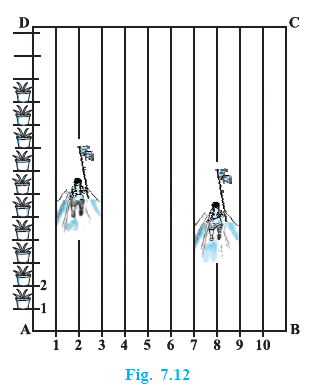
To conduct Sports Day activities, in your rectangular shaped school ground ABCD, lines have been drawn with chalk powder at a distance of 1m each. 100 flower pots have been placed at a distance of 1m from each other along AD, as shown in Fig. 7.12. Niharika runs $\frac{1}{4}$th the distance AD on the 2nd line and posts a green flag. Preet runs $\frac{1}{5}$th the distance AD on the eighth line and posts a red flag. What is the distance between both the flags? If Rashmi has to post a blue flag exactly halfway between the line segment joining the two flags, where should she post her flag?
Worksheet Answers
Solution:
Given:
Let the two points be $A(-3, 10)$ and $B(6, -8)$. Let the point that divides the line segment $AB$ be $P(-1, 6)$.
To Find:
The ratio $m_1 : m_2$ in which the point $P$ divides the line segment $AB$.
Step 1: Applying the Section Formula
The Section Formula states that if a point $P(x, y)$ divides the line segment joining $A(x_1, y_1)$ and $B(x_2, y_2)$ in the ratio $m_1 : m_2$, then the coordinates of $P$ are given by:
$x = \frac{m_1x_2 + m_2x_1}{m_1 + m_2}$ and $y = \frac{m_1y_2 + m_2y_1}{m_1 + m_2}$
Let the ratio be $k : 1$. Thus, $m_1 = k$ and $m_2 = 1$.
Step 2: Substituting the Given Values
Here, $(x_1, y_1) = (-3, 10)$, $(x_2, y_2) = (6, -8)$, and $(x, y) = (-1, 6)$.
Using the x-coordinate formula:
$-1 = \frac{k(6) + 1(-3)}{k + 1}$
Step 3: Solving for k
Multiply both sides by $(k + 1)$:
$-1(k + 1) = 6k - 3$
Expand the left side:
$-k - 1 = 6k - 3$
Rearrange the terms to isolate $k$:
$-1 + 3 = 6k + k$
$2 = 7k$
$k = \frac{2}{7}$
Step 4: Verification using the y-coordinate
To ensure consistency, we check the y-coordinate using $k = \frac{2}{7}$:
$y = \frac{k(y_2) + 1(y_1)}{k + 1} = \frac{\frac{2}{7}(-8) + 1(10)}{\frac{2}{7} + 1}$
$y = \frac{-\frac{16}{7} + 10}{\frac{2+7}{7}} = \frac{\frac{-16 + 70}{7}}{\frac{9}{7}}$
$y = \frac{54}{7} \times \frac{7}{9} = \frac{54}{9} = 6$
Since the calculated y-coordinate matches the given y-coordinate of point $P$, the ratio is correct.
Final Answer: The point (-1, 6) divides the line segment joining (-3, 10) and (6, -8) in the ratio 2 : 7.
Solution:
Given:
1. The school ground is rectangular, represented by a coordinate plane where the x-axis represents the lines (1 to 10) and the y-axis represents the distance along AD (in meters).
2. Total distance along AD = $100$ meters (since there are 100 flower pots placed 1m apart).
3. Niharika runs on the 2nd line ($x_1 = 2$) and covers $\frac{1}{4}$ of the distance AD.
4. Preet runs on the 8th line ($x_2 = 8$) and covers $\frac{1}{5}$ of the distance AD.
To Find:
1. The distance between the green flag (Niharika) and the red flag (Preet).
2. The coordinates where Rashmi should post her blue flag (the midpoint of the two flags).
Step 1: Determine the coordinates of the flags.
Let the position of the green flag be $G(x_1, y_1)$.
$x_1 = 2$
$y_1 = \frac{1}{4} \times 100 = 25$
So, $G = (2, 25)$.
Let the position of the red flag be $R(x_2, y_2)$.
$x_2 = 8$
$y_2 = \frac{1}{5} \times 100 = 20$
So, $R = (8, 20)$.
Step 2: Calculate the distance between the two flags.
Using the Distance Formula: $d = \sqrt{(x_2 - x_1)^2 + (y_2 - y_1)^2}$
$d = \sqrt{(8 - 2)^2 + (20 - 25)^2}$
$d = \sqrt{(6)^2 + (-5)^2}$
$d = \sqrt{36 + 25}$
$d = \sqrt{61}$
$d \approx 7.81$ meters.
Step 3: Determine the position of the blue flag.
The blue flag is at the midpoint $M(x, y)$ of the line segment joining $G(2, 25)$ and $R(8, 20)$.
Using the Midpoint Formula: $M = \left( \frac{x_1 + x_2}{2}, \frac{y_1 + y_2}{2} \right)$
$x = \frac{2 + 8}{2} = \frac{10}{2} = 5$
$y = \frac{25 + 20}{2} = \frac{45}{2} = 22.5$
Therefore, the blue flag should be posted on the 5th line at a distance of 22.5 meters from AD.
Final Answer: The distance between the two flags is $\sqrt{61}$ m (approx 7.81 m). Rashmi should post her blue flag at the coordinates (5, 22.5).
Solution:
Given:
The coordinates of the endpoints of the line segment are $A(x_1, y_1) = (1, -5)$ and $B(x_2, y_2) = (-4, 5)$.
The line segment $AB$ is divided by the $x$-axis.
To Find:
1. The ratio ($k:1$) in which the $x$-axis divides the line segment $AB$.
2. The coordinates of the point of division ($P$).
Step 1: Defining the Point of Division
Let the point $P$ on the $x$-axis divide the line segment $AB$ in the ratio $k:1$.
Since the point $P$ lies on the $x$-axis, its $y$-coordinate must be $0$. Therefore, the coordinates of $P$ are $(x, 0)$.
Step 2: Applying the Section Formula
The Section Formula states that if a point $P(x, y)$ divides the line segment joining $A(x_1, y_1)$ and $B(x_2, y_2)$ in the ratio $m:n$, then:
$x = \frac{mx_2 + nx_1}{m+n}$ and $y = \frac{my_2 + ny_1}{m+n}$
Substituting our values ($m=k, n=1, x_1=1, y_1=-5, x_2=-4, y_2=5$):
$y = \frac{k(5) + 1(-5)}{k+1}$
Step 3: Solving for the Ratio $k$
Since the point lies on the $x$-axis, $y = 0$.
$0 = \frac{5k - 5}{k+1}$
Multiplying both sides by $(k+1)$ (assuming $k \neq -1$):
$0 = 5k - 5$
$5k = 5$
$k = \frac{5}{5} = 1$
Thus, the ratio $k:1$ is $1:1$.
Step 4: Finding the Coordinates of the Point of Division
Now, substitute $k=1$ into the formula for the $x$-coordinate:
$x = \frac{k(x_2) + 1(x_1)}{k+1}$
$x = \frac{1(-4) + 1(1)}{1+1}$
$x = \frac{-4 + 1}{2}$
$x = \frac{-3}{2} = -1.5$
The coordinates of the point of division $P$ are $(x, y) = \left(-\frac{3}{2}, 0\right)$.
Final Answer: The line segment is divided by the x-axis in the ratio 1:1, and the coordinates of the point of division are (-1.5, 0).
Solution:
Given: A line segment joining the points $A(4, -1)$ and $B(-2, -3)$.
To Find: The coordinates of the two points of trisection of the line segment $AB$.
Step 1: Understanding Trisection
Trisection means dividing the line segment into three equal parts. Let the points of trisection be $P$ and $Q$. Thus, $AP = PQ = QB$.
Point $P$ divides $AB$ in the ratio $1:2$.
Point $Q$ divides $AB$ in the ratio $2:1$.
Step 2: Applying the Section Formula
The section formula states that the coordinates of a point dividing a line segment joining $(x_1, y_1)$ and $(x_2, y_2)$ in the ratio $m:n$ are given by:
$x = \frac{mx_2 + nx_1}{m+n}$, $y = \frac{my_2 + ny_1}{m+n}$
Step 3: Finding Coordinates of Point P
For point $P$, $m=1$ and $n=2$. The coordinates are $(x_1, y_1) = (4, -1)$ and $(x_2, y_2) = (-2, -3)$.
$x_P = \frac{1(-2) + 2(4)}{1+2} = \frac{-2 + 8}{3} = \frac{6}{3} = 2$
$y_P = \frac{1(-3) + 2(-1)}{1+2} = \frac{-3 - 2}{3} = -\frac{5}{3}$
So, $P = (2, -\frac{5}{3})$.
Step 4: Finding Coordinates of Point Q
For point $Q$, $m=2$ and $n=1$. The coordinates are $(x_1, y_1) = (4, -1)$ and $(x_2, y_2) = (-2, -3)$.
$x_Q = \frac{2(-2) + 1(4)}{2+1} = \frac{-4 + 4}{3} = \frac{0}{3} = 0$
$y_Q = \frac{2(-3) + 1(-1)}{2+1} = \frac{-6 - 1}{3} = -\frac{7}{3}$
So, $Q = (0, -\frac{7}{3})$.
Final Answer: The coordinates of the points of trisection are $(2, -\frac{5}{3})$ and $(0, -\frac{7}{3})$.
Solution:
Given: The coordinates of the endpoints of the line segment are $A(-2, 2)$ and $B(2, 8)$.
To Find: The coordinates of the three points $P$, $Q$, and $R$ that divide the line segment $AB$ into four equal parts.
Theoretical Basis: The Section Formula states that the coordinates of a point $P(x, y)$ dividing the line segment joining $A(x_1, y_1)$ and $B(x_2, y_2)$ in the ratio $m:n$ are given by:
$x = \frac{mx_2 + nx_1}{m+n}$, $y = \frac{my_2 + ny_1}{m+n}$
Step 1: Finding point Q (The Midpoint of AB)
Since $Q$ divides $AB$ into four equal parts, $Q$ is the midpoint of $AB$. The ratio is $1:1$.
$x_Q = \frac{-2 + 2}{2} = \frac{0}{2} = 0$
$y_Q = \frac{2 + 8}{2} = \frac{10}{2} = 5$
Thus, $Q = (0, 5)$.
Step 2: Finding point P (The Midpoint of AQ)
Point $P$ is the midpoint of the segment $AQ$, where $A = (-2, 2)$ and $Q = (0, 5)$.
$x_P = \frac{-2 + 0}{2} = \frac{-2}{2} = -1$
$y_P = \frac{2 + 5}{2} = \frac{7}{2} = 3.5$
Thus, $P = (-1, 3.5)$.
Step 3: Finding point R (The Midpoint of QB)
Point $R$ is the midpoint of the segment $QB$, where $Q = (0, 5)$ and $B = (2, 8)$.
$x_R = \frac{0 + 2}{2} = \frac{2}{2} = 1$
$y_R = \frac{5 + 8}{2} = \frac{13}{2} = 6.5$
Thus, $R = (1, 6.5)$.
Conclusion: The points dividing the line segment $AB$ into four equal parts are $P(-1, 3.5)$, $Q(0, 5)$, and $R(1, 6.5)$.
Final Answer: The coordinates of the points are $(-1, 3.5)$, $(0, 5)$, and $(1, 6.5)$.
Solution:
Given:
The coordinates of point $A$ are $(x_1, y_1) = (-2, -2)$.
The coordinates of point $B$ are $(x_2, y_2) = (2, -4)$.
Point $P(x, y)$ lies on the line segment $AB$ such that $AP = \frac{3}{7} AB$.
To find:
The coordinates of point $P(x, y)$.
Step 1: Determining the ratio $AP : PB$
We are given $AP = \frac{3}{7} AB$.
Since $P$ lies on $AB$, we can write $AB = AP + PB$.
Substituting the given relation into the equation:
$AP = \frac{3}{7} (AP + PB)$
$7 AP = 3 AP + 3 PB$ [Multiplying both sides by 7]
$7 AP - 3 AP = 3 PB$ [Transposing $3 AP$ to the left side]
$4 AP = 3 PB$
$\frac{AP}{PB} = \frac{3}{4}$
Thus, point $P$ divides the line segment $AB$ in the ratio $m : n = 3 : 4$.
Step 2: Applying the Section Formula
The Section Formula states that the coordinates of a point $P(x, y)$ dividing the line segment joining $A(x_1, y_1)$ and $B(x_2, y_2)$ in the ratio $m : n$ are given by:
$x = \frac{mx_2 + nx_1}{m + n}$
$y = \frac{my_2 + ny_1}{m + n}$
Step 3: Calculating the x-coordinate
$x = \frac{3(2) + 4(-2)}{3 + 4}$
$x = \frac{6 - 8}{7}$
$x = -\frac{2}{7}$
Step 4: Calculating the y-coordinate
$y = \frac{3(-4) + 4(-2)}{3 + 4}$
$y = \frac{-12 - 8}{7}$
$y = -\frac{20}{7}$
Conclusion:
The coordinates of point $P$ are $(-\frac{2}{7}, -\frac{20}{7})$.
Final Answer: The coordinates of point P are $\left(-\frac{2}{7}, -\frac{20}{7}\right)$.
Solution:
Given:
1. A circle with center $O$ at coordinates $(2, -3)$.
2. $AB$ is the diameter of the circle.
3. The coordinates of point $B$ are $(1, 4)$.
To Find:
The coordinates of point $A$, let us denote them as $(x, y)$.
Step 1: Theoretical Basis
In a circle, the center $O$ is the midpoint of any diameter $AB$. According to the Midpoint Formula, if a line segment has endpoints $(x_1, y_1)$ and $(x_2, y_2)$, the midpoint $(x_m, y_m)$ is given by:
$x_m = \frac{x_1 + x_2}{2}$
$y_m = \frac{y_1 + y_2}{2}$
Step 2: Assigning Variables
Let the coordinates of point $A$ be $(x, y)$.
Let the coordinates of point $B$ be $(x_2, y_2) = (1, 4)$.
Let the coordinates of the center $O$ be $(x_m, y_m) = (2, -3)$.
Step 3: Calculating the x-coordinate of A
Using the midpoint formula for the x-coordinate:
$2 = \frac{x + 1}{2}$
[Multiplying both sides by 2]
$4 = x + 1$
[Subtracting 1 from both sides]
$x = 4 - 1$
$x = 3$
Step 4: Calculating the y-coordinate of A
Using the midpoint formula for the y-coordinate:
$-3 = \frac{y + 4}{2}$
[Multiplying both sides by 2]
$-6 = y + 4$
[Subtracting 4 from both sides]
$y = -6 - 4$
$y = -10$
Final Answer: The coordinates of point A are (3, -10).
Solution:
Given:
The coordinates of two points are $A(x_1, y_1) = (-1, 7)$ and $B(x_2, y_2) = (4, -3)$.
The ratio in which the point divides the line segment $AB$ is $m : n = 2 : 3$.
To Find:
The coordinates of the point $P(x, y)$ that divides the line segment joining $A$ and $B$ in the ratio $2 : 3$.
Step 1: Applying the Section Formula
The Section Formula states that the coordinates of a point $P(x, y)$ dividing the line segment joining points $(x_1, y_1)$ and $(x_2, y_2)$ internally in the ratio $m : n$ are given by:
$x = \frac{mx_2 + nx_1}{m + n}$
$y = \frac{my_2 + ny_1}{m + n}$
Step 2: Identifying the variables
From the given information:
$x_1 = -1, y_1 = 7$
$x_2 = 4, y_2 = -3$
$m = 2, n = 3$
Step 3: Calculating the x-coordinate
Substituting the values into the formula for $x$:
$x = \frac{(2)(4) + (3)(-1)}{2 + 3}$
$x = \frac{8 - 3}{5}$ [Performing multiplication and addition]
$x = \frac{5}{5}$
$x = 1$
Step 4: Calculating the y-coordinate
Substituting the values into the formula for $y$:
$y = \frac{(2)(-3) + (3)(7)}{2 + 3}$
$y = \frac{-6 + 21}{5}$ [Performing multiplication and addition]
$y = \frac{15}{5}$
$y = 3$
Final Answer:
The coordinates of the point which divides the join of (-1, 7) and (4, -3) in the ratio 2 : 3 are (1, 3).
Solution:
Given: The vertices of a parallelogram taken in order are $A(1, 2)$, $B(4, y)$, $C(x, 6)$, and $D(3, 5)$.
To find: The values of $x$ and $y$.
Step 1: Understanding the Property of a Parallelogram
A fundamental property of a parallelogram is that its diagonals bisect each other. This means that the midpoint of diagonal $AC$ is the same as the midpoint of diagonal $BD$.
Step 2: Applying the Midpoint Formula
The midpoint $M$ of a line segment with endpoints $(x_1, y_1)$ and $(x_2, y_2)$ is given by the formula:
$M = \left( \frac{x_1 + x_2}{2}, \frac{y_1 + y_2}{2} \right)$
Step 3: Calculating the Midpoint of Diagonal $AC$
For $A(1, 2)$ and $C(x, 6)$:
Midpoint of $AC = \left( \frac{1 + x}{2}, \frac{2 + 6}{2} \right) = \left( \frac{1 + x}{2}, \frac{8}{2} \right) = \left( \frac{1 + x}{2}, 4 \right)$
Step 4: Calculating the Midpoint of Diagonal $BD$
For $B(4, y)$ and $D(3, 5)$:
Midpoint of $BD = \left( \frac{4 + 3}{2}, \frac{y + 5}{2} \right) = \left( \frac{7}{2}, \frac{y + 5}{2} \right)$
Step 5: Equating the Midpoints
Since the diagonals bisect each other, the midpoints must be equal:
$\left( \frac{1 + x}{2}, 4 \right) = \left( \frac{7}{2}, \frac{y + 5}{2} \right)$
Step 6: Solving for $x$
Equating the x-coordinates:
$\frac{1 + x}{2} = \frac{7}{2}$
Multiplying both sides by $2$:
$1 + x = 7$
$x = 7 - 1$
$x = 6$
Step 7: Solving for $y$
Equating the y-coordinates:
$4 = \frac{y + 5}{2}$
Multiplying both sides by $2$:
$8 = y + 5$
$y = 8 - 5$
$y = 3$
Final Answer: $x = 6$ and $y = 3$
Solution:
Given: The vertices of a rhombus taken in order are $A(3, 0)$, $B(4, 5)$, $C(-1, 4)$, and $D(-2, -1)$.
To Find: The area of the rhombus $ABCD$.
Formula Used: The distance $d$ between two points $(x_1, y_1)$ and $(x_2, y_2)$ is given by the Distance Formula: $d = \sqrt{(x_2 - x_1)^2 + (y_2 - y_1)^2}$. The area of a rhombus is given by $\text{Area} = \frac{1}{2} \times d_1 \times d_2$, where $d_1$ and $d_2$ are the lengths of the diagonals.
Step 1: Calculate the length of diagonal $AC$ ($d_1$).
The vertices are $A(3, 0)$ and $C(-1, 4)$.
$d_1 = \sqrt{(-1 - 3)^2 + (4 - 0)^2}$ [Substituting coordinates into the distance formula]
$d_1 = \sqrt{(-4)^2 + (4)^2}$
$d_1 = \sqrt{16 + 16}$
$d_1 = \sqrt{32} = 4\sqrt{2}$ units.
Step 2: Calculate the length of diagonal $BD$ ($d_2$).
The vertices are $B(4, 5)$ and $D(-2, -1)$.
$d_2 = \sqrt{(-2 - 4)^2 + (-1 - 5)^2}$ [Substituting coordinates into the distance formula]
$d_2 = \sqrt{(-6)^2 + (-6)^2}$
$d_2 = \sqrt{36 + 36}$
$d_2 = \sqrt{72} = 6\sqrt{2}$ units.
Step 3: Calculate the area of the rhombus.
$\text{Area} = \frac{1}{2} \times d_1 \times d_2$
$\text{Area} = \frac{1}{2} \times (4\sqrt{2}) \times (6\sqrt{2})$ [Substituting the values of $d_1$ and $d_2$]
$\text{Area} = \frac{1}{2} \times 24 \times (\sqrt{2} \times \sqrt{2})$
$\text{Area} = \frac{1}{2} \times 24 \times 2$
$\text{Area} = 24$ square units.
Final Answer: The area of the rhombus is 24 square units.


