


Your Worksheet is Ready
CBSE - Class 10 Mathematics Coordinate geometry Worksheet
EXERCISE 7.1
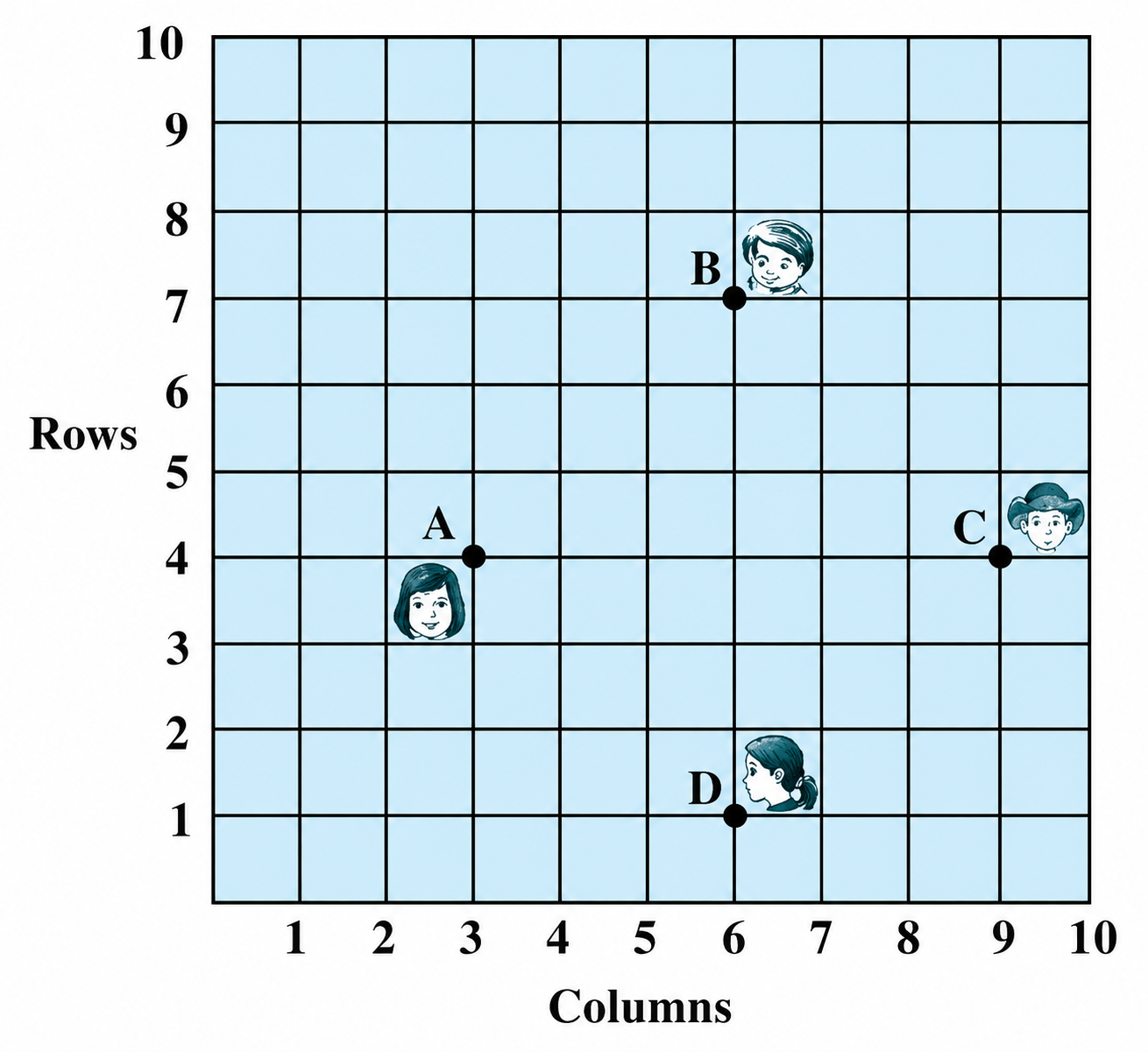
In a classroom, 4 friends are seated at the points A, B, C and D as shown in Fig. 7.8. Champa and Chameli walk into the class and after observing for a few minutes Champa asks Chameli, “Don’t you think ABCD is a square?” Chameli disagrees. Using distance formula, find which of them is correct.

Find the distance between the points (0, 0) and (36, 15). Can you now find the distance between the two towns A and B.
Worksheet Answers
Solution:
Given: The positions of four friends seated in a classroom are represented by coordinates on a Cartesian plane. Based on the provided figure, the coordinates are:
$A = (3, 4)$
$B = (6, 7)$
$C = (9, 4)$
$D = (6, 1)$
To Find: Determine whether the quadrilateral $ABCD$ is a square by calculating the lengths of its sides and diagonals using the distance formula.
Visual Representation:
Step 1: The Distance Formula
The distance $d$ between two points $(x_1, y_1)$ and $(x_2, y_2)$ is given by:
$d = \sqrt{(x_2 - x_1)^2 + (y_2 - y_1)^2}$
Step 2: Calculating Side Lengths
We calculate the lengths of the four sides $AB, BC, CD,$ and $DA$.
Length of $AB = \sqrt{(6 - 3)^2 + (7 - 4)^2} = \sqrt{(3)^2 + (3)^2} = \sqrt{9 + 9} = \sqrt{18} = 3\sqrt{2}$ units.
Length of $BC = \sqrt{(9 - 6)^2 + (4 - 7)^2} = \sqrt{(3)^2 + (-3)^2} = \sqrt{9 + 9} = \sqrt{18} = 3\sqrt{2}$ units.
Length of $CD = \sqrt{(6 - 9)^2 + (1 - 4)^2} = \sqrt{(-3)^2 + (-3)^2} = \sqrt{9 + 9} = \sqrt{18} = 3\sqrt{2}$ units.
Length of $DA = \sqrt{(3 - 6)^2 + (4 - 1)^2} = \sqrt{(-3)^2 + (3)^2} = \sqrt{9 + 9} = \sqrt{18} = 3\sqrt{2}$ units.
[Since all sides are equal ($AB = BC = CD = DA = 3\sqrt{2}$), the quadrilateral is at least a rhombus.]
Step 3: Calculating Diagonal Lengths
For a rhombus to be a square, its diagonals must also be equal in length.
Length of diagonal $AC = \sqrt{(9 - 3)^2 + (4 - 4)^2} = \sqrt{(6)^2 + (0)^2} = \sqrt{36} = 6$ units.
Length of diagonal $BD = \sqrt{(6 - 6)^2 + (1 - 7)^2} = \sqrt{(0)^2 + (-6)^2} = \sqrt{36} = 6$ units.
Step 4: Conclusion
Since all four sides are equal ($3\sqrt{2}$ units) and both diagonals are equal ($6$ units), the quadrilateral $ABCD$ satisfies the geometric properties of a square.
Final Answer: Champa is correct; ABCD is a square.
Solution:
Given:
Point $Q(0, 1)$ is equidistant from points $P(5, -3)$ and $R(x, 6)$.
To find:
1. The value(s) of $x$.
2. The distance $QR$.
3. The distance $PR$.
Step 1: Applying the Distance Formula
The distance $d$ between two points $(x_1, y_1)$ and $(x_2, y_2)$ is given by the formula:
$d = \sqrt{(x_2 - x_1)^2 + (y_2 - y_1)^2}$
Since $Q$ is equidistant from $P$ and $R$, we have $QP = QR$. Therefore, $QP^2 = QR^2$.
Step 2: Calculating $QP^2$
For $Q(0, 1)$ and $P(5, -3)$:
$QP^2 = (5 - 0)^2 + (-3 - 1)^2$
$QP^2 = (5)^2 + (-4)^2$
$QP^2 = 25 + 16 = 41$
Step 3: Calculating $QR^2$ and solving for $x$
For $Q(0, 1)$ and $R(x, 6)$:
$QR^2 = (x - 0)^2 + (6 - 1)^2$
$QR^2 = x^2 + (5)^2$
$QR^2 = x^2 + 25$
Equating $QP^2 = QR^2$:
$41 = x^2 + 25$
$x^2 = 41 - 25$
$x^2 = 16$
$x = \pm \sqrt{16} = \pm 4$
Thus, the possible coordinates for $R$ are $(4, 6)$ or $(-4, 6)$.
Step 4: Finding the distance $QR$
Since $QP = QR$ and $QP^2 = 41$, then $QR = \sqrt{41}$.
Step 5: Finding the distance $PR$
Case 1: If $R = (4, 6)$ and $P = (5, -3)$:
$PR = \sqrt{(4 - 5)^2 + (6 - (-3))^2}$
$PR = \sqrt{(-1)^2 + (9)^2} = \sqrt{1 + 81} = \sqrt{82}$
Case 2: If $R = (-4, 6)$ and $P = (5, -3)$:
$PR = \sqrt{(-4 - 5)^2 + (6 - (-3))^2}$
$PR = \sqrt{(-9)^2 + (9)^2} = \sqrt{81 + 81} = \sqrt{162} = 9\sqrt{2}$
Final Answer:
The values of $x$ are $4$ or $-4$. The distance $QR = \sqrt{41}$. The distance $PR$ is $\sqrt{82}$ (when $x=4$) or $9\sqrt{2}$ (when $x=-4$).
Solution:
Given:
The coordinates of point $P$ are $(x_1, y_1) = (2, -3)$.
The coordinates of point $Q$ are $(x_2, y_2) = (10, y)$.
The distance between points $P$ and $Q$ is $d = 10$ units.
To find:
The value(s) of $y$.
Step 1: Applying the Distance Formula
The distance $d$ between two points $(x_1, y_1)$ and $(x_2, y_2)$ in a Cartesian plane is given by the formula:
$d = \sqrt{(x_2 - x_1)^2 + (y_2 - y_1)^2}$
[By the Distance Formula in Coordinate Geometry]
Step 2: Substituting the Given Values
Substitute $d = 10$, $x_1 = 2$, $y_1 = -3$, $x_2 = 10$, and $y_2 = y$ into the formula:
$10 = \sqrt{(10 - 2)^2 + (y - (-3))^2}$
$10 = \sqrt{(8)^2 + (y + 3)^2}$
Step 3: Squaring Both Sides to Eliminate the Square Root
To solve for $y$, we square both sides of the equation:
$(10)^2 = (\sqrt{(8)^2 + (y + 3)^2})^2$
$100 = 8^2 + (y + 3)^2$
$100 = 64 + (y + 3)^2$
Step 4: Simplifying the Equation
Subtract 64 from both sides:
$100 - 64 = (y + 3)^2$
$36 = (y + 3)^2$
Step 5: Solving for $y$
Take the square root of both sides, remembering to include both positive and negative roots:
$\pm \sqrt{36} = y + 3$
$\pm 6 = y + 3$
This yields two distinct linear equations:
Case 1: $6 = y + 3$
$y = 6 - 3$
$y = 3$
Case 2: $-6 = y + 3$
$y = -6 - 3$
$y = -9$
Conclusion:
The possible values for $y$ that satisfy the condition are $3$ and $-9$.
Final Answer: The values of $y$ are $3$ and $-9$.
Solution:
Given: Two points in a Cartesian plane, $P(x_1, y_1) = (a, b)$ and $Q(x_2, y_2) = (-a, -b)$.
To find: The distance between the points $P$ and $Q$.
Visual Representation:
Step 1: State the Distance Formula
The distance $d$ between two points $(x_1, y_1)$ and $(x_2, y_2)$ is given by the Euclidean distance formula:
$d = \sqrt{(x_2 - x_1)^2 + (y_2 - y_1)^2}$
[This formula is derived from the Pythagorean Theorem applied to the horizontal and vertical differences between coordinates.]
Step 2: Substitute the given coordinates into the formula
Given $x_1 = a$, $y_1 = b$, $x_2 = -a$, and $y_2 = -b$.
Substituting these values into the distance formula:
$d = \sqrt{(-a - a)^2 + (-b - b)^2}$
Step 3: Simplify the expressions inside the parentheses
Perform the subtraction within the brackets:
$(-a - a) = -2a$
$(-b - b) = -2b$
Therefore:
$d = \sqrt{(-2a)^2 + (-2b)^2}$
Step 4: Evaluate the squares
Recall that $(-x)^2 = x^2$:
$(-2a)^2 = 4a^2$
$(-2b)^2 = 4b^2$
Substituting these back into the equation:
$d = \sqrt{4a^2 + 4b^2}$
Step 5: Factor out the common term and simplify the radical
Factor out $4$ from the terms inside the square root:
$d = \sqrt{4(a^2 + b^2)}$
Using the property of radicals $\sqrt{xy} = \sqrt{x} \cdot \sqrt{y}$:
$d = \sqrt{4} \cdot \sqrt{a^2 + b^2}$
Since $\sqrt{4} = 2$:
$d = 2\sqrt{a^2 + b^2}$
Final Answer: The distance between the points $(a, b)$ and $(-a, -b)$ is $2\sqrt{a^2 + b^2}$ units.
Solution:
Given: Two points in a Cartesian plane, $P(-5, 7)$ and $Q(-1, 3)$.
To find: The distance between points $P$ and $Q$, denoted as $PQ$.
Step 1: Identifying the Distance Formula
To find the distance between two points $(x_1, y_1)$ and $(x_2, y_2)$, we use the Distance Formula derived from the Pythagorean Theorem:
$d = \sqrt{(x_2 - x_1)^2 + (y_2 - y_1)^2}$
Step 2: Assigning Coordinates
Let the coordinates of point $P$ be $(x_1, y_1) = (-5, 7)$.
Let the coordinates of point $Q$ be $(x_2, y_2) = (-1, 3)$.
Step 3: Substituting Values into the Formula
Substitute the values of $x_1, y_1, x_2,$ and $y_2$ into the distance formula:
$PQ = \sqrt{(-1 - (-5))^2 + (3 - 7)^2}$
Step 4: Performing Arithmetic Operations
First, simplify the expressions inside the parentheses:
$PQ = \sqrt{(-1 + 5)^2 + (-4)^2}$ [Since subtracting a negative is equivalent to addition]
$PQ = \sqrt{(4)^2 + (-4)^2}$
Step 5: Calculating Squares
Calculate the squares of the numbers:
$PQ = \sqrt{16 + 16}$ [Since $4^2 = 16$ and $(-4)^2 = 16$]
$PQ = \sqrt{32}$
Step 6: Simplifying the Radical
Express $\sqrt{32}$ in its simplest form by finding the prime factors:
$32 = 16 \times 2$
$PQ = \sqrt{16 \times 2}$
$PQ = 4\sqrt{2}$ [Taking the square root of 16]
Final Answer: The distance between the points (-5, 7) and (-1, 3) is $4\sqrt{2}$ units.
Solution:
Given: The coordinates of four points in a Cartesian plane: $A(-3, 5)$, $B(3, 1)$, $C(0, 3)$, and $D(-1, -4)$.
To Find: The type of quadrilateral formed by these points, if any, and the justification for the classification.
Step 1: Distance Formula Application
To determine the nature of the quadrilateral, we calculate the lengths of the four sides ($AB, BC, CD, DA$) and the two diagonals ($AC, BD$) using the distance formula: $d = \sqrt{(x_2 - x_1)^2 + (y_2 - y_1)^2}$.
Step 2: Calculating Side Lengths
For $A(-3, 5)$ and $B(3, 1)$:
$AB = \sqrt{(3 - (-3))^2 + (1 - 5)^2} = \sqrt{(6)^2 + (-4)^2} = \sqrt{36 + 16} = \sqrt{52} = 2\sqrt{13}$ units.
For $B(3, 1)$ and $C(0, 3)$:
$BC = \sqrt{(0 - 3)^2 + (3 - 1)^2} = \sqrt{(-3)^2 + (2)^2} = \sqrt{9 + 4} = \sqrt{13}$ units.
For $C(0, 3)$ and $D(-1, -4)$:
$CD = \sqrt{(-1 - 0)^2 + (-4 - 3)^2} = \sqrt{(-1)^2 + (-7)^2} = \sqrt{1 + 49} = \sqrt{50} = 5\sqrt{2}$ units.
For $D(-1, -4)$ and $A(-3, 5)$:
$DA = \sqrt{(-3 - (-1))^2 + (5 - (-4))^2} = \sqrt{(-2)^2 + (9)^2} = \sqrt{4 + 81} = \sqrt{85}$ units.
Step 3: Analyzing Collinearity
Let us check if the points are collinear or if they form a simple polygon. We observe the slopes of the segments to see if any three points lie on the same line. The slope formula is $m = \frac{y_2 - y_1}{x_2 - x_1}$.
Slope of $AC = \frac{3 - 5}{0 - (-3)} = \frac{-2}{3}$.
Slope of $CB = \frac{1 - 3}{3 - 0} = \frac{-2}{3}$.
[Since the slope of $AC$ is equal to the slope of $CB$ and they share a common point $C$, the points $A, C,$ and $B$ are collinear.]
Step 4: Conclusion
Because points $A, C,$ and $B$ lie on the same straight line, they do not form a quadrilateral. A quadrilateral requires four non-collinear points where no three points are collinear.
Final Answer: The points A, B, C, and D do not form a quadrilateral because the points A, C, and B are collinear.
Solution:
Given: The coordinates of the four points are $A(4, 5)$, $B(7, 6)$, $C(4, 3)$, and $D(1, 2)$.
To Find: The type of quadrilateral formed by these points, if any, and the reasons for the classification.
Step 1: Formula Definition
To determine the nature of the quadrilateral, we use the Distance Formula to find the lengths of the four sides ($AB, BC, CD, DA$) and the two diagonals ($AC, BD$).
The Distance Formula between two points $(x_1, y_1)$ and $(x_2, y_2)$ is given by:
$d = \sqrt{(x_2 - x_1)^2 + (y_2 - y_1)^2}$
Step 2: Calculating Side Lengths
- Length of AB: $\sqrt{(7 - 4)^2 + (6 - 5)^2} = \sqrt{3^2 + 1^2} = \sqrt{9 + 1} = \sqrt{10}$ units.
- Length of BC: $\sqrt{(4 - 7)^2 + (3 - 6)^2} = \sqrt{(-3)^2 + (-3)^2} = \sqrt{9 + 9} = \sqrt{18} = 3\sqrt{2}$ units.
- Length of CD: $\sqrt{(1 - 4)^2 + (2 - 3)^2} = \sqrt{(-3)^2 + (-1)^2} = \sqrt{9 + 1} = \sqrt{10}$ units.
- Length of DA: $\sqrt{(4 - 1)^2 + (5 - 2)^2} = \sqrt{3^2 + 3^2} = \sqrt{9 + 9} = \sqrt{18} = 3\sqrt{2}$ units.
Step 3: Calculating Diagonal Lengths
- Length of AC: $\sqrt{(4 - 4)^2 + (3 - 5)^2} = \sqrt{0^2 + (-2)^2} = \sqrt{4} = 2$ units.
- Length of BD: $\sqrt{(1 - 7)^2 + (2 - 6)^2} = \sqrt{(-6)^2 + (-4)^2} = \sqrt{36 + 16} = \sqrt{52} = 2\sqrt{13}$ units.
Step 4: Analysis and Conclusion
From the calculations:
1. Opposite sides are equal: $AB = CD = \sqrt{10}$ and $BC = DA = 3\sqrt{2}$.
2. Diagonals are unequal: $AC = 2$ and $BD = \sqrt{52}$.
Since the opposite sides are equal and the diagonals are not equal, the quadrilateral satisfies the properties of a parallelogram.
Final Answer: The points form a parallelogram.
Solution:
Given: Two points $A(2, -5)$ and $B(-2, 9)$. A point $P$ lies on the $x$-axis such that it is equidistant from $A$ and $B$.
To Find: The coordinates of point $P$.
Step 1: Defining the coordinates of point P
Since point $P$ lies on the $x$-axis, its $y$-coordinate must be $0$. Let the coordinates of point $P$ be $(x, 0)$.
Step 2: Applying the Distance Formula
The distance $d$ between two points $(x_1, y_1)$ and $(x_2, y_2)$ is given by the formula:
$d = \sqrt{(x_2 - x_1)^2 + (y_2 - y_1)^2}$
Step 3: Setting up the Equidistance Equation
Since $P$ is equidistant from $A(2, -5)$ and $B(-2, 9)$, we have $PA = PB$.
Therefore, $PA^2 = PB^2$ [Squaring both sides to eliminate the square root].
Step 4: Calculating the squared distances
For $PA^2$:
$PA^2 = (x - 2)^2 + (0 - (-5))^2$
$PA^2 = (x - 2)^2 + (5)^2$
$PA^2 = x^2 - 4x + 4 + 25$
$PA^2 = x^2 - 4x + 29$
For $PB^2$:
$PB^2 = (x - (-2))^2 + (0 - 9)^2$
$PB^2 = (x + 2)^2 + (-9)^2$
$PB^2 = x^2 + 4x + 4 + 81$
$PB^2 = x^2 + 4x + 85$
Step 5: Solving for x
Equating $PA^2 = PB^2$:
$x^2 - 4x + 29 = x^2 + 4x + 85$
Subtract $x^2$ from both sides:
$-4x + 29 = 4x + 85$
Subtract $4x$ from both sides:
$-8x + 29 = 85$
Subtract $29$ from both sides:
$-8x = 85 - 29$
$-8x = 56$
Divide by $-8$:
$x = \frac{56}{-8}$
$x = -7$
Final Answer: The point on the x-axis equidistant from (2, –5) and (–2, 9) is (-7, 0).
Solution:
Given: Three points in a Cartesian plane: $A(5, -2)$, $B(6, 4)$, and $C(7, -2)$.
To Find: Determine whether the triangle formed by these vertices is an isosceles triangle.
Definition: An isosceles triangle is a triangle in which at least two sides are equal in length.
Formula: The distance $d$ between two points $(x_1, y_1)$ and $(x_2, y_2)$ is given by the Distance Formula:
$d = \sqrt{(x_2 - x_1)^2 + (y_2 - y_1)^2}$
Step 1: Calculate the length of side $AB$
Let $A = (5, -2)$ and $B = (6, 4)$.
$AB = \sqrt{(6 - 5)^2 + (4 - (-2))^2}$
$AB = \sqrt{(1)^2 + (4 + 2)^2}$
$AB = \sqrt{1^2 + 6^2}$
$AB = \sqrt{1 + 36}$
$AB = \sqrt{37}$ units
Step 2: Calculate the length of side $BC$
Let $B = (6, 4)$ and $C = (7, -2)$.
$BC = \sqrt{(7 - 6)^2 + (-2 - 4)^2}$
$BC = \sqrt{(1)^2 + (-6)^2}$
$BC = \sqrt{1 + 36}$
$BC = \sqrt{37}$ units
Step 3: Calculate the length of side $AC$
Let $A = (5, -2)$ and $C = (7, -2)$.
$AC = \sqrt{(7 - 5)^2 + (-2 - (-2))^2}$
$AC = \sqrt{(2)^2 + (-2 + 2)^2}$
$AC = \sqrt{2^2 + 0^2}$
$AC = \sqrt{4}$
$AC = 2$ units
Step 4: Comparison and Conclusion
We have found the lengths of the sides to be:
$AB = \sqrt{37}$
$BC = \sqrt{37}$
$AC = 2$
[Since $AB = BC = \sqrt{37}$, two sides of the triangle are equal in length.]
Final Answer: Yes, the points (5, – 2), (6, 4) and (7, – 2) are the vertices of an isosceles triangle because two of its sides are equal in length.
Solution:
Given: A point $P(x, y)$ is equidistant from point $A(3, 6)$ and point $B(-3, 4)$.
To Find: A relation between $x$ and $y$.
Step 1: Understanding the Condition of Equidistance
Since point $P(x, y)$ is equidistant from $A(3, 6)$ and $B(-3, 4)$, the distance $PA$ must be equal to the distance $PB$. Mathematically, $PA = PB$, which implies $PA^2 = PB^2$.
Step 2: Applying the Distance Formula
The distance formula between two points $(x_1, y_1)$ and $(x_2, y_2)$ is given by:
$d = \sqrt{(x_2 - x_1)^2 + (y_2 - y_1)^2}$
Therefore, the square of the distance is:
$d^2 = (x_2 - x_1)^2 + (y_2 - y_1)^2$
Step 3: Setting up the Equation
For $PA^2$:
$PA^2 = (x - 3)^2 + (y - 6)^2$
For $PB^2$:
$PB^2 = (x - (-3))^2 + (y - 4)^2 = (x + 3)^2 + (y - 4)^2$
Step 4: Expanding the Algebraic Expressions
Using the identity $(a - b)^2 = a^2 - 2ab + b^2$ and $(a + b)^2 = a^2 + 2ab + b^2$:
$PA^2 = (x^2 - 6x + 9) + (y^2 - 12y + 36)$
$PB^2 = (x^2 + 6x + 9) + (y^2 - 8y + 16)$
Step 5: Equating and Simplifying
Since $PA^2 = PB^2$:
$x^2 - 6x + 9 + y^2 - 12y + 36 = x^2 + 6x + 9 + y^2 - 8y + 16$
Subtract $x^2$ and $y^2$ from both sides:
$-6x - 12y + 45 = 6x - 8y + 25$
Rearrange the terms to one side:
$-6x - 6x - 12y + 8y + 45 - 25 = 0$
$-12x - 4y + 20 = 0$
Step 6: Final Simplification
Divide the entire equation by $-4$ to simplify:
$3x + y - 5 = 0$
Or, $3x + y = 5$.
Final Answer: 3x + y = 5
Solution:
Given: Three points in a Cartesian plane: $A(1, 5)$, $B(2, 3)$, and $C(-2, -11)$.
To Find: Determine whether the points $A$, $B$, and $C$ are collinear.
Conceptual Framework: Three points are said to be collinear if they lie on the same straight line. For three points $A$, $B$, and $C$, they are collinear if and only if the sum of the lengths of two smaller segments equals the length of the longest segment (e.g., $AB + BC = AC$, or any permutation thereof).
Formula Used: The distance $d$ between two points $(x_1, y_1)$ and $(x_2, y_2)$ is given by the Distance Formula:
$d = \sqrt{(x_2 - x_1)^2 + (y_2 - y_1)^2}$
Step 1: Calculate the distance between points $A(1, 5)$ and $B(2, 3)$
Let $(x_1, y_1) = (1, 5)$ and $(x_2, y_2) = (2, 3)$.
$AB = \sqrt{(2 - 1)^2 + (3 - 5)^2}$
$AB = \sqrt{(1)^2 + (-2)^2}$
$AB = \sqrt{1 + 4}$
$AB = \sqrt{5}$ units
Step 2: Calculate the distance between points $B(2, 3)$ and $C(-2, -11)$
Let $(x_1, y_1) = (2, 3)$ and $(x_2, y_2) = (-2, -11)$.
$BC = \sqrt{(-2 - 2)^2 + (-11 - 3)^2}$
$BC = \sqrt{(-4)^2 + (-14)^2}$
$BC = \sqrt{16 + 196}$
$BC = \sqrt{212}$
$BC = \sqrt{4 \times 53} = 2\sqrt{53}$ units
Step 3: Calculate the distance between points $A(1, 5)$ and $C(-2, -11)$
Let $(x_1, y_1) = (1, 5)$ and $(x_2, y_2) = (-2, -11)$.
$AC = \sqrt{(-2 - 1)^2 + (-11 - 5)^2}$
$AC = \sqrt{(-3)^2 + (-16)^2}$
$AC = \sqrt{9 + 256}$
$AC = \sqrt{265}$ units
Step 4: Verify the Collinearity Condition
We check if the sum of any two distances equals the third:
$AB + BC = \sqrt{5} + 2\sqrt{53} \approx 2.236 + 14.56 = 16.796$
$AC = \sqrt{265} \approx 16.279$
Since $AB + BC \neq AC$, $AB + AC \neq BC$, and $BC + AC \neq AB$, the condition for collinearity is not satisfied.
Final Answer: The points $(1, 5)$, $(2, 3)$, and $(-2, -11)$ are not collinear.
Solution:
Given: The coordinates of the four points forming a quadrilateral are $A(-1, -2)$, $B(1, 0)$, $C(-1, 2)$, and $D(-3, 0)$.
To Find: The type of quadrilateral formed by these points, with supporting reasons.
Step 1: Distance Formula Application
To determine the type of quadrilateral, we calculate the lengths of the four sides ($AB, BC, CD, DA$) and the two diagonals ($AC, BD$) using the distance formula: $d = \sqrt{(x_2 - x_1)^2 + (y_2 - y_1)^2}$.
Step 2: Calculating Side Lengths
For $A(-1, -2)$ and $B(1, 0)$:
$AB = \sqrt{(1 - (-1))^2 + (0 - (-2))^2} = \sqrt{(2)^2 + (2)^2} = \sqrt{4 + 4} = \sqrt{8} = 2\sqrt{2}$ units.
For $B(1, 0)$ and $C(-1, 2)$:
$BC = \sqrt{(-1 - 1)^2 + (2 - 0)^2} = \sqrt{(-2)^2 + (2)^2} = \sqrt{4 + 4} = \sqrt{8} = 2\sqrt{2}$ units.
For $C(-1, 2)$ and $D(-3, 0)$:
$CD = \sqrt{(-3 - (-1))^2 + (0 - 2)^2} = \sqrt{(-2)^2 + (-2)^2} = \sqrt{4 + 4} = \sqrt{8} = 2\sqrt{2}$ units.
For $D(-3, 0)$ and $A(-1, -2)$:
$DA = \sqrt{(-1 - (-3))^2 + (-2 - 0)^2} = \sqrt{(2)^2 + (-2)^2} = \sqrt{4 + 4} = \sqrt{8} = 2\sqrt{2}$ units.
Step 3: Calculating Diagonal Lengths
For $A(-1, -2)$ and $C(-1, 2)$:
$AC = \sqrt{(-1 - (-1))^2 + (2 - (-2))^2} = \sqrt{0^2 + 4^2} = \sqrt{16} = 4$ units.
For $B(1, 0)$ and $D(-3, 0)$:
$BD = \sqrt{(-3 - 1)^2 + (0 - 0)^2} = \sqrt{(-4)^2 + 0^2} = \sqrt{16} = 4$ units.
Step 4: Conclusion based on Properties
Since all four sides are equal ($AB = BC = CD = DA = 2\sqrt{2}$) and both diagonals are equal ($AC = BD = 4$), the quadrilateral satisfies the necessary and sufficient conditions for a square.
Final Answer: The quadrilateral formed is a square.
Solution:
Given: Two points in a Cartesian plane, $P(x_1, y_1) = (0, 0)$ and $Q(x_2, y_2) = (36, 15)$.
To Find: The distance between points $P$ and $Q$, and subsequently, the distance between two towns $A$ and $B$ represented by these coordinates.
Step 1: State the Distance Formula
The distance $d$ between any two points $(x_1, y_1)$ and $(x_2, y_2)$ in a coordinate plane is given by the Euclidean distance formula:
$d = \sqrt{(x_2 - x_1)^2 + (y_2 - y_1)^2}$
[This formula is derived from the Pythagorean Theorem applied to the right-angled triangle formed by the horizontal and vertical differences of the coordinates.]
Step 2: Substitute the Given Values
Assign the coordinates:
$x_1 = 0, y_1 = 0$
$x_2 = 36, y_2 = 15$
Substituting these into the formula:
$d = \sqrt{(36 - 0)^2 + (15 - 0)^2}$
Step 3: Perform Algebraic Simplification
Calculate the squares of the differences:
$d = \sqrt{(36)^2 + (15)^2}$
Calculate $36^2$: $36 \times 36 = 1296$
Calculate $15^2$: $15 \times 15 = 225$
Sum the squares:
$d = \sqrt{1296 + 225}$
$d = \sqrt{1521}$
Step 4: Extract the Square Root
To find $\sqrt{1521}$, we look for a number which, when multiplied by itself, equals $1521$.
Since $30^2 = 900$ and $40^2 = 1600$, the value must be between 30 and 40.
Testing $39$: $39 \times 39 = 1521$.
$d = 39$
Step 5: Application to Towns A and B
If town $A$ is located at $(0, 0)$ and town $B$ is located at $(36, 15)$, the distance between them is equivalent to the distance calculated between points $P$ and $Q$.
Therefore, the distance between town $A$ and town $B$ is $39$ units.
Final Answer: The distance between the points (0, 0) and (36, 15) is 39 units. Consequently, the distance between town A and town B is 39 units.
Solution:
Given: Two points in a Cartesian plane, $P(x_1, y_1) = (2, 3)$ and $Q(x_2, y_2) = (4, 1)$.
To find: The distance between the points $P$ and $Q$, denoted as $d(P, Q)$.
Step 1: State the Distance Formula
The distance $d$ between two points $(x_1, y_1)$ and $(x_2, y_2)$ in a coordinate plane is given by the Euclidean distance formula derived from the Pythagorean Theorem:
$d = \sqrt{(x_2 - x_1)^2 + (y_2 - y_1)^2}$
Step 2: Identify the coordinates
From the given points:
$x_1 = 2, y_1 = 3$
$x_2 = 4, y_2 = 1$
Step 3: Substitute the values into the formula
$d = \sqrt{(4 - 2)^2 + (1 - 3)^2}$
Step 4: Perform the arithmetic operations inside the parentheses
$d = \sqrt{(2)^2 + (-2)^2}$
Step 5: Calculate the squares
Since $(2)^2 = 4$ and $(-2)^2 = 4$ [Because the square of any real number is non-negative]:
$d = \sqrt{4 + 4}$
Step 6: Simplify the expression
$d = \sqrt{8}$
Step 7: Express in simplest radical form
$d = \sqrt{4 \times 2}$
$d = 2\sqrt{2}$
Final Answer: The distance between the points (2, 3) and (4, 1) is $2\sqrt{2}$ units.


