


Your Worksheet is Ready
CBSE - Class 10 Mathematics Triangles Worksheet
EXERCISE 6.3
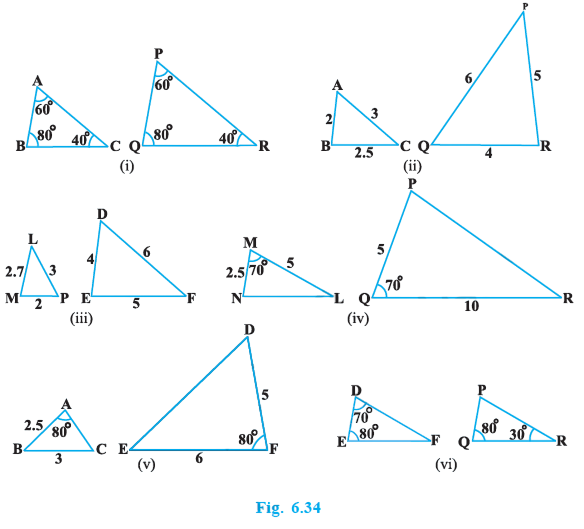
State which pairs of triangles in Fig. 6.34 are similar. Write the similarity criterion used by you for answering the question and also write the pairs of similar triangles in the symbolic form : (ii)
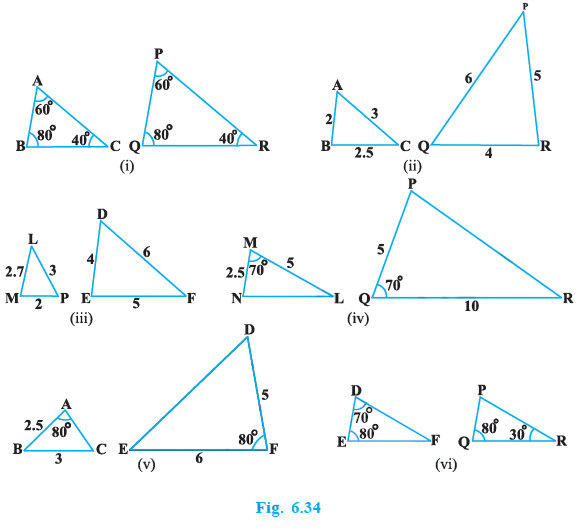
State which pairs of triangles in Fig. 6.34 are similar. Write the similarity criterion used by you for answering the question and also write the pairs of similar triangles in the symbolic form : (iii)
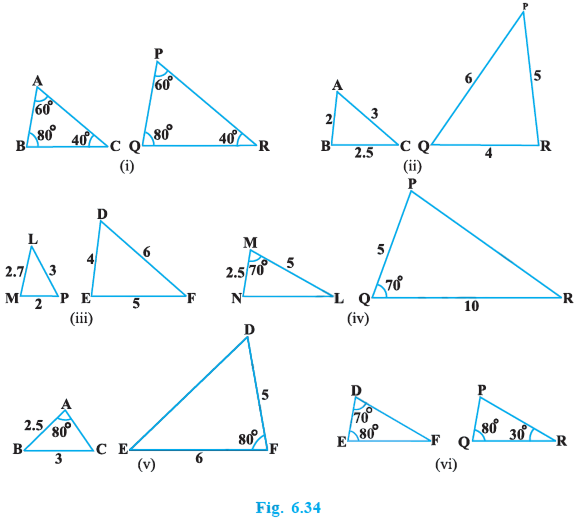
State which pairs of triangles in Fig. 6.34 are similar. Write the similarity criterion used by you for answering the question and also write the pairs of similar triangles in the symbolic form : (i)
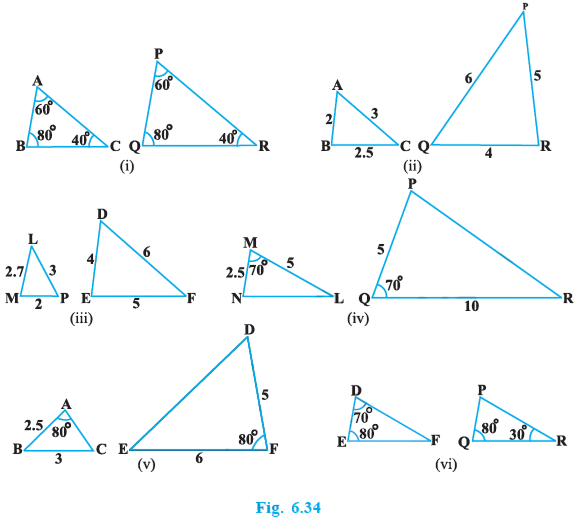
State which pairs of triangles in Fig. 6.34 are similar. Write the similarity criterion used by you for answering the question and also write the pairs of similar triangles in the symbolic form : (iv)
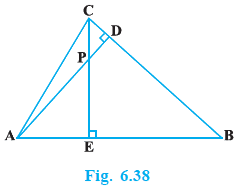
In Fig. 6.38, altitudes $AD$ and $CE$ of $\triangle ABC$ intersect each other at the point $P$. Show that: (i) $\triangle AEP \sim \triangle CDP$
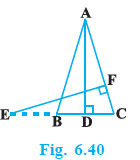
In Fig. 6.40, $E$ is a point on side $CB$ produced of an isosceles triangle $ABC$ with $AB = AC$. If $AD \perp BC$ and $EF \perp AC$, prove that $\triangle ABD \sim \triangle ECF$.
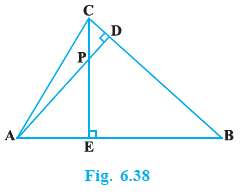
In Fig. 6.38, altitudes $AD$ and $CE$ of $\triangle ABC$ intersect each other at the point $P$. Show that: (ii) $\triangle ABD \sim \triangle CBE$
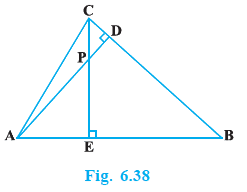
In Fig. 6.38, altitudes $AD$ and $CE$ of $\triangle ABC$ intersect each other at the point $P$. Show that: (iii) $\triangle AEP \sim \triangle ADB$
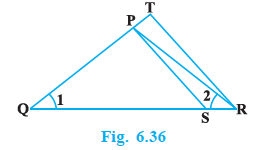
In Fig. 6.36, $\frac{QR}{QS} = \frac{QT}{PR}$ and $\angle 1 = \angle 2$. Show that $\triangle PQS \sim \triangle TQR$.
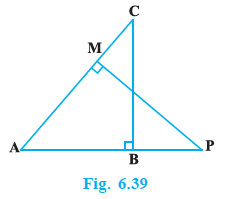
In Fig. 6.39, $ABC$ and $AMP$ are two right triangles, right angled at $B$ and $M$ respectively. Prove that: (i) $\triangle ABC \sim \triangle AMP$
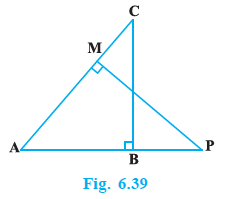
In Fig. 6.39, $ABC$ and $AMP$ are two right triangles, right angled at $B$ and $M$ respectively. Prove that: (ii) $\frac{CA}{PA} = \frac{BC}{MP}$
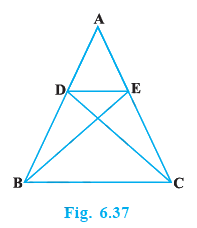
In Fig. 6.37, if $\triangle ABE \cong \triangle ACD$, show that $\triangle ADE \sim \triangle ABC$.
Worksheet Answers
Solution:
Given: In $\triangle ABC$ and $\triangle PQR$, $AD$ and $PM$ are medians to sides $BC$ and $QR$ respectively. The sides are proportional such that:
$\frac{AB}{PQ} = \frac{AC}{PR} = \frac{AD}{PM}$
To Prove: $\triangle ABC \sim \triangle PQR$
Step 1: Construction
Extend $AD$ to a point $E$ such that $AD = DE$. Join $EC$. Similarly, extend $PM$ to a point $N$ such that $PM = MN$. Join $NR$.
Step 2: Proving Quadrilaterals ABEC and PQNR are Parallelograms
In quadrilateral $ABEC$, diagonals $AE$ and $BC$ bisect each other at $D$ (since $AD=DE$ by construction and $BD=DC$ because $AD$ is a median). [Since diagonals bisect each other, the quadrilateral is a parallelogram]. Therefore, $AB = EC$ and $AC = BE$.
Similarly, in quadrilateral $PQNR$, diagonals $PN$ and $QR$ bisect each other at $M$. Therefore, $PQ = NR$ and $PR = QN$.
Step 3: Establishing Similarity of $\triangle ABE$ and $\triangle PQN$
We are given $\frac{AB}{PQ} = \frac{AC}{PR} = \frac{AD}{PM}$.
Substituting $AB=EC$, $AC=BE$, $PQ=NR$, $PR=QN$, and multiplying $AD$ and $PM$ by $2$:
$\frac{AB}{PQ} = \frac{BE}{QN} = \frac{2AD}{2PM} = \frac{AE}{PN}$
Thus, $\frac{AB}{PQ} = \frac{BE}{QN} = \frac{AE}{PN}$. By SSS similarity criterion, $\triangle ABE \sim \triangle PQN$.
Therefore, $\angle BAE = \angle QPN$ (Corresponding parts of similar triangles). [Equation 1]
Step 4: Establishing Similarity of $\triangle ACE$ and $\triangle PRN$
Similarly, we can show $\triangle ACE \sim \triangle PRN$ using the same logic. Thus, $\angle CAE = \angle RPN$. [Equation 2]
Step 5: Final Conclusion
Adding [Equation 1] and [Equation 2]:
$\angle BAE + \angle CAE = \angle QPN + \angle RPN$
$\angle BAC = \angle QPR$
Now, in $\triangle ABC$ and $\triangle PQR$:
$\frac{AB}{PQ} = \frac{AC}{PR}$ (Given)
$\angle BAC = \angle QPR$ (Proved above)
By SAS similarity criterion, $\triangle ABC \sim \triangle PQR$.
Final Answer: $\triangle ABC \sim \triangle PQR$ is proved.
Solution:
Given: A parallelogram $ABCD$ where $E$ is a point on the side $AD$ produced. The line segment $BE$ intersects the side $CD$ at point $F$.
To Prove: $\triangle ABE \sim \triangle CFB$.
Step 1: Identifying the properties of the parallelogram $ABCD$.
In a parallelogram $ABCD$, opposite sides are parallel and opposite angles are equal. Therefore:
$AD \parallel BC$ [Definition of a parallelogram]
Since $E$ lies on the extension of $AD$, it follows that $AE \parallel BC$.
Also, $\angle A = \angle C$ [Opposite angles of a parallelogram are equal].
Step 2: Analyzing $\triangle ABE$ and $\triangle CFB$.
We compare the two triangles based on the Angle-Angle (AA) similarity criterion.
Consider $\angle A$ in $\triangle ABE$ and $\angle BCF$ in $\triangle CFB$.
Since $ABCD$ is a parallelogram, $\angle A = \angle BCD$ [Opposite angles of a parallelogram].
Note that $\angle BCF$ is the same as $\angle BCD$. Thus, $\angle A = \angle BCF$.
Step 3: Establishing the second pair of equal angles.
Consider the parallel lines $AE$ and $BC$ intersected by the transversal $BE$.
$\angle AEB = \angle CBF$ [Alternate interior angles are equal when two parallel lines are intersected by a transversal].
Note that $\angle AEB$ is the same as $\angle AEB$ in $\triangle ABE$, and $\angle CBF$ is the same as $\angle CBF$ in $\triangle CFB$.
Step 4: Applying the AA Similarity Criterion.
In $\triangle ABE$ and $\triangle CFB$:
1. $\angle A = \angle BCF$ [Proved in Step 2]
2. $\angle AEB = \angle CBF$ [Proved in Step 3]
Therefore, by the AA similarity criterion, $\triangle ABE \sim \triangle CFB$.
Final Answer: Since two angles of $\triangle ABE$ are equal to two angles of $\triangle CFB$, the triangles are similar by the AA similarity criterion: $\triangle ABE \sim \triangle CFB$.
Solution:
Given: A triangle $\triangle PQR$ where $S$ is a point on side $PR$ and $T$ is a point on side $QR$. It is given that $\angle P = \angle RTS$.
To Prove: $\triangle RPQ \sim \triangle RTS$.
Step 1: Identifying the triangles to be compared.
We are required to prove the similarity between $\triangle RPQ$ and $\triangle RTS$. Let us examine the vertices of these two triangles:
Step 2: Analyzing the angles of the triangles.
To prove that two triangles are similar, we can use the Angle-Angle (AA) similarity criterion, which states that if two angles of one triangle are respectively equal to two angles of another triangle, then the two triangles are similar.
Consider $\triangle RPQ$ and $\triangle RTS$:
1. In $\triangle RPQ$, we have $\angle R$ (which is $\angle PRQ$).
2. In $\triangle RTS$, we have $\angle R$ (which is $\angle TRS$).
Since both triangles share the same vertex $R$, we can state:
$\angle PRQ = \angle TRS$ [Common angle to both triangles]
Step 3: Utilizing the given information.
It is explicitly given in the problem statement that:
$\angle P = \angle RTS$
In the context of our triangles:
$\angle RPQ = \angle RTS$ [Given]
Step 4: Applying the AA Similarity Criterion.
We have established two correspondences between the angles of $\triangle RPQ$ and $\triangle RTS$:
1. $\angle R = \angle R$ [Common angle]
2. $\angle P = \angle RTS$ [Given]
By the Angle-Angle (AA) similarity criterion, if two angles of one triangle are equal to two angles of another triangle, the triangles are similar.
Therefore, $\triangle RPQ \sim \triangle RTS$.
Final Answer: Since $\angle R = \angle R$ (common) and $\angle P = \angle RTS$ (given), by the AA similarity criterion, $\triangle RPQ \sim \triangle RTS$.
Solution:
Given:
1. A vertical pole $AB$ of length $6\text{ m}$ casts a shadow $BC$ of length $4\text{ m}$ on the ground.
2. A tower $DE$ of unknown height $h$ casts a shadow $EF$ of length $28\text{ m}$ on the ground at the same time.
To Find:
The height of the tower ($DE = h$).
Step 1: Establishing Geometric Similarity
Let $\triangle ABC$ be the triangle formed by the pole and its shadow, and $\triangle DEF$ be the triangle formed by the tower and its shadow.
In $\triangle ABC$ and $\triangle DEF$:
1. $\angle B = \angle E = 90^\circ$ (Since both the pole and the tower are vertical to the ground).
2. $\angle C = \angle F$ (Since the sun's rays fall at the same angle at the same time for both objects).
Therefore, by the AA (Angle-Angle) Similarity Criterion, $\triangle ABC \sim \triangle DEF$.
Step 2: Applying the Property of Similar Triangles
Since the triangles are similar, the ratios of their corresponding sides are equal:
$\frac{AB}{DE} = \frac{BC}{EF}$
Step 3: Substituting Known Values
Given $AB = 6\text{ m}$, $BC = 4\text{ m}$, and $EF = 28\text{ m}$. Let $DE = h$.
$\frac{6}{h} = \frac{4}{28}$
Step 4: Solving for $h$
Simplify the fraction on the right side:
$\frac{4}{28} = \frac{1}{7}$
Now, the equation is:
$\frac{6}{h} = \frac{1}{7}$
By cross-multiplication:
$h \times 1 = 6 \times 7$
$h = 42$
Final Answer: The height of the tower is 42 m.
Solution:
Given: Two triangles, $\triangle ABC$ and $\triangle PQR$.
In $\triangle ABC$: $AB = 2$, $BC = 2.5$, $AC = 3$.
In $\triangle PQR$: $PQ = 4$, $QR = 6$, $PR = 5$.
To Find: Determine if the triangles are similar, state the similarity criterion, and write the symbolic representation.
Step 1: Compare the ratios of corresponding sides.
To check for similarity by the SSS (Side-Side-Side) criterion, we must verify if the ratios of the corresponding sides are equal. We arrange the sides of both triangles in increasing order of length:
Sides of $\triangle ABC$: $AB=2$, $AC=3$, $BC=2.5$.
Sides of $\triangle PQR$: $PQ=4$, $PR=5$, $QR=6$.
Step 2: Calculate the ratios.
Ratio 1: $\frac{AB}{QR} = \frac{2}{6} = \frac{1}{3}$
Ratio 2: $\frac{BC}{PR} = \frac{2.5}{5} = \frac{1}{2}$
Ratio 3: $\frac{AC}{PQ} = \frac{3}{4} = 0.75$
Step 3: Analyze the results.
Comparing the ratios: $\frac{1}{3} \neq \frac{1}{2} \neq \frac{3}{4}$.
[Since the ratios of the corresponding sides are not equal, the condition for SSS similarity is not satisfied.]
Step 4: Conclusion.
Because the ratios of the corresponding sides of $\triangle ABC$ and $\triangle PQR$ are not proportional, the triangles are not similar.
Final Answer: The triangles are not similar because the ratios of their corresponding sides are not equal.
Solution:
Given: Two triangles, $\triangle LMP$ and $\triangle DEF$.
The side lengths of $\triangle LMP$ are:
The side lengths of $\triangle DEF$ are:
To Find: Determine if the triangles are similar, state the similarity criterion, and write the symbolic form of similarity.
Step 1: Comparing the ratios of corresponding sides.
To check for similarity using the SSS (Side-Side-Side) criterion, we must verify if the ratios of the corresponding sides are equal.
Let us compare the sides in increasing order of length:
Ratio 1: $\frac{MP}{DE} = \frac{2}{4} = \frac{1}{2} = 0.5$
Ratio 2: $\frac{LM}{EF} = \frac{2.7}{6} = 0.45$
Ratio 3: $\frac{LP}{DF} = \frac{3}{5} = 0.6$
Step 2: Evaluating the ratios.
[Since $\frac{MP}{DE} \neq \frac{LM}{EF} \neq \frac{LP}{DF}$]
The ratios of the corresponding sides are not equal. Specifically, $0.5 \neq 0.45 \neq 0.6$.
Step 3: Conclusion based on Similarity Criteria.
For two triangles to be similar by the SSS criterion, the ratios of all three pairs of corresponding sides must be equal. Since the ratios calculated above are not equal, the triangles $\triangle LMP$ and $\triangle DEF$ do not satisfy the conditions for similarity.
Final Answer: The triangles $\triangle LMP$ and $\triangle DEF$ are not similar because the ratios of their corresponding sides are not equal.
Solution:
Given:
1. $\triangle ABC \sim \triangle FEG$
2. $CD$ is the bisector of $\angle ACB$, where $D$ lies on $AB$.
3. $GH$ is the bisector of $\angle EGF$, where $H$ lies on $FE$.
To Prove:
$\frac{CD}{GH} = \frac{AC}{FG}$
Step 1: Utilizing the property of similar triangles.
Since $\triangle ABC \sim \triangle FEG$, their corresponding angles are equal and their corresponding sides are proportional [By definition of similar triangles].
Therefore, $\angle A = \angle F$, $\angle B = \angle E$, and $\angle ACB = \angle FGE$.
Also, $\frac{AC}{FG} = \frac{CB}{GE} = \frac{AB}{FE}$.
Step 2: Analyzing the bisected angles.
Given that $CD$ bisects $\angle ACB$, we have $\angle ACD = \angle BCD = \frac{1}{2} \angle ACB$.
Given that $GH$ bisects $\angle FGE$, we have $\angle FGH = \angle EGH = \frac{1}{2} \angle FGE$.
Since $\angle ACB = \angle FGE$, it follows that $\frac{1}{2} \angle ACB = \frac{1}{2} \angle FGE$.
Thus, $\angle ACD = \angle FGH$.
Step 3: Proving similarity between $\triangle ACD$ and $\triangle FGH$.
Consider $\triangle ACD$ and $\triangle FGH$:
1. $\angle A = \angle F$ [From Step 1, as $\triangle ABC \sim \triangle FEG$]
2. $\angle ACD = \angle FGH$ [From Step 2]
Therefore, $\triangle ACD \sim \triangle FGH$ [By AA similarity criterion].
Step 4: Establishing the ratio of sides.
Since $\triangle ACD \sim \triangle FGH$, the ratio of their corresponding sides must be equal [Property of similar triangles].
$\frac{AC}{FG} = \frac{CD}{GH} = \frac{AD}{FH}$.
Conclusion:
From the equality $\frac{AC}{FG} = \frac{CD}{GH}$, we have successfully proven the required relation.
Final Answer: $\frac{CD}{GH} = \frac{AC}{FG}$
Solution:
Given: Two triangles, $\triangle ABC$ and $\triangle PQR$.
In $\triangle ABC$: $\angle A = 60^\circ$, $\angle B = 80^\circ$, $\angle C = 40^\circ$.
In $\triangle PQR$: $\angle P = 60^\circ$, $\angle Q = 80^\circ$, $\angle R = 40^\circ$.
To Find: Determine if the triangles are similar, state the similarity criterion, and write the symbolic representation.
Step 1: Comparing the corresponding angles of the two triangles.
We observe the angles of $\triangle ABC$ and $\triangle PQR$ as follows:
$\angle A = \angle P = 60^\circ$
$\angle B = \angle Q = 80^\circ$
$\angle C = \angle R = 40^\circ$
Step 2: Applying the Similarity Criterion.
[Theorem: If in two triangles, corresponding angles are equal, then their corresponding sides are in the same ratio (or proportion) and hence the two triangles are similar. This is known as the Angle-Angle-Angle (AAA) similarity criterion.]
Since all three corresponding angles are equal, the triangles satisfy the AAA similarity criterion.
Step 3: Writing the symbolic form.
When writing the symbolic form, the order of vertices must correspond to the equality of the angles.
Since $\angle A = \angle P$, $\angle B = \angle Q$, and $\angle C = \angle R$, the correspondence is $A \leftrightarrow P$, $B \leftrightarrow Q$, and $C \leftrightarrow R$.
Therefore, $\triangle ABC \sim \triangle PQR$.
Final Answer: The triangles are similar by the AAA similarity criterion. The symbolic form is $\triangle ABC \sim \triangle PQR$.
Solution:
Given: Two triangles, $\triangle MNL$ and $\triangle QPR$.
In $\triangle MNL$: $MN = 2.5$, $ML = 5$, and $\angle M = 70^\circ$.
In $\triangle QPR$: $PQ = 5$, $QR = 10$, and $\angle Q = 70^\circ$.
To Find: Determine if the triangles are similar, state the similarity criterion, and write the symbolic form.
Step 1: Analyze the ratios of the sides including the given angle.
In $\triangle MNL$ and $\triangle QPR$, the sides forming the angle $70^\circ$ are $(MN, ML)$ and $(PQ, QR)$ respectively.
Calculate the ratio of the corresponding sides:
Ratio 1: $\frac{MN}{PQ} = \frac{2.5}{5} = \frac{1}{2}$
Ratio 2: $\frac{ML}{QR} = \frac{5}{10} = \frac{1}{2}$
[Since $\frac{2.5}{5} = 0.5$ and $\frac{5}{10} = 0.5$]
Step 2: Compare the included angles.
We are given that $\angle M = 70^\circ$ and $\angle Q = 70^\circ$.
Therefore, $\angle M = \angle Q = 70^\circ$.
Step 3: Apply the SAS (Side-Angle-Side) Similarity Criterion.
The SAS Similarity Criterion states that if one angle of a triangle is equal to one angle of the other triangle and the sides including these angles are proportional, then the two triangles are similar.
Since $\frac{MN}{PQ} = \frac{ML}{QR}$ and $\angle M = \angle Q$, the triangles are similar.
Step 4: Write the symbolic form.
The correspondence is $M \leftrightarrow Q$, $N \leftrightarrow P$, and $L \leftrightarrow R$.
Thus, $\triangle MNL \sim \triangle QPR$.
Final Answer: The triangles are similar by the SAS similarity criterion. The symbolic form is $\triangle MNL \sim \triangle QPR$.
Solution:
Given:
1. $\triangle ABC \sim \triangle FEG$.
2. $CD$ is the bisector of $\angle ACB$, where $D$ lies on $AB$.
3. $GH$ is the bisector of $\angle EGF$, where $H$ lies on $FE$.
To Prove:
$\triangle DCB \sim \triangle HGE$
Step 1: Utilizing the property of similar triangles.
Since $\triangle ABC \sim \triangle FEG$, their corresponding angles are equal [By definition of similar triangles]:
$\angle A = \angle F$
$\angle ABC = \angle FEG$ (which can be written as $\angle DBC = \angle HGE$)
$\angle ACB = \angle FGE$
Step 2: Applying the angle bisector property.
We are given that $CD$ bisects $\angle ACB$ and $GH$ bisects $\angle FGE$.
Therefore, $\angle DCB = \frac{1}{2} \angle ACB$ [Since $CD$ is the bisector of $\angle ACB$].
And, $\angle HGE = \frac{1}{2} \angle FGE$ [Since $GH$ is the bisector of $\angle FGE$].
Step 3: Establishing equality of angles.
Since $\angle ACB = \angle FGE$ [From Step 1], it follows that:
$\frac{1}{2} \angle ACB = \frac{1}{2} \angle FGE$
$\angle DCB = \angle HGE$
Step 4: Proving similarity of $\triangle DCB$ and $\triangle HGE$.
In $\triangle DCB$ and $\triangle HGE$:
1. $\angle DBC = \angle HGE$ [Already established in Step 1 as $\angle ABC = \angle FEG$].
2. $\angle DCB = \angle HGE$ [Established in Step 3].
By the Angle-Angle (AA) similarity criterion, if two angles of one triangle are respectively equal to two angles of another triangle, then the two triangles are similar.
Therefore, $\triangle DCB \sim \triangle HGE$.
Final Answer: Since $\angle DBC = \angle HGE$ and $\angle DCB = \angle HGE$, by AA similarity criterion, $\triangle DCB \sim \triangle HGE$.
Solution:
Given:
In $\triangle ABC$, $AD$ is the altitude to side $BC$ (i.e., $AD \perp BC$) and $CE$ is the altitude to side $AB$ (i.e., $CE \perp AB$). The altitudes $AD$ and $CE$ intersect each other at point $P$.
To Prove:
$\triangle AEP \sim \triangle CDP$
Step 1: Identifying the triangles and their properties
We are considering $\triangle AEP$ and $\triangle CDP$.
From the given information, $AD \perp BC$ and $CE \perp AB$.
Therefore, $\angle AEP = 90^\circ$ (since $CE \perp AB$) and $\angle CDP = 90^\circ$ (since $AD \perp BC$).
Step 2: Establishing Equality of Angles
In $\triangle AEP$ and $\triangle CDP$:
1. $\angle AEP = \angle CDP = 90^\circ$ [Given that $AD$ and $CE$ are altitudes].
2. $\angle APE = \angle CPD$ [These are vertically opposite angles, which are always equal].
Step 3: Applying the Similarity Criterion
According to the Angle-Angle (AA) similarity criterion, if two angles of one triangle are respectively equal to two angles of another triangle, then the two triangles are similar.
Since we have established that:
$\angle AEP = \angle CDP$ ($90^\circ$ each)
$\angle APE = \angle CPD$ (Vertically opposite angles)
Therefore, by the AA similarity criterion, we conclude:
$\triangle AEP \sim \triangle CDP$
Conclusion:
The triangles $\triangle AEP$ and $\triangle CDP$ satisfy the conditions for similarity as two of their corresponding angles are equal.
Final Answer: Since $\angle AEP = \angle CDP = 90^\circ$ and $\angle APE = \angle CPD$ (vertically opposite angles), by AA similarity criterion, $\triangle AEP \sim \triangle CDP$.
Solution:
Given:
1. $\triangle ABC \sim \triangle FEG$
2. $CD$ is the bisector of $\angle ACB$, such that $D$ lies on $AB$.
3. $GH$ is the bisector of $\angle EGF$, such that $H$ lies on $FE$.
To Prove:
$\triangle DCA \sim \triangle HGF$
Step 1: Analyze the implications of the similarity of triangles.
Since $\triangle ABC \sim \triangle FEG$, by the definition of similar triangles (corresponding angles are equal):
$\angle A = \angle F$
$\angle B = \angle E$
$\angle ACB = \angle FEG$
Step 2: Utilize the angle bisector property.
We are given that $CD$ bisects $\angle ACB$ and $GH$ bisects $\angle FEG$.
Therefore, $\angle ACD = \frac{1}{2} \angle ACB$
And, $\angle FGH = \frac{1}{2} \angle FEG$
Since $\angle ACB = \angle FEG$ [From Step 1], it follows that:
$\frac{1}{2} \angle ACB = \frac{1}{2} \angle FEG$
$\angle ACD = \angle FGH$
Step 3: Establish similarity between $\triangle DCA$ and $\triangle HGF$.
In $\triangle DCA$ and $\triangle HGF$:
1. $\angle A = \angle F$ [Proved in Step 1]
2. $\angle ACD = \angle FGH$ [Proved in Step 2]
Step 4: Conclusion by AA Similarity Criterion.
By the Angle-Angle (AA) similarity criterion, if two angles of one triangle are respectively equal to two angles of another triangle, then the two triangles are similar.
Therefore, $\triangle DCA \sim \triangle HGF$.
Final Answer: Since $\angle A = \angle F$ and $\angle ACD = \angle FGH$, by the AA similarity criterion, $\triangle DCA \sim \triangle HGF$ is proved.
Solution:
Given:
1. $\triangle ABC$ is an isosceles triangle with $AB = AC$.
2. $E$ is a point on the side $CB$ produced.
3. $AD \perp BC$ (which implies $\angle ADB = \angle ADC = 90^\circ$).
4. $EF \perp AC$ (which implies $\angle EFC = 90^\circ$).
To Prove:
$\triangle ABD \sim \triangle ECF$
Step 1: Analyze the properties of $\triangle ABC$
Since $\triangle ABC$ is isosceles with $AB = AC$, the angles opposite to the equal sides are equal [Theorem: Angles opposite to equal sides of a triangle are equal].
Therefore, $\angle ABC = \angle ACB$ (or $\angle ABD = \angle ECF$).
Step 2: Identify the criteria for similarity
To prove $\triangle ABD \sim \triangle ECF$, we shall use the Angle-Angle (AA) similarity criterion, which states that if two angles of one triangle are respectively equal to two angles of another triangle, then the two triangles are similar.
Step 3: Compare $\triangle ABD$ and $\triangle ECF$
In $\triangle ABD$ and $\triangle ECF$:
1. $\angle ABD = \angle ECF$ (Proved in Step 1, as $\angle ABC = \angle ACB$).
2. $\angle ADB = \angle EFC$ [Since $AD \perp BC$ and $EF \perp AC$, both are $90^\circ$].
Step 4: Conclusion of Similarity
Since two angles of $\triangle ABD$ are equal to two corresponding angles of $\triangle ECF$, by the AA similarity criterion:
$\triangle ABD \sim \triangle ECF$
Final Answer:
Hence, it is proved that $\triangle ABD \sim \triangle ECF$ by the AA similarity criterion.
Solution:
Given:
In $\triangle ABC$, $AD$ is the altitude to side $BC$ (i.e., $AD \perp BC$) and $CE$ is the altitude to side $AB$ (i.e., $CE \perp AB$). The altitudes $AD$ and $CE$ intersect at point $P$.
To Prove:
$\triangle ABD \sim \triangle CBE$
Step 1: Identifying the triangles to be compared
We are considering $\triangle ABD$ and $\triangle CBE$.
Step 2: Analyzing the angles of the triangles
In $\triangle ABD$ and $\triangle CBE$:
1. Consider $\angle ADB$ and $\angle CEB$:
Since $AD \perp BC$, $\angle ADB = 90^\circ$.
Since $CE \perp AB$, $\angle CEB = 90^\circ$.
Therefore, $\angle ADB = \angle CEB = 90^\circ$.
2. Consider $\angle ABD$ and $\angle CBE$:
Observe that $\angle ABD$ is the same angle as $\angle CBE$ because both represent the angle at vertex $B$ of the original triangle $\triangle ABC$.
Therefore, $\angle ABD = \angle CBE$ (Common angle).
Step 3: Applying the Similarity Criterion
We have established two conditions:
i) $\angle ADB = \angle CEB$ ($90^\circ$ each)
ii) $\angle ABD = \angle CBE$ (Common angle)
According to the AA (Angle-Angle) Similarity Criterion, if two angles of one triangle are respectively equal to two angles of another triangle, then the two triangles are similar.
Step 4: Conclusion
Since two corresponding angles are equal, we conclude that:
$\triangle ABD \sim \triangle CBE$
Final Answer: Hence, it is proved that $\triangle ABD \sim \triangle CBE$ by the AA similarity criterion.
Solution:
Given:
In $\triangle ABC$, $AD$ is the altitude to side $BC$ (i.e., $AD \perp BC$) and $CE$ is the altitude to side $AB$ (i.e., $CE \perp AB$). The altitudes $AD$ and $CE$ intersect at point $P$.
To Prove:
$\triangle AEP \sim \triangle ADB$
Step 1: Identify the triangles to be compared.
We are considering $\triangle AEP$ and $\triangle ADB$.
Step 2: List the corresponding angles and properties.
In $\triangle AEP$ and $\triangle ADB$:
1. $\angle AEP = \angle ADB$
Justification: Since $CE \perp AB$, $\angle AEP = 90^\circ$. Since $AD \perp BC$, $\angle ADB = 90^\circ$. Thus, both angles are equal to $90^\circ$.
2. $\angle PAE = \angle DAB$
Justification: Both angles refer to the same angle $\angle A$ of the original triangle $\triangle ABC$. This is the common angle shared by both triangles.
Step 3: Apply the Similarity Criterion.
According to the AA (Angle-Angle) Similarity Criterion, if two angles of one triangle are respectively equal to two angles of another triangle, then the two triangles are similar.
Since we have established:
$\angle AEP = \angle ADB = 90^\circ$
$\angle PAE = \angle DAB$ (Common angle)
Therefore, by the AA similarity criterion:
$\triangle AEP \sim \triangle ADB$
Conclusion:
We have successfully demonstrated that the two triangles satisfy the conditions for similarity based on the equality of their corresponding angles.
Final Answer: Since $\angle AEP = \angle ADB = 90^\circ$ and $\angle PAE = \angle DAB$ (common angle), by AA similarity criterion, $\triangle AEP \sim \triangle ADB$.
Solution:
Given:
1. In $\triangle PQR$, $\angle 1 = \angle 2$ (where $\angle 1 = \angle PQR$ and $\angle 2 = \angle PRQ$).
2. The ratio condition: $\frac{QR}{QS} = \frac{QT}{PR}$.
To Prove:
$\triangle PQS \sim \triangle TQR$
Step 1: Analyze the properties of $\triangle PQR$
In $\triangle PQR$, we are given that $\angle 1 = \angle 2$.
Let $\angle 1 = \angle PQR$ and $\angle 2 = \angle PRQ$.
Since the angles opposite to equal sides are equal, and conversely, if two angles of a triangle are equal, the sides opposite to them are equal [By the Converse of Isosceles Triangle Theorem].
Therefore, $PQ = PR$.
Step 2: Modify the given ratio
The given equation is: $\frac{QR}{QS} = \frac{QT}{PR}$.
Substitute $PR = PQ$ (derived in Step 1) into the equation:
$\frac{QR}{QS} = \frac{QT}{PQ}$
Rearranging the terms to align with the sides of the triangles we intend to prove similar ($\triangle PQS$ and $\triangle TQR$):
$\frac{QS}{QR} = \frac{PQ}{QT}$
Step 3: Establish Similarity using SAS Criterion
Consider $\triangle PQS$ and $\triangle TQR$:
1. From Step 2, we have $\frac{QS}{QR} = \frac{PQ}{QT}$ (or equivalently $\frac{PQ}{QS} = \frac{QT}{QR}$).
2. Observe the common angle between these sides: $\angle PQS = \angle TQR$ (This is the same angle, $\angle 1$).
Since one angle of a triangle is equal to one angle of another triangle and the sides including these angles are in the same ratio, the triangles are similar [By SAS (Side-Angle-Side) Similarity Criterion].
Conclusion:
Therefore, $\triangle PQS \sim \triangle TQR$.
Final Answer: Since the ratio of the sides including the common angle $\angle Q$ are proportional ($\frac{PQ}{QT} = \frac{QS}{QR}$), $\triangle PQS \sim \triangle TQR$ by the SAS similarity criterion.
Solution:
Given:
Two triangles, $\triangle ABC$ and $\triangle AMP$.
$\angle ABC = 90^\circ$ (Given that $\triangle ABC$ is right-angled at $B$).
$\angle AMP = 90^\circ$ (Given that $\triangle AMP$ is right-angled at $M$).
To Prove:
$\triangle ABC \sim \triangle AMP$
Visual Representation:
Detailed Steps:
Step 1: Identify the triangles to be compared.
We are considering $\triangle ABC$ and $\triangle AMP$.
Step 2: Compare the angles of the two triangles.
In $\triangle ABC$ and $\triangle AMP$:
(i) $\angle ABC = \angle AMP = 90^\circ$ [Given that both are right-angled triangles at $B$ and $M$ respectively].
(ii) $\angle BAC = \angle MAP$ [This is the common angle shared by both triangles, as vertex $A$ is common to both].
Step 3: Apply the Similarity Criterion.
According to the AA (Angle-Angle) Similarity Criterion, if two angles of one triangle are respectively equal to two angles of another triangle, then the two triangles are similar.
Since we have established that:
1. $\angle ABC = \angle AMP$ ($90^\circ$ each)
2. $\angle BAC = \angle MAP$ (Common angle)
Therefore, by the AA similarity criterion, we conclude that:
$\triangle ABC \sim \triangle AMP$
Final Answer:
Since two corresponding angles are equal, $\triangle ABC \sim \triangle AMP$ is proved by the AA similarity criterion.
Solution:
Given: A trapezium $ABCD$ in which $AB \parallel DC$. The diagonals $AC$ and $BD$ intersect each other at point $O$.
To Prove: $\frac{OA}{OC} = \frac{OB}{OD}$
Step 1: Identifying the Triangles
Consider $\triangle AOB$ and $\triangle COD$. We aim to prove that these two triangles are similar using the Angle-Angle (AA) similarity criterion.
Step 2: Establishing Equality of Angles
Since $AB \parallel DC$ and $AC$ acts as a transversal, the alternate interior angles are equal. Therefore:
$\angle OAB = \angle OCD$ [Alternate interior angles are equal when lines are parallel]
Similarly, since $AB \parallel DC$ and $BD$ acts as a transversal:
$\angle OBA = \angle ODC$ [Alternate interior angles are equal when lines are parallel]
Step 3: Considering Vertically Opposite Angles
The diagonals $AC$ and $BD$ intersect at $O$. Thus:
$\angle AOB = \angle COD$ [Vertically opposite angles are equal]
Step 4: Applying the Similarity Criterion
In $\triangle AOB$ and $\triangle COD$:
1. $\angle OAB = \angle OCD$ (Proved in Step 2)
2. $\angle OBA = \angle ODC$ (Proved in Step 2)
3. $\angle AOB = \angle COD$ (Proved in Step 3)
By the $AAA$ (Angle-Angle-Angle) similarity criterion, which simplifies to $AA$ similarity:
$\triangle AOB \sim \triangle COD$
Step 5: Establishing the Ratio of Corresponding Sides
Since the triangles are similar, the ratios of their corresponding sides must be equal:
$\frac{OA}{OC} = \frac{OB}{OD} = \frac{AB}{CD}$ [Corresponding parts of similar triangles are proportional (CPST)]
Step 6: Conclusion
From the proportionality established in Step 5, we extract the required equality:
$\frac{OA}{OC} = \frac{OB}{OD}$
Final Answer: Hence, it is proved that $\frac{OA}{OC} = \frac{OB}{OD}$.
Solution:
Given: Two right-angled triangles $\triangle ABC$ and $\triangle AMP$.
1. $\angle ABC = 90^\circ$ (Given that $\triangle ABC$ is right-angled at $B$).
2. $\angle AMP = 90^\circ$ (Given that $\triangle AMP$ is right-angled at $M$).
To Prove: $\frac{CA}{PA} = \frac{BC}{MP}$
Step 1: Identifying the triangles to be compared.
To prove the ratio $\frac{CA}{PA} = \frac{BC}{MP}$, we must establish the similarity between $\triangle ABC$ and $\triangle AMP$.
Step 2: Analyzing the angles of $\triangle ABC$ and $\triangle AMP$.
In $\triangle ABC$ and $\triangle AMP$:
1. $\angle ABC = \angle AMP = 90^\circ$ (Given, both are right angles).
2. $\angle BAC = \angle MAP$ (This is a common angle shared by both triangles, as vertex $A$ is common to both).
Step 3: Applying the AA (Angle-Angle) Similarity Criterion.
The AA Similarity Criterion states that if two angles of one triangle are respectively equal to two angles of another triangle, then the two triangles are similar.
Since $\angle ABC = \angle AMP$ and $\angle BAC = \angle MAP$, we conclude:
$\triangle ABC \sim \triangle AMP$ [By AA Similarity Criterion]
Step 4: Using the property of similar triangles.
When two triangles are similar, their corresponding sides are proportional.
For $\triangle ABC \sim \triangle AMP$, the ratios of the corresponding sides are:
$\frac{AB}{AM} = \frac{BC}{MP} = \frac{CA}{PA}$
Step 5: Extracting the required ratio.
From the proportionality established in Step 4, we specifically select the equality:
$\frac{CA}{PA} = \frac{BC}{MP}$
Final Answer: Since $\triangle ABC \sim \triangle AMP$ by the AA similarity criterion, the ratio of their corresponding sides is equal, hence $\frac{CA}{PA} = \frac{BC}{MP}$ is proved.
Solution:
Given: $\triangle ABE \cong \triangle ACD$.
To Prove: $\triangle ADE \sim \triangle ABC$.
Visual Representation:
Step 1: Analyze the given congruence.
We are given that $\triangle ABE \cong \triangle ACD$. By the property of Congruent Triangles (CPCT - Corresponding Parts of Congruent Triangles), the corresponding sides and angles are equal.
Therefore, $AB = AC$ --- (Equation 1)
And, $AE = AD$ --- (Equation 2)
Step 2: Formulate ratios from the equations.
From Equation 1, we can write: $\frac{AB}{AC} = 1$
From Equation 2, we can write: $\frac{AD}{AE} = 1$
Equating the two, we get: $\frac{AB}{AC} = \frac{AD}{AE}$
By rearranging the terms to align with the sides of $\triangle ADE$ and $\triangle ABC$, we get:
$\frac{AD}{AB} = \frac{AE}{AC}$ --- (Equation 3)
Step 3: Identify the common angle.
In $\triangle ADE$ and $\triangle ABC$, consider the angle at vertex $A$:
$\angle DAE = \angle BAC$ (Common angle to both triangles)
Step 4: Apply the SAS Similarity Criterion.
The SAS (Side-Angle-Side) Similarity Criterion states that if one angle of a triangle is equal to one angle of the other triangle and the sides including these angles are proportional, then the two triangles are similar.
From Equation 3, we have the ratio of the sides: $\frac{AD}{AB} = \frac{AE}{AC}$.
From Step 3, we have the included angle: $\angle DAE = \angle BAC$.
Therefore, by SAS similarity criterion:
$\triangle ADE \sim \triangle ABC$
Final Answer: Since the ratio of the corresponding sides is equal and the included angle is common, $\triangle ADE \sim \triangle ABC$ is proved.


