


Your Worksheet is Ready
CBSE - Class 10 Mathematics Triangles Worksheet
EXERCISE 6.2
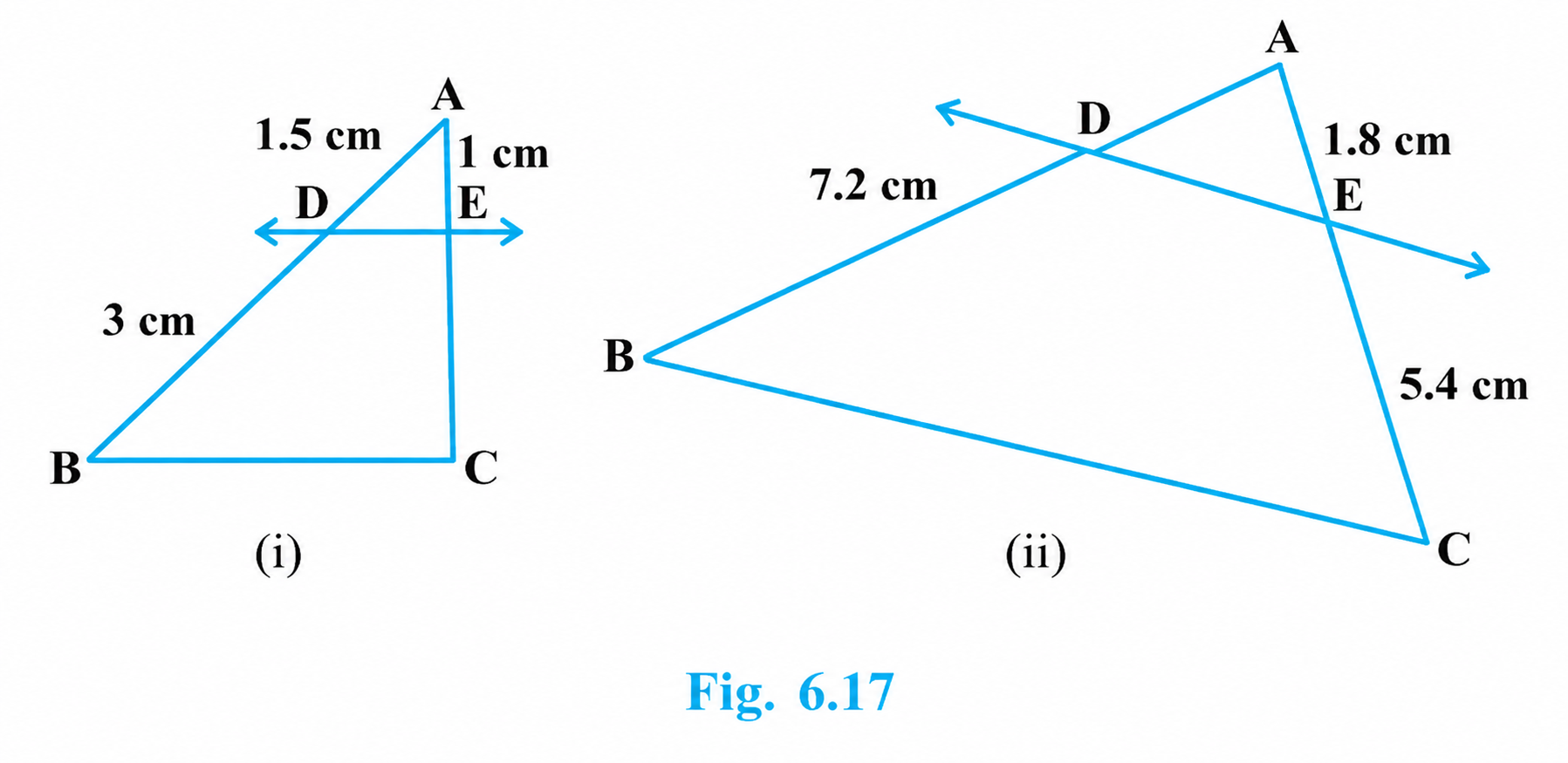
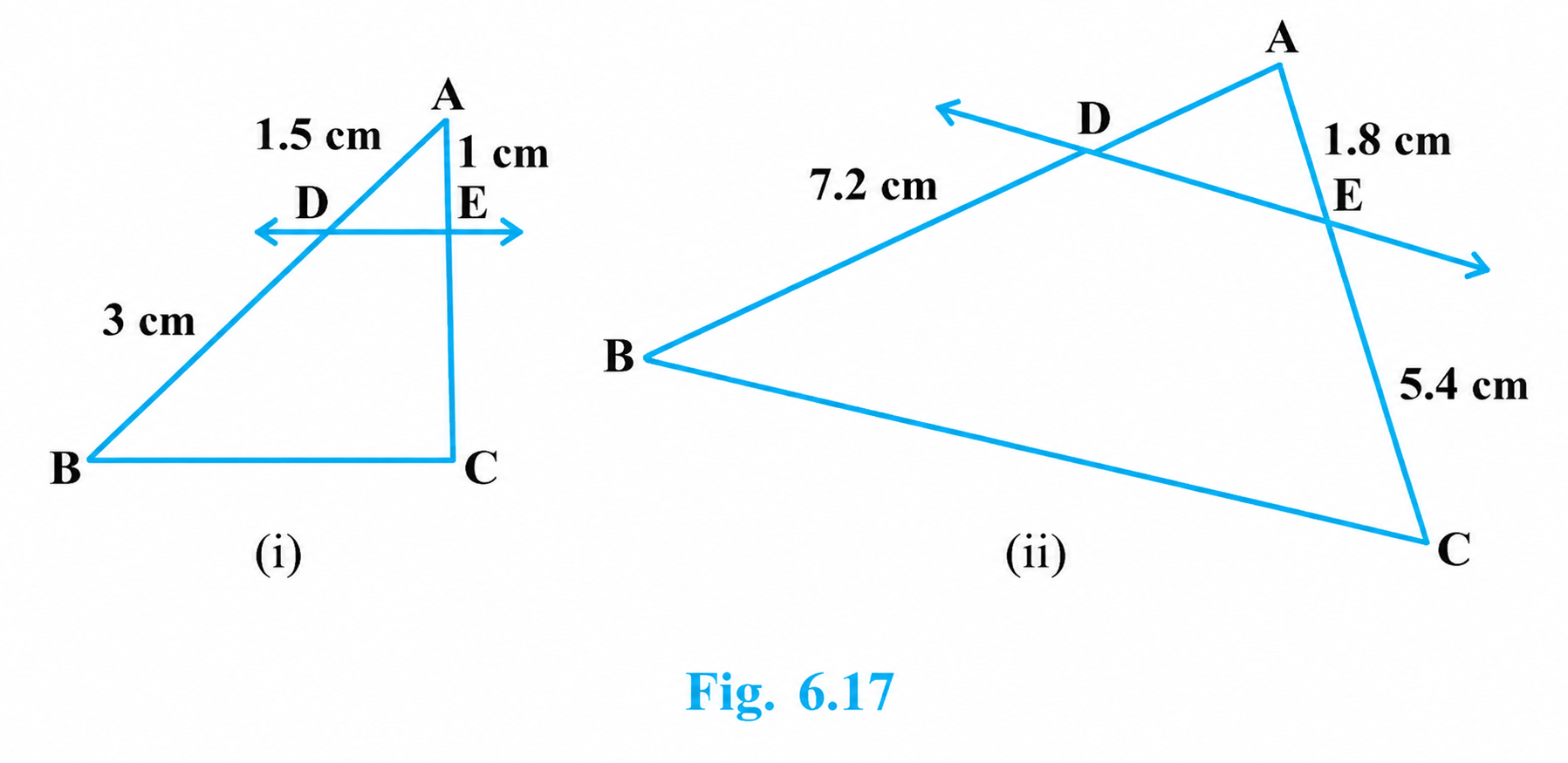
In Fig. 6.17, (i) and (ii), $DE \parallel BC$. Find $AD$ in (ii).
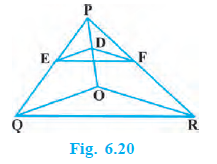
In Fig. 6.20, $DE \parallel OQ$ and $DF \parallel OR$. Show that $EF \parallel QR$.
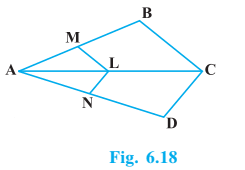
In Fig. 6.18, if $LM \parallel CB$ and $LN \parallel CD$, prove that $\frac{AM}{AB} = \frac{AN}{AD}$.
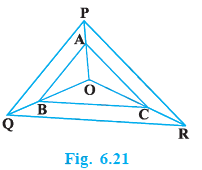
In Fig. 6.21, $A$, $B$ and $C$ are points on $OP$, $OQ$ and $OR$ respectively such that $AB \parallel PQ$ and $AC \parallel PR$. Show that $BC \parallel QR$.
In Fig. 6.17, (i) and (ii), $DE \parallel BC$. Find $EC$ in (i).
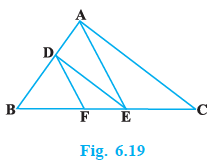
In Fig. 6.19, $DE \parallel AC$ and $DF \parallel AE$. Prove that $\frac{BF}{FE} = \frac{BE}{EC}$.
Worksheet Answers
Solution:
Given:
In $\triangle ABC$, we are given that $DE \parallel BC$.
The lengths provided for figure (ii) are:
To Find:
The length of $AD$.
Visual Representation:
Step 1: Stating the Relevant Theorem
According to the Basic Proportionality Theorem (Thales Theorem), if a line is drawn parallel to one side of a triangle to intersect the other two sides in distinct points, then the other two sides are divided in the same ratio.
Therefore, in $\triangle ABC$, since $DE \parallel BC$, we have:
$\frac{AD}{DB} = \frac{AE}{EC}$
Step 2: Substituting the Given Values
Let $AD = x$. Substituting the known values into the equation:
$\frac{x}{7.2} = \frac{1.8}{5.4}$
Step 3: Solving for $x$
First, simplify the fraction on the right side:
$\frac{1.8}{5.4} = \frac{18}{54} = \frac{1}{3}$
[Since $18 \times 3 = 54$]
Now, the equation becomes:
$\frac{x}{7.2} = \frac{1}{3}$
To isolate $x$, multiply both sides by $7.2$:
$x = \frac{7.2}{3}$
$x = 2.4$
Step 4: Conclusion
Since $x$ represents the length of $AD$, we conclude that $AD = 2.4 \text{ cm}$.
Final Answer: $AD = 2.4 \text{ cm}$
Solution:
Given: In $\triangle PQR$, we have points $D, E,$ and $F$ on sides $PQ, PR,$ and $QR$ respectively (based on the standard configuration of this theorem). Specifically, $DE \parallel OQ$ and $DF \parallel OR$, where $O$ is a point inside the triangle.
To Prove: $EF \parallel QR$.
Step 1: Applying Thales Theorem (Basic Proportionality Theorem) in $\triangle POQ$
We are given that $DE \parallel OQ$. According to the Basic Proportionality Theorem (BPT), if a line is drawn parallel to one side of a triangle to intersect the other two sides in distinct points, the other two sides are divided in the same ratio.
In $\triangle POQ$, since $DE \parallel OQ$:
$\frac{PD}{DQ} = \frac{PE}{EO}$ --- (Equation 1) [By Basic Proportionality Theorem]
Step 2: Applying Thales Theorem in $\triangle POR$
We are given that $DF \parallel OR$. Applying the Basic Proportionality Theorem in $\triangle POR$:
$\frac{PD}{DQ} = \frac{PF}{FR}$ --- (Equation 2) [By Basic Proportionality Theorem]
Step 3: Comparing the Equations
From Equation 1 and Equation 2, we observe that the left-hand side (LHS) of both equations is identical ($\frac{PD}{DQ}$). Therefore, we can equate the right-hand sides (RHS):
$\frac{PE}{EO} = \frac{PF}{FR}$ --- (Equation 3) [By Euclid's Axiom: Things which are equal to the same thing are equal to one another]
Step 4: Applying the Converse of the Basic Proportionality Theorem
In $\triangle PQR$, we have established that $\frac{PE}{EO} = \frac{PF}{FR}$.
According to the Converse of the Basic Proportionality Theorem, if a line divides any two sides of a triangle in the same ratio, then the line is parallel to the third side.
Since $\frac{PE}{EO} = \frac{PF}{FR}$ in $\triangle PQR$, it follows that the line segment $EF$ must be parallel to the base $QR$.
Therefore, $EF \parallel QR$.
Final Answer: Since the ratios of the segments on sides $PQ$ and $PR$ are equal, by the converse of the Basic Proportionality Theorem, $EF \parallel QR$.
Solution:
Given: A triangle $ABC$ where $D$ is the mid-point of side $AB$ and $E$ is the mid-point of side $AC$.
To Prove: The line segment $DE$ is parallel to the third side $BC$ (i.e., $DE \parallel BC$).
Theorem Used: Theorem 6.2 (Converse of Basic Proportionality Theorem): If a line divides any two sides of a triangle in the same ratio, then the line is parallel to the third side.
Step 1: Establishing the ratios based on mid-point definitions.
Since $D$ is the mid-point of $AB$, by definition:
$AD = DB$
Dividing both sides by $DB$, we get:
$\frac{AD}{DB} = 1$ --- (Equation 1)
Step 2: Establishing the ratio for the second side.
Since $E$ is the mid-point of $AC$, by definition:
$AE = EC$
Dividing both sides by $EC$, we get:
$\frac{AE}{EC} = 1$ --- (Equation 2)
Step 3: Comparing the ratios.
From Equation 1 and Equation 2, we observe that both ratios are equal to 1:
$\frac{AD}{DB} = \frac{AE}{EC} = 1$
[Since both ratios are equal to the same value, they are equal to each other.]
Step 4: Applying the Converse of the Basic Proportionality Theorem.
According to Theorem 6.2, if a line $DE$ intersects sides $AB$ and $AC$ of $\triangle ABC$ such that $\frac{AD}{DB} = \frac{AE}{EC}$, then the line $DE$ must be parallel to the third side $BC$.
Therefore, $DE \parallel BC$.
Conclusion:
We have shown that the line segment joining the mid-points of two sides of a triangle divides those sides in the same ratio, which necessitates that the segment is parallel to the third side.
Final Answer: Hence, it is proved that $DE \parallel BC$.
Solution:
Given: A triangle $ABC$ where $D$ is the mid-point of side $AB$ (i.e., $AD = DB$). A line $l$ is drawn through $D$ such that $DE \parallel BC$, where $E$ lies on $AC$.
To Prove: $E$ is the mid-point of $AC$ (i.e., $AE = EC$).
Step 1: Stating the Theorem
We use Theorem 6.1, also known as the Basic Proportionality Theorem (BPT). The theorem states: "If a line is drawn parallel to one side of a triangle to intersect the other two sides in distinct points, the other two sides are divided in the same ratio."
Step 2: Applying the Theorem to Triangle $ABC$
Since $DE \parallel BC$ and $DE$ intersects $AB$ at $D$ and $AC$ at $E$, by the Basic Proportionality Theorem, we have:
$\frac{AD}{DB} = \frac{AE}{EC}$ --- (Equation 1)
Step 3: Utilizing the Given Condition
It is given that $D$ is the mid-point of $AB$. Therefore:
$AD = DB$
Dividing both sides by $DB$, we get:
$\frac{AD}{DB} = 1$ --- (Equation 2)
Step 4: Substituting and Solving
Substitute the value from Equation 2 into Equation 1:
$1 = \frac{AE}{EC}$
Multiplying both sides by $EC$, we obtain:
$EC = AE$
Or, $AE = EC$.
Step 5: Conclusion
Since $AE = EC$, it implies that $E$ is equidistant from $A$ and $C$ on the line segment $AC$. Therefore, $E$ is the mid-point of $AC$.
Final Answer: Hence, it is proved that the line drawn through the mid-point of one side of a triangle parallel to another side bisects the third side.
Solution:
Given: In $\triangle ADC$ and $\triangle ABC$, we have $LM \parallel CB$ and $LN \parallel CD$.
To Prove: $\frac{AM}{AB} = \frac{AN}{AD}$
Theorem Used: Basic Proportionality Theorem (Thales Theorem), which states that if a line is drawn parallel to one side of a triangle to intersect the other two sides in distinct points, the other two sides are divided in the same ratio.
Step 1: Applying BPT in $\triangle ABC$
In $\triangle ABC$, we are given that $LM \parallel CB$.
By the Basic Proportionality Theorem, we have:
$\frac{AM}{AB} = \frac{AL}{AC}$ --- (Equation 1)
[Justification: Since $LM \parallel CB$, the ratio of segments on sides $AB$ and $AC$ are proportional.]
Step 2: Applying BPT in $\triangle ADC$
In $\triangle ADC$, we are given that $LN \parallel CD$.
By the Basic Proportionality Theorem, we have:
$\frac{AN}{AD} = \frac{AL}{AC}$ --- (Equation 2)
[Justification: Since $LN \parallel CD$, the ratio of segments on sides $AD$ and $AC$ are proportional.]
Step 3: Comparing the Equations
From Equation 1, we have $\frac{AM}{AB} = \frac{AL}{AC}$.
From Equation 2, we have $\frac{AN}{AD} = \frac{AL}{AC}$.
Since the right-hand sides of both equations are identical ($\frac{AL}{AC}$), we can equate the left-hand sides.
Therefore, $\frac{AM}{AB} = \frac{AN}{AD}$.
[Justification: Euclid's Axiom - Things which are equal to the same thing are equal to one another.]
Final Answer: Hence, it is proved that $\frac{AM}{AB} = \frac{AN}{AD}$.
Solution:
Given: A triangle $\triangle PQR$ where $E$ is a point on $PQ$ and $F$ is a point on $PR$. The lengths are given as follows:
To Find: Determine whether $EF \parallel QR$.
Theorem Used: Converse of Thales Theorem (Basic Proportionality Theorem). The theorem states that if a line divides any two sides of a triangle in the same ratio, then the line is parallel to the third side. That is, if $\frac{PE}{EQ} = \frac{PF}{FR}$, then $EF \parallel QR$.
Step 1: Calculate the ratio of the segments on side $PQ$.
The ratio is given by $\frac{PE}{QE}$.
Substituting the given values:
$\frac{PE}{QE} = \frac{4}{4.5}$
To simplify, multiply the numerator and denominator by $10$:
$\frac{PE}{QE} = \frac{40}{45}$
Divide both by their greatest common divisor, which is $5$:
$\frac{PE}{QE} = \frac{8}{9}$
Step 2: Calculate the ratio of the segments on side $PR$.
The ratio is given by $\frac{PF}{RF}$.
Substituting the given values:
$\frac{PF}{RF} = \frac{8}{9}$
Step 3: Compare the two ratios.
From Step 1, we have $\frac{PE}{QE} = \frac{8}{9}$.
From Step 2, we have $\frac{PF}{RF} = \frac{8}{9}$.
Since $\frac{PE}{QE} = \frac{PF}{RF}$, the condition for the Converse of the Basic Proportionality Theorem is satisfied.
Conclusion: Because the segments are divided in the same ratio, the line segment $EF$ must be parallel to the side $QR$.
Final Answer: Yes, $EF \parallel QR$ because $\frac{PE}{QE} = \frac{PF}{RF} = \frac{8}{9}$.
Solution:
Given:
In $\triangle OPQ$, $A$ is on $OP$ and $B$ is on $OQ$ such that $AB \parallel PQ$.
In $\triangle OPR$, $A$ is on $OP$ and $C$ is on $OR$ such that $AC \parallel PR$.
To Prove:
$BC \parallel QR$.
Step 1: Applying Thales Theorem (Basic Proportionality Theorem) in $\triangle OPQ$
According to the Basic Proportionality Theorem (BPT), if a line is drawn parallel to one side of a triangle to intersect the other two sides in distinct points, the other two sides are divided in the same ratio.
Since $AB \parallel PQ$ in $\triangle OPQ$:
$\frac{OA}{AP} = \frac{OB}{BQ}$ --- (Equation 1) [By BPT]
Step 2: Applying Thales Theorem in $\triangle OPR$
Since $AC \parallel PR$ in $\triangle OPR$:
$\frac{OA}{AP} = \frac{OC}{CR}$ --- (Equation 2) [By BPT]
Step 3: Comparing the Equations
From Equation 1 and Equation 2, we observe that the left-hand sides are identical ($\frac{OA}{AP}$). Therefore, we can equate the right-hand sides:
$\frac{OB}{BQ} = \frac{OC}{CR}$ --- (Equation 3)
Step 4: Applying the Converse of the Basic Proportionality Theorem
The Converse of the Basic Proportionality Theorem states that if a line divides any two sides of a triangle in the same ratio, then the line is parallel to the third side.
In $\triangle OQR$, we have established from Equation 3 that:
$\frac{OB}{BQ} = \frac{OC}{CR}$
Therefore, by the Converse of the Basic Proportionality Theorem, it follows that:
$BC \parallel QR$
Final Answer: Since the ratios of the segments on sides $OQ$ and $OR$ are equal ($\frac{OB}{BQ} = \frac{OC}{CR}$), by the Converse of the Basic Proportionality Theorem, $BC \parallel QR$ is proved.
Solution:
Given:
In $\triangle PQR$, $E$ is a point on $PQ$ and $F$ is a point on $PR$. The given measurements are:
$PQ = 1.28 \text{ cm}$
$PR = 2.56 \text{ cm}$
$PE = 0.18 \text{ cm}$
$PF = 0.36 \text{ cm}$
To Find:
Determine whether $EF \parallel QR$.
Theorem Used:
Converse of Thales Theorem (Basic Proportionality Theorem): If a line divides any two sides of a triangle in the same ratio, then the line is parallel to the third side. That is, if $\frac{PE}{EQ} = \frac{PF}{FR}$, then $EF \parallel QR$.
Step 1: Calculate the lengths of segments $EQ$ and $FR$.
Since $E$ lies on $PQ$, $EQ = PQ - PE$.
$EQ = 1.28 \text{ cm} - 0.18 \text{ cm} = 1.10 \text{ cm}$
Since $F$ lies on $PR$, $FR = PR - PF$.
$FR = 2.56 \text{ cm} - 0.36 \text{ cm} = 2.20 \text{ cm}$
Step 2: Calculate the ratios $\frac{PE}{EQ}$ and $\frac{PF}{FR}$.
Ratio 1: $\frac{PE}{EQ} = \frac{0.18}{1.10}$
Multiply numerator and denominator by 100 to simplify: $\frac{18}{110} = \frac{9}{55}$
Ratio 2: $\frac{PF}{FR} = \frac{0.36}{2.20}$
Multiply numerator and denominator by 100 to simplify: $\frac{36}{220}$
Divide both by 4: $\frac{36 \div 4}{220 \div 4} = \frac{9}{55}$
Step 3: Compare the ratios.
Since $\frac{PE}{EQ} = \frac{9}{55}$ and $\frac{PF}{FR} = \frac{9}{55}$, it follows that:
$\frac{PE}{EQ} = \frac{PF}{FR}$
Step 4: Conclusion based on the Converse of the Basic Proportionality Theorem.
Because the segments are divided in the same ratio, the line $EF$ must be parallel to the side $QR$ by the Converse of the Basic Proportionality Theorem.
Final Answer: Yes, $EF \parallel QR$.
Solution:
Given: In $\triangle ABC$, $DE \parallel BC$. The lengths of the segments are provided as follows: $AD = 1.5\text{ cm}$, $DB = 3\text{ cm}$, and $AE = 1\text{ cm}$.
To find: The length of segment $EC$.
Step 1: Identifying the Applicable Theorem
Since $DE \parallel BC$ in $\triangle ABC$, we apply the Basic Proportionality Theorem (Thales Theorem). The theorem states that if a line is drawn parallel to one side of a triangle to intersect the other two sides in distinct points, the other two sides are divided in the same ratio.
Mathematically, this is expressed as: $$\frac{AD}{DB} = \frac{AE}{EC}$$ [By Basic Proportionality Theorem]
Step 2: Substituting the Given Values
We substitute the known values into the equation:
$$\frac{1.5}{3} = \frac{1}{EC}$$
Step 3: Solving for $EC$
To isolate $EC$, we perform cross-multiplication:
$$1.5 \times EC = 3 \times 1$$
$$1.5 \times EC = 3$$
Now, divide both sides by $1.5$: $$EC = \frac{3}{1.5}$$
To simplify the division, multiply the numerator and denominator by 10: $$EC = \frac{30}{15}$$ $$EC = 2$$
Step 4: Conclusion
The length of segment $EC$ is calculated to be $2\text{ cm}$.
Final Answer: $EC = 2\text{ cm}$
Solution:
Given: In $\triangle ABC$, $DE \parallel AC$ and $DF \parallel AE$.
To Prove: $\frac{BF}{FE} = \frac{BE}{EC}$
Visual Representation:
Theorem Used: Basic Proportionality Theorem (BPT) or Thales Theorem. It states that if a line is drawn parallel to one side of a triangle intersecting the other two sides, then it divides the two sides in the same ratio.
Step 1: Applying BPT in $\triangle ABC$
In $\triangle ABC$, we are given that $DE \parallel AC$.
According to the Basic Proportionality Theorem, since $DE \parallel AC$, the line $DE$ divides the sides $BA$ and $BC$ proportionally:
$\frac{BD}{DA} = \frac{BE}{EC}$ --- (Equation 1)
[Justification: By Basic Proportionality Theorem, as $DE \parallel AC$]
Step 2: Applying BPT in $\triangle ABE$
In $\triangle ABE$, we are given that $DF \parallel AE$.
According to the Basic Proportionality Theorem, since $DF \parallel AE$, the line $DF$ divides the sides $BA$ and $BE$ proportionally:
$\frac{BD}{DA} = \frac{BF}{FE}$ --- (Equation 2)
[Justification: By Basic Proportionality Theorem, as $DF \parallel AE$]
Step 3: Comparing the Equations
We now have two equations:
From Equation 1: $\frac{BD}{DA} = \frac{BE}{EC}$
From Equation 2: $\frac{BD}{DA} = \frac{BF}{FE}$
Since both expressions are equal to the same ratio $\frac{BD}{DA}$, we can equate them by the Euclid's axiom which states that things which are equal to the same thing are equal to one another.
Therefore, $\frac{BF}{FE} = \frac{BE}{EC}$
Conclusion:
By comparing the ratios derived from the two triangles using the Basic Proportionality Theorem, we have successfully demonstrated the required equality.
Final Answer: Hence Proved, $\frac{BF}{FE} = \frac{BE}{EC}$
Solution:
Given: A quadrilateral $ABCD$ where the diagonals $AC$ and $BD$ intersect at point $O$ such that $\frac{AO}{BO} = \frac{CO}{DO}$.
To Prove: Quadrilateral $ABCD$ is a trapezium (i.e., $AB \parallel DC$ or $AD \parallel BC$).
Step 1: Rearranging the given ratio
We are given the equation:
$\frac{AO}{BO} = \frac{CO}{DO}$
By applying the property of cross-multiplication (alternendo), we can rewrite this as:
$\frac{AO}{CO} = \frac{BO}{DO}$ --- (Equation 1)
Step 2: Construction
Draw a line $EO$ parallel to $AB$ such that $E$ lies on $AD$.
Construction: Draw $EO \parallel AB$, where $E$ is a point on $AD$.
Step 3: Applying Thales' Theorem (Basic Proportionality Theorem)
In $\triangle DAB$, since $EO \parallel AB$ [By construction], by the Basic Proportionality Theorem (BPT), which states that if a line is drawn parallel to one side of a triangle to intersect the other two sides in distinct points, the other two sides are divided in the same ratio:
$\frac{DE}{EA} = \frac{DO}{OB}$ --- (Equation 2)
Step 4: Comparing Equations
From Equation 1, we have:
$\frac{BO}{DO} = \frac{AO}{CO}$
Taking the reciprocal of both sides:
$\frac{DO}{BO} = \frac{CO}{AO}$ --- (Equation 3)
Comparing Equation 2 and Equation 3:
Since $\frac{DE}{EA} = \frac{DO}{OB}$ and $\frac{DO}{OB} = \frac{CO}{AO}$, it follows that:
$\frac{DE}{EA} = \frac{CO}{AO}$
Step 5: Conclusion using Converse of BPT
In $\triangle ADC$, we have $\frac{DE}{EA} = \frac{DO}{OC}$ (rearranging the terms from the previous step).
By the Converse of the Basic Proportionality Theorem, if a line divides any two sides of a triangle in the same ratio, then the line is parallel to the third side.
Therefore, $EO \parallel DC$.
Since we constructed $EO \parallel AB$ and we proved $EO \parallel DC$, it implies that $AB \parallel DC$.
Since one pair of opposite sides is parallel, the quadrilateral $ABCD$ is a trapezium.
Final Answer: Since $AB \parallel DC$, the quadrilateral $ABCD$ is a trapezium.
Solution:
Given: A trapezium $ABCD$ where $AB \parallel DC$. The diagonals $AC$ and $BD$ intersect each other at point $O$.
To Prove: $\frac{AO}{BO} = \frac{CO}{DO}$
Construction: Draw a line $EO$ through point $O$ such that $EO \parallel AB$. Since $AB \parallel DC$ (given) and $EO \parallel AB$ (by construction), it follows that $EO \parallel DC$.
Step 1: Applying Thales Theorem (Basic Proportionality Theorem) in $\triangle ADC$
In $\triangle ADC$, since $EO \parallel DC$, by the Basic Proportionality Theorem (BPT), the line drawn parallel to one side of a triangle intersecting the other two sides divides the two sides in the same ratio.
Therefore: $\frac{AE}{ED} = \frac{AO}{OC}$ --- (Equation 1) [By BPT]
Step 2: Applying Thales Theorem in $\triangle ABD$
In $\triangle ABD$, since $EO \parallel AB$, by the Basic Proportionality Theorem:
$\frac{DE}{EA} = \frac{DO}{OB}$
Taking the reciprocal of both sides:
$\frac{AE}{ED} = \frac{BO}{DO}$ --- (Equation 2) [By BPT]
Step 3: Equating the results
From Equation 1 and Equation 2, since both expressions are equal to $\frac{AE}{ED}$, we can equate them:
$\frac{AO}{OC} = \frac{BO}{DO}$
Step 4: Rearranging the terms
To obtain the required form $\frac{AO}{BO} = \frac{CO}{DO}$, we perform cross-multiplication or swap the means:
$\frac{AO}{BO} = \frac{CO}{DO}$
Conclusion: By applying the Basic Proportionality Theorem to the triangles formed by the construction of a parallel line, we have successfully shown the required ratio.
Final Answer: $\frac{AO}{BO} = \frac{CO}{DO}$
Solution:
Given: A triangle $PQR$ where $E$ is a point on side $PQ$ and $F$ is a point on side $PR$. The lengths are provided as follows:
To Find: Determine whether $EF \parallel QR$.
Theoretical Basis: According to the Converse of Thales' Theorem (Basic Proportionality Theorem), if a line divides any two sides of a triangle in the same ratio, then the line is parallel to the third side. That is, $EF \parallel QR$ if and only if:
$$\frac{PE}{EQ} = \frac{PF}{FR}$$
Step 1: Calculate the ratio of the segments on side $PQ$.
Given $PE = 3.9 \text{ cm}$ and $EQ = 3 \text{ cm}$.
$$\frac{PE}{EQ} = \frac{3.9}{3}$$
$$\frac{PE}{EQ} = 1.3$$
Step 2: Calculate the ratio of the segments on side $PR$.
Given $PF = 3.6 \text{ cm}$ and $FR = 2.4 \text{ cm}$.
$$\frac{PF}{FR} = \frac{3.6}{2.4}$$
To simplify, multiply both numerator and denominator by 10:
$$\frac{PF}{FR} = \frac{36}{24}$$
Divide both by their greatest common divisor, which is 12:
$$\frac{PF}{FR} = \frac{3}{2} = 1.5$$
Step 3: Compare the ratios.
From Step 1, $\frac{PE}{EQ} = 1.3$.
From Step 2, $\frac{PF}{FR} = 1.5$.
Since $1.3 \neq 1.5$, it follows that:
$$\frac{PE}{EQ} \neq \frac{PF}{FR}$$
Conclusion: Since the ratios of the segments are not equal, the condition for the Converse of the Basic Proportionality Theorem is not satisfied.
Final Answer: No, $EF$ is not parallel to $QR$.


