


Your Worksheet is Ready
CBSE - Class 10 Mathematics Triangles Worksheet
EXERCISE 6.1
State whether the following quadrilaterals are similar or not:
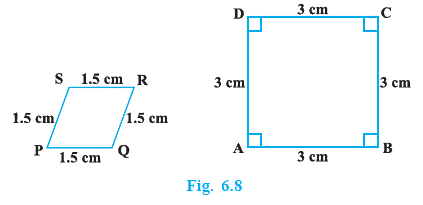
Worksheet Answers
Solution:
Given: The requirement to provide two distinct examples of pairs of non-similar figures.
To Find: Two pairs of geometric figures that do not satisfy the criteria for similarity.
Theoretical Context: Two polygons are said to be similar if:
If either of these conditions is violated, the figures are classified as non-similar.
Step 1: Analyzing Example 1 (Scalene Triangle and Equilateral Triangle)
Let $T_1$ be a scalene triangle with side lengths $3\text{ cm}, 4\text{ cm},$ and $5\text{ cm}$.
Let $T_2$ be an equilateral triangle with side lengths $4\text{ cm}, 4\text{ cm},$ and $4\text{ cm}$.
Justification:
Since neither condition for similarity is met, these figures are non-similar.
Step 2: Analyzing Example 2 (Rectangle and Rhombus)
Let $R_1$ be a rectangle with sides $4\text{ cm}$ and $2\text{ cm}$.
Let $R_2$ be a rhombus with all sides equal to $3\text{ cm}$.
Justification:
Summary of Findings:
| Pair | Figure A | Figure B | Reason for Non-Similarity |
|---|---|---|---|
| 1 | Scalene Triangle | Equilateral Triangle | Angles are unequal; sides are not proportional. |
| 2 | Rectangle | Rhombus | Corresponding angles are not equal. |
Final Answer: Two examples of pairs of non-similar figures are (1) a scalene triangle and an equilateral triangle, and (2) a rectangle and a rhombus.
Solution:
Given: The definition of similar figures in geometry, which states that two figures are similar if they have the same shape but not necessarily the same size.
To Find: Two distinct examples of pairs of similar figures.
Theoretical Context: Two polygons are said to be similar if:
1. Their corresponding angles are equal.
2. Their corresponding sides are in the same ratio (proportion).
Visual Representation:
Step 1: Identifying Example 1 - Equilateral Triangles
Let us consider two equilateral triangles, $\triangle PQR$ and $\triangle ABC$.
In any equilateral triangle, each interior angle is exactly $60^\circ$.
Since all angles in both triangles are $60^\circ$, the condition for equal corresponding angles is satisfied.
Furthermore, the ratio of corresponding sides $\frac{PQ}{AB} = \frac{QR}{BC} = \frac{RP}{CA}$ is constant.
Therefore, any two equilateral triangles are similar figures.
Step 2: Identifying Example 2 - Circles
Let us consider two circles with radii $r_1$ and $r_2$ respectively.
A circle is defined by the set of all points in a plane that are at a fixed distance (radius) from a fixed point (center).
Because all circles have the same round shape and lack corners, they are geometrically similar.
The ratio of their circumferences ($2\pi r_1 : 2\pi r_2$) and the ratio of their diameters ($2r_1 : 2r_2$) both simplify to the ratio of their radii ($r_1 : r_2$).
Therefore, any two circles are similar figures.
Final Answer: Two examples of pairs of similar figures are:
1. Any two equilateral triangles.
2. Any two circles.
Solution:
Given: A statement regarding the similarity of specific types of triangles: "All ______ triangles are similar."
To Find: The correct word from the options (isosceles, equilateral) that completes the statement to make it mathematically true.
Step 1: Understanding the Definition of Similar Triangles
Two triangles are said to be similar if:
1. Their corresponding angles are equal.
2. Their corresponding sides are in the same ratio (proportion).
Step 2: Analyzing Equilateral Triangles
An equilateral triangle is a triangle in which all three sides are equal in length and all three interior angles are equal to $60^\circ$.
Let $T_1$ and $T_2$ be two equilateral triangles with side lengths $s_1$ and $s_2$ respectively.
- The angles of $T_1$ are $60^\circ, 60^\circ, 60^\circ$.
- The angles of $T_2$ are $60^\circ, 60^\circ, 60^\circ$.
Since the corresponding angles are equal ($60^\circ = 60^\circ$), the condition for similarity is satisfied regardless of the side lengths. Thus, all equilateral triangles are similar.
Step 3: Analyzing Isosceles Triangles
An isosceles triangle is a triangle with at least two equal sides. Consider two isosceles triangles:
- Triangle 1: Sides $5, 5, 8$. The angles are approximately $36.87^\circ, 71.56^\circ, 71.56^\circ$.
- Triangle 2: Sides $5, 5, 2$. The angles are approximately $151.04^\circ, 14.48^\circ, 14.48^\circ$.
Since the corresponding angles are not equal, isosceles triangles are not necessarily similar.
Step 4: Conclusion
Based on the geometric properties established in Step 2, the condition of similarity holds true for all equilateral triangles because their angular configuration is constant ($60^\circ$ each).
Final Answer: All equilateral triangles are similar.
Solution:
Given: Two polygons having the same number of sides ($n$).
To Find: The conditions under which these two polygons are considered similar.
Step 1: Understanding the Definition of Similar Polygons
In geometry, two polygons with the same number of sides are defined as similar if and only if they satisfy two specific criteria simultaneously. Similarity implies that the shapes are identical in form but not necessarily in size (i.e., one is a scaled version of the other).
Step 2: Analyzing Condition (a) - Corresponding Angles
For two polygons to be similar, their internal structure must maintain the same "shape." This is preserved if the angles at each corresponding vertex are identical. If the angles were different, the polygons would be distorted relative to each other. Therefore, the corresponding angles must be equal.
Step 3: Analyzing Condition (b) - Corresponding Sides
While the angles define the shape, the sides define the scale. For the polygons to be similar, the ratio of the lengths of any two corresponding sides must be constant. This constant ratio is known as the scale factor. Therefore, the corresponding sides must be proportional.
Step 4: Synthesizing the Statement
Based on the geometric definition of similarity for polygons:
(a) Their corresponding angles are equal.
(b) Their corresponding sides are proportional.
Final Answer: Two polygons of the same number of sides are similar, if (a) their corresponding angles are equal and (b) their corresponding sides are proportional.
Solution:
Given: Two quadrilaterals, $PQRS$ and $ABCD$.
In quadrilateral $PQRS$: $PQ = 1.5\text{ cm}$, $QR = 1.5\text{ cm}$, $RS = 1.5\text{ cm}$, $SP = 1.5\text{ cm}$. All angles are $90^\circ$.
In quadrilateral $ABCD$: $AB = 3\text{ cm}$, $BC = 3\text{ cm}$, $CD = 3\text{ cm}$, $DA = 3\text{ cm}$. All angles are not $90^\circ$ (they are rhombic angles).
To Find: Determine whether the quadrilaterals $PQRS$ and $ABCD$ are similar.
Step 1: Define the conditions for similarity of polygons.
Two polygons of the same number of sides are similar if:
(i) Their corresponding angles are equal.
(ii) Their corresponding sides are in the same ratio (proportion).
Step 2: Check the ratio of corresponding sides.
Let us calculate the ratio of the sides of $PQRS$ to $ABCD$:
$\frac{PQ}{AB} = \frac{1.5}{3} = \frac{1}{2}$
$\frac{QR}{BC} = \frac{1.5}{3} = \frac{1}{2}$
$\frac{RS}{CD} = \frac{1.5}{3} = \frac{1}{2}$
$\frac{SP}{DA} = \frac{1.5}{3} = \frac{1}{2}$
[Since all ratios are equal to $\frac{1}{2}$, the sides are in proportion.]
Step 3: Check the corresponding angles.
In quadrilateral $PQRS$, all angles are $90^\circ$ (it is a square).
In quadrilateral $ABCD$, the angles are not $90^\circ$ (it is a rhombus).
Since the corresponding angles are not equal ($\angle P \neq \angle A$, $\angle Q \neq \angle B$, etc.), the condition for similarity is not satisfied.
Step 4: Conclusion.
For two polygons to be similar, both conditions (proportional sides and equal angles) must be satisfied simultaneously. Since the angles of $PQRS$ and $ABCD$ are not equal, the quadrilaterals are not similar.
Final Answer: The quadrilaterals $PQRS$ and $ABCD$ are not similar because, although their corresponding sides are in the same ratio, their corresponding angles are not equal.
Solution:
Given: A set of geometric figures known as squares.
To Find: The correct term to describe the relationship between all squares, choosing between "similar" and "congruent".
Step 1: Defining Similarity of Polygons
Two polygons are said to be similar if:
1. Their corresponding angles are equal.
2. Their corresponding sides are in the same ratio (proportion).
[Definition of Similar Polygons]
Step 2: Analyzing the Properties of Squares
Let $S_1$ and $S_2$ be two squares with side lengths $a_1$ and $a_2$ respectively.
- All interior angles of any square are $90^\circ$. Therefore, the corresponding angles of $S_1$ and $S_2$ are equal ($90^\circ = 90^\circ$).
- The ratio of corresponding sides is $\frac{a_1}{a_2}$. Since all sides of a square are equal, the ratio of all pairs of corresponding sides is constant, i.e., $\frac{a_1}{a_2} = \frac{a_1}{a_2} = \frac{a_1}{a_2} = \frac{a_1}{a_2}$.
[Since all squares satisfy the criteria for similarity]
Step 3: Evaluating Congruence
Two figures are congruent if they have the same shape and the same size. Since squares can have different side lengths (e.g., a square of side 2cm and a square of side 5cm), they are not necessarily congruent.
[Definition of Congruent Figures]
Step 4: Conclusion
Because all squares possess the same shape (equiangular and proportional sides) but not necessarily the same size, they are classified as similar figures.
[Logical deduction based on geometric definitions]
Final Answer: All squares are similar.
Solution:
Given: A set of geometric figures defined as circles of varying radii.
To Find: Determine whether all circles are "congruent" or "similar" by filling in the blank.
Step 1: Defining Congruency
Two geometric figures are said to be congruent if they have the same shape and the same size. For two circles to be congruent, their radii must be equal ($r_1 = r_2$).
Step 2: Defining Similarity
Two geometric figures are said to be similar if they have the same shape, but not necessarily the same size. In the case of circles, every circle is defined by the set of all points in a plane that are at a fixed distance (radius) from a fixed point (center). Because all circles possess the same round shape, they satisfy the condition of similarity regardless of their radius.
Step 3: Logical Deduction
Since circles can have different radii (as shown in the diagram where $r_1=30$ and $r_2=50$), they cannot be congruent in all cases. However, because the ratio of the corresponding parts (the circumference to the diameter, which is $\pi$) remains constant for all circles, they are always similar.
Step 4: Conclusion
Based on the definition of similarity in geometry, all circles are similar because they share the same shape, even if their sizes differ.
Final Answer: All circles are similar.


