


Your Worksheet is Ready
CBSE - Class 10 Mathematics Arithmetic Progression Worksheet
EXERCISE 5.3
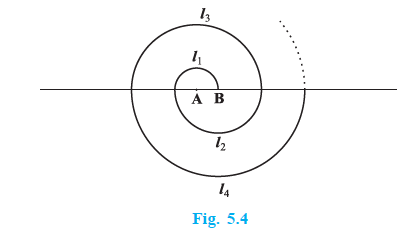
A spiral is made up of successive semicircles, with centres alternately at A and B, starting with centre at A, of radii 0.5 cm, 1.0 cm, 1.5 cm, 2.0 cm, . . . as shown in Fig. 5.4. What is the total length of such a spiral made up of thirteen consecutive semicircles? (Take $\pi = \frac{22}{7}$) [Hint : Length of successive semicircles is $l_1, l_2, l_3, l_4, . . .$ with centres at A, B, A, B, . . ., respectively.]
200 logs are stacked in the following manner: 20 logs in the bottom row, 19 in the next row, 18 in the row next to it and so on (see Fig. 5.5). In how many rows are the 200 logs placed and how many logs are in the top row?

In a potato race, a bucket is placed at the starting point, which is 5 m from the first potato, and the other potatoes are placed 3 m apart in a straight line. There are ten potatoes in the line (see Fig. 5.6).
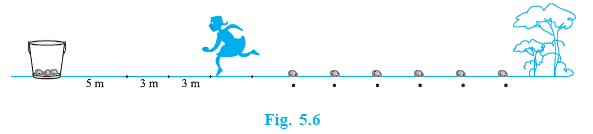
A competitor starts from the bucket, picks up the nearest potato, runs back with it, drops it in the bucket, runs back to pick up the next potato, runs to the bucket to drop it in, and she continues in the same way until all the potatoes are in the bucket. What is the total distance the competitor has to run? [Hint : To pick up the first potato and the second potato, the total distance (in metres) run by a competitor is $2 \times 5 + 2 \times (5 + 3)$]
Worksheet Answers
Solution:
Given:
To Find:
The total number of trees planted by all the students of all classes.
Step 1: Determining the number of trees planted by each class
Let $n$ be the class number, where $n \in \{1, 2, 3, \dots, 12\}$.
Since there are 3 sections for each class, the number of trees planted by a specific class $n$ is given by:
$T_n = 3 \times n$
Calculating the trees for each class:
Step 2: Identifying the Arithmetic Progression (AP)
The sequence of the total trees planted by each class is: $3, 6, 9, \dots, 36$.
This sequence forms an Arithmetic Progression where:
Step 3: Calculating the sum of the Arithmetic Progression
To find the total number of trees, we calculate the sum of the first $n$ terms of the AP using the formula:
$S_n = \frac{n}{2} (a + l)$
[Where $S_n$ is the sum of $n$ terms, $a$ is the first term, and $l$ is the last term.]
Substituting the known values into the formula:
$S_{12} = \frac{12}{2} (3 + 36)$
Step 4: Performing the arithmetic operations
$S_{12} = 6 \times (39)$
$S_{12} = 234$
[Calculation breakdown: $6 \times 30 = 180$ and $6 \times 9 = 54$. Adding these: $180 + 54 = 234$.]
Final Answer: The total number of trees planted by the students is 234.
Solution:
Given:
The first term of the Arithmetic Progression (AP), denoted by $a = 17$.
The last term of the AP, denoted by $l$ or $a_n = 350$.
The common difference of the AP, denoted by $d = 9$.
To Find:
1. The number of terms in the AP, denoted by $n$.
2. The sum of all terms in the AP, denoted by $S_n$.
Step 1: Finding the number of terms ($n$)
We use the formula for the $n^{th}$ term of an Arithmetic Progression:
$a_n = a + (n - 1)d$
Substituting the given values into the formula:
$350 = 17 + (n - 1)9$
Subtract $17$ from both sides of the equation:
$350 - 17 = (n - 1)9$
$333 = (n - 1)9$
Divide both sides by $9$:
$\frac{333}{9} = n - 1$
$37 = n - 1$
Add $1$ to both sides to solve for $n$:
$n = 37 + 1$
$n = 38$
[Since the number of terms must be a positive integer, $n=38$ is valid.]
Step 2: Finding the sum of the terms ($S_n$)
We use the formula for the sum of the first $n$ terms of an AP when the first and last terms are known:
$S_n = \frac{n}{2}(a + l)$
Substituting the values $n = 38$, $a = 17$, and $l = 350$:
$S_{38} = \frac{38}{2}(17 + 350)$
Simplify the fraction and the expression inside the parentheses:
$S_{38} = 19(367)$
Perform the multiplication:
$19 \times 367 = 6973$
Step 3: Verification of calculation
$19 \times 300 = 5700$
$19 \times 60 = 1140$
$19 \times 7 = 133$
$5700 + 1140 + 133 = 6973$
Final Answer: There are 38 terms in the AP, and their sum is 6973.
Solution:
Given: The sum of the first $n$ terms of an Arithmetic Progression (AP) is given by the formula $S_n = 4n - n^2$.
To Find:
1. The first term ($a_1$ or $S_1$).
2. The sum of the first two terms ($S_2$).
3. The second term ($a_2$).
4. The third term ($a_3$).
5. The tenth term ($a_{10}$).
6. The $n$th term ($a_n$).
Step 1: Finding the first term ($a_1$)
By definition, the sum of the first term is the first term itself.
Given $S_n = 4n - n^2$.
For $n = 1$:
$S_1 = 4(1) - (1)^2$
$S_1 = 4 - 1 = 3$
Thus, the first term $a_1 = 3$.
Step 2: Finding the sum of the first two terms ($S_2$)
For $n = 2$:
$S_2 = 4(2) - (2)^2$
$S_2 = 8 - 4 = 4$
Thus, the sum of the first two terms is $4$.
Step 3: Finding the second term ($a_2$)
We know that the sum of the first two terms is the sum of the first term and the second term: $S_2 = a_1 + a_2$.
Substituting the known values:
$4 = 3 + a_2$
$a_2 = 4 - 3 = 1$
Thus, the second term $a_2 = 1$.
Step 4: Finding the third term ($a_3$)
First, calculate the sum of the first three terms ($S_3$):
$S_3 = 4(3) - (3)^2 = 12 - 9 = 3$
The $n$th term of an AP can be found using the relation $a_n = S_n - S_{n-1}$.
For $n = 3$:
$a_3 = S_3 - S_2$
$a_3 = 3 - 4 = -1$
Thus, the third term $a_3 = -1$.
Step 5: Finding the tenth term ($a_{10}$)
Using the relation $a_n = S_n - S_{n-1}$:
$a_{10} = S_{10} - S_9$
Calculate $S_{10}$: $S_{10} = 4(10) - (10)^2 = 40 - 100 = -60$
Calculate $S_9$: $S_9 = 4(9) - (9)^2 = 36 - 81 = -45$
$a_{10} = -60 - (-45)$
$a_{10} = -60 + 45 = -15$
Thus, the tenth term $a_{10} = -15$.
Step 6: Finding the $n$th term ($a_n$)
Using the relation $a_n = S_n - S_{n-1}$:
$S_n = 4n - n^2$
$S_{n-1} = 4(n-1) - (n-1)^2$
Expand $S_{n-1}$:
$S_{n-1} = 4n - 4 - (n^2 - 2n + 1)$
$S_{n-1} = 4n - 4 - n^2 + 2n - 1$
$S_{n-1} = -n^2 + 6n - 5$
Now, subtract $S_{n-1}$ from $S_n$:
$a_n = (4n - n^2) - (-n^2 + 6n - 5)$
$a_n = 4n - n^2 + n^2 - 6n + 5$
$a_n = 5 - 2n$
Final Answer:
The first term ($a_1$) is 3.
The sum of the first two terms ($S_2$) is 4.
The second term ($a_2$) is 1.
The third term ($a_3$) is -1.
The tenth term ($a_{10}$) is -15.
The $n$th term ($a_n$) is $5 - 2n$.
Solution:
Given:
The first term of the Arithmetic Progression (AP), denoted by $a = 5$.
The last term of the AP, denoted by $l$ or $a_n = 45$.
The sum of the $n$ terms of the AP, denoted by $S_n = 400$.
To Find:
1. The number of terms ($n$).
2. The common difference ($d$).
Step 1: Finding the number of terms ($n$)
We use the formula for the sum of an AP when the first and last terms are known:
$S_n = \frac{n}{2}(a + l)$
[Substituting the given values into the formula]
$400 = \frac{n}{2}(5 + 45)$
$400 = \frac{n}{2}(50)$
[Simplifying the expression inside the parentheses and dividing 50 by 2]
$400 = n \times 25$
$n = \frac{400}{25}$
$n = 16$
[Since $n$ represents the number of terms, it must be a positive integer]
Step 2: Finding the common difference ($d$)
We use the formula for the $n^{th}$ term of an AP:
$a_n = a + (n - 1)d$
[Substituting the known values: $a_n = 45$, $a = 5$, and $n = 16$]
$45 = 5 + (16 - 1)d$
$45 = 5 + 15d$
[Subtracting 5 from both sides of the equation]
$45 - 5 = 15d$
$40 = 15d$
[Dividing both sides by 15 to solve for $d$]
$d = \frac{40}{15}$
[Simplifying the fraction by dividing the numerator and denominator by their greatest common divisor, 5]
$d = \frac{8}{3}$
Final Answer: The number of terms is 16 and the common difference is $\frac{8}{3}$.
Solution:
Given:
A spiral is formed by successive semicircles with centers alternating between points A and B. The radii of these semicircles form an arithmetic progression: $r_1 = 0.5\text{ cm}$, $r_2 = 1.0\text{ cm}$, $r_3 = 1.5\text{ cm}$, $r_4 = 2.0\text{ cm}$, and so on. The total number of semicircles is $n = 13$. The value of $\pi$ is given as $\frac{22}{7}$.
To Find:
The total length of the spiral, which is the sum of the lengths of the 13 consecutive semicircles.
Step 1: Determine the formula for the length of each semicircle.
The circumference of a full circle is $2\pi r$. Therefore, the length of a semicircle with radius $r$ is given by $l = \pi r$.
Let $l_1, l_2, l_3, \dots, l_{13}$ be the lengths of the 13 semicircles.
$l_1 = \pi r_1 = \pi(0.5)$
$l_2 = \pi r_2 = \pi(1.0)$
$l_3 = \pi r_3 = \pi(1.5)$
... and so on.
Step 2: Identify the Arithmetic Progression (AP).
The sequence of lengths is: $\pi(0.5), \pi(1.0), \pi(1.5), \dots$
This is an AP where:
First term ($a$) = $0.5\pi$
Common difference ($d$) = $l_2 - l_1 = \pi(1.0) - \pi(0.5) = 0.5\pi$
Number of terms ($n$) = $13$
Step 3: Apply the sum formula for an AP.
The sum of the first $n$ terms of an AP is given by the formula: $S_n = \frac{n}{2} [2a + (n - 1)d]$
Substituting the known values:
$S_{13} = \frac{13}{2} [2(0.5\pi) + (13 - 1)(0.5\pi)]$
$S_{13} = \frac{13}{2} [1.0\pi + 12(0.5\pi)]$
$S_{13} = \frac{13}{2} [1.0\pi + 6.0\pi]$
$S_{13} = \frac{13}{2} [7\pi]$
Step 4: Calculate the final numerical value.
Substitute $\pi = \frac{22}{7}$ into the expression:
$S_{13} = \frac{13}{2} \times 7 \times \frac{22}{7}$
[Canceling the 7 in the numerator and denominator]:
$S_{13} = \frac{13}{2} \times 22$
$S_{13} = 13 \times 11$
$S_{13} = 143$
Final Answer: The total length of the spiral is 143 cm.
Solution:
Given: The $n^{th}$ term of a sequence is defined by the expression $a_n = 3 + 4n$.
To Find:
1. Show that the sequence forms an Arithmetic Progression (AP).
2. Calculate the sum of the first 15 terms ($S_{15}$).
Step 1: Generating the terms of the sequence
To determine if the sequence is an AP, we calculate the first few terms by substituting $n = 1, 2, 3, ...$ into the given formula $a_n = 3 + 4n$.
For $n = 1$: $a_1 = 3 + 4(1) = 3 + 4 = 7$
For $n = 2$: $a_2 = 3 + 4(2) = 3 + 8 = 11$
For $n = 3$: $a_3 = 3 + 4(3) = 3 + 12 = 15$
For $n = 4$: $a_4 = 3 + 4(4) = 3 + 16 = 19$
Step 2: Verifying the Arithmetic Progression
A sequence is an AP if the difference between consecutive terms is constant. This constant is called the common difference ($d$).
Calculate the differences:
$a_2 - a_1 = 11 - 7 = 4$
$a_3 - a_2 = 15 - 11 = 4$
$a_4 - a_3 = 19 - 15 = 4$
[Since the difference $a_n - a_{n-1} = 4$ is constant for all $n$, the sequence is an AP with first term $a = 7$ and common difference $d = 4$.]
Step 3: Calculating the sum of the first 15 terms
The formula for the sum of the first $n$ terms of an AP is given by:
$S_n = \frac{n}{2} [2a + (n - 1)d]$
Here, $n = 15$, $a = 7$, and $d = 4$. Substituting these values into the formula:
$S_{15} = \frac{15}{2} [2(7) + (15 - 1)4]$
Step 4: Simplifying the expression
$S_{15} = \frac{15}{2} [14 + (14)4]$
$S_{15} = \frac{15}{2} [14 + 56]$
$S_{15} = \frac{15}{2} [70]$
$S_{15} = 15 \times 35$ [Dividing 70 by 2]
$S_{15} = 525$
Final Answer: The sequence forms an AP with a common difference of 4, and the sum of the first 15 terms is 525.
Solution:
Given:
Total number of logs ($S_n$) = $200$
Number of logs in the bottom row ($a$) = $20$
Number of logs in the next row = $19$
Number of logs in the row after that = $18$
This forms an Arithmetic Progression (AP) where the common difference ($d$) = $19 - 20 = -1$.
To Find:
1. The number of rows ($n$).
2. The number of logs in the top row ($a_n$).
Step 1: Formulating the Equation
The sum of $n$ terms of an Arithmetic Progression is given by the formula:
$S_n = \frac{n}{2} [2a + (n - 1)d]$
Substituting the given values into the formula:
$200 = \frac{n}{2} [2(20) + (n - 1)(-1)]$
Step 2: Solving for $n$
$200 = \frac{n}{2} [40 - n + 1]$
$200 = \frac{n}{2} [41 - n]$
Multiply both sides by $2$ to eliminate the fraction:
$400 = n(41 - n)$
$400 = 41n - n^2$
Rearranging into a standard quadratic equation form ($ax^2 + bx + c = 0$):
$n^2 - 41n + 400 = 0$
Step 3: Factoring the Quadratic Equation
We need two numbers that multiply to $400$ and add to $-41$. These numbers are $-16$ and $-25$.
$n^2 - 16n - 25n + 400 = 0$
$n(n - 16) - 25(n - 16) = 0$
$(n - 16)(n - 25) = 0$
Therefore, $n = 16$ or $n = 25$.
Step 4: Determining the Valid Value of $n$
Let us check the number of logs in the $n^{th}$ row using the formula $a_n = a + (n - 1)d$.
If $n = 25$:
$a_{25} = 20 + (25 - 1)(-1) = 20 - 24 = -4$
[Since the number of logs cannot be negative, $n = 25$ is rejected.]
If $n = 16$:
$a_{16} = 20 + (16 - 1)(-1) = 20 - 15 = 5$
[This is a valid number of logs.]
Step 5: Final Calculation
The number of rows is $16$.
The number of logs in the top row ($a_{16}$) is $5$.
Final Answer: The 200 logs are placed in 16 rows, and there are 5 logs in the top row.
Solution:
Given: The $n^{th}$ term of a sequence is defined by the formula $a_n = 9 - 5n$.
To Find:
1. Show that the sequence forms an Arithmetic Progression (AP).
2. Calculate the sum of the first 15 terms ($S_{15}$).
Step 1: Generating the terms of the sequence
To determine if the sequence is an AP, we calculate the first few terms by substituting $n = 1, 2, 3, \dots$ into the given formula $a_n = 9 - 5n$.
For $n = 1$: $a_1 = 9 - 5(1) = 9 - 5 = 4$
For $n = 2$: $a_2 = 9 - 5(2) = 9 - 10 = -1$
For $n = 3$: $a_3 = 9 - 5(3) = 9 - 15 = -6$
For $n = 4$: $a_4 = 9 - 5(4) = 9 - 20 = -11$
Step 2: Verifying the Arithmetic Progression
A sequence is an AP if the difference between consecutive terms is constant. This constant is known as the common difference ($d$).
Calculate the differences:
$d_1 = a_2 - a_1 = -1 - 4 = -5$
$d_2 = a_3 - a_2 = -6 - (-1) = -6 + 1 = -5$
$d_3 = a_4 - a_3 = -11 - (-6) = -11 + 6 = -5$
[Since $a_{n} - a_{n-1} = -5$ for all $n$, the difference is constant.]
Therefore, the sequence $4, -1, -6, -11, \dots$ forms an AP with the first term $a = 4$ and common difference $d = -5$.
Step 3: Calculating the sum of the first 15 terms
The formula for the sum of the first $n$ terms of an AP is given by:
$S_n = \frac{n}{2} [2a + (n - 1)d]$
Here, $n = 15$, $a = 4$, and $d = -5$. Substituting these values into the formula:
$S_{15} = \frac{15}{2} [2(4) + (15 - 1)(-5)]$
$S_{15} = \frac{15}{2} [8 + (14)(-5)]$
$S_{15} = \frac{15}{2} [8 - 70]$
$S_{15} = \frac{15}{2} [-62]$
Step 4: Final Arithmetic Simplification
$S_{15} = 15 \times \left(\frac{-62}{2}\right)$
$S_{15} = 15 \times (-31)$
$S_{15} = -465$
Final Answer: The sequence forms an AP with a common difference of $-5$, and the sum of the first 15 terms is $-465$.
Solution:
Given:
An Arithmetic Progression (AP) where:
To find:
The sum of the first 22 terms of the AP, denoted as $S_{22}$.
Step 1: Determine the first term ($a$) of the AP.
We use the general formula for the $n$-th term of an AP:
$a_n = a + (n - 1)d$
Substituting the given values ($n = 22$, $a_{22} = 149$, $d = 7$):
$149 = a + (22 - 1) \times 7$
$149 = a + (21) \times 7$
$149 = a + 147$
Subtracting 147 from both sides to isolate $a$:
$a = 149 - 147$
$a = 2$
Step 2: Calculate the sum of the first 22 terms ($S_{22}$).
We use the formula for the sum of the first $n$ terms of an AP when the last term ($l = a_n$) is known:
$S_n = \frac{n}{2} (a + a_n)$
Here, $n = 22$, $a = 2$, and $a_n = a_{22} = 149$.
Substituting these values into the formula:
$S_{22} = \frac{22}{2} (2 + 149)$
$S_{22} = 11 \times (151)$
Step 3: Perform the final multiplication.
$S_{22} = 11 \times 151$
$S_{22} = 1661$
Final Answer: The sum of the first 22 terms of the AP is 1661.
Solution:
Given:
The penalty for the first day ($a_1$) = ₹ $200$.
The penalty for the second day ($a_2$) = ₹ $250$.
The penalty for the third day ($a_3$) = ₹ $300$.
The common difference ($d$) between consecutive days = $250 - 200 = 50$ and $300 - 250 = 50$.
The total number of days of delay ($n$) = $30$.
To Find:
The total penalty amount to be paid for $30$ days, which is the sum of the first $30$ terms of the arithmetic progression ($S_{30}$).
Step 1: Identifying the Progression
The sequence of penalties forms an Arithmetic Progression (AP) because the difference between consecutive terms is constant.
The sequence is: $200, 250, 300, \dots$
Here, the first term $a = 200$.
The common difference $d = 50$.
The number of terms $n = 30$.
Step 2: Selecting the Formula
To find the sum of the first $n$ terms of an arithmetic progression, we use the formula:
$S_n = \frac{n}{2} [2a + (n - 1)d]$
[Where $S_n$ is the sum of $n$ terms, $a$ is the first term, $n$ is the number of terms, and $d$ is the common difference.]
Step 3: Substituting the Values
Substitute $n = 30$, $a = 200$, and $d = 50$ into the formula:
$S_{30} = \frac{30}{2} [2(200) + (30 - 1)50]$
Step 4: Performing the Calculations
First, simplify the fraction outside the brackets:
$S_{30} = 15 [2(200) + (29)50]$
Next, calculate the values inside the brackets:
$S_{30} = 15 [400 + 1450]$
[Since $2 \times 200 = 400$ and $29 \times 50 = 1450$]
Add the values inside the brackets:
$S_{30} = 15 [1850]$
Finally, multiply the result by $15$:
$S_{30} = 27750$
Conclusion:
The total penalty for a delay of $30$ days is calculated by summing the arithmetic series of the daily penalties.
Final Answer: The contractor has to pay a total penalty of ₹ 27,750.
Solution:
Given: An Arithmetic Progression (AP) series: $-37, -33, -29, \dots$ and the number of terms to be summed, $n = 12$.
To Find: The sum of the first $12$ terms of the given AP ($S_{12}$).
Step 1: Identify the parameters of the Arithmetic Progression.
An Arithmetic Progression is defined by its first term ($a$) and its common difference ($d$).
The first term is given by the first element of the sequence:
$a = -37$
The common difference ($d$) is calculated by subtracting any term from the term that follows it:
$d = a_2 - a_1$
$d = -33 - (-37)$
$d = -33 + 37$
$d = 4$
Step 2: State the formula for the sum of the first $n$ terms of an AP.
The sum of the first $n$ terms of an AP is given by the formula:
$S_n = \frac{n}{2} [2a + (n - 1)d]$
[Where $S_n$ is the sum, $n$ is the number of terms, $a$ is the first term, and $d$ is the common difference.]
Step 3: Substitute the known values into the formula.
Given $n = 12$, $a = -37$, and $d = 4$:
$S_{12} = \frac{12}{2} [2(-37) + (12 - 1)(4)]$
Step 4: Perform the arithmetic calculations.
First, simplify the fraction and the terms inside the brackets:
$S_{12} = 6 [2(-37) + (11)(4)]$
[Since $\frac{12}{2} = 6$ and $12 - 1 = 11$]
Next, calculate the products inside the brackets:
$S_{12} = 6 [-74 + 44]$
[Since $2 \times -37 = -74$ and $11 \times 4 = 44$]
Perform the addition inside the brackets:
$S_{12} = 6 [-30]$
[Since $-74 + 44 = -30$]
Finally, multiply the result by 6:
$S_{12} = -180$
Final Answer: The sum of the first 12 terms of the AP is -180.
Solution:
Given:
The sum of the first $7$ terms of an Arithmetic Progression (AP), denoted as $S_7 = 49$.
The sum of the first $17$ terms of the same AP, denoted as $S_{17} = 289$.
To Find:
The sum of the first $n$ terms of the AP, denoted as $S_n$.
Formulae Used:
The sum of the first $n$ terms of an AP is given by the formula:
$S_n = \frac{n}{2} [2a + (n - 1)d]$
Where $a$ is the first term and $d$ is the common difference.
Step 1: Formulating the equation for the first 7 terms
Using the formula $S_n = \frac{n}{2} [2a + (n - 1)d]$ for $n = 7$:
$49 = \frac{7}{2} [2a + (7 - 1)d]$
$49 = \frac{7}{2} [2a + 6d]$
Divide both sides by $7$:
$7 = \frac{1}{2} [2a + 6d]$
Multiply by $2$:
$14 = 2a + 6d$
Divide the entire equation by $2$ to simplify:
$7 = a + 3d$ --- (Equation 1)
Step 2: Formulating the equation for the first 17 terms
Using the formula $S_n = \frac{n}{2} [2a + (n - 1)d]$ for $n = 17$:
$289 = \frac{17}{2} [2a + (17 - 1)d]$
$289 = \frac{17}{2} [2a + 16d]$
Divide both sides by $17$ (since $17^2 = 289$):
$17 = \frac{1}{2} [2a + 16d]$
Multiply by $2$:
$34 = 2a + 16d$
Divide the entire equation by $2$ to simplify:
$17 = a + 8d$ --- (Equation 2)
Step 3: Solving the system of linear equations
Subtract Equation 1 from Equation 2:
$(a + 8d) - (a + 3d) = 17 - 7$
$a - a + 8d - 3d = 10$
$5d = 10$
$d = 2$
Substitute $d = 2$ into Equation 1:
$7 = a + 3(2)$
$7 = a + 6$
$a = 7 - 6$
$a = 1$
Step 4: Finding the sum of the first $n$ terms ($S_n$)
Substitute $a = 1$ and $d = 2$ into the general formula $S_n = \frac{n}{2} [2a + (n - 1)d]$:
$S_n = \frac{n}{2} [2(1) + (n - 1)(2)]$
$S_n = \frac{n}{2} [2 + 2n - 2]$
$S_n = \frac{n}{2} [2n]$
$S_n = n \times n$
$S_n = n^2$
Final Answer: The sum of the first $n$ terms is $n^2$.
Solution:
Given: An arithmetic series $34 + 32 + 30 + \dots + 10$.
To find: The sum of the given arithmetic series.
Step 1: Identify the components of the Arithmetic Progression (AP)
The given series is $34, 32, 30, \dots, 10$.
Let the first term be $a = 34$.
Let the common difference be $d$.
$d = a_2 - a_1 = 32 - 34 = -2$.
The last term (or $n^{th}$ term) is $a_n = l = 10$.
Step 2: Determine the number of terms ($n$)
We use the formula for the $n^{th}$ term of an AP: $a_n = a + (n - 1)d$.
Substituting the known values into the formula:
$10 = 34 + (n - 1)(-2)$
Subtract $34$ from both sides:
$10 - 34 = (n - 1)(-2)$
$-24 = (n - 1)(-2)$
Divide both sides by $-2$:
$\frac{-24}{-2} = n - 1$
$12 = n - 1$
$n = 12 + 1 = 13$.
[Since there are 13 terms in the series]
Step 3: Calculate the sum of the AP
The formula for the sum of the first $n$ terms of an AP when the last term is known is:
$S_n = \frac{n}{2}(a + l)$
Substituting $n = 13$, $a = 34$, and $l = 10$:
$S_{13} = \frac{13}{2}(34 + 10)$
$S_{13} = \frac{13}{2}(44)$
Simplify the expression:
$S_{13} = 13 \times \left(\frac{44}{2}\right)$
$S_{13} = 13 \times 22$
Step 4: Final Arithmetic Calculation
$13 \times 22 = 13 \times (20 + 2)$
$= 260 + 26$
$= 286$
Final Answer: The sum of the series 34 + 32 + 30 + . . . + 10 is 286.
Solution:
Given: An arithmetic progression (AP) series: $-5 + (-8) + (-11) + \dots + (-230)$.
To Find: The sum of the given arithmetic series.
Step 1: Identify the parameters of the Arithmetic Progression.
The given series is $-5, -8, -11, \dots, -230$.
Let the first term be $a$. Thus, $a = -5$.
Let the common difference be $d$. The common difference is calculated as the difference between any two consecutive terms:
$d = a_2 - a_1 = (-8) - (-5) = -8 + 5 = -3$.
The last term (or $n^{th}$ term) is $a_n = -230$.
Step 2: Determine the number of terms ($n$).
We use the formula for the $n^{th}$ term of an AP: $a_n = a + (n - 1)d$.
Substituting the known values into the formula:
$-230 = -5 + (n - 1)(-3)$
Add $5$ to both sides of the equation:
$-230 + 5 = (n - 1)(-3)$
$-225 = (n - 1)(-3)$
Divide both sides by $-3$:
$\frac{-225}{-3} = n - 1$
$75 = n - 1$
Add $1$ to both sides:
$n = 76$
[Since there are 76 terms in the series].
Step 3: Calculate the sum of the series ($S_n$).
The formula for the sum of the first $n$ terms of an AP when the last term ($l$) is known is:
$S_n = \frac{n}{2}(a + l)$
Where $n = 76$, $a = -5$, and $l = -230$.
Substitute the values into the formula:
$S_{76} = \frac{76}{2}(-5 + (-230))$
Simplify the fraction and the expression inside the parentheses:
$S_{76} = 38(-5 - 230)$
$S_{76} = 38(-235)$
Step 4: Perform the final multiplication.
$38 \times (-235) = -8930$
[Calculation: $38 \times 200 = 7600$; $38 \times 30 = 1140$; $38 \times 5 = 190$; $7600 + 1140 + 190 = 8930$].
Final Answer: The sum of the series is -8930.
Solution:
Given: An Arithmetic Progression (AP) series: $\frac{1}{15}, \frac{1}{12}, \frac{1}{10}, \dots$ and the number of terms $n = 11$.
To Find: The sum of the first 11 terms ($S_{11}$) of the given AP.
Step 1: Identify the parameters of the Arithmetic Progression.
The first term ($a$) is the first element of the sequence:
$a = \frac{1}{15}$
The common difference ($d$) is calculated by subtracting the first term from the second term:
$d = a_2 - a_1 = \frac{1}{12} - \frac{1}{15}$
To subtract these fractions, we find the Least Common Multiple (LCM) of the denominators 12 and 15:
Multiples of 12: 12, 24, 36, 48, 60
Multiples of 15: 15, 30, 45, 60
LCM = 60
Converting the fractions:
$d = \frac{1 \times 5}{12 \times 5} - \frac{1 \times 4}{15 \times 4} = \frac{5}{60} - \frac{4}{60} = \frac{1}{60}$
Step 2: State the formula for the sum of the first $n$ terms of an AP.
The sum of the first $n$ terms of an AP is given by the formula:
$S_n = \frac{n}{2} [2a + (n - 1)d]$
[Where $n$ is the number of terms, $a$ is the first term, and $d$ is the common difference.]
Step 3: Substitute the known values into the formula.
Given $n = 11$, $a = \frac{1}{15}$, and $d = \frac{1}{60}$:
$S_{11} = \frac{11}{2} \left[ 2\left(\frac{1}{15}\right) + (11 - 1)\left(\frac{1}{60}\right) \right]$
Step 4: Perform the arithmetic calculations.
Simplify the expression inside the brackets:
$S_{11} = \frac{11}{2} \left[ \frac{2}{15} + 10\left(\frac{1}{60}\right) \right]$
$S_{11} = \frac{11}{2} \left[ \frac{2}{15} + \frac{10}{60} \right]$
Simplify the fraction $\frac{10}{60}$ to $\frac{1}{6}$:
$S_{11} = \frac{11}{2} \left[ \frac{2}{15} + \frac{1}{6} \right]$
Find the LCM of 15 and 6 to add the fractions inside the brackets:
Multiples of 15: 15, 30
Multiples of 6: 6, 12, 18, 24, 30
LCM = 30
Convert fractions to have a common denominator of 30:
$\frac{2}{15} = \frac{2 \times 2}{15 \times 2} = \frac{4}{30}$
$\frac{1}{6} = \frac{1 \times 5}{6 \times 5} = \frac{5}{30}$
Add the fractions:
$S_{11} = \frac{11}{2} \left[ \frac{4}{30} + \frac{5}{30} \right] = \frac{11}{2} \left[ \frac{9}{30} \right]$
Step 5: Final multiplication.
$S_{11} = \frac{11}{2} \times \frac{9}{30}$
Simplify $\frac{9}{30}$ by dividing both numerator and denominator by 3:
$\frac{9}{30} = \frac{3}{10}$
$S_{11} = \frac{11}{2} \times \frac{3}{10} = \frac{33}{20}$
Final Answer: The sum of the first 11 terms is $\frac{33}{20}$.
Solution:
Given: The range of numbers is between $0$ and $50$. We are interested in the odd numbers within this range.
To Find: The sum of all odd numbers between $0$ and $50$.
Step 1: Identifying the Sequence
The odd numbers between $0$ and $50$ form an Arithmetic Progression (AP) starting from $1$ and ending at $49$.
The sequence is: $1, 3, 5, 7, \dots, 49$.
Here:
First term ($a$) = $1$
Common difference ($d$) = $3 - 1 = 2$
Last term ($a_n$ or $l$) = $49$
Step 2: Determining the Number of Terms ($n$)
We use the formula for the $n^{th}$ term of an Arithmetic Progression:
$a_n = a + (n - 1)d$
Substituting the known values into the formula:
$49 = 1 + (n - 1)2$
Subtract $1$ from both sides:
$49 - 1 = (n - 1)2$
$48 = (n - 1)2$
Divide both sides by $2$:
$\frac{48}{2} = n - 1$
$24 = n - 1$
Add $1$ to both sides:
$n = 24 + 1$
$n = 25$
[Since there are $25$ terms in the sequence]
Step 3: Calculating the Sum of the AP
The formula for the sum of the first $n$ terms of an AP when the last term ($l$) is known is:
$S_n = \frac{n}{2}(a + l)$
Substituting $n = 25$, $a = 1$, and $l = 49$:
$S_{25} = \frac{25}{2}(1 + 49)$
Perform the addition inside the parentheses:
$S_{25} = \frac{25}{2}(50)$
Simplify the expression:
$S_{25} = 25 \times \left(\frac{50}{2}\right)$
$S_{25} = 25 \times 25$
Calculate the product:
$S_{25} = 625$
Final Answer: The sum of the odd numbers between 0 and 50 is 625.
Solution:
Given:
In an Arithmetic Progression (AP):
1. The 3rd term, $a_3 = 15$
2. The sum of the first 10 terms, $S_{10} = 125$
To find:
1. The common difference, $d$
2. The 10th term, $a_{10}$
Step 1: Formulating equations based on the general term of an AP
The formula for the $n^{th}$ term of an AP is given by: $a_n = a + (n - 1)d$, where $a$ is the first term and $d$ is the common difference.
For $n = 3$:
$a_3 = a + (3 - 1)d$
$15 = a + 2d$ --- (Equation 1)
Step 2: Formulating equations based on the sum of $n$ terms of an AP
The formula for the sum of the first $n$ terms of an AP is given by: $S_n = \frac{n}{2} [2a + (n - 1)d]$.
For $n = 10$ and $S_{10} = 125$:
$125 = \frac{10}{2} [2a + (10 - 1)d]$
$125 = 5 [2a + 9d]$
Divide both sides by 5:
$25 = 2a + 9d$ --- (Equation 2)
Step 3: Solving the system of linear equations
From Equation 1, express $a$ in terms of $d$:
$a = 15 - 2d$
Substitute this expression for $a$ into Equation 2:
$25 = 2(15 - 2d) + 9d$
$25 = 30 - 4d + 9d$
$25 = 30 + 5d$
Subtract 30 from both sides:
$25 - 30 = 5d$
$-5 = 5d$
$d = -1$
Step 4: Finding the first term $a$
Substitute $d = -1$ back into the expression for $a$:
$a = 15 - 2(-1)$
$a = 15 + 2$
$a = 17$
Step 5: Calculating the 10th term $a_{10}$
Using the formula $a_n = a + (n - 1)d$ for $n = 10$:
$a_{10} = a + (10 - 1)d$
$a_{10} = 17 + 9(-1)$
$a_{10} = 17 - 9$
$a_{10} = 8$
Final Answer: The common difference $d = -1$ and the 10th term $a_{10} = 8$.
Solution:
Given:
First term of the Arithmetic Progression ($a$) = $2$
Common difference ($d$) = $8$
Sum of $n$ terms ($S_n$) = $90$
To Find:
Number of terms ($n$) and the $n^{th}$ term ($a_n$).
Step 1: Formulating the equation for $n$ using the Sum formula
The formula for the sum of the first $n$ terms of an Arithmetic Progression is given by:
$S_n = \frac{n}{2} [2a + (n - 1)d]$
Substituting the given values into the formula:
$90 = \frac{n}{2} [2(2) + (n - 1)8]$
Step 2: Simplifying the algebraic expression
$90 = \frac{n}{2} [4 + 8n - 8]$
$90 = \frac{n}{2} [8n - 4]$
Factor out $2$ from the bracket:
$90 = \frac{n}{2} \cdot 2(4n - 2)$
$90 = n(4n - 2)$
$90 = 4n^2 - 2n$
Step 3: Solving the quadratic equation
Rearrange the equation into the standard form $an^2 + bn + c = 0$:
$4n^2 - 2n - 90 = 0$
Divide the entire equation by $2$ to simplify:
$2n^2 - n - 45 = 0$
Using the splitting the middle term method, we look for two numbers that multiply to $(2 \times -45) = -90$ and add to $-1$:
The numbers are $-10$ and $9$.
$2n^2 - 10n + 9n - 45 = 0$
$2n(n - 5) + 9(n - 5) = 0$
$(2n + 9)(n - 5) = 0$
This gives two possible values for $n$:
$2n + 9 = 0 \implies n = -\frac{9}{2}$
$n - 5 = 0 \implies n = 5$
[Since the number of terms $n$ must be a positive integer, we reject $n = -\frac{9}{2}$]
Therefore, $n = 5$.
Step 4: Finding the $n^{th}$ term ($a_n$)
The formula for the $n^{th}$ term of an AP is:
$a_n = a + (n - 1)d$
Substitute $a = 2$, $n = 5$, and $d = 8$:
$a_5 = 2 + (5 - 1)8$
$a_5 = 2 + (4 \times 8)$
$a_5 = 2 + 32$
$a_5 = 34$
Final Answer: The number of terms $n = 5$ and the $n^{th}$ term $a_n = 34$.
Solution:
Given: An Arithmetic Progression (AP) with the sequence $9, 17, 25, \dots$ and the sum of $n$ terms $S_n = 636$.
To find: The number of terms $n$ required such that the sum of the AP equals $636$.
Step 1: Identify the parameters of the Arithmetic Progression.
The first term ($a$) is the first number in the sequence: $a = 9$.
The common difference ($d$) is the difference between any two consecutive terms: $d = a_2 - a_1 = 17 - 9 = 8$.
The sum of $n$ terms is given as $S_n = 636$.
Step 2: State the formula for the sum of $n$ terms of an AP.
The formula for the sum of the first $n$ terms of an AP is given by:
$S_n = \frac{n}{2} [2a + (n - 1)d]$
[Where $n$ is the number of terms, $a$ is the first term, and $d$ is the common difference.]
Step 3: Substitute the known values into the formula.
$636 = \frac{n}{2} [2(9) + (n - 1)8]$
$636 = \frac{n}{2} [18 + 8n - 8]$
$636 = \frac{n}{2} [8n + 10]$
Step 4: Simplify the equation to form a quadratic equation.
$636 = n(4n + 5)$ [Dividing the terms inside the bracket by 2]
$636 = 4n^2 + 5n$
$4n^2 + 5n - 636 = 0$
Step 5: Solve the quadratic equation using the quadratic formula.
The quadratic formula is $n = \frac{-b \pm \sqrt{b^2 - 4ac}}{2a}$, where $a=4, b=5, c=-636$.
$n = \frac{-5 \pm \sqrt{(5)^2 - 4(4)(-636)}}{2(4)}$
$n = \frac{-5 \pm \sqrt{25 + 10176}}{8}$
$n = \frac{-5 \pm \sqrt{10201}}{8}$
Since $\sqrt{10201} = 101$:
$n = \frac{-5 \pm 101}{8}$
Step 6: Evaluate the two possible values for $n$.
Case 1: $n = \frac{-5 + 101}{8} = \frac{96}{8} = 12$
Case 2: $n = \frac{-5 - 101}{8} = \frac{-106}{8} = -13.25$
Step 7: Interpret the results.
Since the number of terms ($n$) must be a positive integer, we reject the negative fractional value $n = -13.25$.
Therefore, $n = 12$.
Final Answer: 12 terms must be taken to give a sum of 636.
Solution:
Given:
To Find:
The total distance the competitor has to run to collect all $10$ potatoes.
Step 1: Determine the distance for each potato run.
The competitor runs to the potato and returns to the bucket. Thus, the distance for each potato is $2 \times (\text{distance from bucket to potato})$.
Step 2: Identify the Arithmetic Progression (AP).
The sequence of distances is $10, 16, 22, \dots$
Step 3: Apply the sum formula for an AP.
The sum of the first $n$ terms of an AP is given by the formula:
$S_n = \frac{n}{2} [2a + (n - 1)d]$
Step 4: Substitute the values into the formula.
$S_{10} = \frac{10}{2} [2(10) + (10 - 1)6]$
$S_{10} = 5 [20 + (9 \times 6)]$
$S_{10} = 5 [20 + 54]$
$S_{10} = 5 [74]$
$S_{10} = 370$
Justification:
Since the distance increases by a constant amount ($2 \times 3 = 6$ m) for each subsequent potato, the sequence of distances forms an arithmetic progression. The sum of these distances represents the total path covered by the competitor.
Final Answer: The total distance the competitor has to run is 370 metres.


