


Your Worksheet is Ready
CBSE - Class 9 Mathematics Surface Area and Volumes Worksheet
EXERCISE 11.2
A right circular cylinder just encloses a sphere of radius $r$ (see Fig. 11.10). Find (iii) ratio of the areas obtained in (i) and (ii).
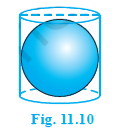
A right circular cylinder just encloses a sphere of radius $r$ (see Fig. 11.10). Find (i) surface area of the sphere,
A right circular cylinder just encloses a sphere of radius $r$ (see Fig. 11.10). Find (ii) curved surface area of the cylinder,
Worksheet Answers
Solution:
The problem requires the calculation of the Surface Area ($SA$) of a sphere given its radius ($r$).
Substitute the given radius value into the formula:
$SA = 4 \times \left( \frac{22}{7} \right) \times (14)^2$
$SA = 4 \times \left( \frac{22}{7} \right) \times 14 \times 14$ [By the definition of exponentiation $x^2 = x \cdot x$]
To simplify, divide $14$ by the denominator $7$:
$SA = 4 \times 22 \times \left( \frac{14}{7} \right) \times 14$
$SA = 4 \times 22 \times 2 \times 14$ [Using associative property of multiplication]
Perform the sequential multiplication:
Since the unit of radius is $\text{cm}$, the unit of surface area is $\text{cm}^2$ [Per the laws of dimensional analysis, where $[L] \times [L] = [L]^2$].
Final Solution: The surface area of the sphere is $2464$ $\text{cm}^2$.
Solution:
To determine the surface area of a sphere, we employ the standard geometric formula derived from integral calculus, which defines the surface area ($A$) in terms of its radius ($r$).
Substituting the given radius into the governing equation:
$A = 4 \times \left(\frac{22}{7}\right) \times (5.6)^2$
$A = 4 \times \left(\frac{22}{7}\right) \times (5.6 \times 5.6)$
Perform the division first to simplify the multiplication:
$5.6 \div 7 = 0.8$
$A = 4 \times 22 \times 0.8 \times 5.6$
$A = 88 \times 4.48$
$A = 394.24$
Since the radius is provided in centimeters ($\text{cm}$), the surface area must be expressed in square centimeters ($\text{cm}^2$) because the units undergo squaring during the operation ($(\text{cm})^2 = \text{cm}^2$).
| Calculation Component | Value |
|---|---|
| Radius ($r$) | $5.6 \text{ cm}$ |
| $r^2$ | $31.36 \text{ cm}^2$ |
| $4\pi r^2$ | $394.24 \text{ cm}^2$ |
Final Solution: The surface area of the sphere is 394.24 $\text{cm}^2$.
Solution:
To determine the outer curved surface area (CSA) of the hemispherical bowl, we identify the following dimensions based on the provided data:
[By the Principle of Geometry for Concentric Spheres/Hemispheres]
The outer radius is the sum of the inner radius and the thickness of the material:
$R = 5\text{ cm} + 0.25\text{ cm} = 5.25\text{ cm}$
Converting to fraction for precision: $R = \frac{21}{4}\text{ cm}$.
The curved surface area ($CSA$) of a full sphere is given by $4\pi r^2$. For a hemispherical bowl, the outer curved surface area is exactly half of the total surface area of a sphere with the outer radius $R$.
Formula: $CSA_{outer} = 2\pi R^2$ [Derived from the geometry of a hemisphere]
Substituting $R = 5.25\text{ cm}$ and taking $\pi \approx \frac{22}{7}$:
$CSA_{outer} = 2 \times \frac{22}{7} \times (5.25)^2$
$CSA_{outer} = 2 \times \frac{22}{7} \times 5.25 \times 5.25$
$CSA_{outer} = 2 \times \frac{22}{7} \times \left(\frac{21}{4}\right) \times \left(\frac{21}{4}\right)$
$CSA_{outer} = 2 \times 22 \times \frac{3 \times 21}{16}$
$CSA_{outer} = 44 \times \frac{63}{16} = 11 \times \frac{63}{4}$
$CSA_{outer} = \frac{693}{4} = 173.25\text{ cm}^2$
Final Solution: The outer curved surface area of the bowl is $173.25\text{ cm}^2$.
Solution:
Given the diameter ($d$) of the sphere:
$d = 3.5 \text{ m}$
To compute the surface area, we first derive the radius ($r$). [Per the definition of a sphere, $r = \frac{d}{2}$].
$r = \frac{3.5}{2} = 1.75 \text{ m}$
Alternatively, in fractional form: $r = \frac{7}{4} \text{ m}$.
The surface area ($S$) of a sphere is defined by the formula:
$S = 4\pi r^2$
[Justification: Based on the surface area of a sphere derivation via calculus, representing the integral of the surface of revolution of a semi-circle].
Substituting the values where $\pi \approx \frac{22}{7}$:
$S = 4 \times \left( \frac{22}{7} \right) \times \left( \frac{7}{4} \right)^2$
$S = 4 \times \frac{22}{7} \times \frac{49}{16}$
Applying algebraic simplification:
$S = 4 \times \frac{22}{1} \times \frac{7}{16}$ [Canceling the $7$ from denominator and numerator]
$S = \frac{4 \times 22 \times 7}{16}$
$S = \frac{88 \times 7}{16}$
$S = \frac{616}{16}$
$S = 38.5 \text{ m}^2$
| Parameter | Value |
|---|---|
| Diameter ($d$) | $3.5 \text{ m}$ |
| Radius ($r$) | $1.75 \text{ m}$ |
| Surface Area ($S$) | $38.5 \text{ m}^2$ |
Final Solution: The surface area of the sphere is $38.5 \text{ m}^2$.
Solution:
The problem provides the diameter ($d$) of a sphere. To calculate the surface area, we must first derive the radius ($r$).
The total surface area ($S$) of a sphere is defined by the formula [Per the standard geometric derivation of spherical surface area]:
$S = 4\pi r^2$
Substitute the value of $r$ into the equation. We utilize $\pi \approx \frac{22}{7}$ for calculation [Standard rational approximation]:
$S = 4 \times \left( \frac{22}{7} \right) \times \left( \frac{21}{2} \right)^2$
Expanding the squared term:
$S = 4 \times \frac{22}{7} \times \frac{21}{2} \times \frac{21}{2}$
Simplifying the numerical expression:
$S = 4 \times \frac{22}{7} \times \frac{441}{4}$
Cancel the common factors $4$ in the numerator and denominator:
$S = \frac{22}{7} \times 441$
Perform the division $441 \div 7 = 63$ [By property of divisibility]:
$S = 22 \times 63$
$S = 1386$ $\text{cm}^2$
| Parameter | Value |
|---|---|
| Radius ($r$) | $10.5$ $\text{cm}$ |
| Surface Area ($4\pi r^2$) | $1386$ $\text{cm}^2$ |
Final Solution: The surface area of the sphere is $1386$ $\text{cm}^2$.
Solution:
The surface area ($S$) of a sphere is defined by the function of its radius ($r$):
$S = 4\pi r^2$ [Per the standard geometric formula for the surface area of a sphere]
Let $S_1$ be the initial surface area and $S_2$ be the final surface area.
$S_1 = 4\pi (r_1)^2 = 4\pi (7)^2 = 4\pi (49) = 196\pi \text{ cm}^2$
$S_2 = 4\pi (r_2)^2 = 4\pi (14)^2 = 4\pi (196) = 784\pi \text{ cm}^2$
The ratio of the surface areas is calculated as $\frac{S_1}{S_2}$:
Ratio = $\frac{4\pi (r_1)^2}{4\pi (r_2)^2}$
Ratio = $\frac{(r_1)^2}{(r_2)^2}$ [By canceling the constant term $4\pi$ from the numerator and denominator]
Ratio = $\left(\frac{r_1}{r_2}\right)^2 = \left(\frac{7}{14}\right)^2$
Ratio = $\left(\frac{1}{2}\right)^2 = \frac{1}{4}$
| Parameter | Initial State | Final State |
|---|---|---|
| Radius ($r$) | $7 \text{ cm}$ | $14 \text{ cm}$ |
| Surface Area ($4\pi r^2$) | $196\pi \text{ cm}^2$ | $784\pi \text{ cm}^2$ |
Final Solution: The ratio of the surface areas of the balloon in the two cases is 1:4.
Solution:
The surface area ($A$) of the sphere is provided as $154 \text{ cm}^2$. We are tasked with determining the radius ($r$) of the sphere.
Substitute the known values into the surface area formula:
$154 = 4 \times \left( \frac{22}{7} \right) \times r^2$
To solve for $r^2$, we must perform inverse operations on the constants:
$r^2 = \frac{154 \times 7}{4 \times 22}$ [Multiplication property of equality]
$r^2 = \frac{154 \times 7}{88}$
$r^2 = \frac{1078}{88}$
Perform the division:
$r^2 = 12.25$
To find $r$, take the square root of both sides:
$r = \sqrt{12.25}$
$r = 3.5 \text{ cm}$
Verification by substituting $r = 3.5$ back into the surface area formula:
$A = 4 \times \left( \frac{22}{7} \right) \times (3.5)^2$
$A = 4 \times \left( \frac{22}{7} \right) \times 12.25$
$A = \frac{88}{7} \times 12.25 = 88 \times 1.75 = 154 \text{ cm}^2$ [The result matches the given area, confirming validity]
Final Solution: The radius of the sphere is $3.5 \text{ cm}$.
Solution:
Let the diameter of the Earth be $D_e$ and the radius of the Earth be $r_e$.
Let the diameter of the Moon be $D_m$ and the radius of the Moon be $r_m$.
Per the problem statement, the diameter of the moon is one-fourth of the diameter of the earth:
$D_m = \frac{1}{4} D_e$
Since the radius $r$ is defined as $\frac{D}{2}$, we can derive the relationship between the radii:
$2r_m = \frac{1}{4}(2r_e)$
$r_m = \frac{1}{4} r_e$ [By division property of equality]
Both celestial bodies are approximated as spheres. The surface area ($SA$) of a sphere is given by the formula:
$SA = 4\pi r^2$ [Geometric definition of spherical surface area]
We seek the ratio $\frac{SA_m}{SA_e}$:
$\frac{SA_m}{SA_e} = \frac{4\pi (r_m)^2}{4\pi (r_e)^2}$
Canceling the constant term $4\pi$:
$\text{Ratio} = \left( \frac{r_m}{r_e} \right)^2$
Substitute the relationship $r_m = \frac{1}{4}r_e$:
$\text{Ratio} = \left( \frac{\frac{1}{4}r_e}{r_e} \right)^2$
$\text{Ratio} = \left( \frac{1}{4} \right)^2$
$\text{Ratio} = \frac{1^2}{4^2} = \frac{1}{16}$
Final Solution: The ratio of the surface area of the Moon to the surface area of the Earth is $1:16$.
Solution:
The geometric figure is a hemisphere. The primary dimension provided is:
The total surface area ($TSA$) of a solid hemisphere consists of two components: the curved surface area (CSA) and the area of the circular base. [Per the geometry of a sphere, the CSA of a hemisphere is $\frac{1}{2}(4\pi r^2) = 2\pi r^2$. The circular base area is $\pi r^2$. Thus, $TSA = 2\pi r^2 + \pi r^2 = 3\pi r^2$].
Formula: $TSA = 3\pi r^2$
Substitute the given values into the derived formula:
$TSA = 3 \times 3.14 \times (10\text{ cm})^2$
[By the Order of Operations / PEMDAS]:
$TSA = 3 \times 3.14 \times 100\text{ cm}^2$
$TSA = 3 \times 314\text{ cm}^2$
$TSA = 942\text{ cm}^2$
| Component | Mathematical Expression |
|---|---|
| Curved Surface Area | $2 \times 3.14 \times 100 = 628\text{ cm}^2$ |
| Circular Base Area | $1 \times 3.14 \times 100 = 314\text{ cm}^2$ |
| Total Surface Area | $942\text{ cm}^2$ |
Final Solution: The total surface area of the hemisphere is 942 cm².
Solution:
To solve for the cost of tin-plating the interior surface of the hemispherical bowl, we must first identify the dimensions provided:
The inner surface of a hemispherical bowl is represented by the Curved Surface Area (CSA). [Per the geometry of a hemisphere, the CSA is exactly half of the total surface area of a sphere].
Formula: $\text{CSA} = 2\pi r^2$
Substitute the value of $r$ into the formula [Using $\pi \approx \frac{22}{7}$]:
$\text{CSA} = 2 \times \left(\frac{22}{7}\right) \times (5.25)^2$
$\text{CSA} = 2 \times \left(\frac{22}{7}\right) \times 5.25 \times 5.25$
$\text{CSA} = 2 \times \left(\frac{22}{7}\right) \times 27.5625$
$\text{CSA} = 44 \times 3.9375$
$\text{CSA} = 173.25\text{ cm}^2$
The cost is calculated based on the rate provided per $100\text{ cm}^2$.
$\text{Cost} = \left(\frac{\text{Area}}{100}\right) \times \text{Rate}$
$\text{Cost} = \left(\frac{173.25}{100}\right) \times 16$
$\text{Cost} = 1.7325 \times 16$
$\text{Cost} = 27.72$
| Component | Value |
|---|---|
| Inner Radius | $5.25\text{ cm}$ |
| Inner Surface Area | $173.25\text{ cm}^2$ |
| Final Calculated Cost | ₹ $27.72$ |
Final Solution: The cost of tin-plating the inside of the hemispherical bowl is ₹ 27.72.
Solution:
Given that a sphere of radius $r$ is enclosed in a right circular cylinder, we define the parameters of both solids based on the sphere's dimensions:
We proceed by evaluating the surface areas defined in the sub-questions (i) and (ii).
| Solid | Formula | Substitution | Result |
|---|---|---|---|
| (i) Surface Area of Sphere ($A_s$) | $4\pi r^2$ | $4\pi r^2$ | $4\pi r^2$ |
| (ii) Curved Surface Area of Cylinder ($A_c$) | $2\pi r_c h$ | $2\pi(r)(2r)$ | $4\pi r^2$ |
To find the ratio of the surface area of the sphere ($A_s$) to the curved surface area of the cylinder ($A_c$), we perform the following division [Per the definition of ratio as a multiplicative comparison]:
$$\text{Ratio} = \frac{A_s}{A_c}$$
Substituting the derived values:
$$\text{Ratio} = \frac{4\pi r^2}{4\pi r^2}$$
Simplifying the fraction by dividing both numerator and denominator by the common factor $4\pi r^2$ ($r > 0$):
$$\text{Ratio} = \frac{1}{1}$$
Final Solution: The ratio of the surface area of the sphere to the curved surface area of the cylinder is 1:1.
Solution:
Given that a sphere of radius $r$ is just enclosed by a right circular cylinder, the physical constraints of the containment dictate the dimensions of the cylinder:
The surface area ($A_s$) of a sphere is defined by the geometric constant involving the square of its radius. The standard formula derived from integral calculus [per the Archimedes' discovery of sphere surface area properties] is:
$A_s = 4 \pi r^2$
Since the problem specifically asks for the surface area of the sphere, we utilize the radius $r$ as the independent variable. The relationship is:
$A_s = 4 \times \pi \times (\text{radius})^2$
Substituting the given variable $r$:
$A_s = 4 \pi r^2$
Final Solution: The surface area of the sphere is $4 \pi r^2$ square units.
Solution:
Given that a right circular cylinder just encloses a sphere of radius $r$, the physical constraints of the containment define the dimensions of the cylinder relative to the sphere:
The curved surface area of a cylinder is defined by the product of the circumference of its base and its height [Per the geometric definition of a cylinder's lateral surface]:
$CSA_{cylinder} = 2\pi Rh$
Substitute the established values $R = r$ and $h = 2r$ into the CSA formula:
$CSA = 2 \times \pi \times (r) \times (2r)$
$CSA = 2 \times 2 \times \pi \times r^2$
$CSA = 4\pi r^2$
The resulting value $4\pi r^2$ is numerically identical to the surface area of the enclosed sphere. This demonstrates Archimedes' theorem, which states that the surface area of a sphere is equal to the curved surface area of the circumscribing cylinder [Per Archimedean Geometry].
Final Solution: The curved surface area of the cylinder is $4\pi r^2$ square units.
Solution:
For a sphere, the surface area ($SA$) is defined by the geometric relation $SA = 4\pi r^2$, where $r$ is the radius of the sphere. Given the diameter ($d$) of the sphere is $14 \text{ cm}$.
The relationship between diameter and radius is given by $r = \frac{d}{2}$ [Per the definition of Euclidean geometry for circular and spherical cross-sections].
Calculating the radius:
$r = \frac{14 \text{ cm}}{2} = 7 \text{ cm}$
We utilize the standard approximation for $\pi \approx \frac{22}{7}$ [As defined in classical Euclidean geometry problems for ease of calculation].
Substituting the values into the formula $SA = 4\pi r^2$:
$SA = 4 \times \frac{22}{7} \times (7 \text{ cm})^2$
$SA = 4 \times \frac{22}{7} \times 49 \text{ cm}^2$
Simplify the expression by canceling the common factor of $7$ in the denominator and numerator:
$SA = 4 \times 22 \times 7 \text{ cm}^2$ [By the Commutative Property of Multiplication]
$SA = 88 \times 7 \text{ cm}^2$
$SA = 616 \text{ cm}^2$
| Parameter | Value |
|---|---|
| Diameter ($d$) | $14 \text{ cm}$ |
| Radius ($r$) | $7 \text{ cm}$ |
| Surface Area Formula | $4\pi r^2$ |
| Total Surface Area | $616 \text{ cm}^2$ |
Final Solution: The surface area of the sphere with a diameter of $14 \text{ cm}$ is $616 \text{ cm}^2$.
Solution:
The problem provides the radius ($r$) of a sphere. To find the total surface area ($SA$) of the sphere, we utilize the standard geometric formula derived from integral calculus for the surface area of a sphere.
The surface area of a sphere is defined as four times the area of a circle with the same radius [Per the definition of Surface Area of a Sphere in Euclidean Geometry].
$SA = 4\pi r^2$
Substitute the given value $r = 10.5\text{ cm}$ into the formula:
$SA = 4 \times \left( \frac{22}{7} \right) \times (10.5)^2$
$SA = 4 \times \left( \frac{22}{7} \right) \times 10.5 \times 10.5$
Perform the division and multiplication systematically:
Since the radius is given in centimeters ($\text{cm}$), the area is calculated as:
Area = $\text{unit} \times \text{unit} = \text{cm} \times \text{cm} = \text{cm}^2$ [Per the principle of Dimensional Homogeneity]
Final Solution: The surface area of the sphere is $1386\text{ cm}^2$


