


Your Worksheet is Ready
CBSE - Class 9 Mathematics Quadrilaterals Worksheet
EXERCISE 8.1
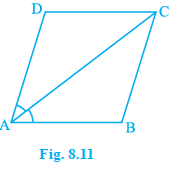
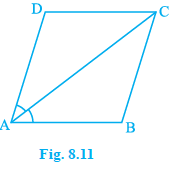
Diagonal $AC$ of a parallelogram $ABCD$ bisects $\angle A$ (see Fig. 8.11). Show that (i) it bisects $\angle C$ also,
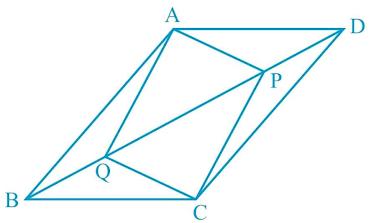
In parallelogram $ABCD$, two points $P$ and $Q$ are taken on diagonal $BD$ such that $DP = BQ$ (see Fig. 8.12). Show that: (iii) $\Delta AQB \cong \Delta CPD$

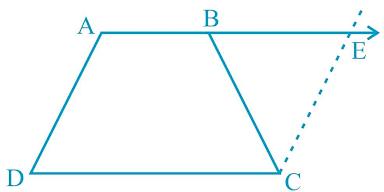
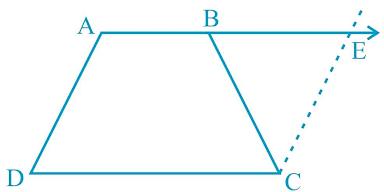
$ABCD$ is a trapezium in which $AB \| CD$ and $AD = BC$ (see Fig. 8.14). Show that (i) $\angle A = \angle B$ [Hint : Extend $AB$ and draw a line through $C$ parallel to $DA$ intersecting $AB$ produced at $E$.]
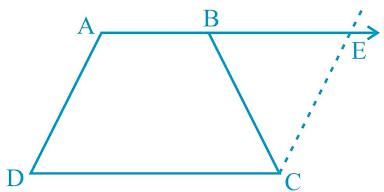

$ABCD$ is a trapezium in which $AB \| CD$ and $AD = BC$ (see Fig. 8.14). Show that (ii) $\angle C = \angle D$ [Hint : Extend $AB$ and draw a line through $C$ parallel to $DA$ intersecting $AB$ produced at $E$.]

Diagonal $AC$ of a parallelogram $ABCD$ bisects $\angle A$ (see Fig. 8.11). Show that (ii) $ABCD$ is a rhombus.
$ABCD$ is a trapezium in which $AB \| CD$ and $AD = BC$ (see Fig. 8.14). Show that (iv) diagonal $AC$ = diagonal $BD$ [Hint : Extend $AB$ and draw a line through $C$ parallel to $DA$ intersecting $AB$ produced at $E$.]

In parallelogram $ABCD$, two points $P$ and $Q$ are taken on diagonal $BD$ such that $DP = BQ$ (see Fig. 8.12). Show that: (iv) $AQ = CP$

$ABCD$ is a trapezium in which $AB \| CD$ and $AD = BC$ (see Fig. 8.14). Show that (iii) $\Delta ABC \cong \Delta BAD$ [Hint : Extend $AB$ and draw a line through $C$ parallel to $DA$ intersecting $AB$ produced at $E$.]


In parallelogram $ABCD$, two points $P$ and $Q$ are taken on diagonal $BD$ such that $DP = BQ$ (see Fig. 8.12). Show that: (i) $\Delta APD \cong \Delta CQB$

$ABCD$ is a parallelogram and $AP$ and $CQ$ are perpendiculars from vertices $A$ and $C$ on diagonal $BD$ (see Fig. 8.13). Show that (i) $\Delta APB \cong \Delta CQD$

$ABCD$ is a parallelogram and $AP$ and $CQ$ are perpendiculars from vertices $A$ and $C$ on diagonal $BD$ (see Fig. 8.13). Show that (ii) $AP = CQ$

In parallelogram $ABCD$, two points $P$ and $Q$ are taken on diagonal $BD$ such that $DP = BQ$ (see Fig. 8.12). Show that: (v) $APCQ$ is a parallelogram

In parallelogram $ABCD$, two points $P$ and $Q$ are taken on diagonal $BD$ such that $DP = BQ$ (see Fig. 8.12). Show that: (ii) $AP = CQ$

Worksheet Answers


