


Your Worksheet is Ready
CBSE - Class 9 Mathematics Triangles Worksheet
EXERCISE 7.1
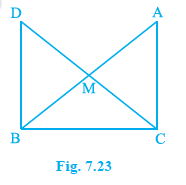
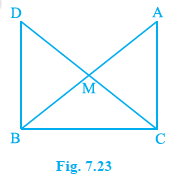
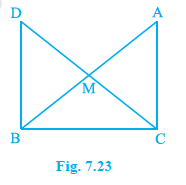
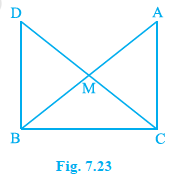
In right triangle ABC, right angled at $C$, $M$ is the mid-point of hypotenuse $AB$. $C$ is joined to $M$ and produced to a point $D$ such that $DM = CM$. Point $D$ is joined to point $B$ (see Fig. 7.23). Show that: (iii) $\triangle DBC \cong \triangle ACB$
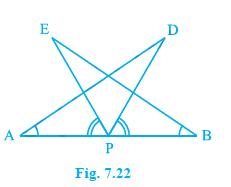
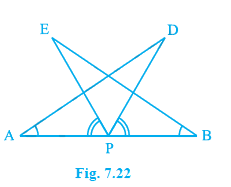
$AB$ is a line segment and $P$ is its mid-point. $D$ and $E$ are points on the same side of $AB$ such that $\angle BAD = \angle ABE$ and $\angle EPA = \angle DPB$ (see Fig. 7.22). Show that (i) $\triangle DAP \cong \triangle EBP$
In right triangle ABC, right angled at $C$, $M$ is the mid-point of hypotenuse $AB$. $C$ is joined to $M$ and produced to a point $D$ such that $DM = CM$. Point $D$ is joined to point $B$ (see Fig. 7.23). Show that: (ii) $\angle DBC$ is a right angle.
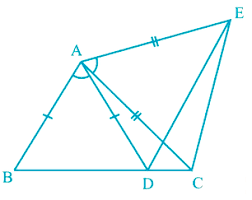
In Fig. 7.21, $AC = AE$, $AB = AD$ and $\angle BAD = \angle EAC$. Show that $BC = DE$.

$AB$ is a line segment and $P$ is its mid-point. $D$ and $E$ are points on the same side of $AB$ such that $\angle BAD = \angle ABE$ and $\angle EPA = \angle DPB$ (see Fig. 7.22). Show that (ii) $AD = BE$
In right triangle ABC, right angled at $C$, $M$ is the mid-point of hypotenuse $AB$. $C$ is joined to $M$ and produced to a point $D$ such that $DM = CM$. Point $D$ is joined to point $B$ (see Fig. 7.23). Show that: (iv) $CM = \frac{1}{2} AB$
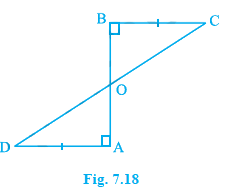
$AD$ and $BC$ are equal perpendiculars to a line segment $AB$ (see Fig. 7.18). Show that $CD$ bisects $AB$.
In right triangle ABC, right angled at $C$, $M$ is the mid-point of hypotenuse $AB$. $C$ is joined to $M$ and produced to a point $D$ such that $DM = CM$. Point $D$ is joined to point $B$ (see Fig. 7.23). Show that: (i) $\triangle AMC \cong \triangle BMD$
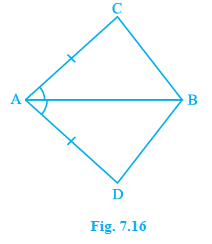
In quadrilateral ACBD, $AC = AD$ and $AB$ bisects $\angle A$ (see Fig. 7.16). Show that $\triangle ABC \cong \triangle ABD$. What can you say about $BC$ and $BD$?
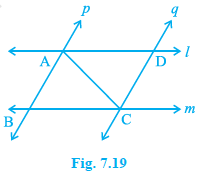
$l$ and $m$ are two parallel lines intersected by another pair of parallel lines $p$ and $q$ (see Fig. 7.19). Show that $\triangle ABC \cong \triangle CDA$.
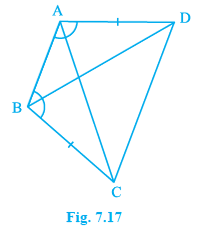
ABCD is a quadrilateral in which $AD = BC$ and $\angle DAB = \angle CBA$ (see Fig. 7.17). Prove that (i) $\triangle ABD \cong \triangle BAC$
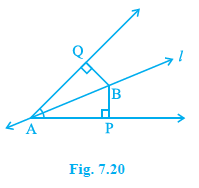
Line $l$ is the bisector of an angle $\angle A$ and $B$ is any point on $l$. $BP$ and $BQ$ are perpendiculars from $B$ to the arms of $\angle A$ (see Fig. 7.20). Show that: (ii) $BP = BQ$ or $B$ is equidistant from the arms of $\angle A$.
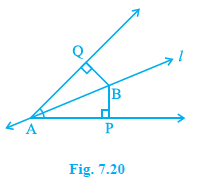
Line $l$ is the bisector of an angle $\angle A$ and $B$ is any point on $l$. $BP$ and $BQ$ are perpendiculars from $B$ to the arms of $\angle A$ (see Fig. 7.20). Show that: (i) $\triangle APB \cong \triangle AQB$
ABCD is a quadrilateral in which $AD = BC$ and $\angle DAB = \angle CBA$ (see Fig. 7.17). Prove that (ii) $BD = AC$
ABCD is a quadrilateral in which $AD = BC$ and $\angle DAB = \angle CBA$ (see Fig. 7.17). Prove that (iii) $\angle ABD = \angle BAC$.
Worksheet Answers


