


Your Worksheet is Ready
CBSE - Class 9 Mathematics Introduction to Euclid’s Geometry Worksheet
EXERCISE 5.1
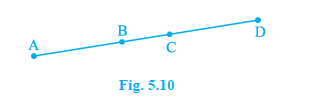
In Fig. 5.10, if $AC = BD$, then prove that $AB = CD$.
Which of the following statements are true and which are false? Give reasons for your answers. (v) In Fig. 5.9, if $AB = PQ$ and $PQ = XY$, then $AB = X
Worksheet Answers
Solution:
Consider a line segment $AB$. By geometric definition, a point $C$ is considered the mid-point of the line segment $AB$ if it lies on the segment between $A$ and $B$, and divides it into two equal parts. Mathematically, this is expressed as:
$AC = BC$
Since point $C$ lies on the line segment $AB$, the sum of the parts equals the whole [Per Euclid's Axiom 4: Things which coincide with one another are equal to one another, and Axiom 5: The whole is greater than the part]. Therefore:
$AC + BC = AB$
Substituting $BC$ with $AC$ yields:
$AC + AC = AB \implies 2AC = AB \implies AC = \frac{1}{2}AB \quad \text{--- (Equation 1)}$
To prove that a line segment has one and only one mid-point, we will utilize a proof by contradiction. We begin by assuming the opposite of our desired conclusion.
Assumption: Let us assume that the line segment $AB$ has two distinct mid-points, namely $C$ and $D$.
If $D$ is also a mid-point of the line segment $AB$, it must satisfy the exact same geometric conditions as point $C$. Therefore, $D$ divides $AB$ into two equal parts ($AD = DB$). Following the identical algebraic derivation from Step 1, we obtain:
$AD = \frac{1}{2}AB \quad \text{--- (Equation 2)}$
Now, we analyze Equation 1 and Equation 2:
We apply Euclid’s First Axiom: "Things which are equal to the same thing are equal to one another."
Since both $AC$ and $AD$ are equal to $\frac{1}{2}AB$, they must be equal to each other:
$AC = AD$
We have established that the distance from $A$ to $C$ is exactly equal to the distance from $A$ to $D$ along the same line segment $AB$.
Because points $C$ and $D$ both lie on the line segment $AB$ and are measured from the same origin point $A$ in the same direction, the equation $AC = AD$ implies that there is zero distance between point $C$ and point $D$.
By Euclid’s Fourth Axiom: "Things which coincide with one another are equal to one another." Conversely, since the lengths are equal and share the same initial point and direction, the endpoints must coincide. Therefore, point $C$ and point $D$ are not distinct; they are the exact same point.
This directly contradicts our initial assumption that $C$ and $D$ are two distinct mid-points. Because the assumption leads to a logical impossibility, the assumption must be false.
Final Solution: By proving that any assumed second mid-point must perfectly coincide with the first, we have rigorously demonstrated that every line segment possesses one, and only one, mid-point.
Solution:
In Euclidean geometry, a square is defined as a regular quadrilateral. Specifically, it is a closed, two-dimensional flat figure bounded by four straight line segments where:
[Per Euclidean classification, a square can also be defined as a rectangle with two adjacent equal sides, or a rhombus with a right interior angle.]
Yes, to rigorously define a "square," several foundational geometric terms must be defined first to avoid circular reasoning. The definition of a square relies on the concepts of a quadrilateral, line segment, angle, and right angle. Furthermore, these terms rely on the undefined primitive terms of Euclidean geometry: point, line, and plane.
To construct the definition of a square from the ground up, the following sequence of definitions is required:
The following diagram illustrates a square $ABCD$, demonstrating the equality of its four sides and the $90^\circ$ measure of its four interior angles.
By defining the primitive and intermediate terms, we establish a rigorous axiomatic foundation. A square cannot exist without the concept of a quadrilateral, which cannot exist without line segments, which in turn rely on points and lines. The condition of "equal sides" requires the concept of geometric congruence, and "right angles" requires the definition of angular measure.
Final Solution: A square is defined as a quadrilateral with all four sides equal and all four angles as right angles ($90^\circ$). Yes, other terms must be defined first. The prerequisite terms are "quadrilateral," "line segment," "angle," "right angle," "point," and "line," which are defined sequentially from undefined primitive concepts to complex polygons to ensure logical consistency in Euclidean geometry.


