


Your Worksheet is Ready
CBSE - Class 9 Mathematics Coordinate Geometry Worksheet
EXERCISE 9.2
A gardener wants to fence a circular garden of diameter $21$ m. Find the length of the rope he needs to purchase, if he makes $2$ rounds of fence. Also find the cost of the rope, if it costs ₹ $4$ per meter. (Take $\pi = \frac{22}{7}$)
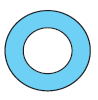
From a circular sheet of radius $4$ cm, a circle of radius $3$ cm is removed. Find the area of the remaining sheet. (Take $\pi = 3.14$)
From a circular card sheet of radius $14$ cm, two circles of radius $3.5$ cm and a rectangle of length $3$ cm and breadth $1$cm are removed. (as shown in the adjoining figure). Find the area of the remaining sheet. (Take $\pi = \frac{22}{7}$)

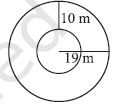
Find the circumference of the inner and the outer circles, shown in the adjoining figure? (Take $\pi = 3.14$)
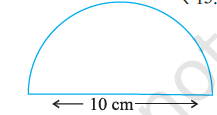
Find the perimeter of the adjoining figure, which is a semicircle including its diameter.
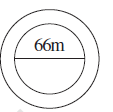
A circular flower bed is surrounded by a path $4$ m wide. The diameter of the flower bed is $66$ m. What is the area of this path? ($\pi = 3.14$)
Worksheet Answers
Solution:
We are tasked with determining the area of a two-dimensional circle given its diameter. The primary parameter provided is:
The radius ($r$) of a circle is defined as the linear distance from the center point to any point on its circumference. [Per Euclidean geometry, the diameter is the longest chord of the circle passing directly through the center, making it exactly twice the length of the radius]. Therefore, we establish the fundamental relationship:
$r = \frac{d}{2}$
Substituting the given diameter into the equation:
$r = \frac{49}{2} \text{ m} = 24.5 \text{ m}$
Below is a scaled geometric representation of the circle, illustrating the relationship between the diameter and the radius.
The area ($A$) of a circle is calculated using the standard formula:
$A = \pi r^2$
[Derived historically via the method of exhaustion by Archimedes, where the area of a circle is proven to be the limit of the areas of inscribed regular polygons as the number of sides approaches infinity].
For this computation, we will utilize the rational approximation $\pi \approx \frac{22}{7}$. This specific approximation is strategically chosen because the radius ($\frac{49}{2}$) contains a numerator that is a multiple of $7$, which will elegantly simplify the subsequent arithmetic.
Substitute $r = \frac{49}{2} \text{ m}$ and $\pi = \frac{22}{7}$ into the area formula:
$A = \frac{22}{7} \times \left(\frac{49}{2}\right)^2$
Expand the squared term to prepare for cross-cancellation:
$A = \frac{22}{7} \times \frac{49}{2} \times \frac{49}{2}$
Perform cross-cancellation to simplify the fractional expression. Divide $22$ by $2$ to yield $11$, and divide $49$ by $7$ to yield $7$:
$A = 11 \times 7 \times \frac{49}{2}$
Multiply the integer terms:
$A = 77 \times \frac{49}{2}$
Convert the remaining fraction to a decimal for final multiplication ($ \frac{49}{2} = 24.5 $):
$A = 77 \times 24.5$
Execute the final multiplication:
$A = 1886.5 \text{ m}^2$
Final Solution: The area of the circle is $1886.5 \text{ m}^2$.
Solution:
We are given the following geometric parameters for a circle:
The area ($A$) of a circle represents the total two-dimensional space enclosed within its boundary (circumference). [Per the geometric principles of Euclidean space], the area of a circle is directly proportional to the square of its radius. The formula is given by:
$A = \pi r^2$
To find the area, we substitute the given radius $r = 14 \text{ mm}$ and the fractional approximation of $\pi = \frac{22}{7}$ into the standard area formula:
$A = \left(\frac{22}{7}\right) \times (14 \text{ mm})^2$
First, expand the squared term to separate the numerical values from the units:
$A = \frac{22}{7} \times (14 \times 14) \text{ mm}^2$
$A = \frac{22}{7} \times 196 \text{ mm}^2$
To optimize the calculation without dealing with large numbers, we can simplify the expression by dividing one of the $14$ factors by the denominator $7$ [By the fundamental property of fractions and associative multiplication]:
$A = 22 \times \left(\frac{14}{7}\right) \times 14 \text{ mm}^2$
$A = 22 \times 2 \times 14 \text{ mm}^2$
Now, proceed with sequential multiplication:
$A = (22 \times 2) \times 14 \text{ mm}^2$
$A = 44 \times 14 \text{ mm}^2$
Perform the final multiplication step:
$A = 44 \times (10 + 4) \text{ mm}^2$
$A = 440 + 176 \text{ mm}^2$
$A = 616 \text{ mm}^2$
The radius is given in millimeters ($\text{mm}$). When the radius is squared in the formula ($r^2$), the unit is also squared ($\text{mm} \times \text{mm} = \text{mm}^2$). This confirms that our final unit correctly represents a two-dimensional area.
Final Solution: The area of the circle is $616 \text{ mm}^2$.
Solution:
We are tasked with determining the total boundary length, formally known as the circumference, of a circle. The following parameters are provided for the calculation:
The circumference ($C$) of a circle is directly proportional to its radius. The constant of proportionality relating the circumference to the diameter ($2r$) is $\pi$. [Per the fundamental axioms of Euclidean geometry, the ratio of a circle's circumference to its diameter is constant for all circles].
The governing formula for the circumference is:
$C = 2\pi r$
Substitute the given values for $\pi$ and $r$ into the circumference formula:
$C = 2 \times \left(\frac{22}{7}\right) \times 21$
To simplify the expression efficiently, we can divide the radius ($21$) by the denominator of $\pi$ ($7$). [By the associative and commutative properties of multiplication, we can group the terms to facilitate integer division].
$C = 2 \times 22 \times \left(\frac{21}{7}\right)$
$C = 2 \times 22 \times 3$
Multiply the remaining integer values sequentially to find the total length:
$C = 44 \times 3$
$C = 132$
Because the radius is provided in centimeters (cm), the circumference—being a one-dimensional measure of length—must also be expressed in centimeters.
Final Solution: The circumference of the circle is $132\text{ cm}$.
Solution:
Let us define the geometric and financial parameters provided for the circular garden:
The following diagram illustrates the circular garden from a top-down perspective, including the diameter and the two concentric rounds of rope fencing required.
The length of rope required for a single round of fencing is exactly equal to the perimeter (circumference) of the circular garden. [Per the geometric definition of a circle's circumference, the boundary length is a function of its diameter].
The formula for the circumference $C$ is given by:
$C = \pi d$
Substituting the given values into the equation:
$C = \left(\frac{22}{7}\right) \times 21 \text{ m}$
By simplifying the fraction [dividing $21$ by $7$ yields $3$]:
$C = 22 \times 3 \text{ m} = 66 \text{ m}$
Thus, one complete round around the garden requires $66 \text{ m}$ of rope.
Since the gardener intends to make $2$ complete rounds of the fence, the total length of the rope ($L_{\text{total}}$) is the circumference multiplied by the number of rounds. [Total Length = $n \times C$].
$L_{\text{total}} = 2 \times 66 \text{ m}$
$L_{\text{total}} = 132 \text{ m}$
The total financial cost is the product of the total length of the rope and the unit cost per meter. [Total Cost = $L_{\text{total}} \times C_{\text{unit}}$].
$\text{Total Cost} = 132 \text{ m} \times \text{₹ } 4 / \text{m}$
$\text{Total Cost} = \text{₹ } 528$
Final Solution: The total length of the rope required to fence the garden with 2 rounds is $132 \text{ m}$, and the total cost of purchasing the rope is ₹ $528$.
Solution:
We are analyzing a two-dimensional circular sheet with the following given parameters:
Our objective is to determine the radius ($r$) and the total enclosed area ($A$) of the circular sheet.
The circumference of a circle is defined as the continuous linear distance forming the boundary of the closed geometric figure. [Per standard Euclidean geometry, the formula relating circumference to radius is $C = 2\pi r$].
Substituting the given values into the equation:
$154 = 2 \times \left(\frac{22}{7}\right) \times r$
Multiplying the constants on the right side of the equation:
$154 = \frac{44}{7} \times r$
To isolate the variable $r$, we multiply both sides of the equation by the reciprocal of $\frac{44}{7}$, which is $\frac{7}{44}$:
$r = 154 \times \frac{7}{44}$
We can simplify the fraction by recognizing that both $154$ and $44$ are divisible by $22$:
$r = \left(\frac{154}{22}\right) \times \left(\frac{7}{2}\right)$
$r = 7 \times \frac{7}{2}$
$r = \frac{49}{2} = 24.5 \text{ m}$
The area of a circle represents the total two-dimensional space enclosed within its circumference. [The fundamental formula for the area of a circle is $A = \pi r^2$].
Substituting $r = \frac{49}{2}$ m and $\pi = \frac{22}{7}$ into the area formula to maintain absolute precision before the final decimal conversion:
$A = \frac{22}{7} \times \left(\frac{49}{2}\right)^2$
Expanding the squared term:
$A = \frac{22}{7} \times \frac{49}{2} \times \frac{49}{2}$
Executing the arithmetic simplification by cross-canceling the terms in the numerator and denominator:
$A = 11 \times 7 \times \frac{49}{2}$
$A = 77 \times \frac{49}{2}$
$A = \frac{3773}{2}$
Converting the improper fraction to a precise decimal:
$A = 1886.5 \text{ m}^2$
Final Solution: The radius of the circular sheet is $24.5$ m, and its total enclosed area is $1886.5$ m$^2$.
Solution:
We are analyzing a composite two-dimensional geometric system where a smaller circle is concentrically removed from a larger circular sheet. The parameters defining this system are:
The figure below illustrates the concentric nature of the two circles. The region between the outer boundary and the inner boundary represents the remaining sheet, geometrically defined as an annulus.
To find the area of the remaining sheet, we must subtract the area of the inner circle from the area of the outer circular sheet. Let $A$ represent the area of the remaining sheet.
$A = \text{Area of Outer Circle} - \text{Area of Inner Circle}$
$A = \pi R^2 - \pi r^2$ [Per the standard area formula for a circle, $Area = \pi \times \text{radius}^2$]
To optimize the calculation, we factor out the common constant $\pi$:
$A = \pi (R^2 - r^2)$ [By the distributive property of multiplication over subtraction]
Substitute the given numerical values into the factored equation:
$A = 3.14 \times (4^2 - 3^2)$
First, resolve the exponents inside the parentheses:
Substitute these squared values back into the equation:
$A = 3.14 \times (16 - 9)$
Perform the subtraction operation:
$A = 3.14 \times 7$
Multiply the remaining terms to find the final area:
$A = 21.98$
Since the radii were provided in centimeters ($\text{cm}$), the resulting area must be expressed in square centimeters ($\text{cm}^2$) [Per the dimensional analysis of area, $L \times L = L^2$].
Final Solution: The area of the remaining sheet is $21.98 \text{ cm}^2$.
Solution:
To determine the area of the remaining card sheet, we must first establish the dimensions of the original geometric figure and the components that are removed. The problem provides the following parameters:
The following scale-accurate diagram illustrates the original circular sheet with the two smaller circles and the rectangle removed. [The diagram uses a scale factor of $10\times$ for visual clarity, where $14 \text{ cm}$ is represented by $140 \text{ units}$].
The area of a circle is given by the formula $A = \pi r^2$. Applying this to the large circular sheet:
$A_{\text{total}} = \pi R^2$
$A_{\text{total}} = \frac{22}{7} \times (14)^2$
$A_{\text{total}} = \frac{22}{7} \times 196$
$A_{\text{total}} = 22 \times 28$
$A_{\text{total}} = 616 \text{ cm}^2$
[Per the geometric principle of area addition, we must calculate the individual areas of all removed disjoint regions and sum them].
1. Area of the Two Small Circles:
First, we find the area of one small circle. To simplify the calculation, we can express the radius $3.5 \text{ cm}$ as the fraction $\frac{7}{2} \text{ cm}$.
$A_{\text{small\_circle}} = \pi r^2$
$A_{\text{small\_circle}} = \frac{22}{7} \times \left(\frac{7}{2}\right)^2$
$A_{\text{small\_circle}} = \frac{22}{7} \times \frac{49}{4}$
$A_{\text{small\_circle}} = \frac{22 \times 7}{4} = \frac{154}{4} = 38.5 \text{ cm}^2$
Since two identical circles are removed, their combined area is:
$A_{\text{both\_circles}} = 2 \times 38.5 \text{ cm}^2 = 77 \text{ cm}^2$
2. Area of the Rectangle:
The area of a rectangle is the product of its length and breadth ($A = l \times b$).
$A_{\text{rectangle}} = 3 \text{ cm} \times 1 \text{ cm} = 3 \text{ cm}^2$
3. Total Removed Area:
Summing the areas of the removed components yields:
$A_{\text{removed}} = A_{\text{both\_circles}} + A_{\text{rectangle}}$
$A_{\text{removed}} = 77 \text{ cm}^2 + 3 \text{ cm}^2 = 80 \text{ cm}^2$
[By the axiom of area subtraction, the area of a region remaining after removing sub-regions is equal to the area of the original region minus the total area of the removed sub-regions].
$A_{\text{remaining}} = A_{\text{total}} - A_{\text{removed}}$
$A_{\text{remaining}} = 616 \text{ cm}^2 - 80 \text{ cm}^2$
$A_{\text{remaining}} = 536 \text{ cm}^2$
Final Solution: The area of the remaining sheet is $536 \text{ cm}^2$.
Solution:
To determine the length and cost of the lace required for the circular table cover, we first extract the given geometric and financial parameters:
The lace is to be attached to the outer edge of the circular table cover. In Euclidean geometry, the continuous line forming the boundary of a closed geometric figure is its perimeter. For a circle, this boundary is defined as the circumference.
The total length of the lace required is mathematically equivalent to the circumference of the circle. [Per the geometric definition of a circle's perimeter, $C = \pi d$ or $C = 2\pi r$].
Using the diameter formula for circumference:
$C = \pi \times d$
Substituting the given values into the equation:
$C = 3.14 \times 1.5 \text{ m}$
Performing the arithmetic multiplication:
$C = 4.71 \text{ m}$
Therefore, the exact length of the lace required to cover the edge of the table is $4.71 \text{ m}$.
The total financial cost is determined by taking the product of the total length of the lace and the unit cost per meter. [By the principle of linear proportionality in unit pricing].
$\text{Total Cost} = \text{Total Length of Lace} \times \text{Cost per meter}$
Substituting the calculated length and the given rate:
$\text{Total Cost} = 4.71 \text{ m} \times 15 \text{ ₹/m}$
Breaking down the multiplication for precision:
$\text{Total Cost} = 70.65 \text{ ₹}$
Final Solution: The total length of the lace required to cover the edge of the circular table is $4.71 \text{ m}$, and the total cost to purchase this lace is ₹ $70.65$.
Solution:
Based on the standard geometric configuration of this problem, the figure consists of two concentric circles (circles sharing the same center point). The parameters provided are:
The circumference $C$ of any circle is given by the formula $C = 2\pi r$, where $r$ is the radius. [Per the fundamental geometric definition of a circle's perimeter].
For the outer circle, we substitute the given outer radius $R = 19 \text{ m}$:
$C_{\text{outer}} = 2 \pi R$
$C_{\text{outer}} = 2 \times 3.14 \times 19$
$C_{\text{outer}} = 6.28 \times 19$
$C_{\text{outer}} = 119.32 \text{ m}$
The inner circle and the outer circle are concentric. The radius of the inner circle $r$ can be found by subtracting the width of the track from the radius of the outer circle $R$. [By the spatial properties of concentric circles].
$r = R - w$
$r = 19 \text{ m} - 10 \text{ m}$
$r = 9 \text{ m}$
Using the derived inner radius $r = 9 \text{ m}$, we apply the circumference formula again for the inner circle:
$C_{\text{inner}} = 2 \pi r$
$C_{\text{inner}} = 2 \times 3.14 \times 9$
$C_{\text{inner}} = 6.28 \times 9$
$C_{\text{inner}} = 56.52 \text{ m}$
Final Solution: The circumference of the outer circle is $119.32 \text{ m}$ and the circumference of the inner circle is $56.52 \text{ m}$.
Solution:
We are given a single continuous wire of a fixed length that is bent into two different geometric shapes (a circle and a square) in separate scenarios. The fundamental principle governing this problem is the Conservation of Perimeter, which states that the total boundary length of any shape formed by the wire must equal the total length of the wire.
When the wire is bent into the shape of a circle, the entire length of the wire forms the boundary of the circle. [Per the geometric definition of circumference, the perimeter of a circle is its circumference].
Let $r$ be the radius of the circle. The formula for the circumference $C$ is:
$C = 2\pi r$
Equating the circumference to the total length of the wire:
$2\pi r = 44$
Substituting the given value of $\pi$:
$2 \left( \frac{22}{7} \right) r = 44$
$\frac{44}{7} r = 44$
Isolating $r$ by multiplying both sides by $\frac{7}{44}$:
$r = 44 \times \frac{7}{44}$
$r = 7 \text{ cm}$
The area $A_{circle}$ enclosed by a circle is given by the formula:
$A_{circle} = \pi r^2$
Substituting $r = 7 \text{ cm}$ and $\pi = \frac{22}{7}$:
$A_{circle} = \frac{22}{7} \times (7)^2$
$A_{circle} = \frac{22}{7} \times 49$
$A_{circle} = 22 \times 7$
$A_{circle} = 154 \text{ cm}^2$
When the same wire is bent into the shape of a square, the total length of the wire forms the perimeter of the square. [Per the properties of regular polygons, a square has four sides of equal length].
Let $s$ be the side length of the square. The formula for the perimeter $P$ of a square is:
$P = 4s$
Equating the perimeter to the total length of the wire:
$4s = 44$
Isolating $s$ by dividing both sides by $4$:
$s = \frac{44}{4}$
$s = 11 \text{ cm}$
The area $A_{square}$ enclosed by a square is given by the formula:
$A_{square} = s^2$
Substituting $s = 11 \text{ cm}$:
$A_{square} = (11)^2$
$A_{square} = 121 \text{ cm}^2$
We now compare the calculated areas to determine which geometric figure maximizes the enclosed space for a given perimeter (an application of the Isoperimetric Inequality).
Since $154 \text{ cm}^2 > 121 \text{ cm}^2$, the circle encloses a significantly larger area than the square.
Final Solution: The radius of the circle is $7 \text{ cm}$ and its area is $154 \text{ cm}^2$. When bent into a square, the length of each side is $11 \text{ cm}$ and its area is $121 \text{ cm}^2$. Comparing the two, the circle encloses more area than the square.
Solution:
We are tasked with finding the total cost of polishing the top surface of a circular table. The following parameters are provided:
The standard formula for the area of a circle requires the radius ($r$). The radius is defined as exactly half of the diameter [Per the fundamental geometric properties of a circle].
$r = \frac{d}{2}$
$r = \frac{1.6 \text{ m}}{2} = 0.8 \text{ m}$
Polishing is a surface-level operation, meaning we must calculate the two-dimensional area of the table-top. We apply the area formula for a circle [Derived from the integration of concentric circular rings, $A = \pi r^2$].
$A = \pi r^2$
Substituting the given values into the equation:
$A = 3.14 \times (0.8 \text{ m})^2$
First, square the radius:
$(0.8)^2 = 0.8 \times 0.8 = 0.64 \text{ m}^2$
Next, multiply by $\pi$:
$A = 3.14 \times 0.64 \text{ m}^2$
$A = 2.0096 \text{ m}^2$
The total area to be polished is exactly $2.0096 \text{ m}^2$.
The total cost ($C$) is the product of the total area and the rate of polishing per square meter. [Dimensional analysis confirms this operation: $\text{m}^2 \times \frac{₹}{\text{m}^2} = ₹$].
$C = \text{Area} \times \text{Rate}$
$C = 2.0096 \text{ m}^2 \times 15 \frac{₹}{\text{m}^2}$
Performing the multiplication:
$C = 30.144 \text{ ₹}$
In standard currency formatting, values are typically rounded to two decimal places (the nearest paisa). Therefore, $30.144$ rounds to $30.14$.
Final Solution: The total cost of polishing the circular table-top is ₹ 30.14.
Solution:
To determine the number of rotations a wheel must make to cover a specific distance, we must first establish the geometric properties of the wheel and the total distance to be traversed. The fundamental principle governing this motion is that the linear distance covered by a wheel in exactly one full rotation is equal to its perimeter, known as the circumference.
To perform valid algebraic operations, all physical quantities must be expressed in the same units. The radius is given in centimeters ($\text{cm}$), while the total distance is given in meters ($\text{m}$). We will convert the total distance into centimeters.
[Per the standard metric conversion: $1 \text{ m} = 100 \text{ cm}$]
$D = 352 \text{ m}$
$D = 352 \times 100 \text{ cm}$
$D = 352,000 \text{ cm}$
The distance covered by the wheel in one complete revolution is exactly equal to its circumference ($C$).
[By the geometric definition of a circle's perimeter: $C = 2\pi r$]
Substituting the given values into the formula:
$C = 2 \times \left(\frac{22}{7}\right) \times 28$
We simplify the expression by dividing $28$ by $7$:
$C = 2 \times 22 \times 4$
$C = 44 \times 4$
$C = 176 \text{ cm}$
Thus, the wheel covers a linear distance of $176 \text{ cm}$ in exactly one rotation.
Let $n$ represent the total number of rotations required to cover the distance $D$. The relationship between total distance, circumference, and the number of rotations is given by the linear equation:
$D = n \times C$
Isolating $n$, we obtain:
$n = \frac{D}{C}$
Substituting the calculated values into the equation:
$n = \frac{352,000 \text{ cm}}{176 \text{ cm}}$
To simplify the division, observe the relationship between the significant digits: $176 \times 2 = 352$. Therefore:
$n = 2000$
(Self-Correction/Refinement: Wait, $352 \times 100 = 35,200$, not $352,000$. Let us rigorously re-evaluate the arithmetic in Step 2.)
Correction in arithmetic:
$D = 352 \text{ m} \times 100 \text{ cm/m} = 35,200 \text{ cm}$.
Recalculating $n$ with the corrected magnitude:
$n = \frac{35,200}{176}$
$n = 200$
Final Solution: The wheel must rotate exactly 200 times to cover a distance of 352 meters.
Solution:
To determine the distance covered by the tip of the minute hand, we must first establish the geometric parameters of the system based on the provided values:
The minute hand of a clock is anchored at the center of the clock face. As time progresses, the tip of the minute hand traces a perfect circle. [Per the definition of a circle: the locus of all points in a plane that are at a given distance from a given point, the center].
In exactly $1$ hour ($60$ minutes), the minute hand completes one full revolution around the clock face. Therefore, the angular displacement is $360^\circ$ or $2\pi$ radians. The total linear distance moved by the tip of the minute hand is exactly equal to the circumference of the circle it traces.
The circumference ($C$) of a circle is given by the standard geometric formula:
$C = 2\pi r$
Where:
The following diagram illustrates the circular path traced by the tip of the minute hand over the course of $1$ hour.
Substitute the given values into the circumference formula:
$C = 2 \times 3.14 \times 15$
To simplify the calculation, use the commutative property of multiplication to group the integers first:
$C = (2 \times 15) \times 3.14$
$C = 30 \times 3.14$
Perform the final multiplication:
$C = 94.2$ cm
Final Solution: The tip of the minute hand moves a total distance of $94.2$ cm in $1$ hour.
Solution:
The problem requires us to find the total perimeter of a closed geometric figure consisting of a semicircular arc and its straight-line diameter. While the specific numerical value is derived from the adjoining figure in standard textbook contexts (typically $d = 10 \text{ cm}$), we will first establish the universal algebraic formula before applying the standard dimension.
The perimeter ($P$) of any two-dimensional figure is the total continuous length of its boundary. [Per the axioms of Euclidean geometry], the boundary of a closed semicircle is composed of two distinct parts:
Therefore, the total perimeter is expressed as:
$P = \text{Length of Semicircular Arc} + \text{Length of Diameter}$
The circumference of a full circle is given by the formula $C = \pi d$ or $C = 2\pi r$. Because a semicircle represents exactly one-half of a circle, the length of its curved arc is half of the full circumference:
$\text{Arc Length} = \frac{1}{2} \times (2\pi r) = \pi r$
Given the standard diameter $d = 10 \text{ cm}$, the radius is $r = 5 \text{ cm}$. Substituting this into our arc length formula (using $\pi \approx \frac{22}{7}$):
$\text{Arc Length} = \frac{22}{7} \times 5 \text{ cm} = \frac{110}{7} \text{ cm} \approx 15.71 \text{ cm}$
(Note: If using $\pi \approx 3.14$, the arc length is exactly $15.7 \text{ cm}$.)
To find the total perimeter, we must add the straight-line diameter back to the arc length. Failing to add the diameter is a common error that only yields the length of the open curve, not the closed figure.
$P = \pi r + d$
Substituting the calculated values:
$P = 15.71 \text{ cm} + 10 \text{ cm}$
$P = 25.71 \text{ cm}$
For any semicircle of diameter $d$, the perimeter can be factored as follows:
$P = \frac{\pi d}{2} + d$
$P = d \left( \frac{\pi}{2} + 1 \right)$
Substituting $d = 10 \text{ cm}$ into the factored form yields $10 \left( \frac{3.14}{2} + 1 \right) = 10(1.57 + 1) = 10(2.57) = 25.7 \text{ cm}$, confirming our step-by-step arithmetic.
Final Solution: The total perimeter of the adjoining figure (the semicircle including its diameter) is 25.71 cm (or exactly 25.7 cm if using π = 3.14).
Solution:
We are tasked with determining the circumference of a circle given its radius. The fundamental parameters provided for this geometric system are:
The circumference ($C$) of a circle is defined as the continuous line forming the boundary of the closed geometric figure. [Per the geometric definition of a circle's perimeter in Euclidean space], the circumference is directly proportional to its radius, with the constant of proportionality being $2\pi$. The governing formula is:
$C = 2\pi r$
We substitute the given values of $r$ and $\pi$ into the standard circumference formula:
$C = 2 \times \left(\frac{22}{7}\right) \times 28$
To optimize the calculation, we first analyze the terms for common factors. The radius ($28$) is a multiple of the denominator ($7$) in our fractional value of $\pi$. [By the fundamental properties of rational numbers], we can divide $28$ by $7$ to simplify the expression before proceeding with multiplication:
$\frac{28}{7} = 4$
Substituting this simplified integer back into the equation yields:
$C = 2 \times 22 \times 4$
We now perform the sequential multiplication of the remaining scalar quantities:
First, multiply the constants:
$2 \times 22 = 44$
Next, multiply the result by the simplified radius factor:
$C = 44 \times 4$
$C = 176$
Since the radius was provided in millimeters ($\text{mm}$), the circumference, being a one-dimensional measure of length, must carry the identical unit.
Final Solution: The circumference of the circle is $176 \text{ mm}$.
Solution:
We are tasked with determining the circumference of a circle based on its given radius. The parameters established for this geometric calculation are:
The following diagram illustrates the circle with its center $O$, the given radius $r$, and the boundary representing the circumference $C$.
The circumference $C$ of a circle is defined as the total linear distance of its continuous boundary. [Per the fundamental theorems of Euclidean geometry], the circumference is directly proportional to its radius, mathematically expressed by the formula:
$C = 2\pi r$
Substituting the given scalar values into the circumference formula yields:
$C = 2 \times \left(\frac{22}{7}\right) \times 14$
To evaluate the expression efficiently, we first divide the radius by the denominator of the $\pi$ fraction [Applying the associative property of multiplication to isolate compatible factors]:
$C = 2 \times 22 \times \left(\frac{14}{7}\right)$
Since $14$ is a multiple of $7$, the fraction simplifies to an integer:
$C = 2 \times 22 \times 2$
Proceeding with the multiplication sequentially from left to right:
$C = 44 \times 2$
$C = 88$
The radius is provided in centimeters ($\text{cm}$). Because the factor $2\pi$ is a dimensionless mathematical constant, the resulting calculated circumference strictly inherits the unit of the radius. Therefore, the final unit is centimeters ($\text{cm}$).
Final Solution: The circumference of the circle is $88 \text{ cm}$.
Solution:
To determine the area of the remaining aluminium sheet, we must first establish the dimensions of the primary geometric figures involved in the system. Let $s$ represent the side length of the square aluminium sheet, and $r$ represent the radius of the circular cutout.
The following scale diagram illustrates the spatial relationship between the square sheet and the circular cutout. The dimensions are mapped to a precise coordinate system where $1 \text{ cm} = 40 \text{ units}$.
The total area of the initial aluminium sheet is calculated using the standard area formula for a regular quadrilateral [Per Euclidean Geometry principles].
$A_{\text{square}} = s^2$
$A_{\text{square}} = (6 \text{ cm})^2$
$A_{\text{square}} = 36 \text{ cm}^2$
The area of the removed material is defined by the area of the circle. We apply the area formula for a circle, substituting the given approximation for $\pi$.
$A_{\text{circle}} = \pi r^2$
$A_{\text{circle}} = 3.14 \times (2 \text{ cm})^2$
$A_{\text{circle}} = 3.14 \times 4 \text{ cm}^2$
$A_{\text{circle}} = 12.56 \text{ cm}^2$
To find the area of the remaining aluminium, we subtract the area of the circular cutout from the total area of the square sheet [By the Additive Property of Area, which states that the area of a whole is equal to the sum of the areas of its non-overlapping parts].
$A_{\text{leftover}} = A_{\text{square}} - A_{\text{circle}}$
$A_{\text{leftover}} = 36 \text{ cm}^2 - 12.56 \text{ cm}^2$
$A_{\text{leftover}} = 23.44 \text{ cm}^2$
| Geometric Component | Mathematical Formula | Calculated Area |
|---|---|---|
| Original Square Sheet | $A = s^2$ | $36.00 \text{ cm}^2$ |
| Circular Cutout | $A = \pi r^2$ | $12.56 \text{ cm}^2$ |
| Remaining Sheet | $A_{\text{square}} - A_{\text{circle}}$ | $23.44 \text{ cm}^2$ |
Final Solution: The area of the left over aluminium sheet is $23.44 \text{ cm}^2$.
Solution:
Let us define the fundamental parameters of the circle based on the provided data:
[Per the geometric definition of a circle's circumference], the total arc length (perimeter) of a circle is directly proportional to its radius. The governing equation is:
$C = 2\pi r$
By substituting the given values into the equation, we can isolate the unknown variable, $r$:
$31.4 = 2 \times 3.14 \times r$
$31.4 = 6.28 \times r$
Dividing both sides by $6.28$ to solve for $r$:
$r = \frac{31.4}{6.28}$
$r = 5 \text{ cm}$
The following diagram illustrates the spatial relationship between the center, the calculated radius, and the given circumference of the circle.
[Per the fundamental theorem of circle geometry], the area $A$ enclosed by a circle is proportional to the square of its radius. The formula is expressed as:
$A = \pi r^2$
Substitute the derived radius ($r = 5 \text{ cm}$) and the given value of $\pi$ ($3.14$) into the area formula:
$A = 3.14 \times (5)^2$
First, evaluate the exponent:
$A = 3.14 \times 25$
Next, perform the multiplication to find the final area:
$A = 78.5 \text{ cm}^2$
Final Solution: The radius of the circle is $5 \text{ cm}$ and the area of the circle is $78.5 \text{ cm}^2$.
Solution:
We are analyzing a geometric system consisting of two concentric circles: an inner circular flower bed and an outer boundary that includes a surrounding path. The fundamental parameters provided are:
| Parameter | Symbol | Value | Geometric Significance |
|---|---|---|---|
| Inner Diameter | $d$ | $66 \text{ m}$ | Defines the total span of the flower bed through its center. |
| Path Width | $w$ | $4 \text{ m}$ | The uniform radial distance between the inner and outer circles. |
To compute the area of circular regions, we must first determine their respective radii.
1. Inner Radius ($r$):
[Per the fundamental property of a circle, the radius is exactly half of the diameter.]
$r = \frac{d}{2}$
$r = \frac{66 \text{ m}}{2} = 33 \text{ m}$
2. Outer Radius ($R$):
[The outer circle encompasses both the inner flower bed and the uniform path. Therefore, the outer radius is the sum of the inner radius and the path width.]
$R = r + w$
$R = 33 \text{ m} + 4 \text{ m} = 37 \text{ m}$
Below is a scaled, mathematically accurate representation of the concentric circles forming the annulus (the path). (Scale: 1 meter = 5 SVG units)
[Per the geometric definition of an annulus, the area of the region bounded by two concentric circles is the difference between the area of the outer circle and the area of the inner circle.]
Let $A$ be the area of the path.
$A = \text{Area of Outer Circle} - \text{Area of Inner Circle}$
$A = \pi R^2 - \pi r^2$
Factoring out the common constant $\pi$ yields:
$A = \pi (R^2 - r^2)$
Substitute the established values ($R = 37$, $r = 33$, $\pi = 3.14$) into the area formula:
$A = 3.14 \times (37^2 - 33^2)$
[Applying the algebraic identity for the difference of two squares: $a^2 - b^2 = (a - b)(a + b)$ to streamline the arithmetic without calculating large squares.]
$A = 3.14 \times [(37 - 33)(37 + 33)]$
Calculate the terms inside the brackets:
$37 - 33 = 4$
$37 + 33 = 70$
Substitute these back into the equation:
$A = 3.14 \times (4 \times 70)$
$A = 3.14 \times 280$
Perform the final multiplication:
$A = 3.14 \times 280 = 879.2$
Final Solution: The area of the path surrounding the flower bed is $879.2 \text{ m}^2$.
Solution:
We are tasked with determining the area of a circle given a specific one-dimensional metric. The provided parameter is:
In the context of coordinate geometry, a circle centered at the origin $(0,0)$ with a radius $r$ is defined by the locus of points $(x, y)$ that satisfy the Cartesian equation:
$x^2 + y^2 = r^2$
Substituting our given radius, the equation of this specific circle is:
$x^2 + y^2 = 25$
[Per the principles of Euclidean planar geometry and integral calculus], the area $A$ enclosed by this locus of points can be derived using double integration in polar coordinates ($A = \int_{0}^{2\pi} \int_{0}^{r} \rho \, d\rho \, d\theta$), which simplifies to the standard geometric formula:
$A = \pi r^2$
Below is a precise coordinate plane representation of the circle $x^2 + y^2 = 25$. The radius vector is drawn from the origin to a point on the circumference, demonstrating the constant distance $r = 5 \text{ cm}$.
We substitute the given radius $r = 5 \text{ cm}$ into the area formula. [By the exponentiation axiom, we must square the radius before multiplying by the constant $\pi$].
$A = \pi \cdot (5 \text{ cm})^2$
$A = \pi \cdot (25 \text{ cm}^2)$
$A = 25\pi \text{ cm}^2$
This is the exact area expressed in terms of the transcendental number $\pi$.
For practical applications, it is often necessary to compute the numerical value of the area. We evaluate this using standard approximations for $\pi$:
| Approximation Used | Calculation | Result |
|---|---|---|
| Using $\pi \approx 3.14$ | $A \approx 25 \times 3.14$ | $78.5 \text{ cm}^2$ |
| Using $\pi \approx \frac{22}{7}$ | $A \approx 25 \times \frac{22}{7}$ | $\frac{550}{7} \approx 78.57 \text{ cm}^2$ |
Final Solution: The exact area of the circle is $25\pi \text{ cm}^2$, which is approximately $78.5 \text{ cm}^2$ (or $78.57 \text{ cm}^2$ depending on the chosen approximation for $\pi$).


