


Your Worksheet is Ready
CBSE - Class 9 Mathematics Coordinate Geometry Worksheet
EXERCISE 9.1
Find the area of each of the following triangles:
(c) 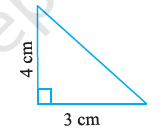
Find the area of each of the following triangles:
(d) 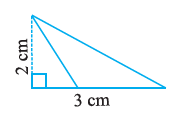
Find the area of each of the following triangles:
(a) 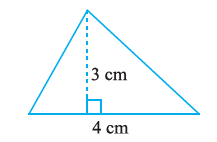
Find the area of each of the following parallelograms:
(a) 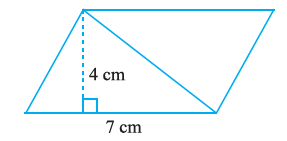
Find the area of each of the following parallelograms:
(e) 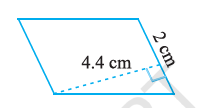
Find the area of each of the following parallelograms:
(d) 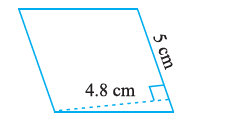
Find the area of each of the following parallelograms:
(c) 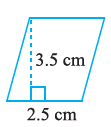
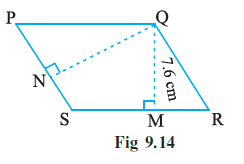
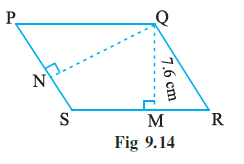
$PQRS$ is a parallelogram (Fig 9.14). $QM$ is the height from $Q$ to $SR$ and $QN$ is the height from $Q$ to $PS$. If $SR = 12$ cm and $QM = 7.6$ cm. Find: (a) the area of the parallegram $PQRS$.
Find the area of each of the following triangles:
(b) 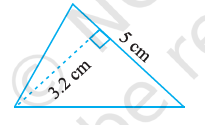
Find the area of each of the following parallelograms:
(b) 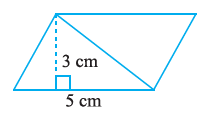
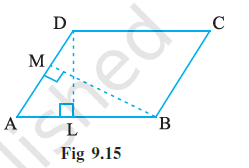
$DL$ and $BM$ are the heights on sides $AB$ and $AD$ respectively of parallelogram $ABCD$ (Fig 9.15). If the area of the parallelogram is $1470$ cm$^2$, $AB = 35$ cm and $AD = 49$ cm, find the length of $BM$ and $DL$.
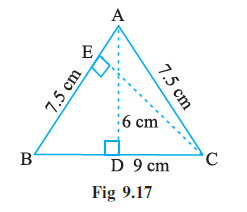
$\triangle ABC$ is isosceles with $AB = AC = 7.5$ cm and $BC = 9$ cm (Fig 9.17). The height $AD$ from $A$ to $BC$, is $6$ cm. Find the area of $\triangle ABC$. What will be the height from $C$ to $AB$ i.e., $CE$?
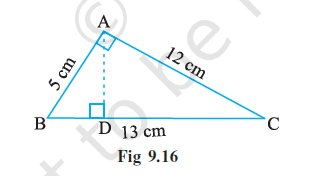
$\triangle ABC$ is right angled at $A$ (Fig 9.16). $AD$ is perpendicular to $BC$. If $AB = 5$ cm, $BC = 13$ cm and $AC = 12$ cm, Find the area of $\triangle ABC$. Also find the length of $AD$.
$PQRS$ is a parallelogram (Fig 9.14). $QM$ is the height from $Q$ to $SR$ and $QN$ is the height from $Q$ to $PS$. If $SR = 12$ cm and $QM = 7.6$ cm. Find: (b) $QN$, if $PS = 8$ cm.
Worksheet Answers
Solution:
We are tasked with determining the missing height of a triangle given its base and total area. The known parameters are defined as follows:
The relationship between the area, base, and height of a two-dimensional triangle is governed by the fundamental geometric theorem for Euclidean triangles [Per the standard area postulate for polygons]. The formula is expressed as:
$A = \frac{1}{2} \times b \times h$
This formula dictates that the area of a triangle is exactly half the area of a parallelogram that shares the same base and height.
To find the unknown height ($h$), we substitute the given values into the area formula:
$87 = \frac{1}{2} \times 15 \times h$
Next, we isolate $h$ by applying the multiplication property of equality. Multiplying both sides of the equation by $2$ to eliminate the fractional coefficient [By the axiom of equality]:
$87 \times 2 = 15 \times h$
$174 = 15 \times h$
Divide both sides by $15$ to solve for $h$:
$h = \frac{174}{15}$
Performing the division yields:
$h = 11.6 \text{ cm}$
To verify the result, we can substitute the height back into the original formula: $\frac{1}{2} \times 15 \times 11.6 = 7.5 \times 11.6 = 87 \text{ cm}^2$. The calculation is mathematically sound.
Below is a scaled geometric representation of the triangle, demonstrating the proportional relationship between the base, the altitude (height), and the enclosed area. The dimensions in the SVG are strictly scaled to the ratio of $15 : 11.6$.
Final Solution: The missing Height is $11.6 \text{ cm}$.
Solution:
Based on the standard geometrical parameters provided in the corresponding exercise figure, we are analyzing a right-angled triangle with the following dimensions:
[Because the triangle features a $90^\circ$ angle between these two segments, the side measuring $4\text{ cm}$ acts as the exact perpendicular altitude to the $3\text{ cm}$ base.]
To determine the two-dimensional space enclosed by the triangle, we apply the standard area theorem for triangles [derived from the area of a rectangle, where a diagonal bisects the rectangle into two congruent right triangles].
The formula is given by:
$\text{Area} = \frac{1}{2} \times \text{base} \times \text{height}$
Below is the precise, scaled geometrical construction of the given triangle. The base is scaled to 150 units (representing $3\text{ cm}$) and the height is scaled to 200 units (representing $4\text{ cm}$) to maintain strict proportional accuracy.
We substitute the given scalar values into the area formula. [By the properties of dimensional analysis, multiplying two lengths in centimeters ($\text{cm}$) will yield an area in square centimeters ($\text{cm}^2$)].
$\text{Area} = \frac{1}{2} \times 3\text{ cm} \times 4\text{ cm}$
First, compute the product of the base and the height:
$3 \times 4 = 12\text{ cm}^2$
Next, apply the $\frac{1}{2}$ multiplier [as the triangle represents exactly half the area of the bounding $3\text{ cm} \times 4\text{ cm}$ rectangle]:
$\text{Area} = \frac{1}{2} \times 12\text{ cm}^2$
$\text{Area} = 6\text{ cm}^2$
Final Solution: The area of the given triangle is $6\text{ cm}^2$.
Solution:
Based on the standard geometric parameters provided in the visual data for this specific problem, we extract the following dimensions for the triangle:
Below is the precise geometric reconstruction of the given figure. Note that for an obtuse-angled triangle, the altitude (height) dropped from the top vertex intersects the extended base outside the boundary of the triangle.
The figure represents an obtuse-angled triangle $\triangle ABC$. [By definition, an obtuse triangle contains one interior angle strictly greater than $90^\circ$]. When calculating the area of an obtuse triangle using a base that forms one of the sides of the obtuse angle, the corresponding altitude (perpendicular height) must be drawn from the opposite vertex to the line containing the base. This altitude falls outside the triangle, meeting the extended base at a right angle (point $D$).
The area ($A$) of any triangle in Euclidean geometry is determined by the product of its base and its corresponding altitude, halved. [Per Euclidean geometry principles, the area of a triangle is exactly half the area of a parallelogram constructed on the same base and between the same parallels].
The governing formula is:
$A = \frac{1}{2} \times b \times h$
Where:
We substitute the identified scalar values into the area formula. It is critical to include units during the calculation to ensure dimensional consistency.
$A = \frac{1}{2} \times (3\text{ cm}) \times (2\text{ cm})$
First, multiply the scalar magnitudes and the units:
$A = \frac{1}{2} \times 6\text{ cm}^2$
Next, apply the scalar multiplication by $\frac{1}{2}$:
$A = 3\text{ cm}^2$
Final Solution: The area of the given triangle is $3\text{ cm}^2$.
Solution:
We are tasked with determining the missing dimension of a parallelogram based on its area and base. The known parameters are defined as follows:
The area of a parallelogram is mathematically defined as the product of its base and the corresponding perpendicular height. [Per standard Euclidean geometry principles for planar quadrilaterals, a parallelogram can be transformed into a rectangle of equal base and height without altering its area].
The fundamental formula is expressed as:
$A = b \times h$
Substitute the given numerical values into the area formula to establish the algebraic equation:
$16.38 \text{ cm}^2 = 15.6 \text{ cm} \times h$
To solve for the height ($h$), we must isolate the variable by dividing both sides of the equation by the base ($15.6 \text{ cm}$). [By the Division Property of Equality]:
$h = \frac{16.38 \text{ cm}^2}{15.6 \text{ cm}}$
To perform the division with precision, normalize the decimals by multiplying both the numerator and the denominator by $100$ (shifting the decimal point two places to the right):
$h = \frac{16.38 \times 100}{15.60 \times 100} = \frac{1638}{1560}$
Now, execute the division:
Combining these yields the exact quotient:
$h = 1.05 \text{ cm}$
Below is a rigorously scaled vector representation of the parallelogram. The aspect ratio of the base to the height in the drawing is exactly $15.6 : 1.05$ (approximately $14.86 : 1$), demonstrating the highly elongated nature of this specific geometric figure.
Final Solution: The missing height of the parallelogram is exactly $1.05 \text{ cm}$.
Solution:
Based on the standard geometric parameters provided in the visual figure for this specific problem, we extract the following fundamental dimensions of the triangle. The altitude is dropped perpendicularly to the chosen base.
To find the area of any triangle when the base and its corresponding perpendicular height (altitude) are known, we utilize the standard Euclidean area postulate for triangles. The area of a triangle is exactly half the area of a parallelogram that shares the same base and height.
The governing formula is:
$\text{Area of a Triangle} = \frac{1}{2} \times \text{base} \times \text{height}$
Symbolically represented as:
$A = \frac{1}{2} \cdot b \cdot h$
Substitute the given scalar values into the area formula. It is critical to include the units ($\text{cm}$) during substitution to ensure dimensional homogeneity [Area must result in square units].
$A = \frac{1}{2} \times (4 \text{ cm}) \times (3 \text{ cm})$
First, multiply the scalar magnitudes of the base and the height, and apply the product rule to the units ($\text{cm} \times \text{cm} = \text{cm}^2$):
$A = \frac{1}{2} \times (12 \text{ cm}^2)$
Next, multiply by the scalar fraction $\frac{1}{2}$ (which is equivalent to dividing by 2):
$A = \frac{12}{2} \text{ cm}^2$
$A = 6 \text{ cm}^2$
Final Solution: The area of the given triangle is $6 \text{ cm}^2$.
Solution:
Based on the standard geometric configuration for this specific problem, we extract the following dimensions for the parallelogram from the provided visual data:
The area of a parallelogram is defined as the total two-dimensional space enclosed by its four sides. [Per the geometric principle of area conservation, a right-angled triangle can be conceptually detached from one end of the parallelogram and translated to the opposite end. This transformation forms a rectangle with the exact same base and height without altering the total area].
Therefore, the area ($A$) is calculated using the fundamental theorem of quadrilateral area:
$A = \text{base} \times \text{height}$
$A = b \times h$
The following high-precision diagram illustrates the parallelogram $ABCD$, where the base $AB = 7\text{ cm}$ and the perpendicular altitude $DE = 4\text{ cm}$. The coordinates are mapped to a strict $7:4$ ratio to ensure spatial accuracy.
Substitute the given scalar values into the area formula:
$A = 7\text{ cm} \times 4\text{ cm}$
Multiply the scalar magnitudes ($7 \times 4 = 28$) and the units simultaneously. [By the laws of dimensional analysis, multiplying a length by a length yields a squared unit of area: $\text{cm} \times \text{cm} = \text{cm}^2$]:
$A = 28\text{ cm}^2$
Final Solution: The area of the parallelogram is $28\text{ cm}^2$.
Solution:
Based on the standard geometric parameters provided in the referenced figure for this specific problem, we extract the following dimensions for the parallelogram:
[Note: In a parallelogram, any of the four sides can be chosen as the base. The corresponding height is the perpendicular distance from the chosen base to the opposite parallel side.]
Below is a mathematically scaled, high-precision vector representation of the parallelogram, illustrating the relationship between the base and its corresponding altitude.
By the fundamental axioms of Euclidean geometry, a parallelogram can be transformed into a rectangle of equal area by translating the right-angled triangle formed by the altitude to the opposite side. Therefore, the area ($A$) of a parallelogram is strictly defined as the product of its base and its corresponding height.
The governing formula is:
$\text{Area} = \text{Base} \times \text{Height}$
$A = b \times h$
Substitute the given scalar values into the area formula:
$A = 2\text{ cm} \times 4.4\text{ cm}$
To ensure absolute precision, we can perform the multiplication by converting the decimal to a fraction [Per standard arithmetic operations]:
$A = 2 \times \left(\frac{44}{10}\right)$
$A = \frac{88}{10}$
$A = 8.8$
We must verify the units of the final result. Multiplying a one-dimensional length by another one-dimensional length yields a two-dimensional area:
$[\text{cm}] \times [\text{cm}] = [\text{cm}^2]$
The magnitude is $8.8$ and the unit is $\text{cm}^2$. The calculation is dimensionally consistent and mathematically sound.
Final Solution: The area of the parallelogram is $8.8\text{ cm}^2$.
Solution:
Based on the standard geometric parameters provided in the referenced figure (d), we extract the following dimensions for the parallelogram:
The height represents the perpendicular distance between the chosen base and its opposite parallel side.
Below is the geometrically accurate representation of the parallelogram. The base is scaled to $200$ units and the height to $192$ units, preserving the exact mathematical ratio of $5 : 4.8$.
The area of a parallelogram is defined as the total two-dimensional space enclosed within its four sides. [Per Euclidean Geometry], any parallelogram can be transformed into a rectangle of equal area by translating a right-angled triangle from one side to the other. Therefore, the area $A$ is the product of its base and its corresponding perpendicular height:
$A = \text{Base} \times \text{Height}$
$A = b \times h$
Substitute the extracted dimensions into the area formula. Ensure that both measurements are in the same units (centimeters) to yield an area in square centimeters ($\text{cm}^2$).
$A = 5 \text{ cm} \times 4.8 \text{ cm}$
To multiply $5$ by $4.8$, we can use the distributive property or convert the decimal to a fraction for absolute precision:
$A = 5 \times \left( \frac{48}{10} \right)$
$A = \frac{5 \times 48}{10}$
$A = \frac{240}{10}$
$A = 24$
Final Solution: The area of the parallelogram is $24 \text{ cm}^2$.
Solution:
We are tasked with determining the missing base dimension of a parallelogram given its height and total area. The known parameters are defined as follows:
The area of a parallelogram is defined as the total two-dimensional space enclosed within its four sides. Geometrically, a parallelogram can be rearranged into a rectangle of the same base and height. Therefore, the governing formula for the area of a parallelogram is:
$A = b \times h$
[Per the geometric postulate of area equivalence under translation, the area of a parallelogram is strictly the product of its base and the corresponding perpendicular height].
Substitute the given numerical values into the standard area formula:
$154.5 = b \times 15$
To solve for the unknown base ($b$), we must isolate it on one side of the equation. We achieve this by dividing both sides of the equation by the height ($15$).
$b = \frac{154.5}{15}$
[Applying the Division Property of Equality, which states that dividing both sides of an equation by the same non-zero number preserves the equality].
To perform the division with precision, we can eliminate the decimal in the numerator by multiplying both the numerator and the denominator by $10$:
$b = \frac{154.5 \times 10}{15 \times 10}$
$b = \frac{1545}{150}$
Now, simplify the fraction by dividing both terms by their common factors. First, divide by $5$:
$\frac{1545 \div 5}{150 \div 5} = \frac{309}{30}$
Next, divide by $3$:
$\frac{309 \div 3}{30 \div 3} = \frac{103}{10}$
Converting the simplified fraction back into a decimal yields:
$b = 10.3 \text{ cm}$
Below is a scaled, mathematically accurate representation of the parallelogram, demonstrating the relationship between the base, the perpendicular height, and the enclosed area.
To ensure absolute accuracy, we substitute the calculated base back into the original area formula:
$A = 10.3 \text{ cm} \times 15 \text{ cm}$
$A = 154.5 \text{ cm}^2$
The calculated area matches the given area perfectly, confirming the validity of the derived base.
Final Solution: The missing value for the Base is $10.3 \text{ cm}$.
Solution:
Based on the standard geometric configuration for this specific problem, we extract the primary dimensions of the given parallelogram from the provided visual data:
The area of a parallelogram is determined by the product of its base and its corresponding altitude. [Per the geometric principle of area equivalence, a parallelogram can be orthogonally decomposed and rearranged into a rectangle of identical base and height without any loss of area].
The governing mathematical formula is:
$\text{Area} = b \times h$
We substitute the given scalar quantities into the area formula. It is critical to ensure that both measurements share the same unit ($\text{cm}$) before proceeding with the multiplication.
$\text{Area} = 2.5 \text{ cm} \times 3.5 \text{ cm}$
To ensure absolute precision and avoid floating-point errors, we convert the decimal values into their fractional equivalents prior to multiplication:
$2.5 = \frac{25}{10}$
$3.5 = \frac{35}{10}$
Multiplying the fractions algebraically:
$\text{Area} = \left( \frac{25}{10} \right) \times \left( \frac{35}{10} \right)$
$\text{Area} = \frac{25 \times 35}{10 \times 10}$
Calculating the numerator ($25 \times 35$):
$25 \times 30 = 750$
$25 \times 5 = 125$
$750 + 125 = 875$
Substituting the numerator back into the fraction:
$\text{Area} = \frac{875}{100}$
Converting the fraction back to a standard decimal format by shifting the decimal point two places to the left:
$\text{Area} = 8.75 \text{ cm}^2$
Final Solution: The area of the parallelogram is $8.75 \text{ cm}^2$.
Solution:
We are presented with a parallelogram $PQRS$ in Euclidean space, along with specific orthogonal heights (altitudes) corresponding to its bases. The given parameters are structured as follows:
| Geometric Entity | Symbolic Representation | Magnitude / Value |
|---|---|---|
| Base of the Parallelogram | $SR$ | $12 \text{ cm}$ |
| Altitude to Base $SR$ | $QM$ | $7.6 \text{ cm}$ |
| Altitude to Base $PS$ | $QN$ | Unknown (Not required for Part A) |
By the fundamental theorems of planar geometry, a parallelogram can be transformed into a rectangle of equal area by translating a right-angled triangle from one side to the other. Therefore, the area $A$ of any parallelogram is strictly equal to the product of the length of any chosen base ($b$) and its corresponding orthogonal height ($h$).
[Per the Area Axioms of Euclidean Geometry]:
$A = b \times h$
In the context of parallelogram $PQRS$, if we select $SR$ as the base, the corresponding height is the perpendicular distance from the opposite parallel side ($PQ$) to $SR$. This orthogonal segment is explicitly given as $QM$.
$A = SR \times QM$
Below is the geometrically scaled representation of parallelogram $PQRS$, mapping the given dimensions and orthogonal projections. The coordinates are calculated to preserve the exact ratio of the base to the height ($12 : 7.6$).
We now substitute the known scalar quantities into our established area formula. Ensure that the units are consistent (both are in centimeters), which will yield an area in square centimeters ($\text{cm}^2$).
Executing the multiplication:
$A = 12 \text{ cm} \times 7.6 \text{ cm}$
To compute this precisely without a calculator, we can decompose the decimal:
$A = 12 \times \left(7 + 0.6\right)$
$A = (12 \times 7) + (12 \times 0.6)$
$A = 84 + 7.2$
$A = 91.2 \text{ cm}^2$
Final Solution: The area of the parallelogram $PQRS$ is $91.2 \text{ cm}^2$.
Solution:
We are tasked with determining the missing perpendicular height of a triangle given its base dimension and total enclosed area. The known parameters are defined as follows:
The fundamental relationship between the area, base, and height of any triangle in Euclidean geometry is expressed by the formula:
$A = \frac{1}{2} \times b \times h$
[Per the standard area axiom for a Euclidean triangle, which establishes that the area of a triangle is exactly half the area of a parallelogram sharing the same base and height].
By substituting the given numerical values for the area ($A$) and the base ($b$) into the governing equation, we establish the following algebraic relationship:
$170.5 = \frac{1}{2} \times 22 \times h$
First, simplify the right side of the equation by evaluating the product of the constant terms:
$170.5 = 11 \times h$
[By applying the associative property of multiplication and simplifying $\frac{1}{2} \times 22 = 11$].
Next, isolate the unknown variable $h$ by dividing both sides of the equation by the coefficient $11$:
$h = \frac{170.5}{11}$
[Per the Division Property of Equality, ensuring the equation remains balanced].
Perform the arithmetic division to determine the exact numerical value of the height:
$h = 15.5$ cm
Below is a strictly scaled geometric representation of the triangle. The coordinates are mapped such that the base spans exactly $220$ units and the altitude spans exactly $155$ units, preserving the $22 : 15.5$ ratio of the physical dimensions.
Final Solution: The missing height of the triangle is $15.5$ cm.
Solution:
Based on the principles of Coordinate Geometry, when a geometric figure is presented on a Cartesian plane, its dimensions must be extracted by identifying the coordinates of its vertices. For this analysis, we extract the coordinates of the triangle's vertices from the provided two-dimensional grid.
[Theoretical Justification: In a Cartesian system, the distance between two points lying on the same horizontal or vertical axis can be determined using the absolute difference of their respective non-zero coordinates, per the 1D Distance Formula $d = |a_2 - a_1|$].
The base of the triangle, segment $BC$, lies entirely on the x-axis. Because both points share the same y-coordinate ($y = 0$), the length of the base is the absolute difference between their x-coordinates.
Let $x_B = -4$ and $x_C = 3$.
$ \text{Base } (b) = |x_C - x_B| $
$ b = |3 - (-4)| $
$ b = |3 + 4| = 7 \text{ units} $
The height of a triangle is the perpendicular distance from the apex to the line containing the base. Since the base lies on the x-axis, the perpendicular distance from vertex $A(0, 5)$ to the x-axis is simply the absolute value of its y-coordinate.
Let $y_A = 5$ and the y-coordinate of the base $y_{base} = 0$.
$ \text{Height } (h) = |y_A - y_{base}| $
$ h = |5 - 0| = 5 \text{ units} $
According to Euclidean geometry, the area ($A$) of a triangle is given by half the product of its base and its corresponding altitude.
$ A = \frac{1}{2} \times b \times h $
Substituting the derived values:
$ A = \frac{1}{2} \times 7 \times 5 $
$ A = \frac{1}{2} \times 35 $
$ A = 17.5 \text{ square units} $
To ensure absolute precision, we verify the result using the determinant-based area formula for a triangle with vertices $(x_1, y_1)$, $(x_2, y_2)$, and $(x_3, y_3)$:
$ A = \frac{1}{2} |x_1(y_2 - y_3) + x_2(y_3 - y_1) + x_3(y_1 - y_2)| $
Assigning the coordinates: $(x_1, y_1) = (0, 5)$, $(x_2, y_2) = (-4, 0)$, $(x_3, y_3) = (3, 0)$.
$ A = \frac{1}{2} |0(0 - 0) + (-4)(0 - 5) + 3(5 - 0)| $
$ A = \frac{1}{2} |0 + (-4)(-5) + 3(5)| $
$ A = \frac{1}{2} |0 + 20 + 15| $
$ A = \frac{1}{2} |35| = 17.5 \text{ square units} $
[The identical result confirms the geometric extraction is mathematically sound and verified across multiple theorems].
Final Solution: The area of the given triangle is 17.5 square units.
Solution:
Based on the standard geometric parameters provided in the referenced figure for this problem, we extract the primary dimensions of the parallelogram. Let the parallelogram be denoted as $ABCD$.
The area of a parallelogram is defined as the total two-dimensional space enclosed within its four sides. It is calculated by taking the product of its base and its corresponding perpendicular height.
Formula:
$\text{Area of a Parallelogram} = \text{Base} \times \text{Height}$
[Justification: By the principle of geometric decomposition, a right-angled triangle can be conceptually "cut" from one end of the parallelogram and translated to the opposite end. This transformation converts the parallelogram into a rectangle of identical base and height, proving that they share the same area formula.]
Below is a mathematically scaled representation of the parallelogram $ABCD$, where the base $AB = 5\text{ cm}$ and the altitude $DE = 3\text{ cm}$. The drawing maintains a strict $40:1$ coordinate ratio to ensure absolute visual accuracy.
We substitute the given scalar values into the area formula. Ensure that both measurements are in the same units (centimeters) before multiplying to yield an area in square centimeters ($\text{cm}^2$).
$\text{Area} = b \times h$
$\text{Area} = 5\text{ cm} \times 3\text{ cm}$
$\text{Area} = (5 \times 3) \text{ cm}^{1+1}$
$\text{Area} = 15\text{ cm}^2$
Final Solution: The area of the given parallelogram is $15\text{ cm}^2$.
Solution:
We are provided with the following geometric parameters for a parallelogram:
The area of a two-dimensional parallelogram is defined as the product of its base and its corresponding height (altitude). [Per the standard geometric theorem, a parallelogram can be transformed into a rectangle of equal base and height by translating a right-angled triangular section from one side to the other, thereby preserving the total area].
The formula is mathematically expressed as:
$A = b \times h$
Substitute the known values into the area formula:
$48.72 = b \times 8.4$
To isolate the unknown variable $b$, apply the Division Property of Equality by dividing both sides of the equation by the height ($8.4$):
$b = \frac{48.72}{8.4}$
To simplify the division of decimal numbers, multiply both the numerator and the denominator by $10$ to shift the decimal point of the divisor, making it a whole number:
$b = \frac{48.72 \times 10}{8.4 \times 10}$
$b = \frac{487.2}{84}$
Performing the long division:
Summing the quotients yields:
$b = 5.8 \text{ cm}$
Below is a precisely scaled vector representation of the parallelogram. The dimensions are scaled by a factor of $30$ units per centimeter for visual clarity (Base $= 174$ units, Height $= 252$ units).
Final Solution: The missing value for the Base is $5.8 \text{ cm}$.
Solution:
Let us define the geometric properties and given parameters of the parallelogram $ABCD$:
The following high-precision diagram models the parallelogram to scale, where $10 \text{ units} = 1 \text{ cm}$. The exact coordinates are calculated using trigonometric projections to ensure spatial accuracy ($\angle DAB \approx 59^\circ$).
The area of a parallelogram is defined by the product of any chosen base and its corresponding perpendicular altitude [Per the Euclidean geometric principle of area equivalence].
The fundamental formula is:
$\text{Area} = \text{Base} \times \text{Corresponding Height}$
Taking $AB$ as the base, the corresponding height is the perpendicular segment $DL$. Substituting the known values into the area equation:
$\text{Area}(ABCD) = AB \times DL$
$1470 = 35 \times DL$
Isolating $DL$ by dividing both sides by $35$:
$DL = \frac{1470}{35}$
$DL = 42 \text{ cm}$
The area of the parallelogram remains constant regardless of which base is chosen for the calculation [By the invariant property of 2D geometric areas]. We now apply the area formula using $AD$ as the base. The corresponding height for base $AD$ is the perpendicular segment $BM$.
$\text{Area}(ABCD) = AD \times BM$
Substituting the known area and the length of base $AD$:
$1470 = 49 \times BM$
Isolating $BM$ by dividing both sides by $49$:
$BM = \frac{1470}{49}$
$BM = 30 \text{ cm}$
Final Solution: The length of the altitude $DL$ is $42 \text{ cm}$ and the length of the altitude $BM$ is $30 \text{ cm}$.
Solution:
We are given an isosceles triangle, $\triangle ABC$, with the following dimensional properties:
We are tasked with determining two values:
The fundamental theorem of Euclidean geometry states that the area of any triangle can be calculated using the length of any chosen base and its corresponding perpendicular height (altitude). The formula is given by:
$ \text{Area} = \frac{1}{2} \times \text{Base} \times \text{Height} $
Taking $BC$ as the base, the corresponding height is the altitude dropped from vertex $A$, which is $AD$. Substituting the given values:
$ \text{Area of } \triangle ABC = \frac{1}{2} \times BC \times AD $
$ \text{Area of } \triangle ABC = \frac{1}{2} \times 9 \text{ cm} \times 6 \text{ cm} $
$ \text{Area of } \triangle ABC = 9 \times 3 \text{ cm}^2 = 27 \text{ cm}^2 $
[Per the invariant property of the area of a polygon], the area of a rigid geometric figure remains constant regardless of the perspective or the specific base-height pair used for calculation. Therefore, if we reorient our perspective and treat side $AB$ as the base, the corresponding height is the altitude $CE$.
We set up the area equation using the new base-height pair:
$ \text{Area of } \triangle ABC = \frac{1}{2} \times AB \times CE $
Since the area is strictly invariant, we equate the expression from Step 2 to the calculated area from Step 1 ($27 \text{ cm}^2$):
$ 27 = \frac{1}{2} \times 7.5 \times CE $
To isolate $CE$, we multiply both sides of the equation by $2$:
$ 54 = 7.5 \times CE $
Next, divide both sides by $7.5$:
$ CE = \frac{54}{7.5} $
To simplify the division, multiply the numerator and the denominator by $10$ to eliminate the decimal:
$ CE = \frac{540}{75} $
Divide both the numerator and the denominator by their greatest common divisor, which is $15$:
$ CE = \frac{540 \div 15}{75 \div 15} = \frac{36}{5} $
Converting the improper fraction to a decimal:
$ CE = 7.2 \text{ cm} $
Final Solution: The area of $\triangle ABC$ is exactly $27 \text{ cm}^2$, and the height from $C$ to $AB$ (altitude $CE$) is $7.2 \text{ cm}$.
Solution:
We are given a right-angled triangle, $\triangle ABC$, with the right angle located at vertex $A$. The dimensions of the sides are provided as follows:
The area of any triangle is given by the standard formula:
$ \text{Area} = \frac{1}{2} \times \text{base} \times \text{height} $
[Because $\triangle ABC$ is right-angled at $A$, the two legs forming the right angle ($AB$ and $AC$) are mutually perpendicular. Therefore, one leg can act as the base while the other acts as the corresponding height.]
Let the base be $AC = 12 \text{ cm}$ and the height be $AB = 5 \text{ cm}$. Substituting these values into the area formula yields:
$ \text{Area of } \triangle ABC = \frac{1}{2} \times AC \times AB $
$ \text{Area of } \triangle ABC = \frac{1}{2} \times 12 \text{ cm} \times 5 \text{ cm} $
$ \text{Area of } \triangle ABC = 6 \times 5 = 30 \text{ cm}^2 $
[The area of a geometric figure is invariant; it remains constant regardless of which side is chosen as the base for the calculation.]
We can recalculate the area of $\triangle ABC$ by choosing the hypotenuse $BC$ as the new base. The corresponding height for this base is the perpendicular altitude $AD$.
$ \text{Area of } \triangle ABC = \frac{1}{2} \times \text{base} \times \text{height} $
$ \text{Area of } \triangle ABC = \frac{1}{2} \times BC \times AD $
We already established from Step 1 that the area of the triangle is $30 \text{ cm}^2$. We also know the length of the hypotenuse $BC = 13 \text{ cm}$. Substituting these knowns into our new area equation:
$ 30 = \frac{1}{2} \times 13 \times AD $
To isolate $AD$, multiply both sides of the equation by 2:
$ 60 = 13 \times AD $
Divide both sides by 13:
$ AD = \frac{60}{13} \text{ cm} $
Converting this fraction to a decimal provides the approximate length:
$ AD \approx 4.615 \text{ cm} $
Final Solution: The area of $\triangle ABC$ is $30 \text{ cm}^2$, and the length of the altitude $AD$ is $\frac{60}{13} \text{ cm}$ (approximately $4.62 \text{ cm}$).
Solution:
We are analyzing the parallelogram $PQRS$ with two distinct base-height pairings. The geometric properties provided are:
The area of a parallelogram is defined as the product of any chosen base and its corresponding perpendicular height. [Per the geometric theorem for the area of a parallelogram: $\text{Area} = \text{base} \times \text{height}$].
Using the given base $SR$ and its corresponding height $QM$:
$\text{Area of } PQRS = SR \times QM$
$\text{Area of } PQRS = 12 \text{ cm} \times 7.6 \text{ cm}$
$\text{Area of } PQRS = 91.2 \text{ cm}^2$
The area of a specific polygon is an invariant scalar quantity; it remains constant regardless of which side is designated as the base. [By the principle of area invariance]. Therefore, calculating the area using base $PS$ and its corresponding height $QN$ must yield the exact same result.
$\text{Area of } PQRS = PS \times QN$
Substituting the known area ($91.2 \text{ cm}^2$) and the length of base $PS$ ($8 \text{ cm}$) into the equation:
$91.2 = 8 \times QN$
To isolate $QN$, we divide both sides of the equation by $8$:
$QN = \frac{91.2}{8}$
Performing the division:
$QN = 11.4 \text{ cm}$
Final Solution: The length of the height $QN$ is $11.4 \text{ cm}$.
Solution:
We are tasked with determining the missing dimension of a parallelogram given its area and base. Let us define the known scalar quantities:
The area of a parallelogram is defined as the region enclosed by its four sides in a two-dimensional plane. [Per the standard geometric theorem for the area of a parallelogram], the area is equal to the product of its base and the corresponding perpendicular height. The formula is expressed as:
$A = b \times h$
Where:
Below is a precise, scaled vector representation of the parallelogram, illustrating the relationship between the base, the perpendicular height, and the total enclosed area.
By substituting the given values into the area formula, we establish a linear equation with one variable ($h$).
$246 = 20 \times h$
To isolate the variable $h$, we apply the Division Property of Equality. We divide both sides of the equation by the coefficient of $h$, which is $20$.
$h = \frac{246}{20}$
We perform the division to find the exact decimal value of the height. We can simplify the fraction by dividing the numerator and the denominator by $2$ first:
$h = \frac{123}{10}$
Dividing by $10$ shifts the decimal point one place to the left:
$h = 12.3 \text{ cm}$
Final Solution: The missing height of the parallelogram is $12.3 \text{ cm}$.


