


Your Worksheet is Ready
CBSE - Class 9 Mathematics Number Systems Worksheet
EXERCISE 1.2
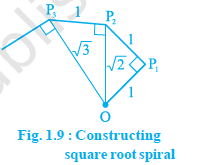
Classroom activity (Constructing the ‘square root spiral’) : Take a large sheet of paper and construct the ‘square root spiral’ in the following fashion. Start with a point $O$ and draw a line segment $OP_1$ of unit length. Draw a line segment $P_1P_2$ perpendicular to $OP_1$ of unit length (see Fig. 1.9). Now draw a line segment $P_2P_3$ perpendicular to $OP_2$. Then draw a line segment $P_3P_4$ perpendicular to $OP_3$. Continuing in this manner, you can get the line segment $P_{n-1}P_n$ by drawing a line segment of unit length perpendicular to $OP_{n-1}$. In this manner, you will have created the points $P_2, P_3,...., P_n,...$ ., and joined them to create a beautiful spiral depicting $\sqrt{2}, \sqrt{3}, \sqrt{4}, ...$
Worksheet Answers
Solution:
To evaluate the statement, we must first define the mathematical entities involved:
The expression $\sqrt{m}$ denotes the principal (non-negative) square root of a natural number $m$. [By the definition of the principal square root function over real numbers], the output of $\sqrt{m}$ is strictly a positive real number for any $m \in \mathbb{N}$.
Mathematically, if $m \in \mathbb{N}$, then $\sqrt{m} > 0$.
The real number line extends infinitely in both the positive and negative directions. Therefore, it contains infinitely many negative real numbers (e.g., $-1, -2, -3.5, -\pi$).
The given statement asserts that every point on the number line can be mapped to the form $\sqrt{m}$. To falsify a universal statement, we only need to provide a single counter-example [Per the rules of formal logic and proof by contradiction].
Consider the point $-2$ on the number line. Because the principal square root of any natural number is always positive, there exists no natural number $m$ such that:
$\sqrt{m} = -2$
Furthermore, the square of any real number is non-negative, meaning the square root of a positive integer can never yield a negative value in the real number system. Therefore, no negative number on the number line can be expressed in the form $\sqrt{m}$.
Note: Additionally, there are infinitely many positive real numbers that cannot be expressed as the square root of a natural number. For example, the point $1.5$ is on the number line, but $1.5 = \sqrt{2.25}$, and $2.25 \notin \mathbb{N}$.
The following diagram maps the exact coordinates of natural number roots ($\sqrt{1}, \sqrt{2}, \sqrt{3}, \sqrt{4}$) and highlights the negative domain, which entirely escapes the form $\sqrt{m}$.
Final Solution: False. The number line contains negative numbers, and no negative number can be expressed as the principal square root of a natural number ($\sqrt{m}$).
Solution:
To evaluate the truth value of the statement, we must first establish the formal definitions of the sets of numbers involved in the real number system.
[By the axioms of set theory], the set of Real Numbers is the union of Rational and Irrational numbers. Mathematically, this is expressed as:
$\mathbb{R} = \mathbb{Q} \cup \mathbb{I}$
Given the union $\mathbb{R} = \mathbb{Q} \cup \mathbb{I}$, it logically follows that the set of irrational numbers is a proper subset of the set of real numbers.
$\mathbb{I} \subset \mathbb{R}$
[Per the definition of a subset], if an element $x$ belongs to the set of irrational numbers ($x \in \mathbb{I}$), it must necessarily belong to the set of real numbers ($x \in \mathbb{R}$). Therefore, every single irrational number is, by definition, a real number.
The following Euler diagram illustrates the partition of the Real Number system, demonstrating that the Irrational Numbers are entirely contained within the boundaries of the Real Numbers.
Because the collection of all rational numbers and irrational numbers together forms the complete collection of real numbers, there is no irrational number that exists outside the domain of real numbers. Every point on the real number line corresponds to either a rational or an irrational number.
Final Solution: True. Every irrational number is a real number because the set of real numbers is composed of the union of all rational and irrational numbers ($\mathbb{R} = \mathbb{Q} \cup \mathbb{I}$).
Solution:
To represent an irrational number of the form $\sqrt{n}$ on a real number line, we utilize the geometric interpretation of the Pythagorean Theorem. The theorem states that in a right-angled triangle, the square of the hypotenuse ($c$) is equal to the sum of the squares of the base ($a$) and the perpendicular ($b$).
Mathematically, this is expressed as:
$c^2 = a^2 + b^2 \implies c = \sqrt{a^2 + b^2}$
Our objective is to represent $\sqrt{5}$. We must find two integers, $a$ and $b$, such that the sum of their squares equals $5$.
We decompose the radicand ($5$) into the sum of two perfect squares:
$5 = 4 + 1$
$5 = (2)^2 + (1)^2$
[By the principles of Euclidean Geometry], if we construct a right-angled triangle with a base of $2$ units and a perpendicular height of $1$ unit, the length of the hypotenuse will be exactly $\sqrt{5}$ units.
The construction proceeds through the following precise steps:
Applying the Pythagorean Theorem to the constructed right-angled triangle $\triangle OAB$ (where $\angle OAB = 90^\circ$):
$OB^2 = OA^2 + AB^2$
$OB^2 = (2)^2 + (1)^2$
$OB^2 = 4 + 1$
$OB^2 = 5$
$OB = \sqrt{5}$ units
[Per the geometric construction], the length of the segment $OB$ is precisely $\sqrt{5}$.
To represent this magnitude on the one-dimensional number line, we use a compass. Placing the compass point at the origin $O$ and setting the pencil point at $B$ (setting the radius to $OB = \sqrt{5}$), we draw an arc downwards until it intersects the positive side of the number line.
Let the point of intersection be $P$. Because $OP$ and $OB$ are radii of the same circular arc, their lengths are equal. Therefore, the distance from $O$ to $P$ is exactly $\sqrt{5}$ units.
Below is the exact geometric representation of the construction. The base $OA$ is $2$ units, the perpendicular $AB$ is $1$ unit, and the arc transfers the hypotenuse $OB$ to point $P$ on the number line.
Final Solution: By constructing a right-angled triangle with a base of $2$ units and a perpendicular of $1$ unit at the origin, the resulting hypotenuse measures exactly $\sqrt{5}$ units. Projecting this hypotenuse onto the number line using a circular arc accurately locates the point $P$, which represents the irrational number $\sqrt{5}$.
Solution:
The construction of the "square root spiral" (historically known as the Spiral of Theodorus) is predicated on the sequential application of the Pythagorean theorem in contiguous right-angled triangles. For any right-angled triangle with legs $a$ and $b$, and hypotenuse $c$, the theorem states:
$c^2 = a^2 + b^2 \implies c = \sqrt{a^2 + b^2}$
By maintaining one leg at a constant unit length ($1$) and using the hypotenuse of the previous triangle as the second leg, we generate a sequence of hypotenuses whose lengths are the square roots of consecutive natural numbers ($\sqrt{2}, \sqrt{3}, \sqrt{4}, \dots$).
[Per the Pythagorean Theorem]:
$OP_2 = \sqrt{OP_1^2 + P_1P_2^2} = \sqrt{1^2 + 1^2} = \sqrt{2} \text{ units}$
[Per the Pythagorean Theorem]:
$OP_3 = \sqrt{OP_2^2 + P_2P_3^2} = \sqrt{(\sqrt{2})^2 + 1^2} = \sqrt{2 + 1} = \sqrt{3} \text{ units}$
$OP_4 = \sqrt{OP_3^2 + P_3P_4^2} = \sqrt{(\sqrt{3})^2 + 1^2} = \sqrt{3 + 1} = \sqrt{4} = 2 \text{ units}$
General Mathematical Induction:
Continuing this process for the $n$-th iteration, we draw a unit segment $P_{n-1}P_n$ perpendicular to the previous hypotenuse $OP_{n-1}$. The length of the new hypotenuse $OP_n$ will always be:
$OP_n = \sqrt{(\sqrt{n-1})^2 + 1^2} = \sqrt{n-1 + 1} = \sqrt{n}$
To physically construct this on a large sheet of paper, execute the following precise steps:
Below is a mathematically exact, coordinate-mapped rendering of the square root spiral up to $P_7$ ($\sqrt{7}$). All angles and lengths are calculated via trigonometric functions to ensure absolute spatial truth.
Final Solution: By iteratively constructing right-angled triangles where one leg is always $1$ unit and the other leg is the hypotenuse of the preceding triangle, the lengths of the successive hypotenuses radiating from the origin $O$ mathematically generate the sequence $\sqrt{1}, \sqrt{2}, \sqrt{3}, \sqrt{4}, \dots, \sqrt{n}$, forming the square root spiral.
Solution:
To evaluate the statement, we must first establish the rigorous mathematical definition of real numbers. The set of real numbers, denoted by $\mathbb{R}$, is defined as the union of two mutually exclusive and exhaustive subsets: the set of rational numbers ($\mathbb{Q}$) and the set of irrational numbers. [Per the fundamental axioms of set theory and the real number system].
Mathematically, this relationship is expressed as:
$\mathbb{R} = \mathbb{Q} \cup (\mathbb{R} \setminus \mathbb{Q})$
Where:
The given statement asserts: "Every real number is an irrational number."
In logical terms, this translates to the claim that the set of real numbers is entirely equivalent to the set of irrational numbers ($\mathbb{R} = \mathbb{R} \setminus \mathbb{Q}$). For this to be true, the set of rational numbers ($\mathbb{Q}$) would have to be an empty set ($\emptyset$). However, we know that the set of rational numbers is infinitely large. Therefore, the statement contains a fundamental logical fallacy.
To formally disprove a universal affirmative statement ("every $X$ is $Y$"), we only need to provide a single valid counterexample [By the rules of deductive logic and proof by contradiction].
The following Venn diagram illustrates the composition of the real number system, clearly demonstrating that irrational numbers only make up one portion of the entire set.
Final Solution: False. The set of real numbers is comprised of both rational and irrational numbers. Therefore, a real number can be rational, meaning it is incorrect to state that every real number is irrational. For example, $5$ is a real number, but it is a rational number, not an irrational one.
Solution:
To rigorously evaluate the proposition, we must first establish the mathematical definitions of the sets of numbers involved:
The question poses a universal statement: "The square roots of all positive integers are irrational."
In formal logic, to disprove a universal statement ("for all $x$"), one only needs to provide a single valid counterexample ("there exists an $x$ such that..."). If we can find even one positive integer whose square root is a rational number, the entire proposition is proven false [By the principle of Proof by Counterexample].
Let us examine the positive integer $n = 4$.
Taking the principal square root of $4$:
$ \sqrt{4} = 2 $
Now, we must determine if the result, $2$, is a rational number. We apply the definition of a rational number ($\frac{p}{q}$):
$ 2 = \frac{2}{1} $
Here, $p = 2$ (which is an integer) and $q = 1$ (which is an integer and $1 \neq 0$). Because $2$ perfectly satisfies the conditions of a rational number, $\sqrt{4}$ is rational. This directly contradicts the claim that the square roots of all positive integers are irrational.
This phenomenon is not isolated to the number $4$. It applies to all perfect squares. A perfect square is an integer that is the square of an integer.
Let $k$ be any positive integer. If we define a positive integer $n$ such that $n = k^2$, then:
$ \sqrt{n} = \sqrt{k^2} = k $
Since $k$ is an integer, it can always be written as $\frac{k}{1}$, making it a rational number. We can observe this pattern in the table below:
| Positive Integer ($n$) | Square Root ($\sqrt{n}$) | Fractional Form ($\frac{p}{q}$) | Classification |
|---|---|---|---|
| $1$ | $1$ | $\frac{1}{1}$ | Rational |
| $2$ | $\approx 1.414213\dots$ | Cannot be expressed | Irrational |
| $3$ | $\approx 1.732050\dots$ | Cannot be expressed | Irrational |
| $4$ | $2$ | $\frac{2}{1}$ | Rational |
| $9$ | $3$ | $\frac{3}{1}$ | Rational |
The geometric representation below maps the square roots of positive integers onto a real number line, demonstrating the precise locations where square roots yield rational integers versus irrational values.
Final Solution: No, the square roots of all positive integers are not irrational. A definitive counterexample is the positive integer $4$. The square root of $4$ is $2$, which is a rational number because it can be expressed exactly as the fraction $\frac{2}{1}$. This holds true for all perfect squares (e.g., $\sqrt{9}=3$, $\sqrt{16}=4$, $\sqrt{25}=5$).


