UrbanPro

Your Worksheet is Ready

CBSE - Class 12 Physics Communication Systems Worksheet

1.
Which of the following would produce analog signals and which would produce digital signals?
(iii) Light pulse.
2.
Audio sine waves of 3 kHz frequency are used to amplitude modulate a carrier signal of 1.5 MHz. Which of the following statements are true?
a. The side band frequencies are 1506 kHz and 1494 kHz. b. The bandwidth required for amplitude modulation is 6kHz. c. The bandwidth required for amplitude modulation is 3 MHz. d. The side band frequencies are 1503 kHz and 1497 kHz.
3.
A 50 MHz sky wave takes 4.04 ms to reach a receiver via re-transmission from a satellite 600 km above earth’s surface. Assuming re-transmission time by satellite negligible, find the distance between source and receiver. If communication between the two was to be done by Line of Sight (LOS) method, what should size and placement of receiving and transmitting antenna be?
4.
In amplitude modulation, the modulation index $m$, is kept less than or equal to 1 because
a. $m > 1$, will result in interference between carrier frequency and message frequency, resulting into distortion. b. $m > 1$ will result in overlapping of both side bands resulting into loss of information. c. $m > 1$ will result in change in phase between carrier signal and message signal. d. $m > 1$ indicates amplitude of message signal greater than amplitude of carrier signal resulting into distortion.
5.
A 100m long antenna is mounted on a 500m tall building. The complex can become a transmission tower for waves with $\lambda$
a. ~ 400 m. b. ~ 25 m. c. ~ 150 m. d. ~ 2400 m.
6.
An audio signal is modulated by a carrier wave of 20MHz such that the bandwidth required for modulation is 3kHz. Could this wave be demodulated by a diode detector which has the values of $R$ and $C$ as (ii) $R = 10 \text{ k}\Omega$, $C = 0.01\mu\text{F}$.
7.
A male voice after modulation-transmission sounds like that of a female to the receiver. The problem is due to
a. poor selection of modulation index (selected $0 < m < 1$) b. poor bandwidth selection of amplifiers. c. poor selection of carrier frequency d. loss of energy in transmission.
8.
Which of the following would produce analog signals and which would produce digital signals?
(iv) Output of NAND gate.
9.

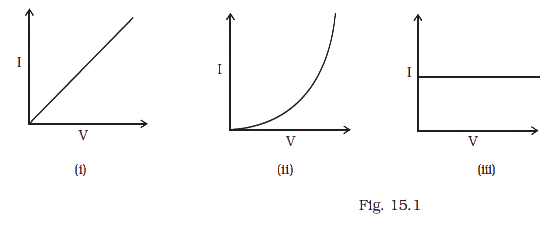
I-V characteristics of four devices are shown in Fig. 15.1 Identify devices that can be used for modulation:

a.

‘i’ and ‘iii’.

b.

only ‘iii’.

c.

‘ii’ and some regions of ‘iv’.

d.

All the devices can be used.

10.
Two waves $A$ and $B$ of frequencies 2 MHz and 3 MHz, respectively are beamed in the same direction for communication via sky wave. Which one of these is likely to travel longer distance in the ionosphere before suffering total internal reflection?
11.
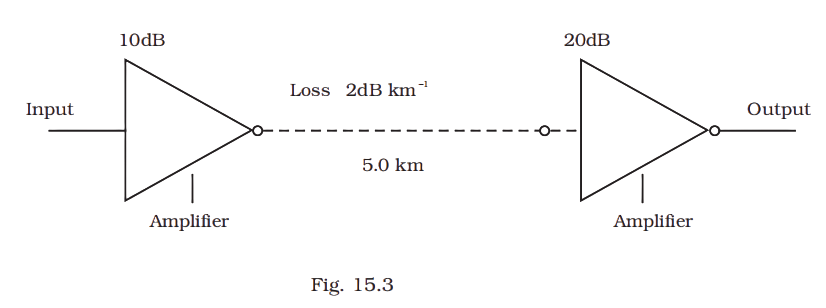
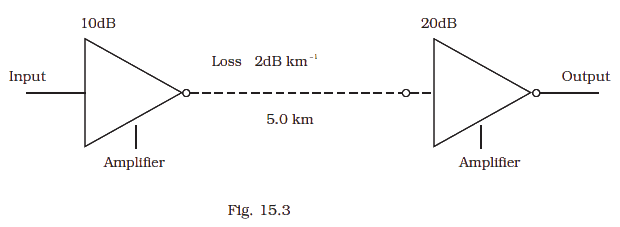
(ii) Attenuation of a signal can be expressed in decibel (dB) according to the relation $\text{dB} = 10 \log_{10} \frac{I_o}{I}$. What is the attenuation in dB/km for an optical fibre in which the intensity falls by 50 per cent over a distance of 50 km?
12.

The frequency response curve (Fig. 15.2) for the filter circuit used for production of AM wave should be

The frequency response curve figure for the filter class 12 physics CBSE


a.

(i) followed by (ii).

b.

(ii) followed by (i).

c.

(iii).

d.

(iv).

13.
Would sky waves be suitable for transmission of TV signals of 60 MHz frequency?
14.
An audio signal is modulated by a carrier wave of 20MHz such that the bandwidth required for modulation is 3kHz. Could this wave be demodulated by a diode detector which has the values of $R$ and $C$ as (iii) $R = 10 \text{ k}\Omega$, $C = 0.1\mu\text{F}$.
15.
(i) The intensity of a light pulse travelling along a communication channel decreases exponentially with distance $x$ according to the relation $I = I_o e^{-\alpha x}$, where $I_o$ is the intensity at $x = 0$ and $\alpha$ is the attenuation constant. Show that the intensity reduces by 75 per cent after a distance of $\frac{\ln 4}{\alpha}$
16.
Identify the mathematical expression for amplitude modulated wave:
a. $A_c \sin [\{\omega_c + k_1 v_m(t)\}t + \phi]$. b. $A_c \sin \{\omega_c t + \phi + k_2 v_m(t)\}$. c. $\{A_c + k_2 v_m(t)\} \sin (\omega_c t + \phi)$. d. $A_c v_m(t) \sin (\omega_c t + \phi)$.
17.
On radiating (sending out) an AM modulated signal, the total radiated power is due to energy carried by $\omega_c$, $\omega_c - \omega_m$ & $\omega_c + \omega_m$. Suggest ways to minimise cost of radiation without compromising on information.
18.
An audio signal of 15kHz frequency cannot be transmitted over long distances without modulation because
a. the size of the required antenna would be at least 5 km which is not convenient. b. the audio signal can not be transmitted through sky waves. c. the size of the required antenna would be at least 20 km, which is not convenient. d. effective power transmitted would be very low, if the size of the antenna is less than 5 km.
19.
A speech signal of 3 kHz is used to modulate a carrier signal of frequency 1 MHz, using amplitude modulation. The frequencies of the side bands will be
a. 1.003 MHz and 0.997 MHz. b. 3001 kHz and 2997 kHz. c. 1003 kHz and 1000 kHz. d. 1 MHz and 0.997 MHz.
20.

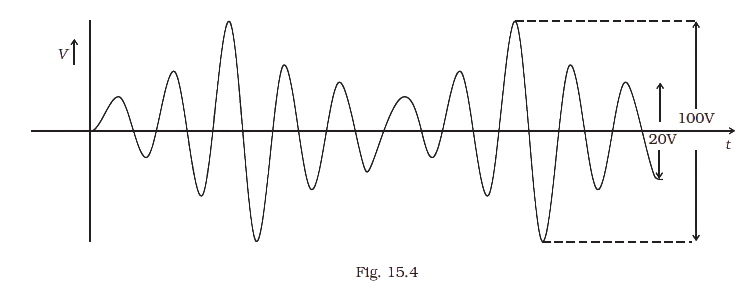
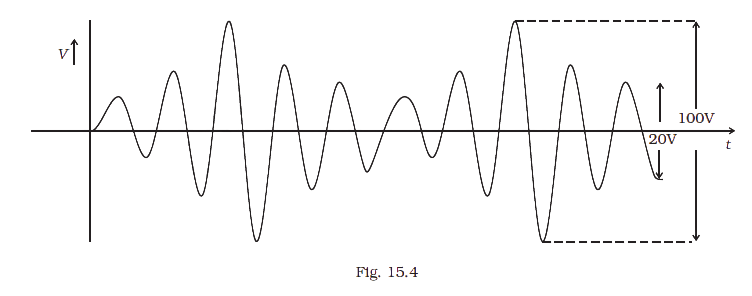
An amplitude modulated wave is as shown in Fig. 15.4. Calculate (iii) peak value of information voltage.
Worksheet Answers

2.
4.
5.
7.
9.
12.
16.
18.
19.

This website uses cookies

We use cookies to improve user experience. Choose what cookies you allow us to use. You can read more about our Cookie Policy in our Privacy Policy

Accept All
Decline All