UrbanPro

Your Worksheet is Ready

CBSE - Class 12 Physics Current Electricity Worksheet

1.
A heating element using nichrome connected to a 230 V supply draws an initial current of 3.2 A which settles after a few seconds to a steady value of 2.8 A. What is the steady temperature of the heating element if the room temperature is 27.0 °C? Temperature coefficient of resistance of nichrome averaged over the temperature range involved is $1.70 \times 10^{-4} °C^{-1}$.
2.
A silver wire has a resistance of $2.1 \Omega$ at 27.5 °C, and a resistance of $2.7 \Omega$ at 100 °C. Determine the temperature coefficient of resistivity of silver.
3.

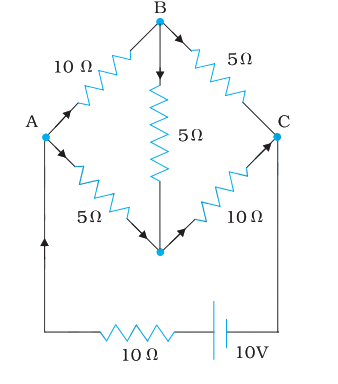
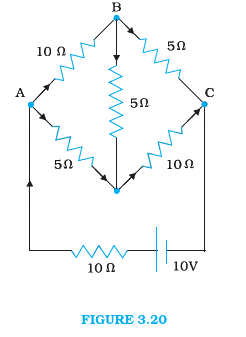
Determine the current in each branch of the network shown in Fig. 3.20:

4.
A storage battery of emf 8.0 V and internal resistance $0.5 \Omega$ is being charged by a 120 V dc supply using a series resistor of $15.5 \Omega$. What is the terminal voltage of the battery during charging? What is the purpose of having a series resistor in the charging circuit?
5.
The storage battery of a car has an emf of 12 V. If the internal resistance of the battery is $0.4 \Omega$, what is the maximum current that can be drawn from the battery?
6.
A battery of emf 10 V and internal resistance $3 \Omega$ is connected to a resistor. If the current in the circuit is 0.5 A, what is the resistance of the resistor? What is the terminal voltage of the battery when the circuit is closed?
7.
The number density of free electrons in a copper conductor estimated in Example 3.1 is $8.5 \times 10^{28} m^{-3}$. How long does an electron take to drift from one end of a wire 3.0 m long to its other end? The area of cross-section of the wire is $2.0 \times 10^{-6} m^2$ and it is carrying a current of 3.0 A.
8.

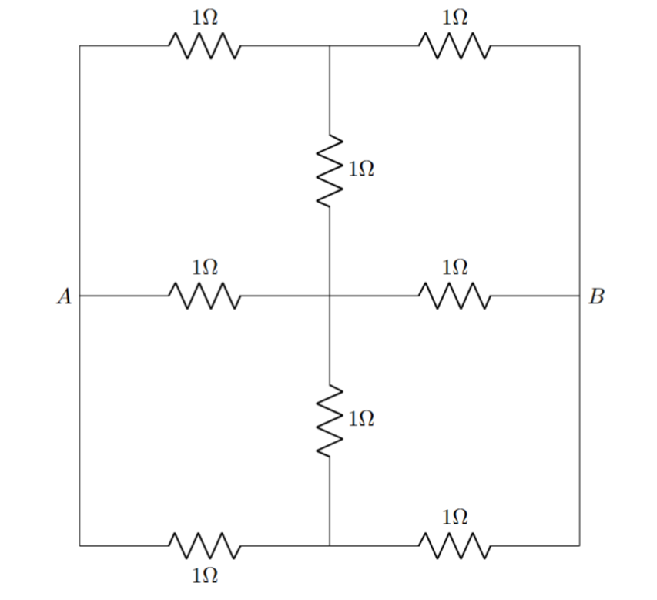
Calculate the equivalent resistance between the point A and B of the presented circuit.
a.

$\frac{1}{3} \Omega$ 

b.

$\frac{4}{3} \Omega$ 

c.

$\frac{3}{2} \Omega$ 

d.

$\frac{2}{3} \Omega$ 

9.

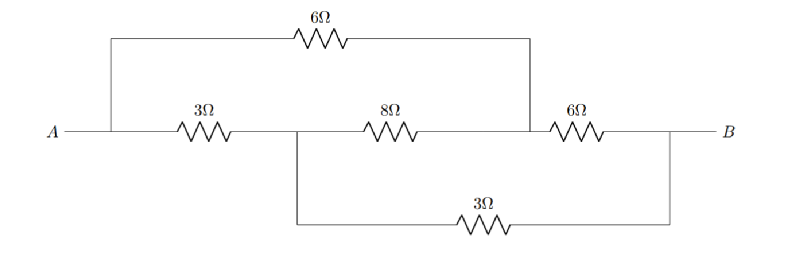
Determine the equivalent resistance between the terminal A and B of the presented figure.
a.

$\frac{25}{4} \Omega$ 

b.

$\frac{25}{8} \Omega$ 

c.

$\frac{5}{4} \Omega$ 

d.

None of these

10.
At room temperature (27.0 °C) the resistance of a heating element is $100 \Omega$. What is the temperature of the element if the resistance is found to be $117 \Omega$, given that the temperature coefficient of the material of the resistor is $1.70 \times 10^{-4} °C^{-1}$.
11.
A negligibly small current is passed through a wire of length 15 m and uniform cross-section $6.0 \times 10^{-7} m^2$, and its resistance is measured to be $5.0 \Omega$. What is the resistivity of the material at the temperature of the experiment?
12.

Find the equivalent resistance between the terminal A and B of the presented figure.
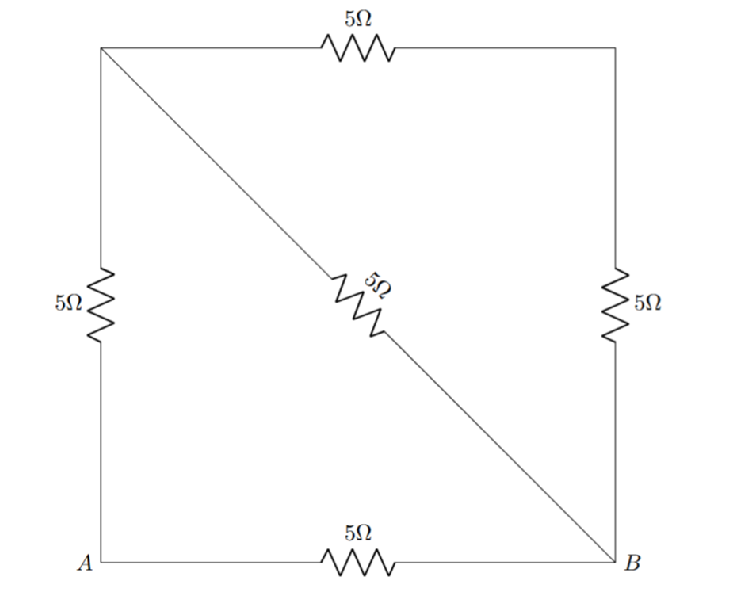
a.

4.0 Ω

b.

2.0 Ω

c.

8.0 Ω

d.

6.0 Ω

Worksheet Answers

8.
Option D
9.
Option B
12.
Option A

This website uses cookies

We use cookies to improve user experience. Choose what cookies you allow us to use. You can read more about our Cookie Policy in our Privacy Policy

Accept All
Decline All