CBSE - Class 12 Physics Electric Charges and Fields Worksheet
1.
A polythene piece rubbed with wool is found to have a negative charge of $3 \times 10^{-7}$ C. (a) Estimate the number of electrons transferred (from which to which?)
2.
A uniformly charged conducting sphere of 2.4 m diameter has a surface charge density of $80.0 \mu C/m^2$. (b) What is the total electric flux leaving the surface of the sphere?
3.
The electrostatic force on a small sphere of charge $0.4 \mu C$ due to another small sphere of charge $-0.8 \mu C$ in air is 0.2 N. (b) What is the force on the second sphere due to the first?
4.
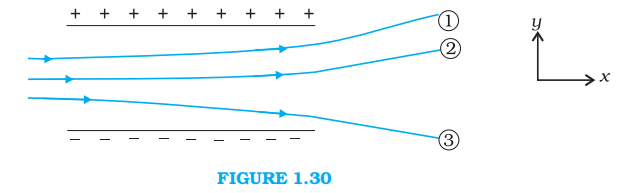
Explain why two field lines never cross each other at any point?
5.
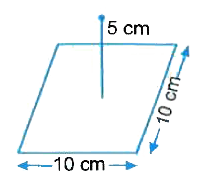
Consider a uniform electric field $E = 3 \times 10^3 \hat{i}$ N/C. (b) What is the flux through the same square if the normal to its plane makes a $60^{\circ}$ angle with the x-axis?
6.
An electrostatic field line is a continuous curve. That is, a field line cannot have sudden breaks. Why not?
7.
A point charge causes an electric flux of $-1.0 \times 10^3$ Nm$^2$/C to pass through a spherical Gaussian surface of 10.0 cm radius centred on the charge. (b) What is the value of the point charge?
8.
Two insulated charged copper spheres A and B have their centres separated by a distance of 50 cm. What is the mutual force of electrostatic repulsion if the charge on each is $6.5 \times 10^{-7}$ C? The radii of A and B are negligible compared to the distance of separation.
9.
A point charge causes an electric flux of $-1.0 \times 10^3$ Nm$^2$/C to pass through a spherical Gaussian surface of 10.0 cm radius centred on the charge. (a) If the radius of the Gaussian surface were doubled, how much flux would pass through the surface?
10.
What is the force of repulsion if each sphere is charged double the above amount, and the distance between them is halved?
11.
Why can one ignore quantisation of electric charge when dealing with macroscopic i.e., large scale charges?
12.
A polythene piece rubbed with wool is found to have a negative charge of $3 \times 10^{-7}$ C. (b) Is there a transfer of mass from wool to polythene?
13.
A conducting sphere of radius 10 cm has an unknown charge. If the electric field 20 cm from the centre of the sphere is $1.5 \times 10^3$ N/C and points radially inward, what is the net charge on the sphere?
14.
Explain the meaning of the statement ‘electric charge of a body is quantised’.
15.
Two large, thin metal plates are parallel and close to each other. On their inner faces, the plates have surface charge densities of opposite signs and of magnitude $17.0 \times 10^{-22}$ C/m$^2$. What is $E$: (c) between the plates?
16.
Careful measurement of the electric field at the surface of a black box indicates that the net outward flux through the surface of the box is $8.0 \times 10^3$ Nm$^2$/C. (a) What is the net charge inside the box?
17.
The electrostatic force on a small sphere of charge $0.4 \mu C$ due to another small sphere of charge $-0.8 \mu C$ in air is 0.2 N. (a) What is the distance between the two spheres?
18.
A uniformly charged conducting sphere of 2.4 m diameter has a surface charge density of $80.0 \mu C/m^2$. (a) Find the charge on the sphere.
19.
A system has two charges $q_A = 2.5 \times 10^{-7}$ C and $q_B = -2.5 \times 10^{-7}$ C located at points A: (0, 0, –15 cm) and B: (0,0, +15 cm), respectively. What are the total charge and electric dipole moment of the system?
20.
What is the force between two small charged spheres having charges of $2 \times 10^{-7}$ C and $3 \times 10^{-7}$ C placed 30 cm apart in air?