

UrbanPro

Your Worksheet is Ready

CBSE - Class 12 Mathematics Probability Worksheet

1.
Let A and B be independent events with $P(A) = 0.3$ and $P(B) = 0.4$. Find (ii) $P(A \cup B)$
2.
In a hostel, 60% of the students read Hindi newspaper, 40% read English newspaper and 20% read both Hindi and English newspapers. A student is selected at random. (a) Find the probability that she reads neither Hindi nor English newspapers.
3.

Suppose we have four boxes A,B,C and D containing coloured marbles as given below: 
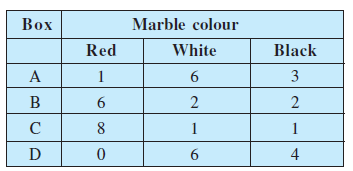
One of the boxes has been selected at random and a single marble is drawn from it. If the marble is red, what is the probability that it was drawn from box A?, box B?, box C?

4.
A factory has two machines A and B. Past record shows that machine A produced 60% of the items of output and machine B produced 40% of the items. Further, 2% of the items produced by machine A and 1% produced by machine B were defective. All the items are put into one stockpile and then one item is chosen at random from this and is found to be defective. What is the probability that it was produced by machine B?
5.
Determine $P(E|F)$. Mother, father and son line up at random for a family picture E : son on one end, F : father in middle
6.
Let A and B be independent events with $P(A) = 0.3$ and $P(B) = 0.4$. Find (i) $P(A \cap B)$
7.
If $P(A) = \frac{6}{11}$ , $P(B) = \frac{5}{11}$ and $P(A \cup B) = \frac{7}{11}$, find (iii) $P(B|A)$
8.

One card is drawn from a pack of 52 cards. Find the probability of  getting a black face card.

a.

3/26 

b.

1/2

c.

4/51

d.

1/13

9.
Probability of solving specific problem independently by A and B are $\frac{1}{2}$ and $\frac{1}{3}$ respectively. If both try to solve the problem independently, find the probability that (ii) exactly one of them solves the problem.
10.
Given that E and F are events such that $P(E) = 0.6$, $P(F) = 0.3$ and $P(E \cap F) = 0.2$, find $P(E|F)$ and $P(F|E)$
11.
An electronic assembly consists of two subsystems, say, A and B. From previous testing procedures, the following probabilities are assumed to be known: $P(A \text{ fails}) = 0.2$, $P(B \text{ fails alone}) = 0.15$, $P(A \text{ and } B \text{ fail}) = 0.15$. Evaluate the following probabilities (ii) $P(A \text{ fails alone})$
12.
Suppose a girl throws a die. If she gets a 5 or 6, she tosses a coin three times and notes the number of heads. If she gets 1, 2, 3 or 4, she tosses a coin once and notes whether a head or tail is obtained. If she obtained exactly one head, what is the probability that she threw 1, 2, 3 or 4 with the die?
13.
Determine $P(E|F)$. A coin is tossed three times, where (iii) E : at most two tails, F : at least one tail
14.
An electronic assembly consists of two subsystems, say, A and B. From previous testing procedures, the following probabilities are assumed to be known: $P(A \text{ fails}) = 0.2$, $P(B \text{ fails alone}) = 0.15$, $P(A \text{ and } B \text{ fail}) = 0.15$. Evaluate the following probabilities (i) $P(A \text{ fails|B has failed})$
15.

Probability of happening even A when event B is also happening simultaneously

a.

P (A)= P(A)/P(B)

b.

P (A/B)= P(A and B)/P(B)

c.

P (A/B)= P(A and B)/P(A)

d.

NONE

16.
A black and a red dice are rolled. (a) Find the conditional probability of obtaining a sum greater than 9, given that the black die resulted in a 5.
17.
Two groups are competing for the position on the Board of directors of a corporation. The probabilities that the first and the second groups will win are 0.6 and 0.4 respectively. Further, if the first group wins, the probability of introducing a new product is 0.7 and the corresponding probability is 0.3 if the second group wins. Find the probability that the new product introduced was by the second group.
18.
Given that the events A and B are such that $P(A) = \frac{1}{2}$, $P(A \cup B) = \frac{3}{5}$ and $P(B) = p$. Find $p$ if they are (ii) independent.
19.
Suppose that 90% of people are right-handed. What is the probability that at most 6 of a random sample of 10 people are right-handed?
20.
In answering a question on a multiple choice test, a student either knows the answer or guesses. Let $\frac{3}{4}$ be the probability that he knows the answer and $\frac{1}{4}$ be the probability that he guesses. Assuming that a student who guesses at the answer will be correct with probability $\frac{1}{4}$. What is the probability that the student knows the answer given that he answered it correctly?

Worksheet Answers

8.
Option A
15.
Option B

This website uses cookies

We use cookies to improve user experience. Choose what cookies you allow us to use. You can read more about our Cookie Policy in our Privacy Policy

Accept All
Decline All
