

UrbanPro

Your Worksheet is Ready

CBSE - Class 12 Chemistry Alcohols Worksheet

1.

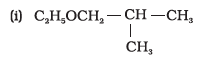
Give IUPAC names of the following ethers:
2.
Write IUPAC names of the following compounds: \(C_{6}H_{5}–O–C_{7}H_{15}(n–)\)
3.
Draw the structures of all isomeric alcohols of molecular formula \(C_{5}H_{12}O\) and give their IUPAC names.
4.
Write structures of the compounds whose IUPAC names are as follows: 1-Phenylpropan-2-ol
5.
How are the following conversions carried out? Propene \(\rightarrow\) Propan-2-ol.
6.
Give equations of the following reactions: Oxidation of propan-1-ol with alkaline \(KMnO_{4}\) solution.
7.
Classify the isomers of alcohols as primary, secondary and tertiary alcohols.
8.

Which of the following in eliminations reaction

a.

Chlorination of ethane

b.

Hydration of ethene

c.

Conversion of but- 1-ene into but-2-ene

d.

Dehydration of ethanol

9.
Give reason for the higher boiling point of ethanol in comparison to methoxymethane.
10.
Write the mechanism of the reaction of \(HI\) with methoxymethane.
11.
Write structures of the compounds whose IUPAC names are as follows: 2-Methylbutan-2-ol
12.
Explain why propanol has higher boiling point than that of the hydrocarbon, butane?
13.

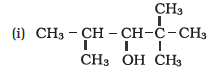
Give IUPAC names of the following ethers:

14.
Give equations of the following reactions: Bromine in \(CS_{2}\) with phenol.
15.
Write the mechanism of acid dehydration of ethanol to yield ethene.
16.

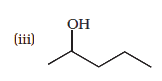
Show how would you synthesise the following alcohols from appropriate alkenes?
17.
Give equations of the following reactions: Dilute \(HNO_{3}\) with phenol.
18.
Write the names of reagents and equations for the preparation of the following ethers by Williamson’s synthesis: Ethoxybenzene
19.
Alcohols are comparatively more soluble in water than hydrocarbons of comparable molecular masses. Explain this fact.
20.

Which of the following statements are correct -

a.

All negative and lone pair containing species behave like nucleophile?

b.

All positive species behave like electrophile?

c.

Electrone deficient species are electrophile?

d.

None of the above 

Worksheet Answers

8.
Option D
20.
Option A

This website uses cookies

We use cookies to improve user experience. Choose what cookies you allow us to use. You can read more about our Cookie Policy in our Privacy Policy

Accept All
Decline All

