UrbanPro

Your Worksheet is Ready

CBSE - Class 12 Chemistry Chemical Kinetics Worksheet

1.
The half-life for radioactive decay of \(^{14}C\) is 5730 years. An archaeological artifact containing wood had only 80% of the \(^{14}C\) found in a living tree. Estimate the age of the sample.
2.

The experimental data for decomposition of \(N_{2}O_{5}\) [\(2N_{2}O_{5} \rightarrow 4NO_{2} + O_{2}\)] in gas phase at 318K are given below:

(vi) Calculate the half-life period from \(k\) and compare it with (ii).

3.
The rate constant for the first order decomposition of \(H_{2}O_{2}\) is given by the following equation:
\(log k = 14.34 – \frac{1.25 \times 10^{4}K}{T}\)
Calculate \(E_{a}\) for this reaction and at what temperature will its half-period be 256 minutes?
4.
Calculate the half-life of a first order reaction from their rate constants given below:
(iii) \(4 years^{-1}\)
5.

In a reaction between \(A\) and \(B\), the initial rate of reaction (\(r_{0}\)) was measured for different initial concentrations of \(A\) and \(B\) as given below: 

What is the order of the reaction with respect to \(A\) and \(B\)?

6.
A reaction is second order with respect to a reactant. How is the rate of reaction affected if the concentration of the reactant is
(ii) reduced to half ?
7.
During nuclear explosion, one of the products is \(^{90}Sr\) with half-life of 28.1 years. If \(1 \mu g\) of \(^{90}Sr\) was absorbed in the bones of a newly born baby instead of calcium, how much of it will remain after 10 years and 60 years if it is not lost metabolically.
8.
A reaction is first order in \(A\) and second order in \(B\).
(iii) How is the rate affected when the concentrations of both \(A\) and \(B\) are doubled?
9.
From the rate expression for the following reactions, determine their order of reaction and the dimensions of the rate constants.
(iii) \(CH_{3}CHO (g) \rightarrow CH_{4} (g) + CO(g)\) Rate = \(k [CH_{3}CHO]^{\frac{3}{2}}\)
10.
The rate constant for a first order reaction is \(60 s^{-1}\). How much time will it take to reduce the initial concentration of the reactant to its \(\frac{1}{16}\)th value?
11.
The decomposition of \(A\) into product has value of \(k\) as \(4.5 \times 10^{3} s^{-1}\) at 10°C and energy of activation \(60 kJ mol^{-1}\). At what temperature would \(k\) be \(1.5 \times 10^{4}s^{-1}\)?
12.

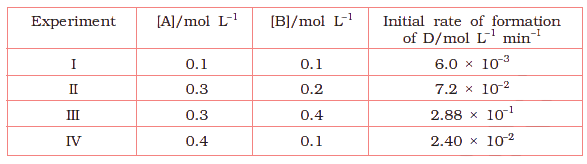
The following results have been obtained during the kinetic studies of the reaction: \(2A + B \rightarrow C + D\)

Determine the rate law and the rate constant for the reaction.

13.

For the decomposition of azoisopropane to hexane and nitrogen at 543 K, the following data are obtained. 
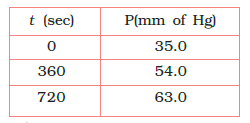
Calculate the rate constant.

14.
What is the effect of temperature on the rate constant of a reaction? How can this effect of temperature on rate constant be represented quantitatively?
15.

The experimental data for decomposition of \(N_{2}O_{5}\) [\(2N_{2}O_{5} \rightarrow 4NO_{2} + O_{2}\)] in gas phase at 318K are given below:

(v) Calculate the rate constant.

16.
For the reaction:
\(2A + B \rightarrow A_{2}B\)
the rate = \(k[A][B]^{2}\) with \(k = 2.0 \times 10^{-6} mol^{-2} L^{2} s^{-1}\). Calculate the initial rate of the reaction when \([A] = 0.1 \text{ mol } L^{-1}\), \([B] = 0.2 \text{ mol } L^{-1}\). Calculate the rate of reaction after \([A]\) is reduced to \(0.06 \text{ mol } L^{-1}\).
17.

The reaction between \(A\) and \(B\) is first order with respect to \(A\) and zero order with respect to \(B\). Fill in the blanks in the following table:

18.
The decomposition of \(NH_{3}\) on platinum surface is zero order reaction. What are the rates of production of \(N_{2}\) and \(H_{2}\) if \(k = 2.5 \times 10^{-4} mol^{-1} L s^{-1}\)?
19.
A reaction is first order in \(A\) and second order in \(B\).
(i) Write the differential rate equation.
20.

The following data were obtained during the first order thermal decomposition of \(SO_{2}Cl_{2}\) at a constant volume. \(SO_{2}Cl_{2}(g) \rightarrow SO_{2}(g) + Cl_{2}(g)\) 

Calculate the rate of the reaction when total pressure is 0.65 atm.

Worksheet Answers

This website uses cookies

We use cookies to improve user experience. Choose what cookies you allow us to use. You can read more about our Cookie Policy in our Privacy Policy

Accept All
Decline All