


Your Worksheet is Ready
CBSE - Class 11 Mathematics Relations and Functions Worksheet
The function f{x}=logx/x is increasing in the interval ?
(1 e)
b.(0. e)
c.(2 2e)
d.(1/e. 2e)
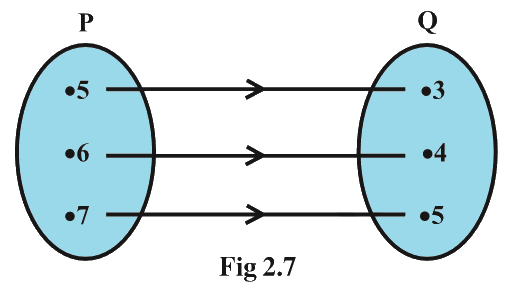
The Fig2.7 shows a relationship between the sets $P$ and $Q$. Write this relation (ii) roster form. What is its domain and range?
Worksheet Answers
Solution:
The relationship between temperature in degrees Celsius ($C$) and degrees Fahrenheit ($F$) is provided by the linear function:
$t(C) = \frac{9}{5}C + 32$
where $t(C)$ represents the temperature in degrees Fahrenheit. [Per the definition of the linear temperature conversion function].
We are given that the temperature in Fahrenheit is $t(C) = 212$. We substitute this value into the governing equation to solve for the unknown variable $C$:
$212 = \frac{9}{5}C + 32$
To isolate the term containing $C$, we apply the subtraction property of equality by subtracting 32 from both sides of the equation:
$212 - 32 = \frac{9}{5}C$
$180 = \frac{9}{5}C$
To isolate $C$, multiply both sides of the equation by the reciprocal of the coefficient $\frac{9}{5}$, which is $\frac{5}{9}$:
$C = 180 \times \frac{5}{9}$
$C = \left(\frac{180}{9}\right) \times 5$ [By the Associative Property of Multiplication]
$C = 20 \times 5$
$C = 100$
Final Solution: The value of $C$ when $t(C) = 212$ is $100^{\circ}\text{C}$.
Solution:
The Cartesian product of two sets $A$ and $B$, denoted by $A \times B$, is the set of all ordered pairs $(a, b)$ such that $a \in A$ and $b \in B$. [Per the definition of Cartesian product in Set Theory].
Given:
Mapping elements of $A$ to $B$:
Thus, $A \times B = \{(1, 3), (1, 4), (2, 3), (2, 4)\}$.
The total number of subsets of any set $S$ is given by the formula $2^n$, where $n$ is the number of elements (cardinality) in the set $S$. [Per the Power Set Axiom].
Here, the cardinality of $A \times B$ is $|A \times B| = 4$.
Number of subsets $= 2^4 = 16$.
Let $S = A \times B = \{p_1, p_2, p_3, p_4\}$, where $p_1=(1,3), p_2=(1,4), p_3=(2,3), p_4=(2,4)$. The 16 subsets are listed as follows:
| Subset Size | Subsets |
|---|---|
| 0 (Empty Set) | $\emptyset$ |
| 1 | $\{(1, 3)\}, \{(1, 4)\}, \{(2, 3)\}, \{(2, 4)\}$ |
| 2 | $\{(1, 3), (1, 4)\}, \{(1, 3), (2, 3)\}, \{(1, 3), (2, 4)\}, \{(1, 4), (2, 3)\}, \{(1, 4), (2, 4)\}, \{(2, 3), (2, 4)\}$ |
| 3 | $\{(1, 3), (1, 4), (2, 3)\}, \{(1, 3), (1, 4), (2, 4)\}, \{(1, 3), (2, 3), (2, 4)\}, \{(1, 4), (2, 3), (2, 4)\}$ |
| 4 | $\{(1, 3), (1, 4), (2, 3), (2, 4)\}$ |
Final Solution: $A \times B = \{(1, 3), (1, 4), (2, 3), (2, 4)\}$. The set has $16$ subsets.
Solution:
The relation $R$ is defined on the set of natural numbers $\mathbb{N}$ as $R = \{(a, b) : a, b \in \mathbb{N} \text{ and } a = b^2\}$.
The statement to evaluate is the transitivity property: $(a, b) \in R$ and $(b, c) \in R \implies (a, c) \in R$.
Let $(a, b) \in R$ and $(b, c) \in R$. By the definition provided in the problem statement, we have:
We substitute the expression for $b$ from the second equation into the first equation to determine the relationship between $a$ and $c$:
$a = (c^2)^2$
$a = c^4$ [By the Law of Indices, $(x^m)^n = x^{m \cdot n}$]
For the condition $(a, c) \in R$ to be true, it must satisfy the definition $a = c^2$. However, we have derived $a = c^4$.
To disprove the statement, we must find a set of values $(a, b, c) \in \mathbb{N}$ that satisfy the antecedent but fail the consequent.
| Variable | Value |
|---|---|
| $c$ | $2$ |
| $b$ | $b = c^2 = 2^2 = 4$ |
| $a$ | $a = b^2 = 4^2 = 16$ |
Testing the condition $(a, c) \in R$ with these values:
Since $a = 16$ and $c = 2$, $a \neq c^2$. Therefore, $(16, 2) \notin R$.
Final Solution: The statement is False. Since $a=b^2$ and $b=c^2$ implies $a=c^4$, and $c^4 \neq c^2$ for $c \in \mathbb{N} \setminus \{1\}$, the relation is not transitive. A counter-example is $(16, 4) \in R$ and $(4, 2) \in R$, but $(16, 2) \notin R$.
Solution:
A relation $f$ from a set $A$ to a set $B$ is defined as a function if and only if every element in the domain $A$ has exactly one unique image in the codomain $B$. [Per the definition of a mapping in Set Theory].
The given relation $R$ is defined as the set of ordered pairs: $R = \{(2, 1), (4, 2), (6, 3), (8, 4), (10, 5), (12, 6), (14, 7)\}$.
To determine if $R$ is a function, we map each element of the domain ($x$) to its corresponding image ($y$):
Observation: Each distinct input $x$ in the domain set $\{2, 4, 6, 8, 10, 12, 14\}$ corresponds to exactly one unique output $y$ in the range set $\{1, 2, 3, 4, 5, 6, 7\}$. [By the Vertical Line Test and Function Mapping Principle]. Therefore, $R$ is a function.
| Attribute | Definition | Result |
|---|---|---|
| Domain | The set of all first components of the ordered pairs. | $\{2, 4, 6, 8, 10, 12, 14\}$ |
| Range | The set of all second components of the ordered pairs. | $\{1, 2, 3, 4, 5, 6, 7\}$ |
Final Solution: The relation is a function because every element of the domain has a unique image in the range. The domain is $\{2, 4, 6, 8, 10, 12, 14\}$ and the range is $\{1, 2, 3, 4, 5, 6, 7\}$.
Solution:
We are given the set $A = \{9, 10, 11, 12, 13\}$. The function $f: A \to \mathbb{N}$ is defined such that $f(n)$ maps each element $n \in A$ to its highest prime factor.
To determine the highest prime factor for each element, we perform prime factorization for each $n \in A$:
We represent the function $f$ as a set of ordered pairs $(n, f(n))$:
| $n$ | $f(n)$ |
|---|---|
| $9$ | $3$ |
| $10$ | $5$ |
| $11$ | $11$ |
| $12$ | $3$ |
| $13$ | $13$ |
The range of a function $f$ is the set of all unique images $f(n)$ for all $n$ in the domain $A$. [Per the definition of the range of a function, $\text{Range}(f) = \{f(n) : n \in A\}$.]
Collecting the values obtained in Step 2:
$\text{Range}(f) = \{3, 5, 11, 3, 13\}$
By removing duplicate elements to satisfy the properties of a set:
$\text{Range}(f) = \{3, 5, 11, 13\}$
Final Solution: The range of $f$ is $\{3, 5, 11, 13\}$.
Solution:
The relation $R$ is defined on the set of natural numbers $\mathbb{N}$ as follows:
$R = \{(a, b) : a, b \in \mathbb{N} \text{ and } a = b^2\}$
The question asks to evaluate the truth value of the following implication: if $(a, b) \in R$, then $(b, a) \in R$.
In formal logic, this property is known as Symmetry. For the relation to be symmetric, the condition $(a, b) \in R \implies (b, a) \in R$ must hold for all $a, b \in \mathbb{N}$.
To disprove the statement, we seek a pair $(a, b)$ such that $(a, b) \in R$ but $(b, a) \notin R$.
1. Choose a value for $b$ such that $b \in \mathbb{N}$ and $b > 1$. Let $b = 2$.
2. Calculate $a$ based on the relation definition $a = b^2$:
$a = 2^2 = 4$
3. Thus, the ordered pair $(4, 2) \in R$ because $4 = 2^2$ [Per the definition of the relation $R$].
4. Now, check if the converse pair $(2, 4)$ belongs to $R$. For $(2, 4) \in R$, the condition $a = b^2$ must hold, where $a=2$ and $b=4$:
$2 = 4^2 \implies 2 = 16$
Since $2 \neq 16$, the pair $(2, 4) \notin R$ [By the definition of equality in arithmetic].
Since we have found at least one instance where $(a, b) \in R$ but $(b, a) \notin R$, the universal statement " $(a, b) \in R \implies (b, a) \in R$ " is false.
| Condition | Status |
|---|---|
| $(4, 2) \in R$ | True ($4 = 2^2$) |
| $(2, 4) \in R$ | False ($2 \neq 4^2$) |
Final Solution: The statement is False. The relation $R$ is not symmetric because for elements $a, b \in \mathbb{N}$, $a = b^2$ does not imply $b = a^2$ unless $a = b = 1$.
Solution:
The Cartesian product of two sets $X$ and $Y$, denoted by $X \times Y$, is the set of all ordered pairs $(a, b)$ such that $a \in X$ and $b \in Y$. [By Definition of Cartesian Product].
Given $A = \{1, 2\}$ and $C = \{5, 6\}$.
$A \times C = \{(a, c) : a \in \{1, 2\}, c \in \{5, 6\}\}$
Performing the distribution:
Thus, $A \times C = \{(1, 5), (1, 6), (2, 5), (2, 6)\}$.
Given $B = \{1, 2, 3, 4\}$ and $D = \{5, 6, 7, 8\}$.
$B \times D = \{(b, d) : b \in \{1, 2, 3, 4\}, d \in \{5, 6, 7, 8\}\}$
The set $B \times D$ contains $4 \times 4 = 16$ elements:
| 5 | 6 | 7 | 8 | |
|---|---|---|---|---|
| 1 | (1, 5) | (1, 6) | (1, 7) | (1, 8) |
| 2 | (2, 5) | (2, 6) | (2, 7) | (2, 8) |
| 3 | (3, 5) | (3, 6) | (3, 7) | (3, 8) |
| 4 | (4, 5) | (4, 6) | (4, 7) | (4, 8) |
A set $S$ is a subset of $T$ ($S \subseteq T$) if and only if every element of $S$ is also an element of $T$. [By Definition of Subset].
Since all four elements of $A \times C$ are present within the set $B \times D$, the condition for a subset is satisfied.
Final Solution: Since every element of $A \times C = \{(1, 5), (1, 6), (2, 5), (2, 6)\}$ is contained within $B \times D$, it is verified that $A \times C \subseteq B \times D$.
Solution:
A relation $f$ from a set $A$ to a set $B$ is defined as a function if every element $x \in A$ has one and only one image $y \in B$. [Per the Definition of a Mapping/Function]. Specifically, for a set of ordered pairs, a relation is a function if and only if no two distinct ordered pairs share the same first element (domain value).
Let the given relation be $R = \{(2,1), (5,1), (8,1), (11,1), (14,1), (17,1)\}$.
| Input ($x$) | Output ($y$) |
|---|---|
| 2 | 1 |
| 5 | 1 |
| 8 | 1 |
| 11 | 1 |
| 14 | 1 |
| 17 | 1 |
Observation: Every input value ($2, 5, 8, 11, 14, 17$) is mapped to exactly one output value ($1$). There are no instances where the same input yields different outputs. [By the Uniqueness Condition of Functions].
Final Solution: The relation is a function because every element in the domain has a unique image in the range. The domain is $\{2, 5, 8, 11, 14, 17\}$ and the range is $\{1\}$.
Solution:
The given function is defined as $f(x) = 2 - 3x$. The domain of the function is restricted by the condition $x \in \mathbb{R}$ and $x > 0$. In interval notation, the domain is $(0, \infty)$.
To determine the range, we must find the set of all possible values for $f(x)$ as $x$ varies across its domain $(0, \infty)$. We begin with the given inequality [By Definition of Domain]:
$x > 0$
Multiply both sides by $-3$. Per the rules of inequality, multiplying by a negative number reverses the inequality sign [Property of Inequalities]:
$-3x < -3(0)$
$-3x < 0$
To reach the functional form $f(x) = 2 - 3x$, add $2$ to both sides of the inequality [Property of Addition in Inequalities]:
$2 - 3x < 2 + 0$
$2 - 3x < 2$
Since $f(x) = 2 - 3x$, we substitute the function notation:
$f(x) < 2$
As $x$ approaches $0$ from the positive side, $f(x)$ approaches $2 - 3(0) = 2$. As $x \to \infty$, $f(x)$ decreases infinitely toward $-\infty$. Therefore, the range is the set of all values strictly less than $2$.
The range represents all real numbers $y$ such that $y < 2$. In set-builder notation and interval notation:
Final Solution: The range of the function $f(x) = 2 - 3x$ for $x > 0$ is $(-\infty, 2)$.
Solution:
Based on the standard representation of the provided function diagram (Figure 2.7), we observe the following mapping between set $P$ and set $Q$:
A relation in roster form is represented as a set of ordered pairs $(x, y)$ such that $x \in P$ and $y \in Q$, and $x$ is related to $y$ [Per Definition of a Relation in Set Theory].
From the visual mapping:
Thus, the Roster Form $R$ is:
$R = \{(5, 3), (6, 4), (7, 5)\}$
The domain of a relation is the set of all first components of the ordered pairs in $R$ [Per Definition of Domain].
Extracting the first components from $R$:
$\text{Domain} = \{5, 6, 7\}$
The range of a relation is the set of all second components of the ordered pairs in $R$ [Per Definition of Range].
Extracting the second components from $R$:
$\text{Range} = \{3, 4, 5\}$
Final Solution: The relation in roster form is $\{(5, 3), (6, 4), (7, 5)\}$. The domain is $\{5, 6, 7\}$ and the range is $\{3, 4, 5\}$.
Solution:
The domain of a rational function $f(x) = \frac{P(x)}{Q(x)}$ consists of all real numbers $x \in \mathbb{R}$ such that the denominator $Q(x) \neq 0$. Any value of $x$ that results in $Q(x) = 0$ is excluded from the domain to avoid division by zero, which is undefined in the set of real numbers [Per the definition of functions in $\mathbb{R}$].
Given $f(x) = \frac{x^2 + 2x + 1}{x^2 - 8x + 12}$, the denominator is defined as the quadratic polynomial:
$Q(x) = x^2 - 8x + 12$
To find the excluded values, we set $Q(x) = 0$ and solve for $x$ using the factorization method [By the Zero Product Property]:
$x^2 - 8x + 12 = 0$
We seek two numbers that multiply to $12$ and add to $-8$. These numbers are $-6$ and $-2$.
$x^2 - 6x - 2x + 12 = 0$
$x(x - 6) - 2(x - 6) = 0$
$(x - 2)(x - 6) = 0$
Therefore, $x - 2 = 0 \implies x = 2$ or $x - 6 = 0 \implies x = 6$.
The function $f(x)$ is defined for all real numbers except for the set of points where the denominator vanishes. Thus, the domain is the set of all real numbers excluding $\{2, 6\}$.
Expressing the result in standard set notation:
$Domain(f) = \mathbb{R} \setminus \{2, 6\}$
Alternatively, in interval notation:
$Domain(f) = (-\infty, 2) \cup (2, 6) \cup (6, \infty)$
Final Solution: The domain of the function is the set of all real numbers except $2$ and $6$, represented as $\mathbb{R} - \{2, 6\}$.
Solution:
Given the sets $A = \{x, y, z\}$ and $B = \{1, 2\}$, we define the cardinal number (the number of elements in a set) as follows:
The Cartesian product $A \times B$ is the set of all possible ordered pairs $(a, b)$ such that $a \in A$ and $b \in B$. The total number of elements in $A \times B$ is given by the product of the cardinalities of the individual sets:
$n(A \times B) = n(A) \times n(B)$
$n(A \times B) = 3 \times 2 = 6$
[Per the definition of the Cartesian product of two finite sets]
A relation $R$ from set $A$ to set $B$ is defined as any subset of the Cartesian product $A \times B$. [By the definition of a relation: $R \subseteq A \times B$].
The total number of relations from $A$ to $B$ is equivalent to the number of possible subsets of the Cartesian product $A \times B$.
If a set has $m$ elements, the number of its subsets is given by $2^m$. Here, $m = n(A \times B) = 6$.
Total number of relations = $2^{n(A \times B)}$
Total number of relations = $2^6$
$2^6 = 2 \times 2 \times 2 \times 2 \times 2 \times 2 = 64$
Final Solution: The total number of relations from set $A$ to set $B$ is $64$.
Solution:
Given set $A = \{1, 2, 3, 4, 6\}$. The relation $R$ is defined as $R = \{(a, b) : a, b \in A \text{ and } b \equiv 0 \pmod{a}\}$, where the notation $b \equiv 0 \pmod{a}$ denotes that $b$ is exactly divisible by $a$. This implies that the quotient $\frac{b}{a}$ must be an integer, which is equivalent to saying $a$ is a factor of $b$ [Definition of Divisibility in Number Theory].
We test each element $a \in A$ against every element $b \in A$ to determine if $\frac{b}{a} \in \mathbb{Z}$:
| $a$ | Potential $b$ (such that $b$ is a multiple of $a$) | Valid Ordered Pairs $(a, b)$ |
|---|---|---|
| $1$ | $1, 2, 3, 4, 6$ | $(1, 1), (1, 2), (1, 3), (1, 4), (1, 6)$ |
| $2$ | $2, 4, 6$ | $(2, 2), (2, 4), (2, 6)$ |
| $3$ | $3, 6$ | $(3, 3), (3, 6)$ |
| $4$ | $4$ | $(4, 4)$ |
| $6$ | $6$ | $(6, 6)$ |
By collecting all ordered pairs identified in the systematic verification, we define the relation $R$ in roster form. We ensure that every pair satisfies the condition $b = k \cdot a$ for some $k \in \{1, 2, 3, \dots\}$ [Property of Divisibility].
The collection of all valid pairs $(a, b)$ constitutes the roster form of the relation $R$.
Final Solution: $R = \{(1, 1), (1, 2), (1, 3), (1, 4), (1, 6), (2, 2), (2, 4), (2, 6), (3, 3), (3, 6), (4, 4), (6, 6)\}$
Solution:
The set $A$ is defined as $A = \{-1, 1\}$. We are required to determine the Cartesian product of the set $A$ with itself three times, denoted as $A \times A \times A$ (also known as the set of all ordered triples $(a, b, c)$ such that $a, b, c \in A$).
By the definition of the Cartesian product of two sets [Per the definition of Cartesian Product $X \times Y = \{(x, y) : x \in X, y \in Y\}$], we first compute the product of two sets $A = \{-1, 1\}$:
$A \times A = \{(-1, -1), (-1, 1), (1, -1), (1, 1)\}$To find the triple Cartesian product, we map each element of the resulting set from Step 1 with each element of the original set $A = \{-1, 1\}$. Each element $(x, y) \in A \times A$ will be appended with an element $z \in A$ to form the triple $(x, y, z)$.
Consolidating the steps above, the set $A \times A \times A$ contains $2^3 = 8$ distinct elements.
$A \times A \times A = \{(-1, -1, -1), (-1, -1, 1), (-1, 1, -1), (-1, 1, 1), (1, -1, -1), (1, -1, 1), (1, 1, -1), (1, 1, 1)\}$Final Solution: $A \times A \times A = \{(-1, -1, -1), (-1, -1, 1), (-1, 1, -1), (-1, 1, 1), (1, -1, -1), (1, -1, 1), (1, 1, -1), (1, 1, 1)\}$
Solution:
The function is defined as $f(x) = x^2$. We are tasked with evaluating the difference quotient:
$\frac{f(1.1) - f(1)}{1.1 - 1}$
[Per the definition of the derivative/average rate of change, this expression represents the slope of the secant line passing through points $(1, f(1))$ and $(1.1, f(1.1))$.]
We calculate $f(x)$ for the specified points in the domain:
Performing the arithmetic multiplication $(1.1 \times 1.1) = 1.21$. [By the law of exponents where $(a \cdot b)^n = a^n \cdot b^n$ is not applicable, rather simple decimal multiplication $11 \times 11 = 121$ with two decimal places].
Substitute the evaluated values into the expression:
$\frac{1.21 - 1}{1.1 - 1}$
Perform the subtraction in the numerator and denominator:
$\text{Numerator: } 1.21 - 1.00 = 0.21$
$\text{Denominator: } 1.1 - 1.0 = 0.1$
$\frac{0.21}{0.1}$
Multiply both numerator and denominator by $10$ to remove the decimal fraction: [Property of Equivalent Fractions: $\frac{a}{b} = \frac{a \cdot k}{b \cdot k}$ for $k \neq 0$]
$\frac{0.21 \times 10}{0.1 \times 10} = \frac{2.1}{1} = 2.1$
Final Solution: 2.1
Solution:
The relation $R$ is defined on the set of integers $\mathbb{Z}$ as follows:
$R = \{(a, b) : a, b \in \mathbb{Z}, a - b \in \mathbb{Z}\}$
[By the property of closure under subtraction for integers: If $a, b \in \mathbb{Z}$, then $(a - b)$ is always an integer $\mathbb{Z}$.]
The domain of a relation $R$ consists of all the first elements of the ordered pairs $(a, b)$ that belong to $R$.
Thus, the domain of $R$ is the set of all integers, $\mathbb{Z}$.
The range of a relation $R$ consists of all the second elements of the ordered pairs $(a, b)$ that belong to $R$.
Thus, the range of $R$ is the set of all integers, $\mathbb{Z}$.
| Set | Definition |
|---|---|
| Domain | $\{x : x \in \mathbb{Z}\}$ |
| Range | $\{y : y \in \mathbb{Z}\}$ |
Final Solution: The domain of $R$ is $\mathbb{Z}$ and the range of $R$ is $\mathbb{Z}$.
Solution:
Given the sets:
The intersection of any set $B$ with the empty set $\phi$ is defined by the property that no element can exist in both $B$ and the empty set simultaneously.
$B \cap \phi = \{x : x \in B \text{ and } x \in \phi\}$ [By the definition of Set Intersection]
Since $\phi$ has no elements, there is no $x$ such that $x \in \phi$. Therefore:
$B \cap \phi = \emptyset$
Substitute the result from Step 2 into the expression:
$A \times (B \cap \phi) = A \times \emptyset$
The Cartesian product of any set $A$ with the empty set is defined as the set of all ordered pairs $(a, b)$ such that $a \in A$ and $b \in \emptyset$. [Per the definition of Cartesian Product]
Since there are no elements in the empty set to form a pair, the resulting set must also be empty:
$A \times \emptyset = \emptyset$
The original statement is: $A \times (B \cap \phi) = \phi$.
Based on the derivation in Step 3, $A \times (B \cap \phi) = \emptyset$, which is equal to $\phi$.
Final Solution: The statement is True.
Solution:
A function $f: A \rightarrow B$ assigns to each element $x \in A$ exactly one element $f(x) \in B$. To evaluate a function $f(x)$ for a specific value $x = a$, we perform a direct substitution of the constant $a$ into the variable $x$ within the defined algebraic rule [Per the definition of functional mapping].
The given function is defined as:
$f(x) = 2x - 5$
We are required to find the value of $f(0)$. Here, the independent variable $x$ is assigned the value of $0$.
$f(0) = 2(0) - 5$ [By substitution property of equality]
Applying the arithmetic operations as per the order of operations (BODMAS/PEMDAS):
The graph represents the line $y = 2x - 5$. At $x = 0$, the line intersects the y-axis at the point $(0, -5)$, which confirms our analytical calculation.
Final Solution: $f(0) = -5$
Solution:
Given the sets:
The relation $R$ is defined as $R = \{(x, y) : |x - y| \in \{ \text{odd numbers} \}; x \in A, y \in B\}$. [Per the definition of relation in Cartesian product $A \times B$].
To determine if the difference $|x - y|$ is odd, we utilize the parity property: The difference between two integers is odd if and only if one integer is even and the other is odd. [Parity Law: $Odd - Even = Odd$ and $Even - Odd = Odd$].
| $x \in A$ | $y \in B$ | Difference $|x - y|$ | Parity | Include in $R$? |
|---|---|---|---|---|
| 1 | 4 | $|1-4| = 3$ | Odd | Yes |
| 1 | 6 | $|1-6| = 5$ | Odd | Yes |
| 1 | 9 | $|1-9| = 8$ | Even | No |
| 2 | 4 | $|2-4| = 2$ | Even | No |
| 2 | 6 | $|2-6| = 4$ | Even | No |
| 2 | 9 | $|2-9| = 7$ | Odd | Yes |
| 3 | 4 | $|3-4| = 1$ | Odd | Yes |
| 3 | 6 | $|3-6| = 3$ | Odd | Yes |
| 3 | 9 | $|3-9| = 6$ | Even | No |
| 5 | 4 | $|5-4| = 1$ | Odd | Yes |
| 5 | 6 | $|5-6| = 1$ | Odd | Yes |
| 5 | 9 | $|5-9| = 4$ | Even | No |
Collecting all identified pairs $(x, y)$ where the difference is odd:
$R = \{(1, 4), (1, 6), (2, 9), (3, 4), (3, 6), (5, 4), (5, 6)\}$
Final Solution: $R = \{(1, 4), (1, 6), (2, 9), (3, 4), (3, 6), (5, 4), (5, 6)\}$


