UrbanPro

Your Worksheet is Ready

CBSE - Class 11 Physics Motion in a Plane Worksheet

1.
Can you associate vectors with (a) the length of a wire bent into a loop,
2.
Read each statement below carefully and state, with reasons and examples, if it is true or false : A scalar quantity is one that (a) is conserved in a process
3.
Read each statement below carefully and state, with reasons, if it is true or false : (b) The velocity vector of a particle at a point is always along the tangent to the path of the particle at that point
4.
Read each statement below carefully and state, with reasons and examples, if it is true or false : A scalar quantity is one that (b) can never take negative values
5.
On an open ground, a motorist follows a track that turns to his left by an angle of $60^{\circ}$ after every 500 m. Starting from a given turn, specify the displacement of the motorist at the third, sixth and eighth turn. Compare the magnitude of the displacement with the total path length covered by the motorist in each case.
6.
Read each statement below carefully and state with reasons, if it is true or false : (b) each component of a vector is always a scalar,
7.
Read each statement below carefully and state with reasons, if it is true or false : (c) the total path length is always equal to the magnitude of the displacement vector of a particle.
8.
(b) Shows that the projection angle $\theta_0$ for a projectile launched from the origin is given by $\theta_0 = \tan^{-1}\left(\frac{4h_m}{R}\right)$ where the symbols have their usual meaning.
9.
Read each statement below carefully and state, with reasons and examples, if it is true or false : A scalar quantity is one that (c) must be dimensionless
10.
The position of a particle is given by $\boldsymbol{r} = 3.0t \hat{i} - 2.0t^2 \hat{j} + 4.0 \hat{k} m$ where $t$ is in seconds and the coefficients have the proper units for $\boldsymbol{r}$ to be in metres. (a) Find the $\boldsymbol{v}$ and $\boldsymbol{a}$ of the particle?
11.
A passenger arriving in a new town wishes to go from the station to a hotel located 10 km away on a straight road from the station. A dishonest cabman takes him along a circuitous path 23 km long and reaches the hotel in 28 min. What is (a) the average speed of the taxi,
12.
Given $a + b + c + d = 0$, which of the following statements are correct : (a) $a$, $b$, $c$, and $d$ must each be a null vector,
13.

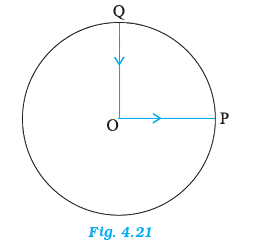
A cyclist starts from the centre O of a circular park of radius 1 km, reaches the edge P of the park, then cycles along the circumference, and returns to the centre along QO as shown in Fig. 4.21. If the round trip takes 10 min, what is the (b) average velocity,

14.
$\hat{i}$ and $\hat{j}$ are unit vectors along x- and y- axis respectively. What is the magnitude and direction of the vectors $\hat{i} + \hat{j}$ , and $\hat{i} - \hat{j}$ ? What are the components of a vector $A= 2 \hat{i} + 3 \hat{j}$ along the directions of $\hat{i} + \hat{j}$ and $\hat{i} - \hat{j}$ ? [You may use graphical method]
15.

A cyclist starts from the centre O of a circular park of radius 1 km, reaches the edge P of the park, then cycles along the circumference, and returns to the centre along QO as shown in Fig. 4.21. If the round trip takes 10 min, what is the (c) average speed of the cyclist ?
16.
Given $a + b + c + d = 0$, which of the following statements are correct : (b) The magnitude of $(a + c)$ equals the magnitude of $( b + d)$,
17.
State with reasons, whether the following algebraic operations with scalar and vector physical quantities are meaningful : (e) adding any two vectors,
18.
A vector has magnitude and direction. Does it have a location in space ? Can it vary with time ? Will two equal vectors a and b at different locations in space necessarily have identical physical effects ? Give examples in support of your answer.
19.
A particle starts from the origin at $t = 0 s$ with a velocity of $10.0 \hat{j} m/s$ and moves in the x-y plane with a constant acceleration of $(8.0 \hat{i} + 2.0 \hat{j}) m s^{-2}$. (b) What is the speed of the particle at the time ?
20.
Establish the following vector inequalities geometrically or otherwise : (c) $|a-b| < |a| + |b|$. When does the equality sign above apply?

Worksheet Answers

This website uses cookies

We use cookies to improve user experience. Choose what cookies you allow us to use. You can read more about our Cookie Policy in our Privacy Policy

Accept All
Decline All