


Your Worksheet is Ready
CBSE - Class 11 Physics Oscillations Worksheet
What would be ideal for dealing with a potential risk?
Eliminate
b.Avoid
c.Accept and Manage
d.Ignore
Let us take the position of mass when the spring is unstreched as $x = 0$, and the direction from left to right as the positive direction of x-axis. Give $x$ as a function of time $t$ for the oscillating mass if at the moment we start the stopwatch ($t = 0$), the mass is (a) at the mean position,
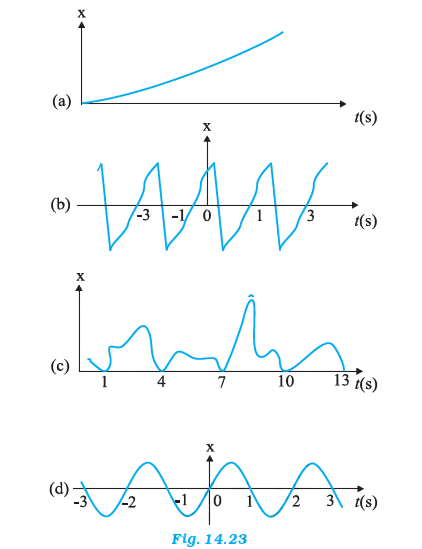
Fig. 14.23 depicts four x-t plots for linear motion of a particle. Which of the plots represent periodic motion? What is the period of motion (in case of periodic motion) ?
An upcoming RBI policy annoucement has made you think about whether not to trade in banking stocks just before the annoucement. What is your best strategy?
Accept risk and manage
b.Avoid
c.Eliminiate
d.Ignore
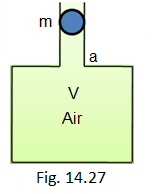
An air chamber of volume $V$ has a neck area of cross section $a$ into which a ball of mass $m$ just fits and can move up and down without any friction (Fig.14.27). Show that when the ball is pressed down a little and released , it executes SHM. Obtain an expression for the time period of oscillations assuming pressure-volume variations of air to be isothermal [see Fig. 14.27].
Between Index and Stocks, Index has a lower risk profile as a result of of risk diversification by the pool of underlying stocks
When you're trying to exit a trade, the trading platform gives error messages. Turns out that the broker's servers are down. What kind of risk has just manifested itself?
Market Risk
b.Human Risk
c.System Risk
d.Major Risk
If you're not 100% sure about a potential setup, which of these can you adopt to reduce risk?
Chunking
b.Avoid the trade
c.Go in with a bigger position size but for shorter amount of time
d.Trade in derivatives to utilize leverage
Worksheet Answers
Solution:
Elimination is always better than any other way of risk management.
Solution:
Avoidance is the best risk mitigation strategy here. What's the point in unnecessarily taking the risk?
Solution:
Diversification reduces risk. The same concept that is applied in investing works in trading as well.
A stock in itself can go up or down 5-10% in a day and noone would be surprised whereas NIFTY or Bank NIFTY will never make that kind of a wild move. Therefore, a lot of professional traders prefer to trade in the indices rather than individual stocks because it is easier to manage risk and there is higher predictability.
Solution:
Yes, it's a system risk and you could have easily mitigated by another brokerage account that could have acted like a backup for the primary account.
Solution:
The best option would be to just avoid the trade altogether. However, if you do decide to trade, get into the trade with a smaller position size and later if the trade starts to look better, add more to it. That way, even if you are wrong, you would be taking a loss on a smaller position size.
At the end of the day, it is all about risk management.


