UrbanPro

Your Worksheet is Ready

CBSE - Class 11 Physics Kinetic Theory Worksheet

1.
Estimate the mean free path and collision frequency of a nitrogen molecule in a cylinder containing nitrogen at 2.0 atm and temperature 17 0C. Take the radius of a nitrogen molecule to be roughly 1.0 Å. Compare the collision time with the time the molecule moves freely between two successive collisions (Molecular mass of $N_2$ = 28.0 u).
2.
Estimate the total number of air molecules (inclusive of oxygen, nitrogen, water vapour and other constituents) in a room of capacity 25.0 $m^3$ at a temperature of 27 °C and 1 atm pressure.
3.
An air bubble of volume 1.0 $cm^3$ rises from the bottom of a lake 40 m deep at a temperature of 12 °C. To what volume does it grow when it reaches the surface, which is at a temperature of 35 °C ?
4.
Estimate the average thermal energy of a helium atom at (ii) the temperature on the surface of the Sun (6000 K),
5.
Three vessels of equal capacity have gases at the same temperature and pressure. The first vessel contains neon (monatomic), the second contains chlorine (diatomic), and the third contains uranium hexafluoride (polyatomic). Do the vessels contain equal number of respective molecules ? Is the root mean square speed of molecules the same in the three cases? If not, in which case is $v_{rms}$ the largest ?
6.
At what temperature is the root mean square speed of an atom in an argon gas cylinder equal to the rms speed of a helium gas atom at – 20 °C ? (atomic mass of $Ar$ = 39.9 u, of $He$ = 4.0 u).
7.
Estimate the average thermal energy of a helium atom at (i) room temperature (27 °C),
8.

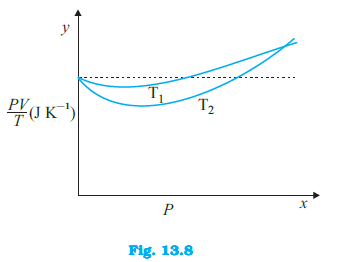
Figure 13.8 shows plot of $frac{PV}{T}$ versus $P$ for $1.00 \times 10^{-3}$ kg of oxygen gas at two different temperatures. (c) What is the value of $frac{PV}{T}$ where the curves meet on the y-axis?

9.

Figure 13.8 shows plot of $frac{PV}{T}$ versus $P$ for $1.00 \times 10^{-3}$ kg of oxygen gas at two different temperatures. (d) If we obtained similar plots for $1.00 \times 10^{-3}$ kg of hydrogen, would we get the same value of $frac{PV}{T}$ at the point where the curves meet on the y-axis? If not, what mass of hydrogen yields the same value of $frac{PV}{T}$ (for low pressure high temperature region of the plot) ? (Molecular mass of $H_2$ = 2.02 u, of $O_2$ = 32.0 u, $R = 8.31$ J $mol^{-1} K^{-1}$.)

10.
Estimate the fraction of molecular volume to the actual volume occupied by oxygen gas at STP. Take the diameter of an oxygen molecule to be 3 Å.
11.

Figure 13.8 shows plot of $frac{PV}{T}$ versus $P$ for $1.00 \times 10^{-3}$ kg of oxygen gas at two different temperatures. (b) Which is true: $T_1 > T_2$ or $T_1 < T_2$?

12.

Figure 13.8 shows plot of $frac{PV}{T}$ versus $P$ for $1.00 \times 10^{-3}$ kg of oxygen gas at two different temperatures. (a) What does the dotted plot signify?
13.
Molar volume is the volume occupied by 1 mol of any (ideal) gas at standard temperature and pressure (STP : 1 atmospheric pressure, 0 °C). Show that it is 22.4 litres.
14.
An oxygen cylinder of volume 30 litres has an initial gauge pressure of 15 atm and a temperature of 27 °C. After some oxygen is withdrawn from the cylinder, the gauge pressure drops to 11 atm and its temperature drops to 17 °C. Estimate the mass of oxygen taken out of the cylinder ($R = 8.31$ J $mol^{-1} K^{-1}$, molecular mass of $O_2$ = 32 u).
15.
Estimate the average thermal energy of a helium atom at (iii) the temperature of 10 million kelvin (the typical core temperature in the case of a star).

Worksheet Answers

This website uses cookies

We use cookies to improve user experience. Choose what cookies you allow us to use. You can read more about our Cookie Policy in our Privacy Policy

Accept All
Decline All