

UrbanPro

Your Worksheet is Ready

CBSE - Class 11 Physics Thermodynamics Worksheet

1.

A 3KW electric resistance heater submerged in 2.5kg water is turned on and left on for 5 min. During the process ,150KJ of heat is lost from the water . The final temperature of water(in ºC) if the initial temperature of water is 40ºC.

a.

26.26

b.

57.42

c.

71.77

d.

91.45

2.
Explain why (a) Two bodies at different temperatures $T_1$ and $T_2$ if brought in thermal contact do not necessarily settle to the mean temperature $(T_1 + T_2)/2$.
3.
What amount of heat must be supplied to $2.0 \times 10^{-2}$ kg of nitrogen (at room temperature) to raise its temperature by $45^\circ C$ at constant pressure ? (Molecular mass of $N_2 = 28$; $R = 8.3 J mol^{-1} K^{-1}$.)
4.
Two cylinders A and B of equal capacity are connected to each other via a stopcock. A contains a gas at standard temperature and pressure. B is completely evacuated. The entire system is thermally insulated. The stopcock is suddenly opened. Answer the following : (a) What is the final pressure of the gas in A and B ?
5.
Two cylinders A and B of equal capacity are connected to each other via a stopcock. A contains a gas at standard temperature and pressure. B is completely evacuated. The entire system is thermally insulated. The stopcock is suddenly opened. Answer the following : (b) What is the change in internal energy of the gas ?
6.
A refrigerator is to maintain eatables kept inside at $9^\circ C$. If room temperature is $36^\circ C$, calculate the coefficient of performance.
7.
Explain why (d) The climate of a harbour town is more temperate than that of a town in a desert at the same latitude.
8.

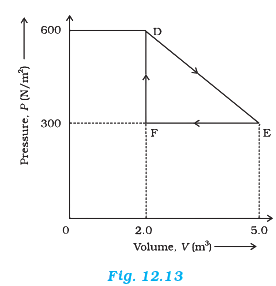
A thermodynamic system is taken from an original state to an intermediate state by the linear process shown in Fig. (12.13). Its volume is then reduced to the original value from E to F by an isobaric process. Calculate the total work done by the gas from D to E to F.
9.
Explain why (b) The coolant in a chemical or a nuclear plant (i.e., the liquid used to prevent the different parts of a plant from getting too hot) should have high specific heat.
10.
A geyser heats water flowing at the rate of 3.0 litres per minute from $27^\circ C$ to $77^\circ C$. If the geyser operates on a gas burner, what is the rate of consumption of the fuel if its heat of combustion is $4.0 \times 10^4 J/g$ ?
11.
Explain why (c) Air pressure in a car tyre increases during driving.
12.
Two cylinders A and B of equal capacity are connected to each other via a stopcock. A contains a gas at standard temperature and pressure. B is completely evacuated. The entire system is thermally insulated. The stopcock is suddenly opened. Answer the following : (c) What is the change in the temperature of the gas ?
13.
A steam engine delivers $5.4 \times 10^8 J$ of work per minute and services $3.6 \times 10^9 J$ of heat per minute from its boiler. What is the efficiency of the engine? How much heat is wasted per minute?
14.

Energy is recieved by a solar collector at the rate of 300KW from a source temperatureof 2400 K . If 60KW of this energy is lost to the surrounding at steady state and if the user temperature remains constant at 600 K , what are the first law and second law efficiencies .(Take temperature of surrounding as 300 K)

a.

0.75 , 0.57

b.

0.68 , 0.72

c.

0.84 , 0.67

d.

0.80 , 0.45

15.
Two cylinders A and B of equal capacity are connected to each other via a stopcock. A contains a gas at standard temperature and pressure. B is completely evacuated. The entire system is thermally insulated. The stopcock is suddenly opened. Answer the following : (d) Do the intermediate states of the system (before settling to the final equilibrium state) lie on its P-V-T surface ?
16.
An electric heater supplies heat to a system at a rate of 100W. If system performs work at a rate of 75 joules per second. At what rate is the internal energy increasing?
17.
In changing the state of a gas adiabatically from an equilibrium state A to another equilibrium state B, an amount of work equal to 22.3 J is done on the system. If the gas is taken from state A to B via a process in which the net heat absorbed by the system is 9.35 cal, how much is the net work done by the system in the latter case ? (Take 1 cal = 4.19 J)
18.
A cylinder with a movable piston contains 3 moles of hydrogen at standard temperature and pressure. The walls of the cylinder are made of a heat insulator, and the piston is insulated by having a pile of sand on it. By what factor does the pressure of the gas increase if the gas is compressed to half its original volume ?

Worksheet Answers

1.
Option C
14.
Option D

This website uses cookies

We use cookies to improve user experience. Choose what cookies you allow us to use. You can read more about our Cookie Policy in our Privacy Policy

Accept All
Decline All
