UrbanPro

Your Worksheet is Ready

CBSE - Class 11 Physics Mechanical Properties of Solids Worksheet

1.
How much should the pressure on a litre of water be changed to compress it by 0.10%?
2.
The edge of an aluminium cube is 10 cm long. One face of the cube is firmly fixed to a vertical wall. A mass of 100 kg is then attached to the opposite face of the cube. The shear modulus of aluminium is 25 GPa. What is the vertical deflection of this face?
3.
Four identical hollow cylindrical columns of mild steel support a big structure of mass 50,000 kg. The inner and outer radii of each column are 30 and 60 cm respectively. Assuming the load distribution to be uniform, calculate the compressional strain of each column.
4.
A rigid bar of mass 15 kg is supported symmetrically by three wires each 2.0 m long. Those at each end are of copper and the middle one is of iron. Determine the ratios of their diameters if each is to have the same tension.
5.
A 14.5 kg mass, fastened to the end of a steel wire of unstretched length 1.0 m, is whirled in a vertical circle with an angular velocity of 2 rev/s at the bottom of the circle. The cross-sectional area of the wire is $0.065 \text{ cm}^2$. Calculate the elongation of the wire when the mass is at the lowest point of its path.
6.
Compute the bulk modulus of water from the following data: Initial volume = 100.0 litre, Pressure increase = 100.0 atm (1 atm = $1.013 \times 10^5$ Pa), Final volume = 100.5 litre. Compare the bulk modulus of water with that of air (at constant temperature). Explain in simple terms why the ratio is so large.
7.
What is the density of water at a depth where pressure is 80.0 atm, given that its density at the surface is $1.03 \times 10^3 \text{ kg m}^{-3}$?
8.
Read the following two statements below carefully and state, with reasons, if it is true or false. (a) The Young’s modulus of rubber is greater than that of steel;
9.
Read the following two statements below carefully and state, with reasons, if it is true or false. (b) The stretching of a coil is determined by its shear modulus.
10.

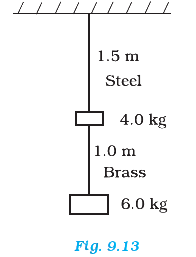
Two wires of diameter 0.25 cm, one made of steel and the other made of brass are loaded as shown in Fig. 9.13. The unloaded length of steel wire is 1.5 m and that of brass wire is 1.0 m. Compute the elongations of the steel and the brass wires.

11.

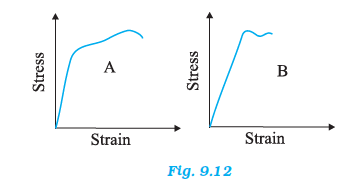
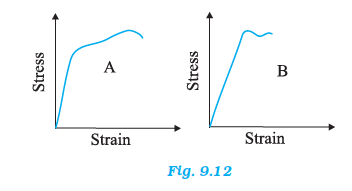
The stress-strain graphs for materials A and B are shown in Fig. 9.12. The graphs are drawn to the same scale. (a) Which of the materials has the greater Young’s modulus?

12.
A piece of copper having a rectangular cross-section of $15.2 \text{ mm} \times 19.1 \text{ mm}$ is pulled in tension with 44,500 N force, producing only elastic deformation. Calculate the resulting strain?
13.

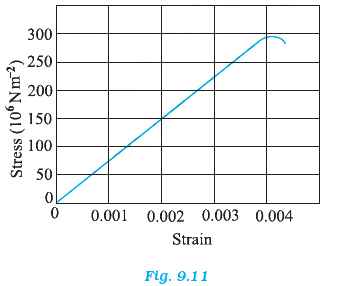
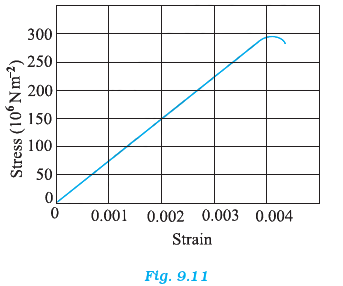
Figure 9.11 shows the strain-stress curve for a given material. What are (b) approximate yield strength for this material?

14.
A steel cable with a radius of 1.5 cm supports a chairlift at a ski area. If the maximum stress is not to exceed $10^8 \text{ N m}^{-2}$, what is the maximum load the cable can support ?
15.

Figure 9.11 shows the strain-stress curve for a given material. What are (a) Young’s modulus for this material?

16.
A steel wire of length 4.7 m and cross-sectional area $3.0 \times 10^{-5} m^2$ stretches by the same amount as a copper wire of length 3.5 m and cross-sectional area of $4.0 \times 10^{-5} m^2$ under a given load. What is the ratio of the Young’s modulus of steel to that of copper?
17.

The stress-strain graphs for materials A and B are shown in Fig. 9.12. The graphs are drawn to the same scale. (b) Which of the two is the stronger material?
18.
Compute the fractional change in volume of a glass slab, when subjected to a hydraulic pressure of 10 atm.
19.
Determine the volume contraction of a solid copper cube, 10 cm on an edge, when subjected to a hydraulic pressure of $7.0 \times 10^6$ Pa.

Worksheet Answers

This website uses cookies

We use cookies to improve user experience. Choose what cookies you allow us to use. You can read more about our Cookie Policy in our Privacy Policy

Accept All
Decline All