UrbanPro

Your Worksheet is Ready

CBSE - Class 11 Physics Gravitation Worksheet

1.
Choose the correct alternative : (d) The formula $-G Mm(\frac{1}{r_2} – \frac{1}{r_1})$ is more/less accurate than the formula $mg(r_2 – r_1)$ for the difference of potential energy between two points $r_2$ and $r_1$ distance away from the centre of the earth.
2.
Does the escape speed of a body from the earth depend on (a) the mass of the body,
3.
Suppose there existed a planet that went around the sun twice as fast as the earth. What would be its orbital size as compared to that of the earth ?
4.
Choose the correct alternative: (b) The energy required to launch an orbiting satellite out of earth’s gravitational influence is more/less than the energy required to project a stationary object at the same height (as the satellite) out of earth’s influence.
5.
A comet orbits the sun in a highly elliptical orbit. Does the comet have a constant (f) total energy throughout its orbit? Neglect any mass loss of the comet when it comes very close to the Sun.
6.
Choose the correct alternative: (a) If the zero of potential energy is at infinity, the total energy of an orbiting satellite is negative of its kinetic/potential energy.
7.

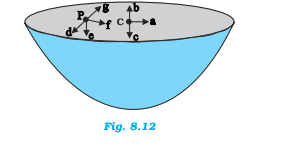
Choose the correct answer from among the given ones: The gravitational intensity at the centre of a hemispherical shell of uniform mass density has the direction indicated by the arrow (see Fig 8.12)
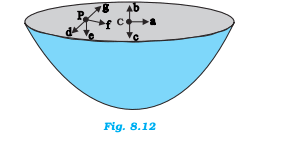
The gravitational intensity at the ...

a.

a

b.

b

c.

c

d.

0

8.
A star 2.5 times the mass of the sun and collapsed to a size of 12 km rotates with a speed of 1.2 rev. per second. (Extremely compact stars of this kind are known as neutron stars. Certain stellar objects called pulsars belong to this category). Will an object placed on its equator remain stuck to its surface due to gravity ? (mass of the sun = $2 \times 10^{30}$ kg).
9.
The escape speed of a projectile on the earth’s surface is 11.2 km s$^{–1}$. A body is projected out with thrice this speed. What is the speed of the body far away from the earth? Ignore the presence of the sun and other planets.
10.
A rocket is fired vertically with a speed of 5 km s$^{-1}$ from the earth’s surface. How far from the earth does the rocket go before returning to the earth ? Mass of the earth = $6.0 \times 10^{24}$ kg; mean radius of the earth = $6.4 \times 10^6$ m; G = $6.67 \times 10^{–11}$ N m$^2$ kg$^{–2}$.
11.
A satellite orbits the earth at a height of 400 km above the surface. How much energy must be expended to rocket the satellite out of the earth’s gravitational influence? Mass of the satellite = 200 kg; mass of the earth = $6.0 \times 10^{24}$ kg; radius of the earth = $6.4 \times 10^6$ m; G = $6.67 \times 10^{–11}$ N m$^2$ kg$^{–2}$.
12.
A comet orbits the sun in a highly elliptical orbit. Does the comet have a constant (b) angular speed, throughout its orbit? Neglect any mass loss of the comet when it comes very close to the Sun.
13.
As you have learnt in the text, a geostationary satellite orbits the earth at a height of nearly 36,000 km from the surface of the earth. What is the potential due to earth’s gravity at the site of this satellite ? (Take the potential energy at infinity to be zero). Mass of the earth = $6.0 \times 10^{24}$ kg, radius = 6400 km.
14.
Assuming the earth to be a sphere of uniform mass density, how much would a body weigh half way down to the centre of the earth if it weighed 250 N on the surface ?
15.
A comet orbits the sun in a highly elliptical orbit. Does the comet have a constant (a) linear speed, throughout its orbit? Neglect any mass loss of the comet when it comes very close to the Sun.
16.
Which of the following symptoms is likely to afflict an astronaut in space (c) headache,
17.
Two stars each of one solar mass (= $2 \times 10^{30}$ kg) are approaching each other for a head on collision. When they are a distance $10^9$ km, their speeds are negligible. What is the speed with which they collide ? The radius of each star is $10^4$ km. Assume the stars to remain undistorted until they collide. (Use the known value of G).
18.
Answer the following : (b) An astronaut inside a small space ship orbiting around the earth cannot detect gravity. If the space station orbiting around the earth has a large size, can he hope to detect gravity ?
19.
Does the escape speed of a body from the earth depend on (c) the direction of projection,
20.
Which of the following symptoms is likely to afflict an astronaut in space (d) orientational problem.

Worksheet Answers

7.

This website uses cookies

We use cookies to improve user experience. Choose what cookies you allow us to use. You can read more about our Cookie Policy in our Privacy Policy

Accept All
Decline All