UrbanPro

Your Worksheet is Ready

CBSE - Class 11 Physics Laws of Motion Worksheet

1.
Give the magnitude and direction of the net force acting on a stone of mass 0.1 kg, (b) just after it is dropped from the window of a train running at a constant velocity of 36 km/h,
2.

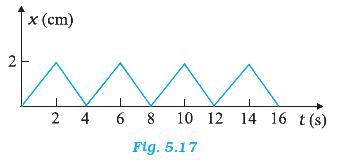
Figure 5.17 shows the position-time graph of a body of mass 0.04 kg. Suggest a suitable physical context for this motion. What is the time between two consecutive impulses received by the body ? What is the magnitude of each impulse ?
3.
A nucleus is at rest in the laboratory frame of reference. Show that if it disintegrates into two smaller nuclei the products must move in opposite directions.
4.
A man of mass 70 kg stands on a weighing scale in a lift which is moving (c) upwards with a uniform acceleration of $5 m s^{-2}$. What would be the readings on the scale in each case?
5.
Explain why (a) a horse cannot pull a cart and run in empty space,
6.

If, A stone of mass 0.25 kg tied to the end of a string is whirled round in a circle of radius 1.5 m with a speed of 40 rev./min in a horizontal plane. What is the tension in the string ? What is the maximum speed with which the stone can be whirled around if the string can withstand a maximum tension of 200 N, the speed of the stone is increased beyond the maximum permissible value, and the string breaks suddenly, which of the following correctly describes the trajectory of the stone after the string breaks :

a.

the stone moves radially outwards,

b.

the stone flies off tangentially from the instant the string breaks,

c.

the stone flies off at an angle with the tangent whose magnitude depends on the speed of the particle ?

7.
Two billiard balls each of mass 0.05 kg moving in opposite directions with speed $6 m s^{-1}$ collide and rebound with the same speed. What is the impulse imparted to each ball due to the other ?
8.
A man of mass 70 kg stands on a weighing scale in a lift which is moving (b) downwards with a uniform acceleration of $5 m s^{-2}$,
9.
Give the magnitude and direction of the net force acting on a stone of mass 0.1 kg, (a) just after it is dropped from the window of a stationary train,
10.

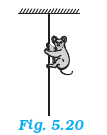
A monkey of mass 40 kg climbs on a rope (Fig. 5.20) which can stand a maximum tension of 600 N. In which of the following cases will the rope break: the monkey (b) climbs down with an acceleration of $4 m s^{-2}$

11.
A block of mass 15 kg is placed on a long trolley. The coefficient of static friction between the block and the trolley is 0.18. The trolley accelerates from rest with $0.5 m s^{-2}$ for 20 s and then moves with uniform velocity. Discuss the motion of the block as viewed by (b) an observer moving with the trolley.
12.
A body of mass 5 kg is acted upon by two perpendicular forces 8 N and 6 N. Give the magnitude and direction of the acceleration of the body.
13.
A helicopter of mass 1000 kg rises with a vertical acceleration of $15 m s^{-2}$. The crew and the passengers weigh 300 kg. Give the magnitude and direction of the (b) action of the rotor of the helicopter on the surrounding air,
14.
A shell of mass 0.020 kg is fired by a gun of mass 100 kg. If the muzzle speed of the shell is $80 m s^{-1}$, what is the recoil speed of the gun ?
15.
A thin circular loop of radius R rotates about its vertical diameter with an angular frequency $\omega$. Show that a small bead on the wire loop remains at its lowermost point for $\omega \leq \sqrt{g / R}$. What is the angle made by the radius vector joining the centre to the bead with the vertical downward direction for $\omega = \sqrt{2g / R}$ ? Neglect friction.
16.

The rear side of a truck is open and a box of 40 kg mass is placed 5 m away from the open end as shown in Fig. 5.22. The coefficient of friction between the box and the surface below it is 0.15. On a straight road, the truck starts from rest and accelerates with $2 m s^{-2}$. At what distance from the starting point does the box fall off the truck? (Ignore the size of the box).

17.
Explain why (b) passengers are thrown forward from their seats when a speeding bus stops suddenly,
18.
A batsman deflects a ball by an angle of 45° without changing its initial speed which is equal to 54 km/h. What is the impulse imparted to the ball ? (Mass of the ball is 0.15 kg.)
19.
A helicopter of mass 1000 kg rises with a vertical acceleration of $15 m s^{-2}$. The crew and the passengers weigh 300 kg. Give the magnitude and direction of the (c) force on the helicopter due to the surrounding air.
20.

Two bodies A and B of masses 5 kg and 10 kg in contact with each other rest on a table against a rigid wall (Fig. 5.21). The coefficient of friction between the bodies and the table is 0.15. A force of 200 N is applied horizontally to A. What are (a) the reaction of the partition

Worksheet Answers

6.

This website uses cookies

We use cookies to improve user experience. Choose what cookies you allow us to use. You can read more about our Cookie Policy in our Privacy Policy

Accept All
Decline All