


Your Worksheet is Ready
CBSE - Class 11 Physics Motion in a Straight Line Worksheet
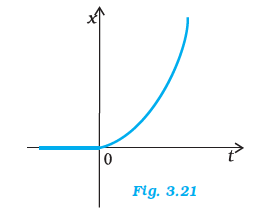
Figure 3.21 shows the $x-t$ plot of one-dimensional motion of a particle. Is it correct to say from the graph that the particle moves in a straight line for $t < 0$ and on a parabolic path for $t > 0$ ? If not, suggest a suitable physical context for this graph.
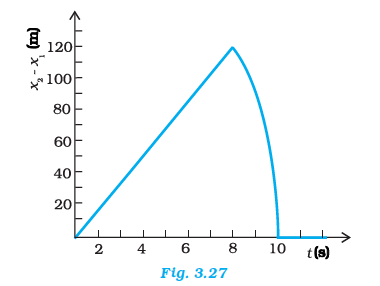
Two stones are thrown up simultaneously from the edge of a cliff $200 m$ high with initial speeds of $15 m s^{-1}$ and $30 m s^{-1}$. Verify that the graph shown in Fig. 3.27 correctly represents the time variation of the relative position of the second stone with respect to the first. Neglect air resistance and assume that the stones do not rebound after hitting the ground. Take $g = 10 m s^{-2}$. Give the equations for the linear and curved parts of the plot.
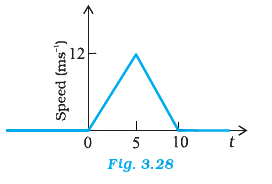
The speed-time graph of a particle moving along a fixed direction is shown in Fig. 3.28. Obtain the distance traversed by the particle between (a) $t = 0 s$ to $10 s$.
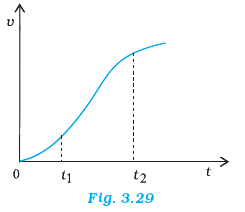
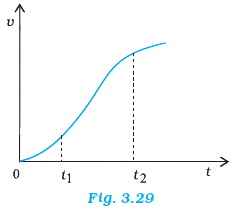
The velocity-time graph of a particle in one-dimensional motion is shown in Fig. 3.29 : Which of the following formulae are correct for describing the motion of the particle over the time-interval $t_1$ to $t_2$: (c) $v_{average} = \frac{x(t_2) - x(t_1)}{t_2 - t_1}$
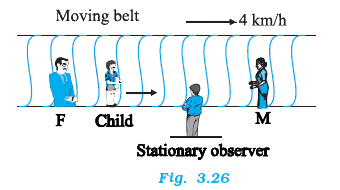
On a long horizontally moving belt (Fig. 3.26), a child runs to and fro with a speed $9 km h^{-1}$ (with respect to the belt) between his father and mother located $50 m$ apart on the moving belt. The belt moves with a speed of $4 km h^{-1}$. For an observer on a stationary platform outside, what is the (a) speed of the child running in the direction of motion of the belt ?.
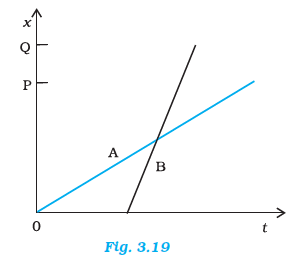
The position-time ($x-t$) graphs for two children A and B returning from their school O to their homes P and Q respectively are shown in Fig. 3.19. Choose the correct entries in the brackets below ; (d) A and B reach home at the (same/different) time
The velocity-time graph of a particle in one-dimensional motion is shown in Fig. 3.29 : Which of the following formulae are correct for describing the motion of the particle over the time-interval $t_1$ to $t_2$: (b) $v(t_2) = v(t_1) + a (t_2 - t_1)$
Worksheet Answers


