


Your Worksheet is Ready
CBSE - Class 10 Mathematics Triangles Worksheet
what are methods to make triangles similar?
You see the following stocks rally" Jet Airways, Interglobe Aviation & Spice Jet". Which of these strategies might be put into action?
Momentum Plays
b.Major Support
c.Range Breakout
d.Sectoral Move
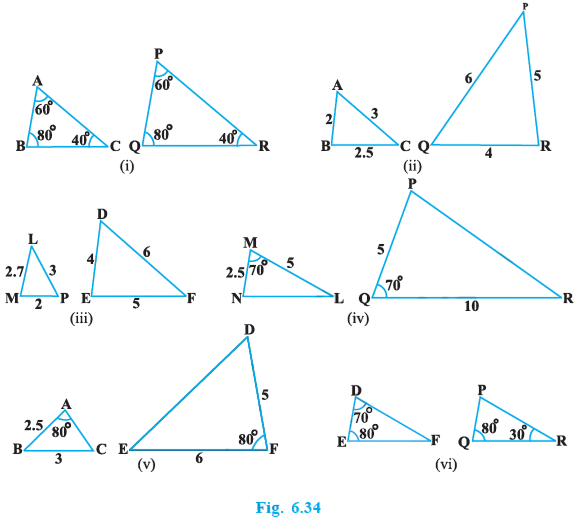
State which pairs of triangles in Fig. 6.34 are similar. Write the similarity criterion used by you for answering the question and also write the pairs of similar triangles in the symbolic form : (i)
"Sectoral Moves" swing trading strategy has typically a lower risk profile as compared to say "Momentum Plays"
This is a daily chart of Adani Enterprises. You spotted a great swing trading opportunity and entered at point A. You decided to follow the 8 day Moving Average (blue line). At what point would you exit the trade?

B
b.C
c.D
d.No need to exit
These are the daily charts of Jubilant Foods and Hindustan Level. Which of them would be better suited for the "Momentum Plays" strategy?


Hindustan Lever
b.Jubilant FoodWorks
c.Both
d.None
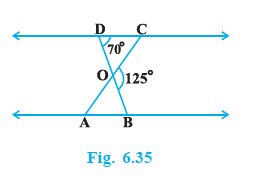
In Fig. 6.35, $\triangle ODC \sim \triangle OBA$, $\angle BOC = 125^{\circ}$ and $\angle CDO = 70^{\circ}$. Find $\angle DOC$, $\angle DCO$ and $\angle OAB$.
This is the daily chart of Allahabad Bank. Which strategy can be deployed for taking swing trades?

Momentum Plays
b.Range Breakout
c.Major Support
d.Range Trading
e.None of the above
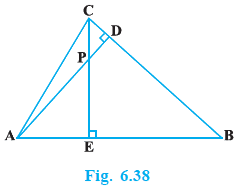
In Fig. 6.38, altitudes $AD$ and $CE$ of $\triangle ABC$ intersect each other at the point $P$. Show that: (i) $\triangle AEP \sim \triangle CDP$
This is a daily chart of Divis Lab. If you are following "Range Trading" stragey, where would your buy order be placed?

1100
b.900
c.950
d.1000
This is a daily chart of Bhansali Engineering (BEPL). It would have been and can be a great choice for which swing trading strategy?

Range Breakout
b.Range Trading
c.Results Anticipation
d.Momentum Plays
e.Sector Moves
Which kind of stocks are ideal for "Major Support" swing trading strategy?
High Beta
b.Small Caps
c.Mid Caps
d.Blue Chips
Worksheet Answers
Solution:
Given: A quadrilateral $ABCD$ where the diagonals $AC$ and $BD$ intersect at point $O$ such that $\frac{AO}{BO} = \frac{CO}{DO}$.
To Prove: Quadrilateral $ABCD$ is a trapezium (i.e., $AB \parallel DC$ or $AD \parallel BC$).
Step 1: Rearranging the given ratio
We are given the equation:
$\frac{AO}{BO} = \frac{CO}{DO}$
By applying the property of cross-multiplication (alternendo), we can rewrite this as:
$\frac{AO}{CO} = \frac{BO}{DO}$ --- (Equation 1)
Step 2: Construction
Draw a line $EO$ parallel to $AB$ such that $E$ lies on $AD$.
Construction: Draw $EO \parallel AB$, where $E$ is a point on $AD$.
Step 3: Applying Thales' Theorem (Basic Proportionality Theorem)
In $\triangle DAB$, since $EO \parallel AB$ [By construction], by the Basic Proportionality Theorem (BPT), which states that if a line is drawn parallel to one side of a triangle to intersect the other two sides in distinct points, the other two sides are divided in the same ratio:
$\frac{DE}{EA} = \frac{DO}{OB}$ --- (Equation 2)
Step 4: Comparing Equations
From Equation 1, we have:
$\frac{BO}{DO} = \frac{AO}{CO}$
Taking the reciprocal of both sides:
$\frac{DO}{BO} = \frac{CO}{AO}$ --- (Equation 3)
Comparing Equation 2 and Equation 3:
Since $\frac{DE}{EA} = \frac{DO}{OB}$ and $\frac{DO}{OB} = \frac{CO}{AO}$, it follows that:
$\frac{DE}{EA} = \frac{CO}{AO}$
Step 5: Conclusion using Converse of BPT
In $\triangle ADC$, we have $\frac{DE}{EA} = \frac{DO}{OC}$ (rearranging the terms from the previous step).
By the Converse of the Basic Proportionality Theorem, if a line divides any two sides of a triangle in the same ratio, then the line is parallel to the third side.
Therefore, $EO \parallel DC$.
Since we constructed $EO \parallel AB$ and we proved $EO \parallel DC$, it implies that $AB \parallel DC$.
Since one pair of opposite sides is parallel, the quadrilateral $ABCD$ is a trapezium.
Final Answer: Since $AB \parallel DC$, the quadrilateral $ABCD$ is a trapezium.
Solution:
Given: In $\triangle ABC$ and $\triangle PQR$, $AD$ and $PM$ are medians to sides $BC$ and $QR$ respectively. The sides are proportional such that:
$\frac{AB}{PQ} = \frac{AC}{PR} = \frac{AD}{PM}$
To Prove: $\triangle ABC \sim \triangle PQR$
Step 1: Construction
Extend $AD$ to a point $E$ such that $AD = DE$. Join $EC$. Similarly, extend $PM$ to a point $N$ such that $PM = MN$. Join $NR$.
Step 2: Proving Quadrilaterals ABEC and PQNR are Parallelograms
In quadrilateral $ABEC$, diagonals $AE$ and $BC$ bisect each other at $D$ (since $AD=DE$ by construction and $BD=DC$ because $AD$ is a median). [Since diagonals bisect each other, the quadrilateral is a parallelogram]. Therefore, $AB = EC$ and $AC = BE$.
Similarly, in quadrilateral $PQNR$, diagonals $PN$ and $QR$ bisect each other at $M$. Therefore, $PQ = NR$ and $PR = QN$.
Step 3: Establishing Similarity of $\triangle ABE$ and $\triangle PQN$
We are given $\frac{AB}{PQ} = \frac{AC}{PR} = \frac{AD}{PM}$.
Substituting $AB=EC$, $AC=BE$, $PQ=NR$, $PR=QN$, and multiplying $AD$ and $PM$ by $2$:
$\frac{AB}{PQ} = \frac{BE}{QN} = \frac{2AD}{2PM} = \frac{AE}{PN}$
Thus, $\frac{AB}{PQ} = \frac{BE}{QN} = \frac{AE}{PN}$. By SSS similarity criterion, $\triangle ABE \sim \triangle PQN$.
Therefore, $\angle BAE = \angle QPN$ (Corresponding parts of similar triangles). [Equation 1]
Step 4: Establishing Similarity of $\triangle ACE$ and $\triangle PRN$
Similarly, we can show $\triangle ACE \sim \triangle PRN$ using the same logic. Thus, $\angle CAE = \angle RPN$. [Equation 2]
Step 5: Final Conclusion
Adding [Equation 1] and [Equation 2]:
$\angle BAE + \angle CAE = \angle QPN + \angle RPN$
$\angle BAC = \angle QPR$
Now, in $\triangle ABC$ and $\triangle PQR$:
$\frac{AB}{PQ} = \frac{AC}{PR}$ (Given)
$\angle BAC = \angle QPR$ (Proved above)
By SAS similarity criterion, $\triangle ABC \sim \triangle PQR$.
Final Answer: $\triangle ABC \sim \triangle PQR$ is proved.
Solution:
Given: The definition of similar figures in geometry, which states that two figures are similar if they have the same shape but not necessarily the same size.
To Find: Two distinct examples of pairs of similar figures.
Theoretical Context: Two polygons are said to be similar if:
1. Their corresponding angles are equal.
2. Their corresponding sides are in the same ratio (proportion).
Visual Representation:
Step 1: Identifying Example 1 - Equilateral Triangles
Let us consider two equilateral triangles, $\triangle PQR$ and $\triangle ABC$.
In any equilateral triangle, each interior angle is exactly $60^\circ$.
Since all angles in both triangles are $60^\circ$, the condition for equal corresponding angles is satisfied.
Furthermore, the ratio of corresponding sides $\frac{PQ}{AB} = \frac{QR}{BC} = \frac{RP}{CA}$ is constant.
Therefore, any two equilateral triangles are similar figures.
Step 2: Identifying Example 2 - Circles
Let us consider two circles with radii $r_1$ and $r_2$ respectively.
A circle is defined by the set of all points in a plane that are at a fixed distance (radius) from a fixed point (center).
Because all circles have the same round shape and lack corners, they are geometrically similar.
The ratio of their circumferences ($2\pi r_1 : 2\pi r_2$) and the ratio of their diameters ($2r_1 : 2r_2$) both simplify to the ratio of their radii ($r_1 : r_2$).
Therefore, any two circles are similar figures.
Final Answer: Two examples of pairs of similar figures are:
1. Any two equilateral triangles.
2. Any two circles.
Solution:
Please start categorizing stocks in clusters, if you have not already.
Solution:
Given: Two triangles, $\triangle ABC$ and $\triangle PQR$.
In $\triangle ABC$: $\angle A = 60^\circ$, $\angle B = 80^\circ$, $\angle C = 40^\circ$.
In $\triangle PQR$: $\angle P = 60^\circ$, $\angle Q = 80^\circ$, $\angle R = 40^\circ$.
To Find: Determine if the triangles are similar, state the similarity criterion, and write the symbolic representation.
Step 1: Comparing the corresponding angles of the two triangles.
We observe the angles of $\triangle ABC$ and $\triangle PQR$ as follows:
$\angle A = \angle P = 60^\circ$
$\angle B = \angle Q = 80^\circ$
$\angle C = \angle R = 40^\circ$
Step 2: Applying the Similarity Criterion.
[Theorem: If in two triangles, corresponding angles are equal, then their corresponding sides are in the same ratio (or proportion) and hence the two triangles are similar. This is known as the Angle-Angle-Angle (AAA) similarity criterion.]
Since all three corresponding angles are equal, the triangles satisfy the AAA similarity criterion.
Step 3: Writing the symbolic form.
When writing the symbolic form, the order of vertices must correspond to the equality of the angles.
Since $\angle A = \angle P$, $\angle B = \angle Q$, and $\angle C = \angle R$, the correspondence is $A \leftrightarrow P$, $B \leftrightarrow Q$, and $C \leftrightarrow R$.
Therefore, $\triangle ABC \sim \triangle PQR$.
Final Answer: The triangles are similar by the AAA similarity criterion. The symbolic form is $\triangle ABC \sim \triangle PQR$.
Solution:
Yes, because when a whole sector is moving, you have the safety that it is not one stock that is making the move- it's the whole sector.
Solution:
Given:
To Find:
Visual Representation:
Step 1: Finding $\angle DOC$
Since $DB$ is a straight line, the angles $\angle DOC$ and $\angle BOC$ form a linear pair. [Axiom: The sum of angles on a straight line is $180^{\circ}$].
$\angle DOC + \angle BOC = 180^{\circ}$
$\angle DOC + 125^{\circ} = 180^{\circ}$
$\angle DOC = 180^{\circ} - 125^{\circ}$
$\angle DOC = 55^{\circ}$
Step 2: Finding $\angle DCO$
Consider $\triangle ODC$. The sum of the interior angles of a triangle is always $180^{\circ}$. [Theorem: Angle Sum Property of a Triangle].
$\angle ODC + \angle DOC + \angle DCO = 180^{\circ}$
Given $\angle ODC = 70^{\circ}$ and we found $\angle DOC = 55^{\circ}$.
$70^{\circ} + 55^{\circ} + \angle DCO = 180^{\circ}$
$125^{\circ} + \angle DCO = 180^{\circ}$
$\angle DCO = 180^{\circ} - 125^{\circ}$
$\angle DCO = 55^{\circ}$
Step 3: Finding $\angle OAB$
It is given that $\triangle ODC \sim \triangle OBA$. [Definition: If two triangles are similar, their corresponding angles are equal].
Therefore, $\angle OAB = \angle OCD$ (which is the same as $\angle DCO$).
Since $\angle DCO = 55^{\circ}$, it follows that:
$\angle OAB = 55^{\circ}$
Final Answer:
$\angle DOC = 55^{\circ}$, $\angle DCO = 55^{\circ}$, and $\angle OAB = 55^{\circ}$.
Solution:
Given: Two polygons having the same number of sides ($n$).
To Find: The conditions under which these two polygons are considered similar.
Step 1: Understanding the Definition of Similar Polygons
In geometry, two polygons with the same number of sides are defined as similar if and only if they satisfy two specific criteria simultaneously. Similarity implies that the shapes are identical in form but not necessarily in size (i.e., one is a scaled version of the other).
Step 2: Analyzing Condition (a) - Corresponding Angles
For two polygons to be similar, their internal structure must maintain the same "shape." This is preserved if the angles at each corresponding vertex are identical. If the angles were different, the polygons would be distorted relative to each other. Therefore, the corresponding angles must be equal.
Step 3: Analyzing Condition (b) - Corresponding Sides
While the angles define the shape, the sides define the scale. For the polygons to be similar, the ratio of the lengths of any two corresponding sides must be constant. This constant ratio is known as the scale factor. Therefore, the corresponding sides must be proportional.
Step 4: Synthesizing the Statement
Based on the geometric definition of similarity for polygons:
(a) Their corresponding angles are equal.
(b) Their corresponding sides are proportional.
Final Answer: Two polygons of the same number of sides are similar, if (a) their corresponding angles are equal and (b) their corresponding sides are proportional.
Solution:
Given:
1. $\triangle ABC \sim \triangle PQR$
2. $AD$ is the median of $\triangle ABC$ to side $BC$ (i.e., $BD = DC = \frac{1}{2}BC$)
3. $PM$ is the median of $\triangle PQR$ to side $QR$ (i.e., $QM = MR = \frac{1}{2}QR$)
To Prove:
$\frac{AB}{PQ} = \frac{AD}{PM}$
Step 1: Utilizing the property of similar triangles
Since $\triangle ABC \sim \triangle PQR$, by the definition of similar triangles, their corresponding sides are proportional and their corresponding angles are equal:
$\frac{AB}{PQ} = \frac{BC}{QR} = \frac{AC}{PR}$ --- (Equation 1)
$\angle B = \angle Q$ --- (Equation 2)
Step 2: Expressing sides in terms of medians
Given that $AD$ and $PM$ are medians, $D$ is the midpoint of $BC$ and $M$ is the midpoint of $QR$.
Therefore, $BC = 2BD$ and $QR = 2QM$.
Substituting these into Equation 1:
$\frac{AB}{PQ} = \frac{2BD}{2QM} = \frac{BD}{QM}$
Thus, $\frac{AB}{PQ} = \frac{BD}{QM}$ --- (Equation 3)
Step 3: Proving similarity of $\triangle ABD$ and $\triangle PQM$
In $\triangle ABD$ and $\triangle PQM$:
1. $\frac{AB}{PQ} = \frac{BD}{QM}$ [From Equation 3]
2. $\angle B = \angle Q$ [From Equation 2]
By the SAS (Side-Angle-Side) Similarity Criterion, if one angle of a triangle is equal to one angle of another triangle and the sides including these angles are proportional, then the two triangles are similar.
Therefore, $\triangle ABD \sim \triangle PQM$.
Step 4: Establishing the final ratio
Since $\triangle ABD \sim \triangle PQM$, the ratios of their corresponding sides must be equal:
$\frac{AB}{PQ} = \frac{BD}{QM} = \frac{AD}{PM}$
From this, we extract the required equality:
$\frac{AB}{PQ} = \frac{AD}{PM}$
Final Answer:
Hence, it is proved that $\frac{AB}{PQ} = \frac{AD}{PM}$.
Solution:
Given:
In $\triangle ABC$, $AD$ is the altitude to side $BC$ (i.e., $AD \perp BC$) and $CE$ is the altitude to side $AB$ (i.e., $CE \perp AB$). The altitudes $AD$ and $CE$ intersect each other at point $P$.
To Prove:
$\triangle AEP \sim \triangle CDP$
Step 1: Identifying the triangles and their properties
We are considering $\triangle AEP$ and $\triangle CDP$.
From the given information, $AD \perp BC$ and $CE \perp AB$.
Therefore, $\angle AEP = 90^\circ$ (since $CE \perp AB$) and $\angle CDP = 90^\circ$ (since $AD \perp BC$).
Step 2: Establishing Equality of Angles
In $\triangle AEP$ and $\triangle CDP$:
1. $\angle AEP = \angle CDP = 90^\circ$ [Given that $AD$ and $CE$ are altitudes].
2. $\angle APE = \angle CPD$ [These are vertically opposite angles, which are always equal].
Step 3: Applying the Similarity Criterion
According to the Angle-Angle (AA) similarity criterion, if two angles of one triangle are respectively equal to two angles of another triangle, then the two triangles are similar.
Since we have established that:
$\angle AEP = \angle CDP$ ($90^\circ$ each)
$\angle APE = \angle CPD$ (Vertically opposite angles)
Therefore, by the AA similarity criterion, we conclude:
$\triangle AEP \sim \triangle CDP$
Conclusion:
The triangles $\triangle AEP$ and $\triangle CDP$ satisfy the conditions for similarity as two of their corresponding angles are equal.
Final Answer: Since $\angle AEP = \angle CDP = 90^\circ$ and $\angle APE = \angle CPD$ (vertically opposite angles), by AA similarity criterion, $\triangle AEP \sim \triangle CDP$.
Solution:
Given: A statement regarding the similarity of specific types of triangles: "All ______ triangles are similar."
To Find: The correct word from the options (isosceles, equilateral) that completes the statement to make it mathematically true.
Step 1: Understanding the Definition of Similar Triangles
Two triangles are said to be similar if:
1. Their corresponding angles are equal.
2. Their corresponding sides are in the same ratio (proportion).
Step 2: Analyzing Equilateral Triangles
An equilateral triangle is a triangle in which all three sides are equal in length and all three interior angles are equal to $60^\circ$.
Let $T_1$ and $T_2$ be two equilateral triangles with side lengths $s_1$ and $s_2$ respectively.
- The angles of $T_1$ are $60^\circ, 60^\circ, 60^\circ$.
- The angles of $T_2$ are $60^\circ, 60^\circ, 60^\circ$.
Since the corresponding angles are equal ($60^\circ = 60^\circ$), the condition for similarity is satisfied regardless of the side lengths. Thus, all equilateral triangles are similar.
Step 3: Analyzing Isosceles Triangles
An isosceles triangle is a triangle with at least two equal sides. Consider two isosceles triangles:
- Triangle 1: Sides $5, 5, 8$. The angles are approximately $36.87^\circ, 71.56^\circ, 71.56^\circ$.
- Triangle 2: Sides $5, 5, 2$. The angles are approximately $151.04^\circ, 14.48^\circ, 14.48^\circ$.
Since the corresponding angles are not equal, isosceles triangles are not necessarily similar.
Step 4: Conclusion
Based on the geometric properties established in Step 2, the condition of similarity holds true for all equilateral triangles because their angular configuration is constant ($60^\circ$ each).
Final Answer: All equilateral triangles are similar.
Solution:
Given: A trapezium $ABCD$ in which $AB \parallel DC$. The diagonals $AC$ and $BD$ intersect each other at point $O$.
To Prove: $\frac{OA}{OC} = \frac{OB}{OD}$
Step 1: Identifying the Triangles
Consider $\triangle AOB$ and $\triangle COD$. We aim to prove that these two triangles are similar using the Angle-Angle (AA) similarity criterion.
Step 2: Establishing Equality of Angles
Since $AB \parallel DC$ and $AC$ acts as a transversal, the alternate interior angles are equal. Therefore:
$\angle OAB = \angle OCD$ [Alternate interior angles are equal when lines are parallel]
Similarly, since $AB \parallel DC$ and $BD$ acts as a transversal:
$\angle OBA = \angle ODC$ [Alternate interior angles are equal when lines are parallel]
Step 3: Considering Vertically Opposite Angles
The diagonals $AC$ and $BD$ intersect at $O$. Thus:
$\angle AOB = \angle COD$ [Vertically opposite angles are equal]
Step 4: Applying the Similarity Criterion
In $\triangle AOB$ and $\triangle COD$:
1. $\angle OAB = \angle OCD$ (Proved in Step 2)
2. $\angle OBA = \angle ODC$ (Proved in Step 2)
3. $\angle AOB = \angle COD$ (Proved in Step 3)
By the $AAA$ (Angle-Angle-Angle) similarity criterion, which simplifies to $AA$ similarity:
$\triangle AOB \sim \triangle COD$
Step 5: Establishing the Ratio of Corresponding Sides
Since the triangles are similar, the ratios of their corresponding sides must be equal:
$\frac{OA}{OC} = \frac{OB}{OD} = \frac{AB}{CD}$ [Corresponding parts of similar triangles are proportional (CPST)]
Step 6: Conclusion
From the proportionality established in Step 5, we extract the required equality:
$\frac{OA}{OC} = \frac{OB}{OD}$
Final Answer: Hence, it is proved that $\frac{OA}{OC} = \frac{OB}{OD}$.
Solution:
Given: A set of geometric figures defined as circles of varying radii.
To Find: Determine whether all circles are "congruent" or "similar" by filling in the blank.
Step 1: Defining Congruency
Two geometric figures are said to be congruent if they have the same shape and the same size. For two circles to be congruent, their radii must be equal ($r_1 = r_2$).
Step 2: Defining Similarity
Two geometric figures are said to be similar if they have the same shape, but not necessarily the same size. In the case of circles, every circle is defined by the set of all points in a plane that are at a fixed distance (radius) from a fixed point (center). Because all circles possess the same round shape, they satisfy the condition of similarity regardless of their radius.
Step 3: Logical Deduction
Since circles can have different radii (as shown in the diagram where $r_1=30$ and $r_2=50$), they cannot be congruent in all cases. However, because the ratio of the corresponding parts (the circumference to the diameter, which is $\pi$) remains constant for all circles, they are always similar.
Step 4: Conclusion
Based on the definition of similarity in geometry, all circles are similar because they share the same shape, even if their sizes differ.
Final Answer: All circles are similar.


